
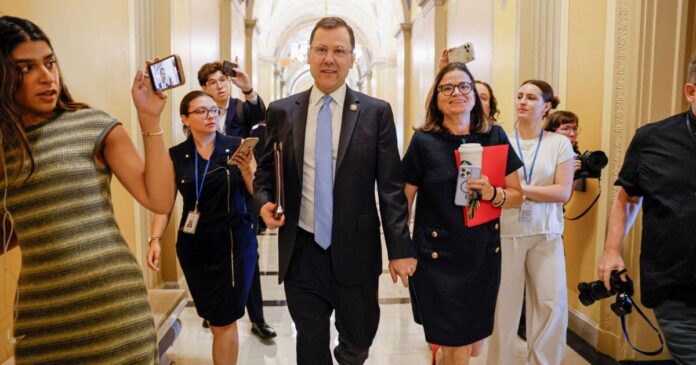

Representative Tom Kean Jr. ended four months of unexplained absence from the House of Representatives on June 30 with a five-minute floor speech in which he disclosed that he had been receiving inpatient hospital treatment for clinical depression since March — a disclosure that simultaneously resolved the sustained mystery around the Republican congressman’s whereabouts, reopened a persistent national debate about what public officials owe their constituents when a serious illness removes them from their duties, and launched what Kean himself has framed as a personal mission to translate his private experience into public policy. “There is no timeline for healing,” Kean told his House colleagues, a formulation that carries the specific weight of personal experience and that acknowledges, without dwelling on, the gap between his office’s initial projection of a return “in a matter of weeks” and the 116 days that actually elapsed before he walked back onto the House floor.
Kean, who represents New Jersey’s 7th Congressional District — a competitive suburban district in the north-central part of the state encompassing portions of Union, Morris, Somerset, and Hunterdon counties — had not cast a vote in Congress since March 5, 2026. For the entirety of that absence, his office’s communication to constituents, to the New Jersey press, and to congressional leadership maintained the same deliberately limited description: that the congressman was dealing with an undisclosed personal medical condition. The phrase told voters that something was wrong without telling them what, and it raised questions that a four-month absence from a swing district with a thin House majority made increasingly difficult to defer. Kean’s office did not elaborate on the condition, did not update constituents on his progress, and consistently declined to address questions about when he expected to return.
In the floor speech, Kean explained that the depression diagnosis was not something he had been managing before March — it was identified during what he described as a routine health evaluation, after which doctors recommended immediate inpatient treatment. He characterized his office’s initial “matter of weeks” projection as reflecting genuine belief rather than deliberate misdirection, and he acknowledged that the subsequent months taught him, in his words, that healing from depression operates on a timeline that the patient does not control. His prepared remarks thanked his family and his medical team, expressed gratitude for the letters and messages of support his office received from constituents, and concluded with a statement of renewed purpose: that while he had supported mental health legislation before his illness, he now understands it in a far more personal way.
The immediate legislative action Kean took upon his return is the clearest signal of how he intends to reframe the political narrative around his absence. Within days of returning to Washington, he introduced the Mental Health Parity Enforcement and Funding Act, legislation that would authorize the Department of Labor to penalize insurance providers that violate federal mental health parity mandates — the existing legal requirement that insurers provide mental and behavioral health benefits on terms comparable to their coverage of physical medical conditions. Mental health parity enforcement has long been characterized by advocates as a significant gap between the law on paper and the reality of insurance coverage in practice, and Kean’s bill, while it will require committee consideration and floor votes before any chance of enactment, positions him as a legislator whose personal experience of the mental health treatment system has produced a specific policy agenda rather than a general statement of sympathy.
The political question that his return does not fully resolve is the transparency one, and it is the dimension of the situation that the Fetterman comparison makes most pointed. In February 2023, Senator John Fetterman of Pennsylvania was admitted to Walter Reed National Military Medical Center for treatment of clinical depression. His office disclosed the diagnosis publicly within approximately 24 hours of his admission, identifying the condition, the treatment facility, and the expected duration of his hospitalization. Fetterman, a Democrat elected in November 2022, continued to be broadly transparent about his experience during and after treatment, eventually granting a lengthy interview to The Guardian in which he discussed the specific nature of his depression and his recovery in considerable detail. The contrast between Fetterman’s disclosure approach and Kean’s 116-day maintenance of ambiguity has been cited in political coverage as a meaningful distinction between two individuals confronting the same diagnosis in roughly comparable circumstances of public office.
Kean’s response to the comparison is captured in a single phrase: he is, he has said, a private person by nature. It is a genuine and common personality orientation, and it is a defensible personal preference in most contexts. In the context of elected office — and specifically in the context of a congressman representing a competitive swing district whose presence or absence from the House floor has measurable consequences for his constituents’ representation and for his party’s ability to pass legislation with a thin majority — the privacy argument has a more complex relationship to public accountability than it does in a non-political setting. A private individual dealing with clinical depression has no obligation to disclose the diagnosis to anyone other than those they choose to tell. A member of Congress exercising a public trust granted by approximately 350,000 voting constituents occupies a position in which the capacity to perform the job’s core function — showing up and voting — is itself a matter of public consequence. Kean’s 116-day absence was not simply a private health matter; it was a 116-day absence of representation for the residents of New Jersey’s 7th District and a 116-day reduction in the voting margin available to House Republican leadership.
That operational impact is the context in which the political stakes of the 7th District’s competitive nature become most visible. House Republicans in this Congress have been managing one of the slimmest House majorities in recent history, and a single member’s extended absence from voting has real consequences for which legislation can pass and which falls short. Kean won an uncontested Republican primary in June — a primary he won while completely outside public view, his candidacy maintained by the party apparatus around an absent incumbent — and now faces Democrat Rebecca Bennett in what political forecasters characterize as a genuinely competitive general election. The 7th District is one of the handful of swing-seat contests that will help determine which party controls the House after the November midterms, and Kean’s ability to run a credible reelection campaign as both an incumbent congressman and a candidate who was absent for four months of his term is a political question without a clear historical precedent to guide expectations.
What the Kean situation ultimately contributes to the ongoing national conversation about mental health in public life is something specific and useful, independent of the transparency debate: documentation that serious clinical depression requiring months of inpatient treatment is not incompatible with ultimately returning to public office and immediately resuming a policy agenda. Kean sat out 116 days of the legislative calendar, returned, gave a speech, introduced a bill, and is running for reelection. That trajectory does not resolve every question the situation has raised, but it demonstrates something that the stigma surrounding mental illness treatment has historically made difficult for the public to witness in a political figure: that depression is a treatable medical condition, that treatment takes the time it takes, and that a person who has received that treatment can return to work. Kean’s described intention to use his experience as the foundation for a sustained mental health policy agenda means that whatever political consequences his absence produces in November, his personal experience of the system will continue to shape the legislative conversation in ways that his prior, theoretical support for mental health parity legislation would not have.
For New Jersey voters in the 7th District who are now evaluating the full context of the past four months — the unexplained absence, the diagnosis, the recovery, the return, and the legislation — the task is the specific one that representative democracy requires of an electorate: assessing whether the person who has asked for their vote is the person they wish to send to Congress, with the full factual record as the basis for that judgment. Kean has given them that record. It is not a simple one.
















