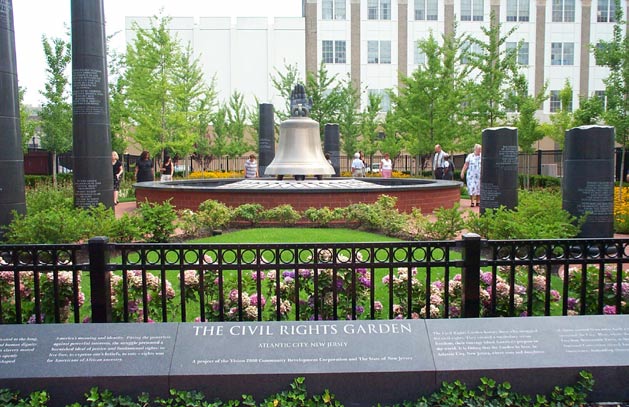

Walk four blocks inland from the Atlantic City Boardwalk, away from the casinos and the salt air and the concentrated commerce of the shore’s most famous strip, and you arrive at the corner of Pacific Avenue and South Dr. Martin Luther King Boulevard, where a different version of the city exists in almost complete silence. The Civil Rights Garden sits here, next to the Carnegie Library, occupying a space that the city’s tourism infrastructure treats as a footnote and that its history makes one of the most significant public monuments in the state. Eleven granite columns rise from winding pathways laid through ginkgo trees and flowering plantings, each column inscribed with quotations and documentation of specific events and figures in the American civil rights movement. A large fountain anchors the composition. A sculpture called the Hand of Justice presides over the grounds. The garden is open from early morning until evening, admission is free, and on most summer days — when tens of thousands of visitors are within a ten-minute walk spending money in the casinos and on the boardwalk — it is empty.
The garden was completed in 2001, designed by artist Larry Kirkland with the late Rutgers-Newark historian Clement Price serving as its historical consultant. Price, who spent his career documenting the Black history of New Jersey and urban centers in the Northeast, understood what made Atlantic City specifically the right location for the first large-scale civil rights memorial park built in a Northern state. The choice was not incidental geography. Atlantic City’s history with race, freedom, and the gap between American ideals and American practice runs through the city’s entire existence as an urban community — from its founding as a resort in the 1850s through the decades when it was simultaneously one of the most racially integrated resort economies in the country and one of the most formally segregated, and through the single most consequential civil rights moment that directly unfolded within the city’s limits.
In August 1964, the Democratic National Convention was held in Atlantic City, and it became the site of one of the civil rights movement’s most dramatically documented confrontations with the American political establishment. Fannie Lou Hamer, the Mississippi sharecropper and voting rights activist who had been beaten and jailed for attempting to register to vote, appeared before the credentials committee of the convention to challenge the seating of Mississippi’s all-white official delegation and demand recognition for the Mississippi Freedom Democratic Party, the interracial delegation whose members had risked their lives and livelihoods to participate in the democratic process from which they were legally excluded. Her testimony — delivered in Atlantic City, in the specific geography where the Civil Rights Garden now stands — was broadcast on national television and remains one of the most direct and emotionally devastating documents of the civil rights era. President Lyndon Johnson, fearful that the challenge would fracture the Southern Democratic coalition at the worst possible moment before his landslide victory, arranged a competing press conference to preempt the live coverage. The networks ran the testimony on the evening news anyway. The Freedom Democratic Party was offered two non-voting at-large seats and declined. The confrontation in Atlantic City did not produce the outcome Hamer sought in 1964, but it accelerated the transformation of American political geography that would produce the Voting Rights Act in 1965 and the complete realignment of Southern politics over the subsequent decade.
The Civil Rights Garden’s location near the convention site is a deliberate act of spatial memory. The granite columns, with their deliberately unfinished tops — raw, rough surfaces rising above the inscribed text — are not accidental. The design choice articulates what Kirkland and Price understood to be the monument’s central argument: the work is not finished. The columns do not end in smooth, completed surfaces because the history they document does not end in smooth, completed resolution. They rise and stop, abruptly, at heights that suggest structures still under construction, buildings whose upper stories have not yet been built. Every visitor who looks up at those unfinished tops is looking at a visual argument about the present tense.
That argument acquires a specific weight when placed against the history that most New Jersey residents have never been fully taught about the ground on which they live. New Jersey is not merely adjacent to the history of American slavery — it participated in that history as actively as any state outside the Deep South, and it resisted the legal abolition of slavery longer than any other Northern state, through a sequence of evasions and renamings that constitute one of the more thorough exercises in official bad faith in American political history. When the English took control of New Jersey in 1664, the colonial proprietors explicitly offered white settlers 75 acres of land for every enslaved person they brought into the colony — a direct financial incentive for human trafficking built into the colony’s foundational land distribution policy. Perth Amboy served as a major official port of entry for slave ships arriving from West Africa. By 1800, more than 12,000 enslaved people lived in New Jersey, with concentrations in Bergen, Essex, Monmouth, and Somerset counties — the same counties that today are among the most economically and culturally prominent in the state.
The New Jersey Legislature passed a Gradual Abolition Act in 1804 that freed no one immediately. It specified that children born to enslaved mothers after that date would be freed eventually, after working without compensation until age 21 or 25. The adults already enslaved remained enslaved. Then, in 1846, the Legislature passed an Act to Abolish Slavery whose title bore no relationship to its operative content: rather than freeing the people still held in bondage, the law reclassified them as apprentices for life — a legal category that preserved every condition of enslavement except the word. They could not leave. They could not vote. They worked without compensation. They could be sold. The state had changed the vocabulary and kept the system intact. When the 1860 census was taken in the year preceding the Civil War, New Jersey was the only Northern state that still listed enslaved people in its official records. The Emancipation Proclamation of 1863 freed enslaved people in states in rebellion against the Union — which New Jersey was not — meaning the state’s remaining bonded population was unaffected. In early 1865, as the Civil War was concluding and the 13th Amendment was moving toward ratification, the New Jersey Legislature voted to reject it. Slavery in New Jersey did not become illegal until January 23, 1866, when a new governor signed a state amendment conforming to federal law — months after Juneteenth, months after the war’s end, and more than sixty years after the Legislature had first claimed, in 1804, to be moving toward abolition.
This is the history that the tourists walking four blocks away from the Civil Rights Garden are walking over. It is in the soil of Atlantic City specifically, a city whose Black community built the resort economy whose profits the broader white ownership class accumulated, whose residents created the distinctive cultural and culinary institutions that gave the city its character, and who were simultaneously confined during the height of segregation to the stretch of beach at Missouri Avenue that became known as Chicken Bone Beach — so named because the families who gathered there brought food from home, since the restaurants that profited from their labor as hotel staff and service workers would not serve them as customers. The ginkgo trees in the Civil Rights Garden are planted in that specific soil. The unfinished tops of those eleven granite columns are rising from that specific ground.
The garden is not difficult to find. It is at Pacific Avenue and South Dr. Martin Luther King Boulevard, next to the Carnegie Library, open daily during daylight hours. It is free. It is quiet, which is remarkable for Atlantic City, where quiet is not typically available at any price. It is the first large-scale civil rights memorial park built in a Northern state, and on a summer afternoon when the city is managing its largest tourist volumes of the year, it is almost certainly empty. Whether that reflects a marketing failure, a cultural indifference to the history it preserves, or the specific way that cities built on entertainment commerce tend to treat the evidence of their own most complicated histories, is a question the garden itself poses in the most direct possible terms. The columns stand. The tops are unfinished. The work continues.