
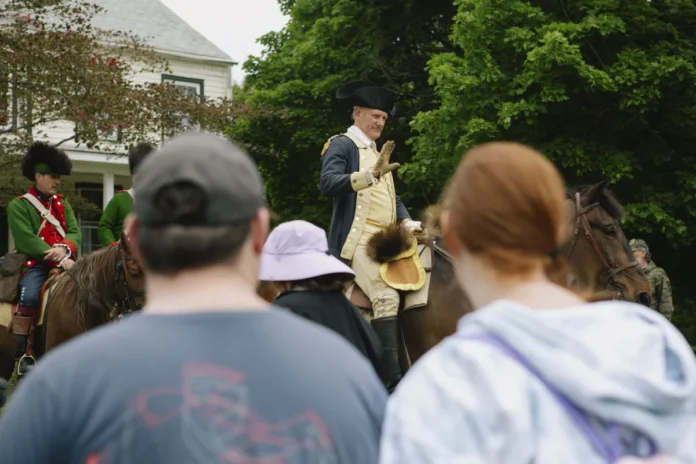

The official commemoration of America’s 250th anniversary is organized around a foundational narrative: a group of visionary men in Philadelphia drafted a document proclaiming universal human liberty, and a citizen army of ordinary colonists rallied to its principles and won independence from one of the world’s most powerful military establishments. The narrative is, in broad outline, accurate enough to sustain its role in the American civic tradition. It is also incomplete in ways that historians and preservation organizations across the country are using the Semiquincentennial to address with unusual directness — surfacing the specific, documented stories of the people whose participation in the Revolution was as real and as consequential as the founders’, but whose names have been largely absent from the textbooks, the monuments, and the anniversary ceremonies that constitute the official commemoration. New Jersey’s own history of the Revolutionary War period, which is the most militarily dense of any state in the union, offers some of the most striking examples of what this recovery effort looks like in practice.
The most fully documented and most startling of the overlooked New Jersey Revolutionary figures is a man who was born into slavery around 1753 in Colt’s Neck, Monmouth County, enslaved to a Quaker farmer named John Corlies on the Navesink River near Shrewsbury. His birth name was Titus. He would become known to both sides in the war, and to the governors of New Jersey and the editors of newspapers from Philadelphia to New York, as Colonel Tye. His story does not fit neatly into the patriot-versus-loyalist framework that structures most popular Revolutionary War narrative, because Tye fought for the British — not out of monarchical loyalty, not out of Tory ideology, but because in November 1775, Virginia’s Royal Governor Lord Dunmore issued a proclamation offering freedom to any enslaved person who would join the British forces. The choice Tye made — to escape the Shrewsbury farm where Corlies had kept him in bondage past the age of 21, the age by which most Quakers freed their enslaved people, and to join the British side of a war being fought in the name of liberty — was a rational, clear-eyed decision made by a person who evaluated which side of the conflict was actually prepared to offer him freedom and made his choice accordingly.
Tye’s military career between 1778 and 1780, operating out of a fortified Loyalist settlement known as Refugeetown at Sandy Hook on the Atlantic coastline, constitutes one of the most documented and most effective guerrilla campaigns of the entire Revolutionary War. His unit, known as the Black Brigade — approximately 24 Black men, later joined by white Loyalist fighters from the Queen’s Rangers — operated across Monmouth County with a tactical precision that reflected Tye’s intimate knowledge of the terrain of the county where he had been enslaved. The Black Brigade raided Patriot militias, captured senior militia officers, seized cattle and horses and military supplies, freed enslaved people from Patriot farms, and executed vigilante Patriot leaders whose own record of summary killing of captured Loyalists made them specific targets. In a single week in June 1780, Tye led three separate raids that captured most of the leadership of the Monmouth County militia, including the Smock family commanders, and destroyed the militia’s artillery. The Pennsylvania Gazette described him in print as a Loyalist leader who wears the title of colonel and commands a motley crew at Sandy Hook — an acknowledgment that his rank, which the British Army’s racial policies prevented from being formally commissioned, had been assigned to him informally out of respect for the tactical competence that had made him the most feared guerrilla commander in central New Jersey.
The impact of Tye’s operations on the Patriot cause in Monmouth County extended beyond the military outcomes of individual raids. Governor William Livingston declared martial law in response to Tye’s campaign — a measure of the disruption the Black Brigade was causing to Patriot governance and security in the county. When Livingston called for the Shrewsbury militia to assemble and pursue Tye in August 1780, only two of 17 men mustered — testimony to how thoroughly the Black Brigade had demoralized the local militia through months of successful and punishing raids. Tye met his end on September 1, 1780, in Colt’s Neck — the same township where he had been enslaved — during a siege of the home of Captain Joshua Huddy, a Patriot militia leader known for the summary execution of captured Loyalists. Tye’s forces briefly captured Huddy before being overwhelmed by a relief party, during which Tye was shot through the wrist. The wound was minor. Tetanus was not. Colonel Tye died two days later, approximately 27 years old, from lockjaw and gangrene, having spent five years in a war that he understood to be, from the perspective of his own life, a fight for freedom — fought on the side that was offering it.
The contrast with Hercules Mulligan, whose connection to New Jersey’s Revolutionary War history runs through his formative relationship with Alexander Hamilton, illuminates a different dimension of the same broader story of who was actually doing the Revolution’s work. Mulligan, an Irish-born tailor who operated a shop in New York City, was one of George Washington’s most important intelligence assets — a man whose position as a clothier to British officers gave him routine, intimate access to military conversations that produced actionable information about British operational plans. He uncovered two documented plots to assassinate George Washington, and the intelligence he gathered was transmitted to Washington’s command through a courier who, for most of the history in which Mulligan’s story appears at all, went unnamed. The courier was Cato, an enslaved man who worked in Mulligan’s shop and who moved through British-occupied New York regularly enough to carry intelligence past checkpoints without raising suspicion — one of countless enslaved people during the Revolutionary period who used the invisibility that the dominant culture’s indifference to their personhood imposed on them as a functional tool for work of genuine military consequence.
Mulligan’s New Jersey connection traces directly to his King’s College friendship with Alexander Hamilton, the young immigrant who would become one of the Revolution’s most consequential figures. When Hamilton needed to transition from civilian intellectual to military officer at the war’s outset, it was Mulligan’s practical network and financial assistance that helped facilitate his entry into a New Jersey-based artillery unit. The entire arc of Hamilton’s Revolutionary career — the one that made him Washington’s aide-de-camp, the author of The Federalist Papers, and eventually the first Secretary of the Treasury — begins in the period when Mulligan helped him navigate the transition from student to soldier. The Hamilton-Mulligan connection is one of the better-documented instances of the specific, practical networks through which the Revolution was actually organized and sustained, as opposed to the grand narrative framework that attributes its outcomes primarily to the ideological vision of the founders.
The story of Cudja Benquante, who enlisted in the Continental Army in 1777 in the immediate aftermath of Washington’s New Jersey campaigns, begins at the specific moment in the war when New Jersey had already become its primary theater — the period of the Battle of Trenton, the Battle of Princeton, and the strategic recapture of New Jersey that transformed a revolution on the verge of collapse into one that would ultimately prevail. Benquante was an enslaved man who chose the other side of the same calculation Colonel Tye had made: the Patriot side, with its document proclaiming universal human liberty that the men who wrote it were simultaneously violating through their own ownership of other human beings. Benquante fought as a Patriot for the remainder of the war — a documented participant in exactly the military effort that is being commemorated at ceremonies across New Jersey and the country this summer, whose name is absent from the commemorative record precisely because the historical documentation practices of the 18th century recorded the names and biographies of the officers and delegates and excluded the names and biographies of the vast majority of the people who did the actual fighting.
William Billy Lee occupies perhaps the most intimate position in the entire Revolutionary War’s overlooked history: Washington’s personal enslaved manservant, present at every major battle of the seven-year conflict, who managed Washington’s military maps and spyglass on the battlefield and who functioned, by the accounts of those who knew Washington during the war, as something close to a trusted personal advisor despite holding no military rank and possessing no legal standing as a free person. Lee’s presence at Yorktown, at Valley Forge, at the crossing of the Delaware, at Monmouth — present throughout the entire military campaign that produced American independence, in the immediate physical proximity of the man who commanded it, as an enslaved person — is the biographical fact that most directly confronts the gap between the Revolution’s stated ideals and its lived reality. Washington freed Lee in his will, the only one of his enslaved people given unconditional freedom rather than freedom contingent on Martha Washington’s death. The gesture is sometimes cited as evidence of Washington’s ambivalence about slavery; it is equally evidence of a relationship across six years of war that Washington himself could not fully reduce to the category of property.
Deborah Sampson, who enlisted as Robert Shurtlieff and served 17 months in the Continental Army — fighting in battles, sustaining wounds, and on one documented occasion removing a musket ball from her own thigh with a penknife to prevent the military surgeon from examining her closely enough to discover her biological sex — is a story about a kind of courage that operates differently from the combat valor the official commemoration tends to emphasize. The courage required to maintain an identity that, if discovered, would result not in medals but in immediate expulsion and likely prosecution, sustained for 17 months across the most dangerous months of a seven-year war, is documented and verifiable and represents a form of participation in the Revolution that the American civic tradition has systematically refused to accommodate in its standard account.
Rebecca Brewton Motte’s willingness to hand Patriot forces the incendiary arrows they used to burn down her own South Carolina mansion — which British troops had converted into a fortified headquarters — is the kind of Revolutionary War story that the 250th is also recovering: not a story of battlefield valor but of civilian sacrifice so concrete and so specific that its absence from the standard commemorative account is simply the product of a tradition that has organized its sense of what heroism looks like around exclusively masculine and exclusively military categories. Isaac Davis, the Acton gunsmith who told the hesitating Minutemen at the Battle of Concord that he hadn’t a man that was afraid to go and led the charge that made him the first American officer killed in action during the Revolution, represents the category of ordinary local leaders whose names and stories have been absorbed into the general phrase citizen soldiers without any of the biographical specificity that would make their individual contributions visible and memorable.
What the 250th anniversary’s expanded commemorative attention to these figures represents is not a revision of the Revolution’s meaning but an expansion of its cast — a recognition that the ideals the Declaration proclaimed were understood and responded to by a far larger and more diverse group of people than the official narrative has historically acknowledged, and that their stories, recovered and told honestly, make the founding period more rather than less compelling as a historical moment. For New Jersey residents who have spent this summer watching tall ships in Sandy Hook harbor, reading the Declaration aloud in Morristown, and tracing the Washington-Rochambeau Revolutionary Route through the county where Colonel Tye once made Patriot governors declare martial law, the recovery of these overlooked figures is not a corrective to the summer’s commemorative activities but a necessary completion of them.
















