
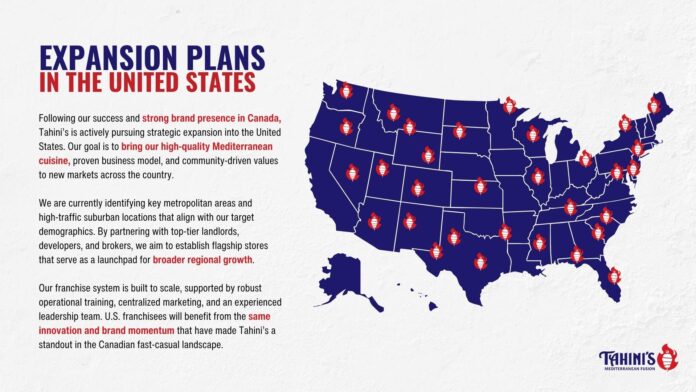

New Jersey’s restaurant scene is about to become even more competitive as one of Canada’s fastest-growing and most digitally dominant fast-casual food chains officially targets the Garden State for aggressive expansion. Tahini’s, the rapidly scaling Mediterranean and Middle Eastern fusion restaurant brand founded by brothers Omar and Aly Hamam, is now positioning New Jersey as one of the centerpiece markets in its broader American growth strategy — a move that could significantly reshape the state’s already thriving Mediterranean fast-casual landscape over the next several years.
For Explore New Jersey readers following emerging restaurant trends, franchise expansion, viral food culture, and the future of modern fast-casual dining, Tahini’s arrival represents far more than another chain entering the regional market.
It reflects the growing convergence of global street food, social media-driven restaurant branding, fusion cuisine innovation, late-night dining culture, and highly scalable digital-first restaurant operations now redefining the modern restaurant industry itself.
Founded in London, Ontario, the company has transformed from a single independent Mediterranean restaurant into one of the fastest-expanding food brands anywhere in Canada. What began as a traditional shawarma-focused operation has evolved into a multi-layered fast-casual empire operating more than 75 locations across major Canadian markets including Ontario, British Columbia, and Alberta.
Now the company is turning its attention toward the United States — and New Jersey sits directly near the top of that expansion map.
The significance of that decision cannot be overstated.
New Jersey already possesses one of the most sophisticated and competitive Mediterranean and Middle Eastern food ecosystems in the country. From independently owned falafel counters and Lebanese bakeries to Turkish grills, Palestinian restaurants, Israeli street-food concepts, Egyptian cafés, Persian kitchens, and high-end modern Mediterranean dining rooms, the state’s food culture already maintains deep familiarity with the flavors and culinary traditions Tahini’s is entering the market to serve.
That means Tahini’s will not succeed here simply because shawarma and rice bowls are trendy.
The brand appears to understand that reality clearly.
Instead of relying purely on authenticity marketing alone, Tahini’s has built its identity around something much more modern and commercially aggressive: fusion-forward Mediterranean fast food engineered specifically for the digital era.
The company’s slogan, “Eat Unbland,” effectively summarizes the entire strategy.
Tahini’s combines traditional Middle Eastern proteins and preparation techniques with globally inspired fast-food hybrids designed to maximize visual appeal, flavor intensity, social media engagement, and younger consumer curiosity. The result is a menu that feels simultaneously rooted in Mediterranean street-food traditions while heavily influenced by contemporary internet food culture.
Classic menu staples remain central to the concept.
Chicken shawarma, beef shawarma, gyro, falafel wraps, customizable rice bowls, and fresh saj bread preparations still anchor the brand’s culinary identity. But Tahini’s increasingly differentiates itself through highly stylized fusion creations built specifically to stand out inside crowded social feeds and food-delivery marketplaces.
Items such as Butter Chicken Shawarma, Jamaican Jerk bowls, loaded Mediterranean fries, shawarma poutines, and globally influenced protein mashups represent a very intentional business model designed around flavor experimentation and viral visibility.
That strategy appears to be working at extraordinary scale.
Tahini’s has become one of the most successful restaurant social media brands in North America, reportedly generating more than two billion views and building a combined following exceeding five million users across TikTok, YouTube, and other platforms.
That kind of digital presence fundamentally changes how restaurant expansion works.
Traditionally, restaurant chains entering new states relied heavily on expensive advertising campaigns, local awareness-building, and gradual word-of-mouth growth. Tahini’s instead arrives in markets with an already established internet audience familiar with its branding, menu hacks, food videos, and online personality.
In many cases, younger consumers may already recognize the brand before ever seeing a physical storefront.
That creates a massive strategic advantage in today’s restaurant economy where visibility often matters almost as much as food quality itself.
The company’s social-media-first approach also reflects a broader transformation happening throughout fast-casual dining.
Modern restaurant brands increasingly operate as entertainment entities as much as food-service operations. Viral menu launches, influencer collaborations, visual food presentation, short-form video marketing, and internet-driven product hype now directly influence expansion success. Restaurants capable of generating sustained digital engagement build customer loyalty and cultural relevance far faster than traditional advertising models alone.
Tahini’s appears exceptionally aware of that shift.
One of the clearest examples may be the company’s recent Shawarma Ramen launch — a highly unconventional menu item combining rich broth, noodles, mozzarella cheese, and seasoned shawarma chicken into a hybrid comfort-food bowl specifically engineered for online attention and social sharing.
Whether customers view such creations as culinary innovation or internet-era excess almost becomes secondary.
The key is that people talk about them.
That ability to remain culturally visible represents one of the defining characteristics separating modern fast-casual success stories from interchangeable chain restaurants increasingly struggling for relevance.
New Jersey’s inclusion within Tahini’s U.S. expansion strategy also makes enormous business sense geographically.
The state’s dense population, highly diverse demographics, strong commuter economies, late-night food culture, and sophisticated delivery infrastructure create ideal conditions for scalable fast-casual concepts built around portability, speed, customization, and digital ordering.
Additionally, New Jersey consumers already possess unusually strong familiarity with Mediterranean flavors compared to many American regions. That reduces the educational barrier many chains face when introducing shawarma, falafel, tahini, saj bread, or Middle Eastern spice profiles into mainstream suburban markets.
Importantly, however, Tahini’s is not positioning itself purely as “traditional” Mediterranean dining.
The brand appears far more interested in occupying the same cultural territory currently dominated by modern fast-casual disruptors — places where food, branding, internet culture, customization, and lifestyle identity all merge together into a single consumer experience.
That positioning may resonate particularly strongly with younger New Jersey diners already deeply engaged with delivery platforms, late-night ordering habits, food influencers, and hybrid global comfort-food culture.
The company’s operational model reinforces that strategy even further.
Tahini’s has aggressively embraced delivery infrastructure, streamlined ordering systems, franchising scalability, and alternative retail formats. Beyond standalone restaurants, the company has already launched smaller-format “Tahini’s Kitchen” operations inside Canadian FreshCo supermarket locations while simultaneously selling branded sauces through retail grocery channels.
That diversification matters enormously in the modern restaurant industry.
Increasingly, successful restaurant brands no longer depend solely on dine-in traffic alone. They evolve into broader food ecosystems involving packaged goods, ghost kitchens, retail licensing, digital engagement, and multi-channel consumer interaction.
Tahini’s appears to be building exactly that kind of vertically integrated brand structure.
The company’s first major New Jersey-area development currently underway in Budd Lake along Route 46 signals the beginning of what insiders suggest may become a far larger statewide rollout. Franchise recruitment materials reportedly identify New Jersey as a major priority market, particularly because of its combination of suburban density, commuter corridors, college populations, and highly active food-delivery culture.
North Jersey especially may prove fertile territory for expansion.
Areas throughout Bergen County, Passaic County, Essex County, Hudson County, Middlesex County, and Morris County already support highly active fast-casual dining ecosystems where consumers regularly engage with globally influenced restaurant concepts. The challenge for Tahini’s will not be introducing Mediterranean flavors themselves — it will be differentiating its internet-driven fusion identity from the region’s already deeply established independent Mediterranean operators.
That competition may ultimately benefit consumers most.
New restaurant entrants often force innovation across entire dining sectors. Existing restaurants evolve menus, improve service models, strengthen branding strategies, and elevate digital engagement when highly visible competitors enter surrounding markets.
For Explore New Jersey readers tracking restaurant openings, franchise growth, food culture evolution, and the future of fast-casual dining, Tahini’s expansion represents another sign that New Jersey remains one of the most strategically valuable food markets anywhere in North America.
The Garden State continues attracting ambitious concepts precisely because its consumers are knowledgeable, adventurous, highly diverse, digitally connected, and deeply engaged with restaurant culture itself.
Tahini’s now appears ready to test whether its fusion-heavy, social-media-powered, Mediterranean fast-casual model can thrive inside one of the country’s most competitive food environments.
And if the company’s explosive Canadian growth trajectory is any indication, New Jersey may soon become one of the most important battlegrounds in the next phase of the brand’s North American expansion story.
















