
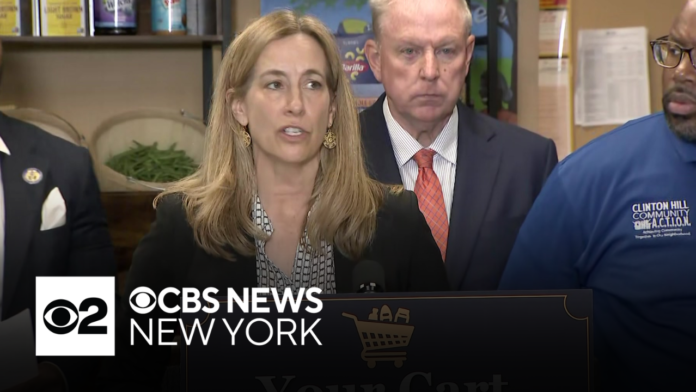

Governor Mikie Sherrill is dominating New Jersey’s news cycle this week, navigating a direct standoff with the U.S. Department of Justice over a multi-year voter registration error even as she simultaneously signed a rapid succession of consumer protection bills into law. Taken together, the week reflects both a genuine crisis management moment for the administration and a continued push on the affordability agenda Sherrill has made central to her governorship.
The Motor Vehicle Commission Error and the DOJ Standoff
The most significant story of the week traces back to a software error at the New Jersey Motor Vehicle Commission, operated by state contractor IDEMIA, which improperly registered roughly 6,600 noncitizens to vote between June 2023 and June 2024. According to state officials, the affected individuals had explicitly selected no when asked about their citizenship status on their driver’s license applications, but the system overrode those responses and registered them to vote regardless, a genuinely serious technical failure given how directly it contradicted the applicants’ own stated answers.
A preliminary state investigation found that fewer than 400 of those improperly registered individuals actually cast ballots across various elections during that window. Sherrill has been direct in noting that the underlying error predates her own administration, since she took office in January 2026, well after the flawed registrations began, though she has moved to address the fallout by hiring an independent firm specifically tasked with purging the affected registrations from the state’s voter rolls entirely.
That response has since escalated into a genuine confrontation with the federal government. This week, the U.S. Department of Justice formally demanded that New Jersey turn over the personal identities and names of all 6,600 individuals affected by the error. Sherrill rejected that demand directly at a press conference, stating that the state does not make a practice of handing over this kind of personally identifying data to the federal government, citing concerns about how that information could be used going forward. That rejection sets up a genuine legal and political standoff between the state and DOJ over exactly how much identifying information New Jersey is obligated to share regarding the affected registrations, a dispute that appears likely to continue playing out in the weeks ahead. Sherrill has placed direct blame for the underlying technical failure on IDEMIA itself, describing the vendor’s performance as reflecting broader systemic incompetence, and has confirmed the Motor Vehicle Commission is already in the process of terminating its relationship with the company and replacing it with a new vendor.
A Rapid Succession of Consumer Protection Bills
Alongside that unfolding standoff, Sherrill has signed a genuinely rapid string of consumer protection legislation into law this week, each aimed at addressing what her office has broadly characterized as hidden corporate pricing practices affecting New Jersey households.
Yesterday, Sherrill signed the Fair Price Protection Act, making New Jersey the third state in the country, following Maryland and Connecticut, to ban grocery stores and third-party delivery platforms from using shoppers’ personal data, including biometric, genetic, and protected class information, to set individually inflated grocery prices. The law also imposes a one-year moratorium on new electronic shelf label installations while the state studies their connection to surveillance pricing practices. Violations under the new law can trigger fines up to $50,000, layered on top of separate Consumer Fraud Act penalties reaching up to $20,000 for repeat offenses. The legislation followed a December 2025 Consumer Reports investigation that found a third-party grocery delivery platform had used an AI-driven algorithm to charge different customers different prices for identical products from the same store, based entirely on an analysis of each customer’s personal data and browsing behavior.
Earlier in the week, on Monday, Sherrill signed the Forbidding the Algorithmic Inflation of Rent Act, banning landlords from using centralized AI software platforms, including RealPage, to coordinate and inflate rent pricing recommendations across otherwise competing properties. She also signed a sweeping data security bill requiring commercial data brokers to register on a new public state registry, while banning those same brokers from selling New Jersey residents’ most sensitive personal data outright.
Energy Reform and Severe Weather Response
Beyond her consumer protection push, Sherrill also finalized a three-bill energy package this month specifically aimed at cutting New Jersey ratepayers’ utility expenses by an estimated $1 billion annually, achieved by eliminating unnecessary corporate electricity incentives and requiring large-scale data centers to pay a fairer share of the grid infrastructure costs their operations generate.
The governor’s office also had to shift attention toward emergency response this week, activating the State Operations Center following violent storms and rare tornado alerts that swept through parts of the state. That activation coordinated emergency road rescues across affected areas, with Sherrill urging residents to maintain heightened weather awareness as additional unsettled conditions continued moving through the region.
A Divided Political Reaction
The reaction to this genuinely eventful week has broken down largely along familiar political lines. Consumer advocacy groups have offered strong praise for Sherrill’s crackdown on digital pricing practices, framing the grocery surveillance pricing ban and related consumer protection laws as genuine wins for household affordability. State Republicans, meanwhile, have focused their attention squarely on the voter registration error, calling for an expanded legislative probe into the underlying MVC system failure and arguing that the disclosure validates concerns they’ve raised previously about the integrity of the state’s voter rolls. That political pressure has extended to the federal level as well, with a group of congressional Republicans setting an August 21 deadline for Sherrill to provide a fuller public explanation of exactly how the registration error occurred and what corrective steps the state has taken since.
With litigation and political pressure building around the voter roll dispute even as her consumer protection agenda continues advancing, Sherrill’s administration finds itself managing two genuinely distinct fronts simultaneously this week, one centered on defending the state’s handling of sensitive voter data against federal demands, and the other focused on delivering the kind of affordability wins that have defined her broader legislative agenda since taking office.
















