
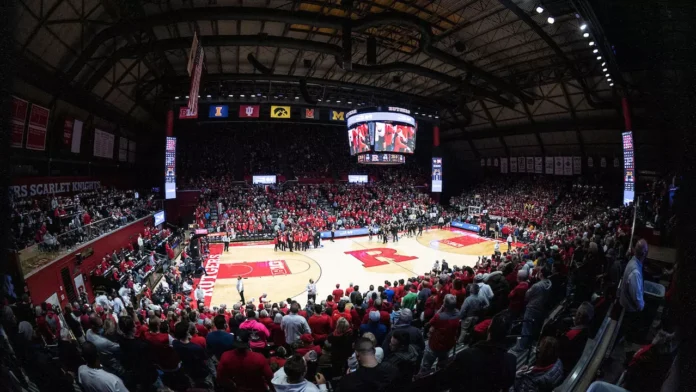

Rutgers men’s basketball is entering the 2026–27 season with a level of internal confidence that reflects both necessity and design. After several uneven campaigns defined by inconsistency and roster turnover, the program under head coach Steve Pikiell has executed one of its most deliberate and physically oriented rebuilds to date. The result is a roster that looks fundamentally different in structure, experience profile, and stylistic identity, and one that is being framed within the program as capable of competing across the upper tiers of the Big Ten if cohesion develops at the expected rate.
That optimism is not rhetorical. It is grounded in a roster construction strategy that prioritizes size, defensive versatility, and veteran production over developmental speculation. In an era defined by transfer portal volatility, Rutgers has leaned aggressively into experience, assembling a rotation that blends established mid-major standouts, Power Five contributors, international size, and returning veterans who have already absorbed the physical demands of Big Ten play. The intent is clear: remove the learning curve that has historically slowed early-season progress and replace it with immediate structural stability on both ends of the floor.
The centerpiece of that transformation is a reconfigured frontcourt built to withstand the physical demands of conference competition. Christian Gurdak, a 6-foot-10 transfer from Virginia Tech, arrives with expectations of anchoring the interior rotation. Early evaluations from offseason workouts have highlighted his mobility relative to his size, particularly in defensive coverage and rebounding positioning, where Rutgers struggled in prior seasons. His presence is expected to stabilize the defensive glass while also providing a reliable interior option in half-court sets.
Alongside him, Dorin Buca introduces a different kind of structural shift. At 7-foot-2, the Kansas State transfer brings a rare combination of length and rim protection that immediately alters opposing shot selection. While his offensive role is expected to be situational, his defensive presence provides a deterrent element that Rutgers has lacked in recent years, particularly against elite Big Ten frontcourts that routinely dictate interior spacing.
The perimeter and wing rotation has also been significantly retooled. Rasheed Jones, a 6-foot-6 guard from Coastal Carolina, arrives after averaging 14.8 points per game and brings a combination of scoring versatility and perimeter defense that aligns with Rutgers’ increasingly physical guard philosophy. His ability to defend multiple positions while contributing consistent outside shooting positions him as a key connective piece in the rotation.
Will Sydnor, a 6-foot-8 forward and former MAAC Rookie of the Year at Manhattan, adds another layer of versatility. His skill set bridges the gap between traditional forward play and modern spacing requirements, allowing Rutgers to shift between lineup configurations without sacrificing defensive integrity. Darin Smith Jr., the NEC Player of the Year from Central Connecticut State, further reinforces the program’s emphasis on proven production at the mid-major level, bringing efficiency, maturity, and a track record of sustained offensive contribution.
The international pipeline also makes a notable appearance with the addition of 7-foot-2 forward Dorin Buca, underscoring Rutgers’ expanded approach to talent acquisition. Rather than relying solely on domestic recruiting and transfers, the program has increasingly incorporated international size profiles to address specific structural gaps in its roster composition.
While the incoming class has reshaped the physical identity of the team, the returning core remains equally important in establishing continuity. Senior guard Tariq Francis returns as the primary offensive focal point after averaging 17 points per game last season, providing a stabilizing scoring presence that the coaching staff can build around without forcing immediate adaptation from newcomers. His role is expected to expand not only as a scorer but as an on-court organizer within a rebalanced offensive structure.
Redshirt senior Darren Buchanan Jr. and guard Jamichael Davis also return with expanded physical development following offseason strength work, positioning both players as essential stabilizers within the rotation. Their experience in Big Ten competition provides a critical reference point for integrating a significantly restructured roster, particularly in high-pressure conference environments where game management and physical resilience become decisive factors.
The developmental trajectory of younger players remains another variable in Rutgers’ projected improvement. Sophomore guards Lino Mark and Kaden Powers are both reported to have made measurable gains in ball handling efficiency and perimeter shooting consistency during summer training sessions. Their progression will be closely tied to the team’s offensive spacing and second-unit production, particularly in games where rotation depth becomes a determining factor.
Beyond roster construction, Rutgers’ scheduling profile also signals a program preparing for immediate competitive stress. The team is set to participate once again in the Players Era Advancement Tournament, marking its third consecutive appearance in a field that has increasingly become a proving ground for programs seeking national relevance outside conference play. Early matchups include a high-level opener against Houston, followed by potential contests against Notre Dame and West Virginia, creating a non-conference slate that offers little margin for early-season adjustment.
This scheduling approach reflects a broader strategic shift within the program: eliminating soft entry points in favor of immediate exposure to high-level competition. For a roster rebuilt around experience and size, the expectation is not gradual development but rapid cohesion under pressure. The tournament structure reinforces that expectation by compressing elite matchups into a short window, effectively simulating postseason intensity months before conference play begins.
Taken together, the 2026–27 Rutgers basketball roster represents a calculated reset rather than a gradual rebuild. The emphasis on transfer portal acquisition, positional size, and veteran presence signals a program intent on reestablishing competitive credibility within the Big Ten through immediate physicality and defensive structure. While questions remain regarding offensive consistency and late-game execution, the foundational architecture of the roster has shifted decisively toward readiness over projection.
In a conference where margin for error continues to narrow and roster stability has become increasingly rare, Rutgers is positioning itself as a team built not around potential, but around present-tense capability. The stated confidence coming out of Piscataway is not framed as aspiration, but as expectation grounded in roster construction, experience distribution, and a deliberate philosophical shift toward size, strength, and adaptability.
















