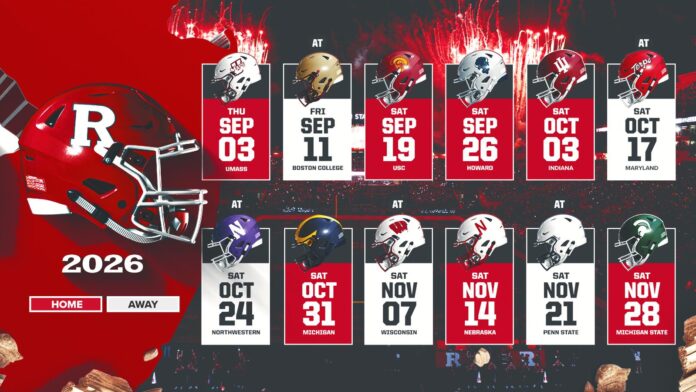

Rutgers football is entering the 2026 season under a scheduling framework that reflects how dramatically the modern college game has shifted around athlete development, media inventory, and year-round training demands. What once was a relatively standardized rhythm of late-August camp, Labor Day weekend kickoff, and Saturday-heavy scheduling has evolved into a more compressed and strategically distributed calendar, one that now places equal weight on competitive readiness and athlete workload management. For Rutgers, that evolution is especially visible in how the preseason is structured and how early-season matchups are being staged under weekday primetime windows that reshape the traditional feel of September football in Piscataway.
The NCAA’s broader adjustment to preseason timing is rooted in player welfare considerations and the reality that programs now operate with near-continuous offseason training cycles. With athletes spending most of the summer on campus participating in strength and conditioning programs, film study, and non-contact walkthroughs, governing bodies have increasingly moved formal contact practices later in the calendar to prevent early burnout and overexertion. The result is a more controlled ramp-up period that separates conditioning phases from full-contact preparation, even as teams remain deeply engaged in structured training activity throughout July.
At Rutgers, that structure begins well before the first whistle of official camp. Players are on campus in July, participating in mandatory workouts that focus on physical development, tactical installation, and foundational conditioning. While NCAA regulations prohibit padded practices and full-team contact during this phase, the work being done is far from informal. Strength staffs and position coaches use this window to establish baseline conditioning levels, refine technique in controlled environments, and introduce schematic concepts that will be expanded once formal training camp begins. The emphasis is on preparation without collision, ensuring that athletes arrive at camp physically ready for the demands of full-speed football.
Head coach Greg Schiano is expected to formally open training camp in the final week of July, aligning Rutgers with the broader national cadence of programs across both the Big Ten and the NFL calendar. This synchronization is not accidental. The late-July ramp into August has become a standard across elite football programs, allowing for a more uniform preseason timeline that balances competitive readiness with mandated rest periods. Once camp officially opens, the program transitions into fully padded practices during the first week of August, marking the point at which installation, depth chart evaluation, and situational preparation accelerate significantly.
The timing of Rutgers’ 2026 opener further compresses that preparation window. The Scarlet Knights begin their season on Thursday, September 3, 2026, at SHI Stadium against UMass in a 6:00 PM kickoff that immediately places the program into a national spotlight slot. Because September 1 falls on a Tuesday that year, the traditional opening weekend structure shifts forward, with Week 1 effectively beginning that Thursday. For Rutgers, that means the preseason calendar operates on a slightly accelerated rhythm compared to programs opening on the standard Saturday slate.
That acceleration becomes even more pronounced when examining the structure of the early-season schedule. Rutgers is set to play three of its first four games on weekdays, a configuration that reflects both television scheduling strategies and conference programming priorities. The result is an opening month that feels more like a serialized primetime event than a traditional Saturday-driven slate of college football.
Following the opener against UMass, Rutgers travels to face Boston College on Friday, September 11 at 7:30 PM in a nationally televised matchup on ESPN2. The game carries additional historical weight as part of Boston College’s annual Red Bandanna Game, which honors the legacy of Welles Crowther and marks the 25th anniversary of September 11 observances. It is a setting that blends competitive football with broader cultural remembrance, placing the game within one of the most emotionally resonant annual moments on the college football calendar.
Week three shifts Rutgers into one of its most significant early tests of the season, hosting USC on Saturday, September 19 at 3:30 PM on CBS. The matchup represents the Trojans’ first trip to Piscataway as a member of the Big Ten and serves as an early measuring point for Rutgers within its evolving conference landscape. The introduction of West Coast programs into traditional Big Ten environments has altered competitive dynamics across the league, and this game is positioned as a high-visibility intersection of those changes.
The early stretch concludes with another Friday night spotlight, as Rutgers hosts Howard on September 25 at 7:00 PM on the Big Ten Network. The sequence of weekday games reinforces how television scheduling has become an increasingly central force in shaping the college football experience, particularly in September when networks seek to maximize exposure across multiple nights rather than concentrate viewership on Saturdays alone.
Beyond scheduling, the 2026 season also carries heightened anticipation around Rutgers’ incoming recruiting class, which has drawn attention for its balance across key positional groups and its potential long-term impact on the program’s trajectory within the Big Ten. The class currently ranks inside the top tier nationally and reflects a strategic emphasis on both offensive explosiveness and defensive versatility.
Wide receiver Dyzier Carter arrives from Virginia as a high-upside vertical threat whose speed and field-stretching ability are expected to reshape the passing attack. On the defensive side, safety Messiah Tilson brings a physical, instinctive presence in the secondary, fitting the aggressive defensive identity long associated with Schiano-led teams. Quarterback Xavier Stearn, a 6-foot-6 prospect from Pennsylvania, represents a developmental cornerstone at the most important position on the field, offering size, arm strength, and long-term potential within the system. Offensive lineman Jared Smith from Georgia adds immediate physical depth in the trenches, reinforcing the program’s continued focus on building a foundationally strong offensive front.
Taken together, the roster additions and early-season structure point toward a program in a transitional phase of competitive identity within the Big Ten. Rutgers is no longer operating as an external disruptor within the conference but as a fully embedded participant navigating the demands of national scheduling exposure, recruiting escalation, and increased performance expectations. The 2026 calendar reflects that reality clearly, from the accelerated preseason timeline to the frequency of primetime weekday games that define the opening month.
What emerges is a season shaped as much by timing as by talent, where preparation begins earlier in structured but non-contact environments, where training camp compresses evaluation into a shorter window, and where the traditional Saturday rhythm of college football is increasingly supplemented by weekday broadcasts designed for national audiences. For Rutgers, the 2026 season is not simply a schedule on paper but a reflection of how modern college football now operates—continuous, media-integrated, and structurally redefined around both athlete management and broadcast reach.