
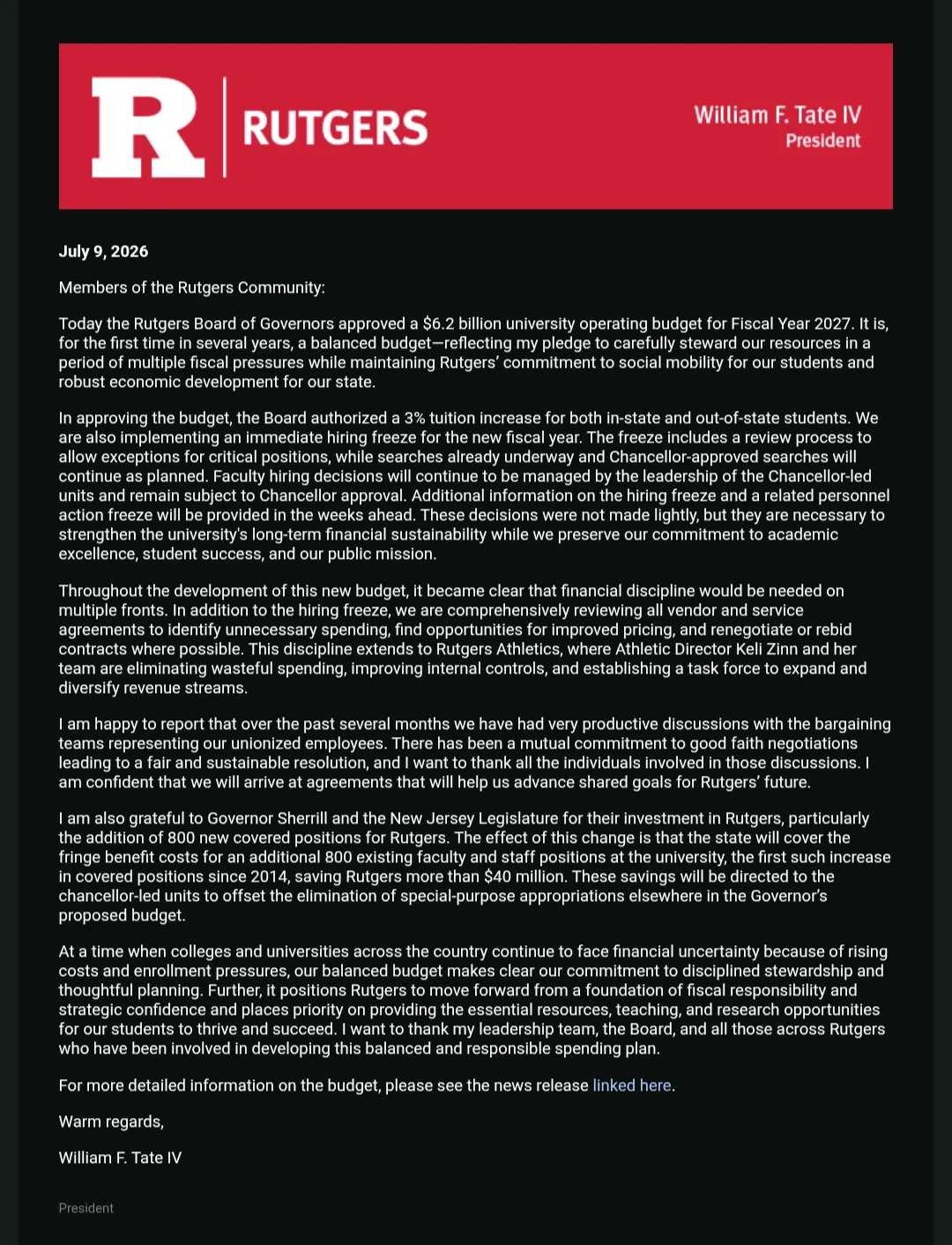
Rutgers University’s Board of Governors has signed off on a $6.2 billion operating budget for the coming academic year, pairing that massive spending plan with a 3 percent tuition increase for both in-state and out-of-state students, a rate that university officials are quick to note is the smallest annual increase Rutgers has approved in four years. The budget arrives at a moment when higher education institutions across the country are grappling with real financial pressure, and Rutgers leadership has framed this year’s plan as evidence of disciplined, deliberate financial management rather than a simple continuation of the steeper increases the university approved in recent years.
That contrast with recent history is significant. Last year’s budget carried a 5 percent tuition increase for in-state students and a 6 percent increase for out-of-state students, meaning this year’s 3 percent hike represents a genuine deceleration in how quickly the cost of attending Rutgers has been climbing. University President William Tate IV, who took over as the school’s 22nd president, framed the new budget as proof that Rutgers can maintain fiscal discipline without compromising the quality of education students receive, even as colleges and universities nationwide continue navigating genuinely difficult financial headwinds and funding uncertainty.
For the typical New Jersey resident enrolled full-time in arts and sciences, that 3 percent increase translates into a $448 jump in tuition, moving the annual cost from $14,933 to $15,381. Out-of-state undergraduates in the same typical arts and sciences track will see a considerably larger increase in dollar terms, with tuition and fees rising $1,190, from $39,649 up to $40,839, reflecting how much steeper the baseline cost already sits for students coming from outside New Jersey. Mandatory fees are also ticking upward for both in-state and out-of-state students alike, rising $117 to reach $4,008 annually. Housing and dining costs are seeing the largest percentage jump of any single line item, climbing 4 percent, or $613, pushing the annual cost for room and board from $15,332 to $15,945.
Board of Governors Chair Amy Towers has been direct in framing these increases against the backdrop of broader inflation, noting that even with this year’s adjustments, Rutgers’ tuition increase remains below the current rate of inflation nationally. Towers, who was recognized as a recipient of the inaugural NJBIZ Board Leadership Awards, has described the budget as a direct response to the fiscal realities facing higher education broadly, pointing specifically to rising operating costs and genuine uncertainty around federal funding as pressures the university had to actively plan around rather than simply absorb. Towers also extended thanks to Governor Mikie Sherrill and the state Legislature for enabling the university to expand its financial aid offerings, a partnership reflected directly in the numbers, since nearly 80 percent of Rutgers undergraduates received some form of financial aid during the 2025-2026 academic year. That level of aid penetration is tied closely to the state’s own budget commitments, with New Jersey’s recently signed Fiscal Year 2027 spending plan including $2.2 billion in direct support for higher education services statewide, according to legislative analysis released earlier this year.
Keeping tuition increases as modest as they were this year required real trade-offs elsewhere in the budget, and Rutgers has been transparent about the cost-cutting measures built into the plan, chief among them an active hiring freeze across the university. That kind of restraint on staffing costs gave Rutgers room to hold tuition growth well below last year’s pace while still funding the university’s core academic and research mission.
Looking at how Rutgers actually allocates its $6.2 billion in spending offers a clearer picture of where the university’s priorities sit. Classroom instruction and academic support make up the single largest share of the budget at 33.1 percent, underscoring that the core teaching mission still commands the biggest piece of university spending by a wide margin. Healthcare and public service functions account for another substantial 21.1 percent, reflecting Rutgers’ significant footprint as a healthcare provider and public-service institution well beyond its traditional academic role. Administration and operations take up 15.8 percent of the budget, while student scholarships, financial aid, and broader student services account for 10.8 percent, a figure that directly supports the financial aid access nearly four in five undergraduates are currently relying on. Sponsored research and other sponsored programs make up 10.4 percent of spending, auxiliary enterprises including housing, dining, and parking account for 5.4 percent, and Division I athletics rounds out the breakdown at 3.4 percent of total university spending.
On the revenue side, tuition and fees remain the single largest funding source for the university, accounting for 28.8 percent of total revenue, followed closely by direct state of New Jersey funding at 21.9 percent. Patient care services, reflecting Rutgers’ extensive healthcare operations, generate 19.8 percent of total revenue, while sponsored research contributes another 12.3 percent. Federal student aid, gifts, endowments, and investment income together make up 10.2 percent of revenue, with the remaining 7 percent coming from miscellaneous sources including the university’s housing, dining, and parking services.
Tate has been candid that reaching this balanced budget required genuinely difficult decisions rather than simple across-the-board adjustments, describing the plan as the product of strategic investments paired with deliberate measures designed to strengthen the university’s long-term financial sustainability, all while preserving Rutgers’ broader commitment to academic excellence, student success, and its public mission as the state’s flagship university. That public mission extends well beyond the university’s own campuses and balance sheet. Earlier this year, Rutgers released an annual report highlighting its estimated $13.3 billion economic impact on New Jersey’s economy during fiscal year 2025, a figure that places the university among the most significant economic engines operating anywhere in the state, and one that adds meaningful context to why state lawmakers continue prioritizing direct financial support for Rutgers and New Jersey’s broader higher education system even amid tighter budgets nationwide.