
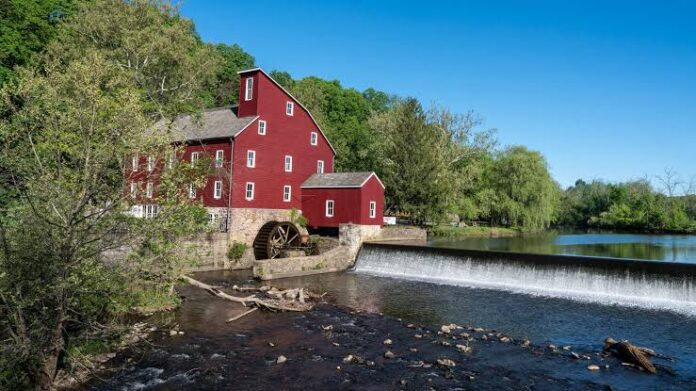

A working stone mill that once ground grain along the Raritan River now grinds out something entirely different, four simultaneous, genuinely praised contemporary art exhibitions, and all of them close September 6. That’s the current state of the Hunterdon Art Museum, and if you haven’t made the trip to Clinton yet this summer, the clock on this particular lineup is already running.
The museum itself occupies Dunham’s Mill, a 19th-century stone grist mill listed on the National Register of Historic Places, and the building’s history is impossible to separate from its setting. It sits directly across the Raritan River from the Red Mill Museum Village, one of the most photographed historic landmarks in this part of New Jersey, and the two institutions have built a genuine collaborative relationship rather than just tolerating proximity. Locals call it the Mill to Mill experience, art history and industrial history sitting on opposite banks of the same waterfall, close enough to visit both comfortably in one unhurried afternoon.
This summer’s exhibition slate earned a full critical review from NJ Arts, and reading through what’s actually on display, it’s easy to see why. Claybash anchors the season as the museum’s signature event, a triennial juried national exhibition built specifically to showcase experimental, unconventional contemporary ceramics rather than the safe, predictable pottery most people picture when they hear the word. It’s the kind of show that rewards walking slowly, since the work here is deliberately pushing against what clay is supposed to look like once it leaves the kiln.
Bascha Mon: Mindscapes takes the opposite emotional register entirely, a retrospective spanning more than sixty years of the artist’s career, built around patient, emotionally rich paintings and colorful abstract landscapes. Sixty years is a genuinely rare span to see compressed into a single exhibition, and it gives visitors a chance to actually watch an artist’s eye evolve across decades rather than catching one isolated moment of a much longer career.
Valerie Huhn’s exhibition, titled The Wound Is the Place Where the Light Enters You, is the one visitors seem to talk about longest after leaving. It’s a conceptual show built around genuinely unexpected materials, including fingerprints pinned onto racing shoes, used to make pointed sociological observations rather than simply decorating a gallery wall. [Your Story Here] Work like this tends to divide a room, some visitors find it striking and necessary, others find it uncomfortable, and honestly, that tension is probably exactly what the artist intended.
Rounding out the lineup, the Steamroller Group’s Uncharted Territories takes a genuinely collaborative approach, presenting a handbound, limited-edition book combining art and poetry from a large collective of local artists and poets. There’s something quietly powerful about a regional museum making room for a project built entirely on community collaboration rather than a single celebrated name, and it fits a museum that’s clearly invested in supporting working artists close to home rather than only importing established reputations from elsewhere.
Beyond the art itself, the museum has clearly put real thought into who actually gets through the door, and the admissions structure reflects that. General admission runs a genuinely modest $7 for adults, $5 for seniors, students, and military, and completely free for children under 12, pricing that keeps a museum visit within reach for a family outing rather than treating it as a luxury activity. New Jersey residents receiving SNAP, WIC, Child Care Subsidy, or WFNJ benefits qualify for entirely free admission, a policy that actively removes cost as a barrier for exactly the families who might otherwise assume a museum trip isn’t for them. Bank of America and Merrill cardholders get free general admission during the first full weekend of every month through the Museums on Us program, and the museum’s participation in the North American Reciprocal Museum network means members of other participating institutions walk in free as well.
Accessibility inside the historic building deserves real credit too, since retrofitting a 19th-century stone mill for modern accessibility standards is genuinely difficult work that plenty of historic sites never fully commit to. The museum features an automated entrance door, a full elevator servicing all four gallery floors complete with Braille lettering, and high-contrast Braille signage in its unisex restrooms. Large-print copies of every gallery and exhibition label are available at the front desk on request, meaning visitors with low vision aren’t left guessing at wall text the rest of the room can read easily. Getting all of that right inside a building this old takes real, deliberate investment rather than a token accommodation bolted on as an afterthought.
Practically speaking, parking shouldn’t be the thing that talks you out of the trip. The immediate downtown area can get competitive on busy weekends, but plenty of free municipal lots and street parking sit a short, easy walk away throughout Clinton’s historic Victorian shopping district, the kind of walk that doubles as its own small tour of the town before you’ve even reached the museum doors.
With all four exhibitions closing September 6, this is genuinely a use-it-or-lose-it window rather than something to file away for later. A sixty-year retrospective, a national ceramics showcase, a conceptual exhibition built to unsettle, and a community-built book of art and poetry, all inside a working 19th-century mill, with a nationally significant historic village sitting directly across the water. Clinton doesn’t need much of an excuse to justify a day trip this summer, and right now it has one of the strongest lineups it’s had in a while.
















