
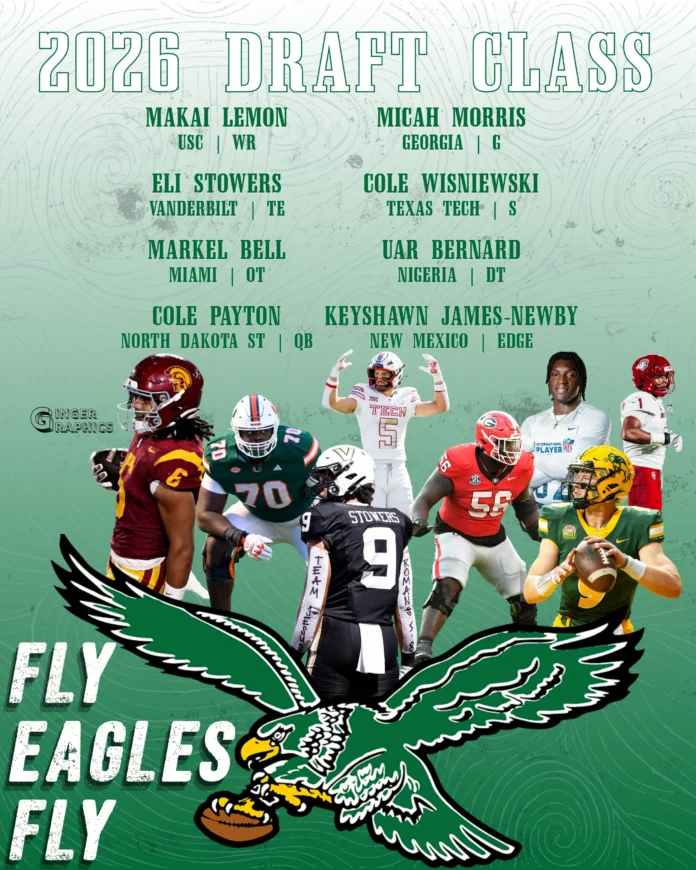

The 2026 NFL Draft served as a defining checkpoint for the Philadelphia Eagles, a franchise that has built its modern identity on calculated aggression, roster layering, and an unwavering commitment to staying ahead of the league’s competitive curve. This year’s draft was not about patching weaknesses—it was about amplifying strengths, extending windows, and reinforcing a roster already built to contend at the highest level. In doing so, the Eagles once again demonstrated why they remain one of the most forward-thinking organizations in professional football.
The Eagles prioritized adding offensive firepower, notably moving up in the first round via a rare trade with the division-rival Dallas Cowboys.
- Makai Lemon (WR, USC): The Biletnikoff Award winner was taken at No. 20 overall after the Eagles moved up from 23. He is seen as a potential high-volume slot weapon.
- Eli Stowers (TE, Vanderbilt): Selected in the second round (No. 54), the John Mackey Award winner is a versatile athlete who can line up in the backfield or slot.
- Day 3 Sleepers: The Eagles took Cole Payton (QB, North Dakota State) in the fifth round and added an intriguing international prospect, Uar Bernard (DT), via the International Player Pathway program in the seventh.
- Veteran Move: During the draft, Philadelphia also traded for Pro-Bowl edge rusher Jonathan Greenard to bolster their defense.
From the outset, Philadelphia made it clear that standing still was not an option. In one of the most notable moves of the first round, the Eagles executed a rare intra-division trade with the Dallas Cowboys, moving up from the 23rd pick to secure a targeted offensive weapon at No. 20 overall. The significance of that move cannot be overstated. Trading within the division is uncommon, and doing so to acquire a player viewed as a foundational offensive piece reflects both conviction and urgency.
That player is Makai Lemon, the Biletnikoff Award-winning wide receiver out of USC, whose arrival in Philadelphia introduces a new dimension to an already potent offensive system. Lemon projects as a high-volume slot weapon with elite route-running precision, spatial awareness, and the ability to consistently create separation in high-traffic areas of the field. His skill set aligns perfectly with the modern NFL’s emphasis on quick-strike passing attacks and tempo control. For the Eagles, Lemon is not simply an addition—he is a multiplier, a player capable of increasing efficiency across the entire passing game while forcing defenses into difficult coverage decisions.
The emphasis on offensive versatility continued into the second round, where the Eagles selected Eli Stowers, the John Mackey Award-winning tight end from Vanderbilt. Stowers embodies the hybrid offensive archetype that has become increasingly valuable in today’s game. His ability to line up in multiple alignments—whether attached to the line, split into the slot, or even positioned in the backfield—creates schematic flexibility that few defenses are equipped to counter consistently. His presence allows the Eagles to disguise intentions, shift personnel groupings without substitutions, and maintain tempo advantages that are critical in high-level competition.
While the early rounds focused on immediate-impact offensive talent, the Eagles’ later selections revealed a continued commitment to depth, development, and long-term upside. In the fifth round, the team selected quarterback Cole Payton out of North Dakota State, adding a developmental prospect with dual-threat capabilities and a proven track record in a winning program. Payton’s addition reflects a strategic approach to the quarterback position, ensuring that the organization maintains depth and flexibility behind its established starter while cultivating future options within its system.
The draft concluded with one of the more intriguing selections of the entire class, as the Eagles added defensive tackle Uar Bernard through the International Player Pathway program in the seventh round. Bernard represents the kind of high-upside investment that has become increasingly common as teams expand their global scouting efforts. While his transition to the NFL will require development, his physical tools and raw potential make him a compelling addition to a defensive front that has consistently prioritized size, strength, and disruption.
Perhaps the most impactful move of the Eagles’ draft weekend, however, did not come in the form of a rookie selection. In a decisive mid-draft transaction, Philadelphia acquired Pro Bowl edge rusher Jonathan Greenard, adding an established pass-rushing presence to a defense already built on pressure and versatility. This move underscores the organization’s dual-track approach: develop through the draft while simultaneously reinforcing the roster with proven talent. Greenard’s arrival immediately elevates the defensive front, providing another layer of pass-rush capability that will be critical in high-stakes matchups.
What emerges from this draft is a clear and cohesive strategy. The Eagles are not chasing trends—they are setting them. By prioritizing offensive firepower, positional flexibility, and defensive reinforcement, they have constructed a roster that is both dynamic and resilient. Every addition serves a purpose, fitting into a broader system designed to maximize efficiency and adaptability.
For fans across New Jersey, where the Eagles maintain a strong and passionate following, this draft represents more than just roster movement. It signals continuity in excellence, a reaffirmation that the organization remains committed to competing at the highest level year after year. The proximity of Philadelphia to the Garden State only deepens that connection, making the team’s success a shared regional experience that resonates far beyond city limits.
The implications for the upcoming season are significant. With an offense that continues to evolve and a defense bolstered by both youth and veteran presence, the Eagles enter the next phase of their competitive cycle with one of the most complete rosters in the league. The additions of Lemon and Stowers alone introduce new layers of unpredictability, while Greenard’s presence ensures that the defense remains a force capable of dictating outcomes.
For continued coverage, in-depth roster analysis, and the latest developments surrounding the team’s pursuit of another championship run, explore more through the official Philadelphia Eagles coverage hub, where every move and milestone is documented as the season approaches.
As rookie minicamps give way to training camp battles and preseason evaluations, the true impact of this draft will begin to take shape on the field. Yet even at this stage, the broader narrative is already established. The Eagles have once again demonstrated an ability to evolve without losing identity, to add without overreaching, and to position themselves firmly within the league’s upper tier. In a sport defined by constant change, that level of sustained excellence is not accidental—it is engineered.
















