Home Blog Page 78

Inside a Global Classroom for Cat Care: How a Leading Veterinary Association Is Redefining Feline Medicine Education in 2026

The future of feline health care education will once again take center stage in 2026, as FelineVMA prepares to deliver its highly anticipated Spring into Feline Medicine eConference—an immersive, three-day virtual learning experience built specifically for veterinary professionals dedicated to advancing the quality of care for cats around the world.

Set to return next spring, the 2026 edition of the Spring into Feline Medicine eConference is being designed as a comprehensive, clinically driven educational event featuring internationally recognized speakers, in-depth medical sessions, and practical, case-based instruction that reflects the rapidly evolving science of feline health. With growing awareness that cats require a distinctly different clinical approach than dogs, the conference continues to position itself as one of the most focused professional learning environments in modern veterinary medicine.

Unlike broad-spectrum veterinary conferences that divide attention across multiple species, this fully feline-centered program delivers three uninterrupted days of expert instruction addressing the unique physiological, behavioral, diagnostic, and therapeutic challenges encountered in cats. Organizers have emphasized that the 2026 agenda will build on the momentum of previous years by offering expanded clinical tracks, deeper dives into emerging research, and interactive learning opportunities designed to support both early-career clinicians and seasoned veterinary specialists.

The upcoming conference is expected to feature a diverse slate of speakers representing academic medicine, private specialty practice, and cutting-edge research institutions. Sessions will focus on real-world clinical applications—ranging from complex internal medicine cases and advances in diagnostic imaging to pain management strategies, geriatric feline care, and updates on infectious disease protocols. Behavioral medicine and stress-reduction practices in clinical environments will also remain a central theme, reflecting the growing emphasis on cat-friendly handling and practice design.

Veterinary leaders involved in developing the 2026 program note that feline medicine is experiencing one of the most significant periods of growth and specialization in the profession’s history. Improved diagnostic tools, deeper understanding of feline-specific disease progression, and expanding pharmacological options are reshaping how clinicians approach long-standing conditions such as chronic kidney disease, diabetes, cardiomyopathies, and inflammatory disorders.

The Spring into Feline Medicine eConference is structured to translate these advances into practical clinical decision-making. Attendees can expect detailed case reviews, protocol updates, and evidence-based treatment discussions that go beyond theory and focus on real outcomes in everyday practice.

One of the defining strengths of the eConference model is accessibility. By offering the program entirely online, the association removes geographic and scheduling barriers that often limit participation in traditional in-person conferences. Veterinary professionals from across New Jersey, the broader United States, and international markets will be able to attend live sessions, engage with presenters, and access recorded presentations without the costs associated with travel and time away from their clinics.

This approach is especially meaningful for smaller and independent practices, where staffing limitations can make multi-day travel impractical. The virtual format allows entire teams—veterinarians, veterinary technicians, and support staff—to participate in continuing education without interrupting patient care.

The 2026 conference will also continue its commitment to offering high-quality continuing education credits, allowing attendees to meet licensure requirements while gaining specialized training that directly enhances their feline caseloads. For many clinicians, the Spring into Feline Medicine eConference has become a cornerstone event in their annual professional development calendars.

Beyond its educational value, the program reflects a broader shift within the veterinary profession toward prioritizing species-specific medicine and individualized care pathways. Cats are now the most common companion animal in many households, yet they remain historically underserved in terms of dedicated medical research, clinical training, and public awareness. Events such as this eConference are helping close that gap by elevating feline medicine to the same level of specialization long established in canine and equine care.

The 2026 agenda is expected to include sessions addressing the growing role of tele-triage, data-driven diagnostics, and multidisciplinary collaboration in feline practice. Presentations exploring the intersection of nutrition, environmental enrichment, and preventive medicine will further highlight the importance of holistic care strategies that extend well beyond the exam room.

In addition to advanced medical topics, the conference will incorporate content focused on communication strategies and client education—critical tools for improving compliance and strengthening relationships between veterinary teams and pet owners. As cats are well known for masking illness until disease is advanced, clinicians increasingly rely on owner awareness and early intervention to improve long-term outcomes.

The Spring into Feline Medicine eConference also plays an important role in fostering professional connection within a field that can often feel isolated, particularly for practitioners who work primarily in small clinics or rural communities. Live discussion segments, moderated Q&A sessions, and peer-to-peer interaction provide participants with an opportunity to exchange perspectives, share clinical challenges, and learn from colleagues who face similar day-to-day realities.

For New Jersey’s veterinary community in particular, the event offers a valuable bridge between local practice and global expertise. The state is home to a large concentration of companion animal hospitals, specialty clinics, and academic institutions, making ongoing professional education essential to maintaining the high standards of care that pet owners increasingly expect.

Readers who follow advances in animal health and clinical education can also explore broader coverage of wellness initiatives and medical innovation through Explore New Jersey’s Health and Wellness section, which highlights how evolving healthcare trends—both human and animal—are shaping communities across the state.

As planning for the 2026 conference continues, organizers have indicated that additional session tracks and speaker announcements will be released in the coming months. The goal, they say, is to create a learning experience that not only reflects current best practices in feline medicine but also anticipates the future needs of a profession adapting to rapid scientific progress and changing client expectations.

In an era when veterinary professionals are being asked to deliver increasingly sophisticated care while navigating staffing shortages, rising operational costs, and growing emotional demands, the Spring into Feline Medicine eConference stands out as a focused investment in clinical excellence, professional resilience, and the long-term health of the world’s cats. By assembling a global faculty, embracing accessible digital education, and centering every discussion on feline-specific care, the 2026 program is poised to reinforce its reputation as one of the most influential learning platforms in modern feline medicine.


Championship Weekend Returns to New Jersey for the Premier Lacrosse League’s Biggest Stage That Is Coming Back to Harrison in 2026

New Jersey is once again positioning itself at the center of professional lacrosse as the Premier Lacrosse League prepares to bring its championship weekend back to Sports Illustrated Stadium in Harrison for a second straight year, confirming the Garden State’s status as one of the sport’s most influential and fast-growing markets in the country.

The 2026 Premier Lacrosse League U.S. Bank Championship will take over the waterfront stadium on Sunday, September 20, following a full championship weekend scheduled from September 18 through September 20. Tickets are already available, with early bird pricing opening access for fans eager to secure seats well in advance of what is expected to be one of the league’s most heavily attended events of the season.

For New Jersey sports fans, the announcement represents more than a returning title game. It signals a long-term commitment by one of the fastest-growing professional leagues in North America to invest in the region’s passionate lacrosse community, deep youth participation network, and expanding pro sports footprint.

The championship will again be staged at Sports Illustrated Stadium, the modern Harrison venue that has rapidly become one of the state’s most versatile hosts for high-profile national events. Formerly known as Red Bull Arena, the stadium sits just minutes from downtown Newark and Manhattan, offering direct transit access and a unique urban backdrop that has proven ideal for national broadcasts, major league showcases, and large-scale fan experiences.

After a successful championship in 2025, league officials confirmed that the return to Harrison was driven by a combination of strong attendance, regional engagement, and operational performance that exceeded internal benchmarks. The 2026 championship will build directly on that momentum while introducing an expanded competitive framework tied to the league’s evolving season format.

The upcoming title weekend will mark the culmination of the Premier Lacrosse League’s 2026 season, which will unfold across a newly expanded 12-week, tour-based schedule. The league’s eight teams will compete both in designated home markets and at select neutral-site locations, a hybrid structure designed to deepen local fan bases while preserving the league’s national touring identity.

By the time teams arrive in Harrison in late September, the championship field will represent the most battle-tested roster of finalists in league history, shaped by a longer season, broader geographic exposure, and increased competitive parity. League executives have emphasized that the 2026 schedule is specifically engineered to create higher-stakes matchups, more meaningful regional rivalries, and deeper fan connections in host cities across the country.

New Jersey’s role in that strategy is particularly significant.

Long recognized as a national lacrosse hotbed, the state consistently ranks among the country’s leaders in youth participation, high school competition, collegiate talent development, and club-level programming. From North Jersey to the Shore, the sport’s footprint is embedded across public and private school systems, elite travel programs, and long-established recreational leagues. The return of the league’s championship to Harrison places professional lacrosse squarely within reach of one of its most engaged grassroots audiences.

That connection between community and professional sport has become a central theme in the Premier Lacrosse League’s growth strategy. Championship weekend is expected to extend well beyond the field of play, incorporating fan festivals, youth clinics, player meet-and-greets, and community activation events designed to link local programs directly to the league’s stars.

For New Jersey families, coaches, and young athletes, the opportunity to see the league’s best players compete for a national title in their own backyard carries enormous cultural and developmental value. It also reinforces the state’s growing reputation as a premier destination for major professional sporting events outside of traditional football and basketball calendars.

The 2026 championship weekend will once again be staged inside Sports Illustrated Stadium, located at 600 Cape May Street in Harrison. The venue’s modern design, broadcast infrastructure, and fan-friendly layout make it uniquely suited to host a fast-paced, high-scoring sport like professional lacrosse. Wide concourses, premium seating options, and unobstructed sightlines allow fans to remain connected to the action throughout the game, while the surrounding development district offers convenient dining and entertainment options before and after matches.

League officials have confirmed that championship weekend will include multiple games featuring the league’s top teams as part of a playoff-style format that culminates in the U.S. Bank Championship game on Sunday, September 20. Additional details regarding game times, auxiliary events, and fan programming will be announced closer to the start of the season.

The return of the championship also underscores the growing commercial and media presence of professional lacrosse in the region. As interest in the sport continues to surge, New Jersey-based sports broadcasters, digital outlets, and regional media platforms are increasingly serving as conduits between national leagues and local audiences. Fans looking to follow the broader sports and entertainment conversation around events like the PLL Championship can explore New Jersey’s vibrant local broadcasting landscape through Explore New Jersey’s guide to New Jersey radio stations, which highlights how communities across the state stay connected to major sporting moments.

The 2025 championship at the same Harrison venue provided a clear preview of what fans can expect in 2026. Last season’s title game featured the New York Atlas and the Denver Outlaws, drawing a national audience and showcasing the league’s ability to deliver a marquee event atmosphere inside a soccer-specific stadium environment. Attendance figures and broadcast performance from that weekend played a direct role in the decision to bring the championship back to New Jersey.

League executives have pointed to the region’s turnout, energy, and fan engagement as defining factors. From pregame festivities to postgame celebrations, Harrison delivered the type of atmosphere the league believes is critical for elevating its championship weekend into a true destination event.

For the Premier Lacrosse League, the New Jersey stop also aligns with broader efforts to establish consistent geographic anchors within its touring model. While the league continues to bring games to new markets, returning to proven host cities allows the organization to deepen sponsorship relationships, build repeat attendance patterns, and expand community programming year over year.

The 2026 championship weekend will arrive during a pivotal growth phase for the league. With rising youth participation nationally, expanding digital coverage, and increasing sponsorship investment, professional lacrosse is rapidly carving out a more prominent position in the American sports calendar. The decision to stage the league’s most important weekend in Harrison once again reflects confidence in both the venue and the surrounding market.

Tickets for the 2026 Premier Lacrosse League U.S. Bank Championship are now on sale through official league and venue channels, with early bird pricing available for a limited time. Organizers expect strong early demand, particularly from New Jersey, New York, and Pennsylvania fans who view the Harrison location as one of the most accessible championship destinations in the league’s rotation.

As September 2026 approaches, Sports Illustrated Stadium is set to transform into the epicenter of professional lacrosse, welcoming the league’s elite athletes, devoted supporters, and the next generation of players inspired by seeing the sport’s biggest prize contested on New Jersey soil. With its return to Harrison, the Premier Lacrosse League is not simply staging a championship—it is reinforcing New Jersey’s standing as one of the most influential homes of the game.

Morris County at 250 on WRNJ: How New Jersey’s Revolutionary Crossroads Is Building a Year-Long Celebration for the Nation

Morris County is preparing to take center stage in one of the most significant commemorations in American history, and local leaders are making it clear that the upcoming 250th anniversary of the American Revolution will be far more than a symbolic milestone. It is being shaped as a countywide cultural moment—designed to connect communities, expand tourism, strengthen local organizations, and tell a deeper, more complete story about New Jersey’s decisive role in the fight for independence.

That vision came into sharp focus during a recent live broadcast of WRNJ’s Local Impact program from the station’s Hackettstown studios, where Morris County Commissioner Director Stephen Shaw joined Sarah Neibart, chair of the Morris County 250th Anniversary Committee, and Craig Schlosser, a board member of the Morris County Historical Society and co-chair of First Night Morris. The hour-long conversation offered residents an early look at how the county is preparing for a once-in-a-generation celebration that will unfold throughout the year.

For county officials and organizers, the Semiquincentennial is not being treated as a single event or a limited seasonal series. Instead, it is being structured as a long-term public history initiative that blends education, tourism, arts, preservation, and economic development into a coordinated regional experience.

Morris County’s place in the American Revolution is not abstract or symbolic. It is physical, documented, and deeply embedded in the landscape. During the war, the county became a strategic hub for the Continental Army and a critical support network for General George Washington’s campaigns. The ironworks that operated in the region supplied essential materials for the war effort, while churches, taverns, private homes, and farms functioned as supply points, meeting places, and temporary quarters for soldiers and officers alike. Most famously, Washington selected Morris County as the site of multiple winter encampments, including those in what is now Morristown National Historical Park, helping to cement the region’s reputation as part of the “Crossroads of the American Revolution.”

Director Shaw emphasized during the broadcast that Morris County was not merely observing the war from the sidelines. It was an active operational center, where logistics, production, and military planning converged. That history, he said, is now being translated into a public experience designed to engage families, students, visitors, and lifelong residents.

The county’s programming is intentionally broad in scope. Reenactments and historic demonstrations will be paired with interactive exhibits, curated driving tours linking Revolutionary landmarks, live music and concerts inspired by early American traditions, colonial cooking programs that bring 18th-century daily life to the table, and hands-on workshops that allow participants to explore crafts, tools, and techniques from the period. The goal, according to Shaw, is to create a celebration that feels accessible and welcoming—one that invites people to experience history, not simply read about it.

Behind the scenes, the scale of planning required to deliver a countywide commemoration of this magnitude has been extensive. Neibart, who oversees the anniversary effort through the Morris County Tourism Bureau, described the project as a collaborative framework that reaches into every corner of the county. All 39 municipalities are involved, along with local historical societies, nonprofit organizations, cultural groups, community partners, county agencies, the Morris County Park Commission, and the county library system.

That collaboration is shaping a unified calendar of programs while still allowing individual communities to highlight their own local stories and sites. Organizers are focused not only on honoring established landmarks but also on surfacing lesser-known narratives—stories of everyday residents, craftsmen, religious communities, and local leaders whose contributions supported the broader struggle for independence.

Neibart stressed that the anniversary is being designed to engage younger generations as much as longtime history enthusiasts. Schools, youth organizations, and libraries are being woven into the planning process, ensuring that students encounter the Revolution as a living story rooted in their own neighborhoods rather than a distant chapter in a textbook.

Media partnerships and regional outreach are playing a central role in amplifying that message. As part of its broader public engagement strategy, Morris County is working closely with local broadcasters and community outlets to make sure residents across the region know how to participate, attend events, and explore historic destinations. For readers interested in discovering more about the stations that help connect New Jersey communities to local news and civic programming, Explore New Jersey maintains a dedicated guide to [New Jersey radio stations]https://explorenewjersey.org/single-category/radio-stations/ that highlights the voices helping shape regional conversation.

Economic impact is also a defining element of the 250th anniversary strategy. Schlosser explained during the interview that heritage tourism is one of the most effective drivers of sustained visitation, especially when supported by coordinated marketing and high-quality programming. Visitors drawn to historic destinations are more likely to stay longer, dine locally, shop in town centers, and return for additional events.

To support that growth, the Morris County Board of County Commissioners has committed $100,000 annually since 2024 to the Morris County Economic Development Alliance and Tourism Bureau. Those funds are dedicated to planning, marketing, and coordination related specifically to the Semiquincentennial. The investment provides the organizational backbone necessary to deliver a countywide initiative rather than a collection of disconnected local events.

Additional financial support has strengthened the program even further. More than $375,000 in new public and private capital funding has been secured to expand event delivery, marketing capacity, and organizational infrastructure. One of the most significant components of that funding is a dedicated $100,000 micro-grant program supported by the FM Kirby Foundation. Administered in partnership with the Morris County Historical Society, the program is designed to build capacity among local historical organizations—many of which operate with small staffs and limited resources—so they can create exhibits, educational programs, and preservation initiatives tied directly to the anniversary.

This focus on organizational sustainability reflects a broader philosophy behind the celebration. The Semiquincentennial is not only about marking a historic date; it is also about strengthening the long-term ability of local institutions to preserve, interpret, and share Morris County’s heritage well beyond 2026.

That commitment is reinforced by the county’s longstanding record of preservation investment. Since 2003, Morris County’s Historic Preservation Trust Fund has distributed more than $56 million in grants supporting the restoration and protection of 136 historic sites. Fifteen of those properties date directly to the Revolutionary era, providing physical anchors for the stories being told during the anniversary year. Those investments ensure that visitors who arrive for special events will also be able to experience well-maintained landmarks that remain part of the county’s cultural fabric for future generations.

The upcoming calendar of programs reflects the diversity and reach of the celebration. Countywide initiatives will begin in early spring with the Read Across Morris County program from March 2 through March 6, linking literacy and history through themed reading activities and community engagement. In April, the annual Spring Encampment at Jockey Hollow within Morristown National Historical Park will bring military life of the Revolutionary period to the public through living history demonstrations on April 18 and 19.

May will feature Pathways of History Weekend on May 2 and 3, offering residents and visitors a coordinated opportunity to explore museums, historic sites, and community programs across the county. In June, Morris County will host the New Jersey Historic Preservation Conference on June 17 and 18, drawing preservation professionals, historians, and civic leaders from across the state.

Summer programming will extend the celebration beyond traditional historic venues. Hop and Sail 250 on Lake Hopatcong on July 11 will highlight the region’s natural and recreational heritage while connecting it to the broader Revolutionary narrative. In August, Veterans Purple Heart Day at Mennen Arena on August 7 will create a direct link between the sacrifices of the nation’s founding generation and the service of modern veterans.

The fall season will bring a Colonial Weekend Fair in September, combining educational programming with family-oriented activities and traditional crafts. Throughout the year, additional concerts, exhibitions, lectures, and pop-up events will be announced as community partners finalize their own local programs.

Organizers are also encouraging residents who missed the live broadcast to explore the recorded interview through the Morris County Government YouTube channel, providing a behind-the-scenes look at how the celebration is being built and what visitors can expect in the months ahead.

As Morris County prepares to welcome regional, national, and international visitors during the nation’s 250th anniversary, the message emerging from local leaders is clear. This is not simply a commemorative campaign. It is a coordinated cultural investment—one that connects preservation with education, tourism with economic development, and local stories with national history. By positioning Morris County as both a historic crossroads and a modern center for public engagement, the Semiquincentennial celebration is set to elevate the county’s profile while inviting a new generation to experience where American independence was truly lived, supported, and sustained.

Soul Line Dance

0

February 11 @ 8:00 AM 5:00 PM

Newark Symphony Hall Becomes a Friday Night Dance Floor for Community, Culture, and Soul Line Dance Celebration

After an unforgettable turnout at last month’s Centennial Soul Line Dance Celebration, Newark Symphony Hall is inviting the community back to keep the energy alive with the return of Soul Line Dance—an uplifting, rhythm-filled social experience that blends music, movement, and cultural pride into one dynamic night out.

The next Soul Line Dance gathering takes place Friday, February 13, with the series continuing every second Friday of the month, transforming one of Newark’s most historic performance spaces into a vibrant hub of connection, celebration, and collective joy.

Designed for dancers of every experience level, Soul Line Dance offers a welcoming environment where first-time participants and seasoned line dancers share the floor together. Whether guests arrive knowing every step or simply come ready to learn, the focus remains on community, fun, and the shared rhythm that brings everyone into sync.

Throughout the evening, attendees can expect a lively mix of classic and contemporary soul, R&B, and feel-good dance tracks that set the tone for an inclusive and high-energy experience. Guided line dance instruction helps newcomers jump right in, while longtime dancers enjoy the freedom to move confidently through familiar routines. The atmosphere is relaxed, encouraging, and rooted in the idea that dance is for everyone—not just performers, but neighbors, families, and friends coming together.

Food and beverages will be available for purchase on-site, allowing guests to settle in, socialize, and turn the evening into a full night out in the heart of downtown Newark. From casual conversation between songs to spontaneous group moments on the dance floor, Soul Line Dance is designed to feel less like a formal event and more like a community gathering fueled by music and movement.

This February edition carries special meaning as part of a broader Black History celebration, honoring the legacy, leadership, and cultural contributions of Black organizations and institutions that have shaped communities locally and nationally. The evening proudly recognizes the impact of historically Black colleges and universities, the Divine Nine Greek-letter organizations, Masonic and fraternal orders, Eastern Star chapters, Elks, Jack and Jill chapters, The Links, and many other civic and social groups that continue to strengthen networks of service, mentorship, and cultural preservation.

By bringing together dancers, alumni, members of community organizations, and supporters under one roof, Soul Line Dance creates a space where history and modern culture intersect naturally—through music, shared movement, and collective celebration.

Hosting the series at Newark Symphony Hall adds another meaningful layer to the experience. The landmark venue has long served as a cultural cornerstone for the city, presenting everything from classical concerts and jazz performances to community-driven programming and special events. Opening its doors for a recurring dance night reinforces its role as a gathering place where the arts remain accessible, interactive, and deeply connected to the community it serves.

For many participants, Soul Line Dance is not only about learning steps—it is about reclaiming joy, staying active, and finding new ways to connect with neighbors across generations. Line dancing, with its emphasis on group movement and shared rhythm, naturally encourages conversation, laughter, and camaraderie, making it an ideal setting for both social connection and personal wellness.

As Newark continues to expand its cultural offerings, events like Soul Line Dance reflect a growing appetite for interactive experiences that bring people together beyond traditional concerts and performances. Readers interested in discovering additional live events, performances, and cultural gatherings across the state can explore Explore New Jersey’s ongoing music and live entertainment coverage, which highlights programs and venues shaping New Jersey’s vibrant creative landscape.

With its mix of soulful music, welcoming instruction, community recognition, and celebratory spirit, Soul Line Dance at Newark Symphony Hall offers far more than a dance class. It is an open invitation to move together, honor shared history, and build new memories—one Friday night at a time.

Newark Symphony Hall

(973) 643-4550 x111

View Organizer Website

Newark Symphony Hall

1020 Broad Street
Newark, New Jersey 07102 United States
+ Google Map
(973) 643-4550 x111
View Venue Website

The Fab Faux

0

Recreating the Impossible: The Fab Faux Bring The Beatles’ Studio Masterpieces to Life in a One-Night New Jersey Event

June 13 @ 7:00 PM 11:30 PM

For fans who have always wondered what it would sound like to hear the most ambitious music in The Beatles’ catalog performed exactly as it was created in the studio, one of the country’s most respected tribute ensembles is returning to New Jersey for a rare, detail-driven live experience. On Saturday, June 13, The Fab Faux take the stage for a performance built entirely around musical precision, historical accuracy, and a deep reverence for one of the most influential songbooks ever written.

For more than a quarter century, The Fab Faux have carved out a singular place in the live music world by focusing not on imitation, costumes, or nostalgia-driven theatrics, but on the music itself—specifically, the extraordinarily complex recordings that reshaped popular music in the second half of The Beatles’ career. Led by longtime musical director and keyboardist Jimmy Vivino and joined by Rich Pagano, Frank Agnello, Jack Petruzzelli, and newest member Jim Boggia, the group approaches every arrangement with the mindset of a restoration project rather than a tribute set.

The result is a concert experience that feels closer to hearing a master recording come alive than watching a traditional cover performance.

The Fab Faux are best known for tackling the most technically demanding material in The Beatles’ catalog—songs that were never performed live by the original band because of the studio innovations, layered instrumentation, and experimental production techniques that defined the era. Rather than simplifying those arrangements for the stage, The Fab Faux reconstruct them in full, preserving every vocal harmony, instrumental texture, and rhythmic detail.

For audiences, this means hearing elaborate compositions such as “Strawberry Fields Forever” and “I Am the Walrus” recreated in complete, part-perfect form. It also means experiencing harmony-driven recordings like “Because,” “Nowhere Man,” and “Paperback Writer” exactly as they were conceived, with every vocal line carefully balanced and every musical phrase placed where it belongs.

What separates The Fab Faux from most tribute projects is their commitment to historical and musical authenticity. They do not reinterpret or modernize the songs. Instead, they recreate them with a level of discipline that allows listeners to hear how revolutionary these recordings truly were. The precision is so meticulous that longtime fans often describe the experience as rediscovering the music for the first time.

Yet despite their devotion to accuracy, the performance never feels sterile. Each member brings his own musical voice to the stage, allowing the arrangements to breathe while remaining faithful to the original recordings. That subtle blend of technical discipline and live spontaneity is what has kept audiences returning year after year, eager to hear how the band solves each new addition to the set list.

For more than 25 years, The Fab Faux have built a loyal following across the country by continuing to expand their repertoire. Rather than repeating a static program, the group regularly introduces new songs, often selecting some of the most production-heavy tracks in The Beatles’ catalog—material many musicians would never attempt to perform live. Every new piece becomes a fresh challenge, and for audiences, an opportunity to hear rarely performed studio classics rendered in full detail.

The June 13 performance will spotlight the later-period Beatles material that reshaped the boundaries of rock, pop, and studio recording itself. These are the songs that blurred the line between rock band and experimental ensemble, fusing orchestration, unconventional instrumentation, tape manipulation, and vocal layering into recordings that still influence modern music production today.

For New Jersey fans of classic rock and live performance, the return of The Fab Faux also reflects the state’s growing role as a destination for high-level touring musicians and specialty projects that go beyond standard nostalgia shows. From intimate theaters to large-scale concert halls, New Jersey continues to attract artists who value attentive audiences and venues designed for immersive listening. Readers interested in discovering additional concerts and touring acts across the state can explore Explore New Jersey’s ongoing music coverage, which highlights upcoming performances and live events throughout the region.

A special presale for the June 13 performance begins Wednesday, February 4 at 10 a.m. and runs through Thursday, February 5 at 10 p.m. Fans can access early tickets using the presale code HEARTS.

For those who believe that The Beatles’ most groundbreaking work belongs to the studio—and should stay there—The Fab Faux offer a powerful counterargument. By faithfully rebuilding every layer of these iconic recordings on stage, they deliver a live experience that captures the ingenuity, ambition, and emotional resonance that made the original music timeless.

The Wellmont Theater

Newark Symphony Hall

1020 Broad Street
Newark, New Jersey 07102 United States
+ Google Map
(973) 643-4550 x111
View Venue Website

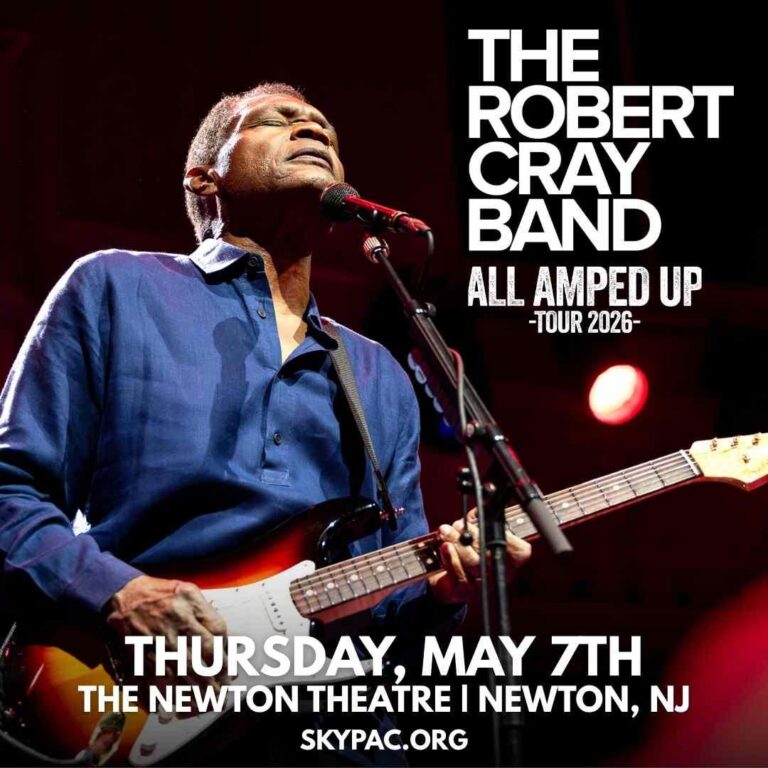
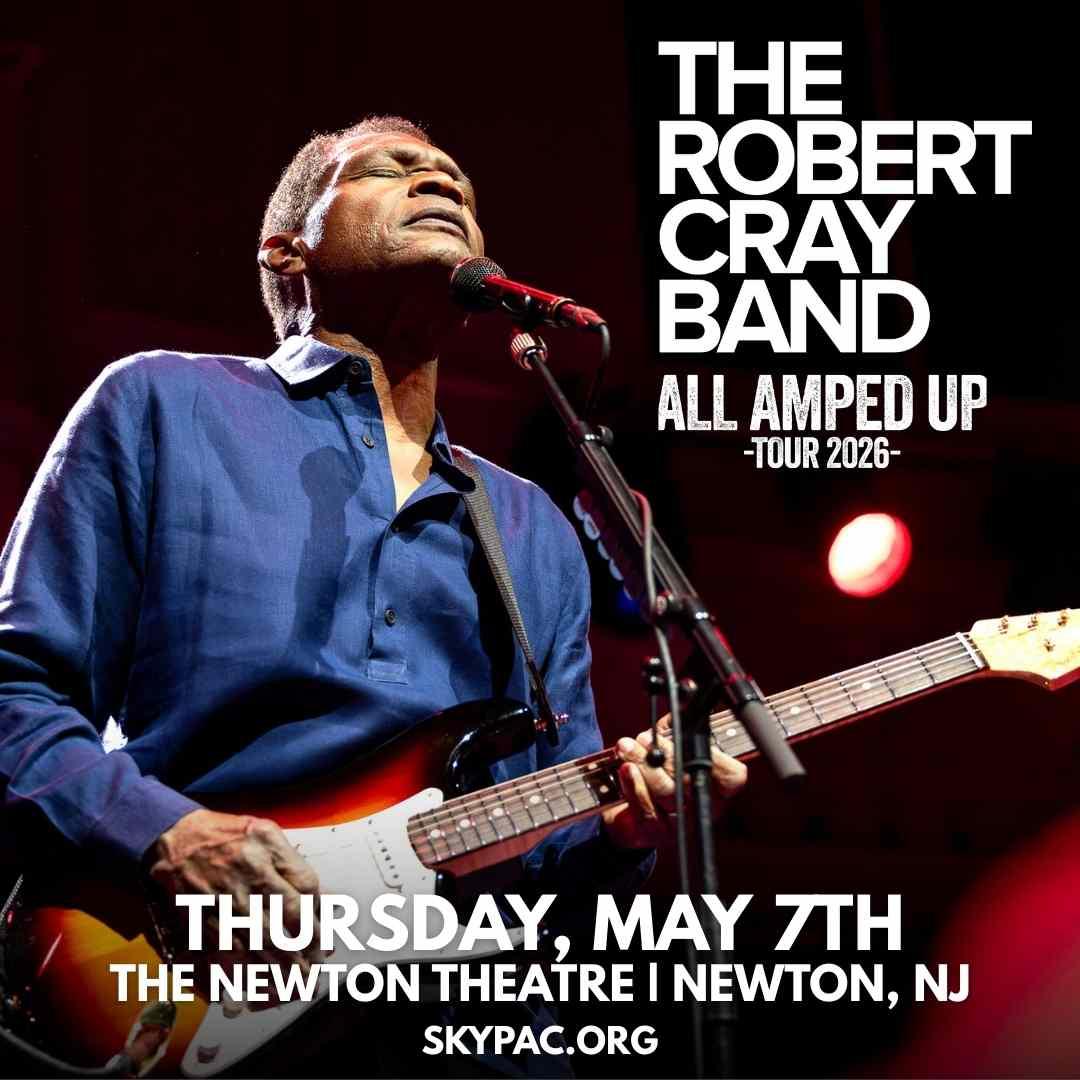
The Robert Cray Band All Amped Up Tour 2026

0

A Living Blues Legacy Arrives in Sussex County as Robert Cray Brings His All Amped Up Tour to The Newton Theatre

May 7 @ 7:00 PM 11:30 PM

Few artists in American music can claim to have reshaped an entire genre while remaining unmistakably true to its roots. This spring, one of those rare voices returns to the New Jersey stage when The Robert Cray Band brings its All Amped Up Tour 2026 to The Newton Theatre on Thursday, May 7, at 7 p.m., delivering a night built around timeless blues, deep soul, and electrifying live musicianship.

Tickets for the performance go on sale this Friday at 10 a.m., and anticipation is already high among longtime fans who recognize Robert Cray not simply as a celebrated guitarist, but as one of the defining architects of modern blues and soul-infused American roots music.

Across a career that now spans more than five decades, Cray has quietly built one of the most respected catalogs in contemporary music. His work helped reintroduce blues to a new generation of listeners in the late twentieth century by blending classic structures with polished songwriting, emotional clarity, and a distinctly modern sense of groove. While many artists have borrowed from blues traditions, Cray helped bring the genre back into the cultural conversation with a voice and sound that felt both authentic and accessible.

The All Amped Up Tour reflects that ongoing creative momentum. Rather than serving as a retrospective, the tour emphasizes Cray’s continued commitment to live performance as a living, evolving craft. Audiences can expect a dynamic set that draws from his extensive catalog while highlighting the tight ensemble playing and expressive storytelling that have become trademarks of The Robert Cray Band.

Cray’s body of work includes 19 studio albums, each built around his unmistakable songwriting style—direct, emotionally grounded, and anchored in melody. Over the years, that consistency has earned him five Grammy Awards and widespread recognition as one of the most influential blues-based artists of his generation. Yet even with accolades and a legacy firmly established, Cray has remained remarkably focused on the present moment—on writing songs that reflect contemporary life and performing them with the same urgency that defined his earliest recordings.

What separates Cray from many of his peers is his ability to merge technical excellence with emotional restraint. His guitar playing is instantly recognizable for its clarity and sharp phrasing rather than sheer speed. Each note is shaped to serve the song, allowing space, silence, and tone to carry as much weight as volume. Paired with his warm, understated vocal delivery, the result is a sound that feels intimate even in a theater setting.

Throughout his career, Cray has shared stages and studios with some of the most revered names in American and international music. From blues pioneers such as John Lee Hooker, Muddy Waters, B.B. King, and Buddy Guy, to rock and soul legends including Chuck Berry, The Rolling Stones, Eric Clapton, Tina Turner, and Stevie Ray Vaughan, his collaborations form a living bridge between generations of artists. Those relationships were not built on nostalgia, but on mutual respect for musicianship and a shared belief in the enduring power of roots-driven music.

As a bandleader, Cray is equally revered. The Robert Cray Band is known for its disciplined arrangements, deep pocket rhythm section, and carefully balanced interplay between guitar, vocals, and keys. Live performances highlight the group’s chemistry as much as individual virtuosity, creating a collective sound that elevates each song without overshadowing its emotional core.

The May 7 performance at The Newton Theatre offers Sussex County audiences the opportunity to experience that chemistry in an intimate, acoustically rich venue that has become a cultural anchor for live entertainment in North Jersey. With its historic architecture and close-up sightlines, the theatre provides an ideal setting for blues and soul, where subtle phrasing, quiet passages, and expressive solos can be fully appreciated.

The Newton Theatre has steadily expanded its reputation as a regional destination for touring musicians across multiple genres, welcoming both legacy performers and contemporary artists who value attentive audiences and authentic performance spaces. In addition to concerts, the venue also plays a growing role in live comedy and spoken-word programming. Readers looking to explore more live performance options in the area can discover upcoming comedy shows and touring acts through Explore New Jersey’s curated stand-up comedy coverage, which highlights events at theaters and clubs throughout the state.

For Cray, continuing to tour at this level represents more than professional longevity. It reflects an artistic philosophy centered on connection—between musician and listener, tradition and innovation, history and the present. In an industry that often prioritizes trends and reinvention, Cray has built a career by trusting the emotional honesty of his music and allowing his sound to mature naturally over time.

When The Robert Cray Band steps onto the Newton Theatre stage for the All Amped Up Tour 2026, the performance will carry with it the weight of five decades of American musical history—delivered not as a tribute to the past, but as a living, breathing expression of blues and soul at their most enduring and relevant.

Skylands Performing Arts Center (SkyPAC)

(973) 940-6398

View Organizer Website

Newark Symphony Hall

1020 Broad Street
Newark, New Jersey 07102 United States
+ Google Map
(973) 643-4550 x111
View Venue Website

Big Apple Comedy Club 66

0

Four Nationally Touring Comics Bring New York Energy to Sussex County as Big Apple Comedy Club Returns to The Newton Theatre

March 21 @ 8:00 PM 11:30 PM

A night of fast-paced punchlines, sharp storytelling, and nationally recognized stand-up is headed back to Sussex County this spring as the Big Apple Comedy Club series returns to The Newton Theatre on Saturday, March 21, with an 8 p.m. showtime.

Now in its sixty-sixth edition, the popular touring showcase has become a fan favorite at the historic Newton venue, regularly drawing sold-out crowds eager for a high-caliber comedy lineup without making the drive into New York City. The upcoming performance continues that tradition by assembling four distinctly different comedic voices—each with major stage, television, and festival credentials—into one tightly produced evening designed to deliver nonstop laughs from start to finish.

This year’s lineup features Richie Byrne, Ariel Elias, Nick Griffin, and Joyelle Johnson, four performers whose styles span high-energy crowd interaction, observational storytelling, cultural commentary, and fearless self-aware humor. Together, they represent a cross-section of the modern stand-up landscape, making the show accessible to longtime comedy fans and first-time attendees alike.

Richie Byrne brings a dynamic, interactive style that thrives on real-time audience engagement. Known for his ability to turn everyday moments and spontaneous crowd conversations into structured comedic set pieces, Byrne has built a reputation as a performer who treats each show as a unique event rather than a rehearsed routine. His quick timing and improvisational instincts make him a natural opener for an ensemble showcase, immediately pulling the audience into the rhythm of the night.

Ariel Elias adds a smart, conversational voice shaped by sharp social observation and personal storytelling. Her material often explores relationships, identity, and modern cultural contradictions with a tone that feels intimate while still delivering big laughs. Elias has steadily gained national attention for her ability to blend sincerity and sarcasm into a style that resonates with audiences across generations.

Veteran comedian Nick Griffin brings a polished, fast-moving delivery that reflects decades of experience on major comedy stages and television platforms. Griffin is widely respected for his crisp joke construction and tightly layered punchlines, crafting material that feels effortless while remaining technically precise. His presence in the lineup anchors the evening with a seasoned perspective and a classic stand-up structure that complements the newer voices on the bill.

Joyelle Johnson rounds out the showcase with bold, deeply personal comedy rooted in perspective and unapologetic confidence. Her work blends cultural commentary with self-aware humor, creating a set that balances warmth and edge while remaining sharply relatable. Johnson’s stage presence is commanding yet approachable, and her storytelling ability allows audiences to connect quickly with both her humor and her point of view.

Together, the four performers deliver a full-spectrum comedy experience—ranging from rapid-fire punchlines to longer narrative arcs—designed to mirror the energy and diversity of New York City’s most respected comedy clubs.

The return of Big Apple Comedy Club to The Newton Theatre highlights the growing role of regional venues in bringing nationally touring stand-up acts directly to New Jersey audiences. Located in the heart of Sussex County, The Newton Theatre has become a cultural hub for live entertainment, offering an intimate setting where audiences can experience top-tier comedy without sacrificing the atmosphere of a classic performing arts space.

For local audiences, the series has become a reliable destination for discovering comedians who regularly headline clubs, theaters, and festivals across the country. The rotating lineup format ensures that each edition offers a fresh experience, while maintaining the consistent production quality that has helped build a loyal following for the showcase.

Tickets for the March 21 performance go on sale this Friday at 10 a.m., and organizers anticipate strong demand based on previous editions of the series. With only one performance scheduled, early purchasing is recommended for fans eager to secure seats.

The Big Apple Comedy Club showcase also arrives during a particularly active season for live comedy across the state. From club residencies to touring theater shows, New Jersey continues to expand as a regional destination for stand-up entertainment. Readers interested in discovering additional shows, touring comics, and live comedy experiences can explore Explore New Jersey’s curated stand-up comedy coverage, which highlights upcoming performances and venues throughout the state.

RICHIE BYRNE

A true crowd favorite wherever he performs, Richie Byrne stands out in today’s stand-up landscape for delivering fast-paced, high-impact comedy that is clean, inclusive, and relentlessly funny. His style blends everyday family life, pop culture, and sharp real-world observations into an energetic, feel-good set that works just as seamlessly for all-ages audiences as it does for late-night comedy crowds. Richie is one of the hardest-working comics on the circuit, appearing in more than 500 live shows each year at comedy clubs, colleges, corporate events, and major resort venues, including top Atlantic City destinations such as the Borgata.

In addition to his extensive live career, Richie has made multiple national television appearances, including Comedy Central’s Premium Blend, VH1’s Stand-Up Spotlight, and The Rosie O’Donnell Show. His on-screen work also includes acting roles on several of television’s most iconic series, including HBO’s The Sopranos, Sex and the City, and NBC’s Law & Order. Known for his explosive energy and universal appeal, Richie Byrne consistently delivers a brand of comedy that connects across generations.


ARIEL ELIAS

New York City–based comedian Ariel Elias brings a refreshingly personal and quietly fearless voice to modern stand-up. Originally from Kentucky, she first discovered her knack for comedy by winning over a room at her own bat mitzvah—and she has been building on that instinct ever since. Her material blends deeply relatable stories with smart, understated commentary and a distinctly dry delivery that makes even the most unexpected moments land with precision.

Ariel has been recognized nationally as one of comedy’s most exciting emerging performers, earning the title of “New Face” at the 2021 Just for Laughs Comedy Festival and being named among Paste Magazine’s Best Comedians of 2022. Her work has been highlighted by major media outlets including The New York Times, Rolling Stone, The Washington Post, and Good Morning America.

She gained widespread attention after a viral stand-up moment caught the eye of Jimmy Kimmel, leading to her late-night television debut on Jimmy Kimmel Live!—a clip that quickly surpassed one million views online. In 2024, she followed that breakout appearance with a performance on The Late Show with Stephen Colbert. Offstage, Ariel is usually attempting crossword puzzles or giving far too much affection to nearby dogs.


NICK GRIFFIN

Widely respected for his sharp writing and effortlessly polished delivery, Nick Griffin is a veteran stand-up comedian whose career spans more than two decades on the national stage. His comedy is built on smart, tightly crafted observations, dry sarcasm, and a confident storytelling style that rewards both casual fans and seasoned comedy audiences.

Nick has appeared on many of television’s most recognizable comedy platforms, including Conan, The Late Late Show, The Late Show with David Letterman—where he appeared eleven times—his own Comedy Central half-hour special, and most recently The Late Show with Stephen Colbert. Originally from Kansas City, Griffin is now based in New York City and is a regular performer at premier clubs such as The Comedy Cellar, Stand Up NY, and Gotham Comedy Club.

On the road, he headlines clubs across the country and remains a frequent guest on the nationally syndicated Bob and Tom Show. Known for his precision, honesty, and razor-sharp timing, Nick Griffin’s comedy is personal, controlled, and consistently powerful.


JOYELLE JOHNSON

Brooklyn-based comedian, writer, and actress Joyelle Johnson has quickly become one of the most compelling voices in New York’s stand-up scene. Her comedy is bold, deeply personal, and driven by a fearless point of view that blends sharp social insight with playful self-awareness.

Joyelle made her network television debut on Late Night with Seth Meyers and has since delivered standout performances on The Tonight Show Starring Jimmy Fallon. Her additional credits include Comedy Central’s digital series Comics to Watch, Wyatt Cenac’s Night Train, and Laff Tracks on truTV.

She has appeared at some of the country’s most prominent comedy and cultural festivals, including Sketchfest, Bonnaroo, the New York Comedy Festival, and Bumbershoot. As she continues her rise as a headlining performer, Joyelle has shared stages with some of the biggest names in comedy, including Hannibal Buress, Dave Chappelle, and Russell Peters.

Beyond the stage, she also merges comedy with advocacy through her work touring with Lady Parts Justice League, founded by The Daily Show creator Lizz Winstead—using humor as a platform for social engagement and activism.

With four nationally recognized comedians sharing one stage for a single-night event, Big Apple Comedy Club #66 promises an energetic, laugh-driven evening that captures the spirit of New York’s comedy scene—right in the heart of Sussex County.

Skylands Performing Arts Center (SkyPAC)

(973) 940-6398

View Organizer Website

Newark Symphony Hall

1020 Broad Street
Newark, New Jersey 07102 United States
+ Google Map
(973) 643-4550 x111
View Venue Website

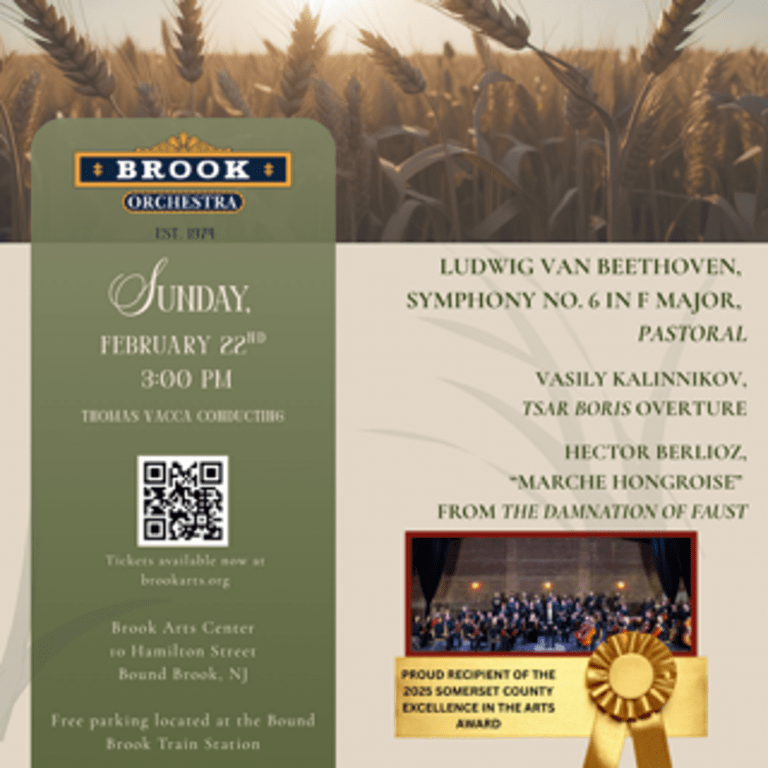
Brook Orchestra Winter Concert 2026

0

Romance, Renewal, and a Grand Afternoon of Symphonic Storytelling as the Brook Orchestra Returns to the Brook Arts Center

February 22 @ 3:00 PM 5:00 PM

A winter afternoon filled with sweeping melodies, emotional contrast, and timeless orchestral brilliance will take center stage in Bound Brook as the Brook Orchestra returns to the historic Brook Arts Center for a special Valentine-season performance on Sunday, February 22, at 3:00 p.m., led by Music Director Thomas Vacca.

Designed as a romantic and uplifting mid-winter concert experience, the program brings together three powerful works that reflect drama, longing, and the restorative beauty of nature—offering audiences an ideal way to celebrate the season through live music in one of Central New Jersey’s most treasured cultural landmarks.

Under Vacca’s direction, the orchestra will open the afternoon with Hector Berlioz’s electrifying Hungarian March from The Damnation of Faust, a work known for its cinematic intensity and bold orchestration. The piece immediately draws listeners into a world of vivid color and rhythmic drive, showcasing Berlioz’s distinctive ability to fuse theatrical energy with symphonic structure. Its opening fanfares and surging climaxes provide a striking and dramatic beginning to the concert, setting an atmosphere of anticipation and emotional depth from the first downbeat.

From there, the program turns toward sweeping lyricism and grand narrative expression with the Tsar Boris Overture by Russian composer Vasily Kalinnikov. Rich in melody and orchestral warmth, the overture is admired for its expansive emotional range and expressive harmonic language. The work carries a deeply romantic sensibility, unfolding in broad musical arcs that highlight both the lush sonorities of the orchestra and the composer’s gift for storytelling through sound. Its soaring themes and reflective passages create a natural emotional bridge between the intensity of Berlioz and the serenity that follows later in the afternoon.

The centerpiece and closing work of the concert is Ludwig van Beethoven’s Symphony No. 6 in F Major, widely known as the “Pastoral” Symphony. Among Beethoven’s most beloved and approachable compositions, the Sixth Symphony celebrates the quiet joys of rural life and humanity’s connection to the natural world. Rather than dramatic struggle, the symphony embraces tranquility, gentle humor, and heartfelt optimism. From the soft murmur of flowing streams to the joyful gathering of country villagers and the gentle calm that follows a summer storm, Beethoven’s musical landscape unfolds as a tribute to renewal and peace.

For Valentine’s season audiences, the choice of the “Pastoral” Symphony brings a particularly fitting message. Its warmth, sense of gratitude, and emotional openness offer a reminder of the restorative power of shared experiences—especially when experienced live, surrounded by the resonance of a full orchestra in an intimate historic theater.

The Brook Arts Center itself plays a central role in shaping the experience. The beautifully restored venue has become a cultural anchor for Bound Brook and surrounding Somerset County communities, hosting concerts, theater productions, and special events that celebrate both classical traditions and contemporary creativity. Its architectural charm and acoustics create an inviting environment for orchestral music, allowing audiences to feel immersed in the sound while maintaining a close connection to the performers on stage.

The return of the Brook Orchestra to this historic space continues the organization’s mission of bringing accessible, high-quality classical programming to local audiences. With Thomas Vacca on the podium, the ensemble has steadily built a reputation for expressive performances and thoughtfully curated programs that balance familiar masterpieces with lesser-heard repertoire. This Valentine-season concert reflects that philosophy by pairing a universally recognized symphony with dramatic and lyrical works that broaden the emotional scope of the afternoon.

The performance also arrives at a time when live classical music continues to reassert its place within New Jersey’s vibrant cultural calendar. Across the state, orchestras, chamber groups, and touring ensembles are drawing new audiences eager for shared artistic experiences that feel both personal and timeless. Readers interested in discovering additional concerts, touring performances, and cultural events across the region can explore Explore New Jersey’s ongoing music coverage, which highlights live performances and artists appearing throughout the state.

Whether attending as a romantic outing, a family tradition, or a solo afternoon of reflection, the Brook Orchestra’s Valentine concert offers something rare in the middle of winter: a few unhurried hours of beauty, storytelling, and musical connection. With its dramatic opening, lyrical centerpiece, and life-affirming conclusion, the February 22 performance promises an inspiring return to live symphonic music at the Brook Arts Center—an afternoon designed to linger long after the final notes fade.

Brook Arts Center

732-469-7700

View Organizer Website

Newark Symphony Hall

1020 Broad Street
Newark, New Jersey 07102 United States
+ Google Map
(973) 643-4550 x111
View Venue Website

New Jersey’s Craft Beer Scene Enters a Pivotal 2026 Season With New Laws, New Breweries, and a Wave of Valentine’s and Stout Month Releases

New Jersey’s independent beer industry is heading into one of its most transformative stretches in years, as regulatory changes, long-anticipated brewery openings, and a packed winter event calendar converge across the state. From licensing reform and farm brewery legislation to Valentine’s week specialty beers and large-scale festival announcements, early 2026 is shaping up to be a defining moment for how—and where—residents experience local craft beer.

At the regulatory level, one of the most immediate shifts is already in effect. As of January 20, 2026, the New Jersey Division of Alcoholic Beverage Control ended its long-standing practice of accepting so-called “placeholder” applications for Limited Brewery Licenses. Going forward, new applications must be administratively complete at the time of submission, including documentation and required materials. For aspiring brewery owners, this change effectively raises the bar at the front end of the process, accelerating legitimate applications while discouraging speculative filings that once allowed applicants to reserve a spot without a finalized business plan.

Industry advocates say the move reflects a broader effort to streamline licensing and bring greater clarity to the approval pipeline—an important consideration as the state continues to see steady interest from new brewery startups and expanding operators.

At the same time, lawmakers are actively advancing a slate of bills that could further reshape how New Jersey breweries operate.

One proposal introduced in January would allow farm breweries to sell their own beer for on-premises consumption, rather than limiting customers to tastings and packaged off-premise sales. Supporters argue that the change would help agricultural-based breweries operate more sustainably and compete more fairly with traditional taprooms.

Another bill, commonly referred to as the Garden State Grocery Liquor Licensing Act, proposes a new license category that would permit supermarkets to sell alcoholic beverages manufactured in New Jersey. If enacted, the measure could dramatically expand retail visibility for local breweries and create a new pathway for distribution within the state.

A third bill under consideration would allow limited breweries to operate up to 15 off-site salesrooms, giving producers far greater flexibility to build regional footprints without needing to open fully independent brewery locations at each site.

Collectively, the legislative agenda reflects growing recognition in Trenton that New Jersey’s craft beer sector has matured—and now requires modernized rules to keep pace with consumer demand and regional competition.

That momentum is already visible on the ground, with several major brewery openings and expansions moving forward across the state.

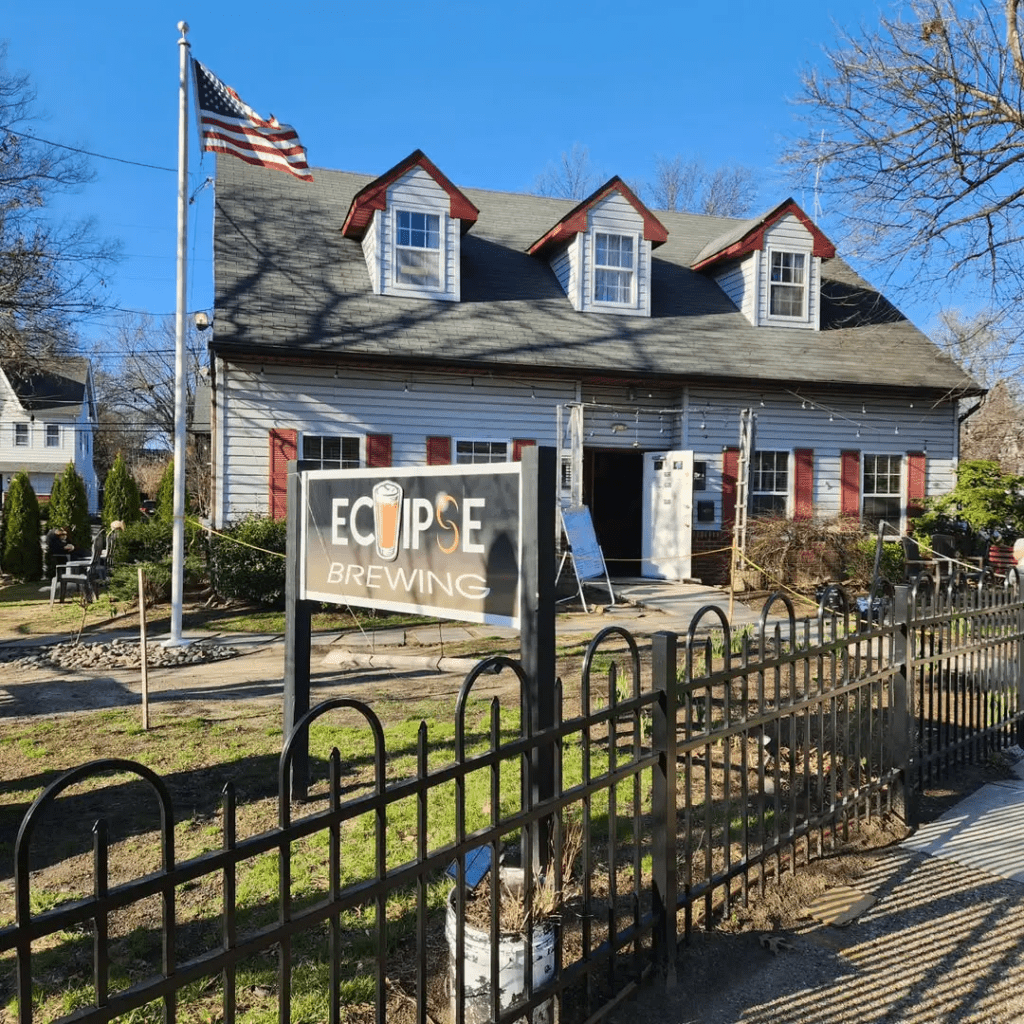
In South Jersey, Eclipse Brewing in Merchantville has officially reopened under new ownership following a full renovation and a complete reimagining of its taproom and brand experience. The relaunch, which took place February 6, marks a fresh start for a space that had long been a local fixture.

In Moorestown, Community House Brewery is preparing to open inside the historic Moorestown Community House, introducing a new microbrewery concept from the team behind King’s Road Brewing. The project blends historic preservation with modern taproom design and is expected to debut in early 2026.

Further south, construction is underway on Wander Back in Vineland, a new brewery being built into the city’s developing convention center complex, located within the former Amish Market property. The project represents one of the more ambitious brewery integrations into a multi-use civic development in the region, with an anticipated opening later this year.

Along the Jersey Shore, Five Dimes Brewery has broken ground on its third location in Point Pleasant Beach, positioned near the train station. The new site is targeting a summer 2026 opening and is designed to support both local foot traffic and seasonal visitors traveling the coastal rail corridor.

In Union County, Emberside Brewery is emerging as part of the large-scale “The Park” redevelopment in Berkeley Heights. The rooftop brewery concept has already hired its director of operations and is planning a November 2026 debut, positioning itself as both a destination brewery and a centerpiece of the mixed-use complex.

While new facilities continue to take shape, February’s calendar is already packed with themed taproom programming tied to Valentine’s week, seasonal releases, and experiential events.

In Wildwood, MudHen Brewing is running a multi-day Valentine’s celebration through February 14, featuring a special holiday menu, live music, and a limited seasonal beer release crafted specifically for the occasion. In Ewing, River Horse Brewing is hosting a Galentine’s Day “Girls Night Out” built around a true-crime themed evening on February 13. Tall Oaks Farm and Brewery in Farmingdale is hosting a winter pop-up market on February 15, offering guests a blend of local vendors and on-site beer experiences. Readington Brewery is also leaning into culinary collaboration later in the month with a hands-on burrata-making experience in partnership with a local specialty cheese shop.

Beyond events, February has become one of the most creative release windows of the year for New Jersey brewers, particularly around Valentine’s Day and the increasingly popular Stout Month programming.

In Colts Neck, Source Farmhouse Brewery has once again released its annual Valentine’s Day IPA, a hazy India pale ale infused with cherries, raspberries, and strawberries that pours with a distinctive pink-magenta hue and leans heavily into fruit-forward aromatics.

On Long Beach Island, Ship Bottom Brewery has unveiled two contrasting seasonal offerings. One is Love Buzz, a chocolate-covered cherry stout built on chocolate malt and cacao nibs, finished with dark sweet cherries and milk sugar for a rich dessert profile. The second, Abominable Snow Monster, is a high-gravity Belgian-style winter ale brewed with honey, sugar plums, figs, and cherries, offering a layered and warming counterpoint to the Valentine’s releases.

MudHen Brewing’s seasonal calendar includes its strawberry porter created specifically for its Valentine’s programming, while River Horse Brewing is pairing its Galentine’s event with a special glittered draft beer release. In Morris County, Diamond Spring Brewing in Denville is running “Podium Flights” through February 21, featuring rotating selections of limited and specialty releases in curated tasting formats.

Stout Month is also driving experimentation across several tap lists.

Broad Street Brewing has introduced its new Sovereign Sour Series, beginning with a Blueberry Mosaic sour IPA, followed by a cherry and blood orange sour ale. Meanwhile, Ramstein—Highpoint Brewing’s long-running German-style brewery—has released a rare and highly limited Ice Storm Eisbock 2026. At 14 percent ABV and available only in growler fills while supplies last, the release stands out as one of the most sought-after specialty beers of the winter.

Additional February drops tied to Stout Month include a strawberry and marshmallow pastry blonde, a maple vanilla brownie milk stout, and a blood orange mimosa-inspired blonde ale—each scheduled to roll out across different taprooms as part of staggered mid-month releases.

Looking beyond the winter calendar, several large-scale beer festivals are already generating early buzz.

On March 7, the Red, White & Brew Fest will return to the CURE Insurance Arena in Trenton with more than 50 New Jersey craft beers on tap and a unique historical twist: a small-beer recreation inspired by George Washington’s 1750s brewing recipe. Later in the year, Crystal Springs Resort has confirmed that its June 20 New Jersey Beer and Food Festival will feature more than 200 unique beer samples, making it one of the state’s largest curated tasting events of 2026.

Experiential programming is also expanding beyond traditional tastings. In Pompton Lakes, Pompton Craft House is hosting a Candle Making and Drinks night on February 11, blending guided candle-making with craft beverages in a social, hands-on setting designed for small groups and Valentine’s week gatherings. The event reflects a growing trend among New Jersey taprooms toward creative lifestyle programming that brings new audiences into brewery spaces without centering exclusively on beer education.

Together, the regulatory momentum, development pipeline, and winter release calendar illustrate just how dynamic New Jersey’s beer culture has become. For readers who want to explore taprooms, upcoming releases, festivals, and brewery destinations statewide, Explore New Jersey’s ongoing beer and brewery coverage continues to spotlight the people, places, and projects shaping the next chapter of the state’s craft beverage scene.

As lawmakers debate modernization in Trenton and brewers continue pushing creativity in taprooms from Sussex County to Cape May, early 2026 is proving that New Jersey’s craft beer industry is not simply growing—it is actively redefining how local beer is produced, shared, and experienced across the state.

Blackberry Smoke Rattle, Ramble and Roll Tour 2026

0

Southern Rock Storytellers Return to New Jersey as Blackberry Smoke Brings the Rattle, Ramble and Roll Tour to the Garden State in 2026

March 5 @ 7:00 PM 11:30 PM

Few modern bands carry the weight of Southern rock history while still sounding unmistakably current. In 2026, Georgia-based road warriors Blackberry Smoke will bring that balance of tradition and momentum back to New Jersey as part of their nationwide Rattle, Ramble and Roll Tour, delivering a live experience built around groove-driven guitar work, narrative songwriting, and the deep-rooted musical identity that has defined their career for more than two decades.

For longtime fans and new listeners alike, the 2026 tour represents a continuation of what Blackberry Smoke has done better than almost any band in their lane: honor the legacy of the American South while writing songs that speak directly to the realities of modern life. From the first chord of their earliest records to their most recent studio work, the band has consistently drawn inspiration from the people, places, and everyday stories of their home state of Georgia—transforming regional culture into music that resonates far beyond its borders.

At the center of the tour is the band’s latest album, Be Right Here, a release that leans deeply into Southern rock’s melodic backbone while weaving in blues-inflected classic rock and roots-based country textures. The album stands out not only for its sonic warmth, but for its storytelling. Each track introduces vivid, emotionally grounded characters, with lyrics that unfold like short stories rather than traditional radio-ready hooks. It is this narrative approach—anchored in lived experience, reflection, and personal grit—that continues to set Blackberry Smoke apart in a crowded roots and Americana landscape.

The New Jersey appearance on the Rattle, Ramble and Roll Tour will showcase material from Be Right Here alongside fan favorites that have helped define the band’s catalog across six consecutive chart-performing albums. Over the past several years, Blackberry Smoke has quietly built one of the most consistent discographies in modern roots rock. Their 2021 release You Hear Georgia debuted at number one on Billboard’s Americana and Folk Albums chart, marking a major milestone for a band that built its reputation on relentless touring rather than commercial shortcuts. In 2024, Be Right Here followed with a top five debut on Billboard’s Top Current Album Sales chart, reinforcing the group’s ability to evolve creatively while maintaining a fiercely loyal fan base.

That loyalty was not created overnight. Blackberry Smoke has spent more than twenty years earning its reputation the hard way—on the road. The band has appeared on some of the most recognizable festival and broadcast stages in the world, including Austin City Limits, Bonnaroo, Summerfest, Glastonbury, and Download Festival in the United Kingdom. These appearances introduced their sound to international audiences while solidifying their standing as one of the most dependable live acts in the modern Southern rock and Americana scene.

What makes a Blackberry Smoke show particularly compelling is the band’s refusal to treat nostalgia as a crutch. While their music pays tribute to the lineage of Southern rock pioneers, their live performances are driven by forward motion. Songs are stretched, reshaped, and reenergized on stage, allowing extended guitar interplay, blues-inflected solos, and dynamic tempo shifts to take center stage. The result is a set that feels organic and unfiltered—designed to be experienced in real time rather than replicated from studio recordings.

The Rattle, Ramble and Roll Tour reflects that philosophy. The tour’s title captures the restless spirit that has defined the band since its earliest days—an approach rooted in constant movement, creative exploration, and the emotional highs and lows that come with a life built around music. Rather than positioning the tour as a retrospective, Blackberry Smoke is leaning into the present, highlighting new material that explores resilience, personal reckoning, and the quiet optimism that emerges when life does not unfold as planned.

For New Jersey audiences, the 2026 stop offers a rare opportunity to experience a band that continues to bridge multiple musical worlds without diluting its identity. The group’s blend of Southern rock, blues, classic guitar-driven arrangements, and country storytelling appeals equally to fans of vintage Americana and modern roots revival. Their concerts attract a uniquely diverse crowd—listeners who grew up on classic rock radio standing shoulder to shoulder with younger fans discovering guitar-centered music through contemporary playlists and streaming culture.

The tour is co-presented with The Bowery Presents, a national promoter known for curating high-profile tours and artist-driven live experiences. In keeping with standard ticketing policies for high-demand shows, orders will be limited to four tickets per transaction, a measure designed to protect fans and reduce large-scale resale activity.

Blackberry Smoke’s return also arrives during a particularly active season for live touring throughout the state. New Jersey continues to serve as a vital stop for national and international artists traveling through the Northeast corridor, offering fans access to everything from arena headliners to intimate club performances. Readers planning their concert calendars can explore more upcoming tours and live performances through Explore New Jersey’s ongoing music and live event coverage, which highlights major shows and touring artists appearing across the state.

As the Rattle, Ramble and Roll Tour rolls into New Jersey in 2026, Blackberry Smoke remains exactly what its audience has come to expect—authentic, road-tested, and deeply committed to songwriting that values emotional truth over trends. In a live landscape increasingly shaped by spectacle and viral moments, the band continues to prove that powerful stories, real musicianship, and a relentless touring ethic still matter.

State Theatre New Jersey

732-246-7469

View Organizer Website

Newark Symphony Hall

1020 Broad Street
Newark, New Jersey 07102 United States
+ Google Map
(973) 643-4550 x111
View Venue Website

Celtic Woman—A New Era

0

A New Chapter for a Global Phenomenon: Celtic Woman Brings ‘A New Era’ Tour to State Theatre New Jersey in 2026

March 6 @ 7:00 PM 11:30 PM

For more than two decades, Celtic Woman has redefined how the world experiences Irish music, blending classical training, contemporary production, and deep-rooted tradition into a global touring phenomenon. In spring 2026, the internationally celebrated ensemble will return to New Jersey with a newly reimagined live production, bringing its latest tour, Celtic Woman – A New Era, to State Theatre New Jersey on Friday, March 6, 2026, at 8:00 p.m.

The New Brunswick performance marks a major stop on the group’s highly anticipated North American tour and offers local audiences a front-row seat to a refreshed creative direction for one of the most recognizable names in international touring music.

Recognized worldwide as the most successful all-female Irish music group in history, the Grammy-nominated collective has built its reputation on performances that move seamlessly between soaring classical arrangements, contemporary interpretations, and traditional Celtic melodies. Over the years, the group has sold millions of albums, earned chart-topping releases, and cultivated a global fan base that spans generations.

The upcoming tour signals a creative evolution rather than a departure from what longtime audiences love. A New Era is designed to introduce fresh musical arrangements, new staging concepts, and an expanded visual production that reflects how the ensemble continues to grow while honoring its unmistakable roots.

For New Jersey audiences, the State Theatre engagement carries particular significance. The historic venue has become one of the state’s most respected destinations for international touring artists, and the arrival of Celtic Woman adds another marquee performance to its 2026 calendar. With its acoustics, sightlines, and architectural intimacy, the theatre offers an ideal setting for the ensemble’s signature blend of vocal power, instrumental precision, and emotionally charged storytelling.

Celtic Woman’s global rise has always been built on more than technical excellence. The group’s success comes from its ability to translate Ireland’s musical heritage into performances that feel personal, cinematic, and accessible to listeners of all backgrounds. From sweeping anthems to intimate ballads, their concerts are structured as complete narratives—each song flowing into the next with carefully crafted pacing and visual design.

The A New Era tour reflects the group’s continued commitment to reinvention. Audiences can expect newly curated material alongside modern reworkings of fan favorites, enhanced by contemporary lighting design and immersive stage visuals. The production places greater emphasis on the individuality of the performers, allowing each artist’s voice and musical identity to shine within the ensemble framework.

Behind the scenes, the creative team has placed particular focus on blending traditional instrumentation with modern orchestration. The result is a sound that feels unmistakably Celtic while embracing the tonal depth and dynamic range of contemporary touring productions. For longtime fans, the tour represents an opportunity to rediscover beloved music in a new context. For first-time attendees, it offers an accessible and visually captivating introduction to Irish-inspired performance at the highest international level.

The group’s Grammy recognition and long-running commercial success have positioned Celtic Woman as cultural ambassadors for Ireland’s musical tradition. Their tours consistently reach audiences far beyond the typical world-music circuit, appearing on mainstream stages and major performing arts centers across North America and Europe. The New Jersey stop continues that tradition, reinforcing the state’s growing reputation as a destination for globally recognized touring productions.

The March 6 performance also arrives at a moment when New Jersey’s live entertainment landscape continues to expand. From historic theaters to contemporary concert halls, the state has become a vibrant crossroads for international touring artists, orchestras, and crossover ensembles. Readers exploring upcoming concerts and artist tours throughout the region can discover more performances through Explore New Jersey’s ongoing music coverage and concert listings, which highlight major touring acts and emerging performers appearing across the state.

For fans who have followed Celtic Woman since its early international broadcasts and debut recordings, A New Era represents both continuity and renewal. The group remains rooted in the musical traditions that first introduced them to the world, yet fully embraces the creative possibilities of modern live production and evolving artistic identity.

When Celtic Woman takes the stage at State Theatre New Jersey on March 6, 2026, audiences can expect more than a concert. The evening promises a carefully crafted journey through sound, culture, and contemporary performance—a celebration of Irish musical heritage reimagined for a new generation and presented in one of New Jersey’s most storied live performance venues.

State Theatre New Jersey

732-246-7469

View Organizer Website

Newark Symphony Hall

1020 Broad Street
Newark, New Jersey 07102 United States
+ Google Map
(973) 643-4550 x111
View Venue Website

Winter’s Crucible in New Jersey High School Sports: Championships, Controversy, and a Coaching Legend’s Curtain Call

New Jersey high school athletics has reached that annual stretch where every possession carries weight, every lineup decision is magnified, and entire seasons can swing on a single late whistle, one sudden pin, or one perfectly timed relay exchange. As of Wednesday, February 11, 2026, the Garden State’s winter postseason is in full roar across basketball, wrestling, swimming, bowling, and indoor track, delivering the kind of high-stakes nights that turn gyms into pressure cookers and natatoriums into echoing theaters of possibility. The state’s winter calendar is always intense, but this year has layered in something extra: milestone performances, bracket drama, program-defining decisions, and a major farewell that feels like the end of an era.

New Jersey high school sports are currently in the midst of critical winter tournament play. As of February 11, 2026, the primary focus is on county tournament openers for basketball and state tournament seeding for wrestling and bowling.

Basketball Results & Standings

Local county and conference tournaments are underway, with several top-ranked teams in action today. 

  • Boys Basketball (Feb 11):
    • St. Peter’s Prep (No. 2): Continued their dominant run with a high-scoring win over Morris Catholic.
    • Colonial Valley Conference (CVC)Notre Dame (12th seed) upset 5th-seeded Hightstown 55–53. Trenton (2nd seed) dominated WW-P South 84–43.
    • Hudson County Tournament: Preliminary rounds feature matchups like Lincoln vs. McNair and Kearny vs. BelovED Charter.
  • Girls Basketball (Feb 11):
    • Metuchen: Pulled a 19-over-14 seed upset by defeating South Brunswick 47–41 in the GMC preliminary round.
    • Cape-Atlantic League: First-round games today include Middle Township (1st seed) vs. Bridgeton and Egg Harbor (2nd seed) vs. Vineland

Wrestling & Ice Hockey

  • Wrestling State Tournament: Seeding for the state team tournament was finalized this week. Southern Regional (No. 1 in South Group 5) recently clinched a massive 37–31 win over defending champion DelseaManville remains undefeated at 25–0 heading into the Central Group 1 quarterfinals.
  • Ice Hockey: The NJ.com Hockey Rankings currently show St. Augustine and Delbarton as major contenders for state titles as the regular season winds down. 

Other Recent Results

  • SwimmingHaddonfield boys and girls teams both reached their respective sectional finals today. The boys defeated Delran 105–65 to advance to the Central Group C final against Holmdel.
  • Bowling: State tournament results for Wednesday, February 11, show Pascack Valley and Demarest advancing in North Jersey Group brackets. 
Sport Notable Top 20 TeamStatus/Result
Boys BasketballNo. 1 Bergen Catholic18–3–0
Boys BasketballNo. 2 St. Peter’s Prep19–2–0
WrestlingNo. 1 Southern RegionalWon vs. Delsea
WrestlingNo. 2 Manville25–0–0

Perhaps the most resonant storyline belongs to Pascack Valley, where Jeff Jasper—widely regarded as the winningest girls basketball coach in New Jersey history—has announced he will step away at season’s end after 53 years and more than 1,150 victories. In a state that reveres its high school traditions, Jasper’s retirement is more than a coaching change. It is the closing chapter of a living institution, the kind of career that reshaped expectations, elevated entire leagues, and created generations of players who learned that excellence is a habit rather than an occasional peak. Even as the postseason accelerates, his announcement has rippled through the statewide basketball community, a reminder that the winter tournament chase is always happening in the shadow of something bigger: legacy.

On the boys side, the postseason intensity is colliding with real consequences in a development that has sent shockwaves through the state’s hoops landscape. St. Benedict’s, a perennial power and one of the most recognizable brands in New Jersey high school basketball, has been barred from the 2026 state tournament after a bench incident led to three disqualifications. In a season where the margins are already razor thin, the decision removes a heavyweight from the bracket and forces a larger conversation about program standards, discipline, and the line between competitive fire and unacceptable conduct. For opposing teams, it changes the competitive map. For fans, it changes the story of March before March truly arrives.

If winter in New Jersey is defined by anything, though, it’s the relentless production of moments that feel too big for the gyms and pool decks that contain them. Few were bigger than Deptford’s Jordan Williams erupting for a school-record 54 points, the highest single-game total in the state so far this season. It’s the kind of number that doesn’t just win a game—it becomes a landmark, a performance that players in the program will chase for years and opponents will reference with a mix of respect and disbelief. Around the state, other personal milestones have been piling up as well, with Colosimo at Dwight-Englewood and McKenzie at Paulsboro both crossing the coveted 1,000-career-point threshold—an achievement that speaks not just to one hot season, but to sustained production, durability, and the trust of coaches who build offenses around a consistent scorer.

While basketball headlines often dominate, the state’s wrestling scene is never far behind, especially once the NJSIAA team tournament brackets are released and the pressure of seeding gives way to the reality of matchups. This year’s team tournament conversation has been sharpened by the recent high-profile clash between Delbarton and Blair Academy—two nationally respected programs whose meeting felt less like a regular-season event and more like a statement game. Blair’s win in that showdown didn’t simply add a notch to a schedule; it reinforced the reality that New Jersey wrestling remains one of the sport’s deepest ecosystems in the country, a place where the best teams test themselves early and treat February as both proving ground and prelude.

In the pool, the postseason has its own kind of drama—less noise, more precision. Haddonfield has advanced to the South Group C final, continuing a run that reflects the program’s winter consistency and the depth required to win in a sport where one star rarely carries the day alone. St. Augustine has also advanced to the South Jersey final in the Non-Public bracket, a reminder that when championship season arrives, the programs with balanced lineups, strong relay chemistry, and calm under pressure tend to separate from the pack. Swimming is a sport of tenths, and this time of year those tenths become everything.

Bowling, too, has entered its sectional stage, where the quiet confidence of repeatable mechanics becomes a weapon. Barnegat, seeded second, swept Delran to reach the quarterfinals—an early postseason result that matters not just for what it shows on paper, but for what it can build in momentum. Teams that roll well early in the bracket often find the sport’s most valuable edge: belief that travels from frame to frame.

Indoor track is also barreling toward its championship weekend, with sectional previews bringing the sport’s biggest names and deepest events into sharper focus. In Group 2 and Group 4, the conversation is already shifting from regular-season times to championship tactics—how teams manage heats, how sprinters handle rounds, how distance runners ration effort, and how coaches decide when to chase points versus when to protect athletes for relays. This is the week when a single decision can change a meet, and when athletes who have trained in the quiet for months finally get a stage.

Even away from the scoreboard, winter has delivered meaningful movement on the coaching front. Haddonfield has brought Olympian Erin Donohue LiVecci back to her alma mater as the new head girls track and field coach, a homecoming that instantly raises the profile of a program and signals serious intent. Her presence is the kind of addition that can reshape a training culture, draw attention to the program, and give athletes daily exposure to elite-level standards. Elsewhere, Immaculata announced a head coaching change in football mid-winter, a reminder that program planning never truly stops in New Jersey—especially as schools evaluate direction, culture, and the long runway required to build a contender.

And then there is the night-to-night reality of tournament basketball, where the brackets don’t care about narratives, only results. In the CVC Tournament, Trenton delivered one of the most emphatic statements of the opening round, routing WW-P South 84–43 in a performance defined by pace, physicality, and sustained scoring pressure. Aivaye Ingram poured in 31 points in a dominant outing, while Juan Sanchez added 21 and buried four three-pointers, turning the game from competitive to conclusive early. Trenton, seeded second, now moves forward to host Nottingham in the quarterfinals, a matchup that will test whether the Tornadoes can keep their offensive engine running while tightening the details that matter deeper in the bracket.

Hopewell Valley also advanced with a convincing 52–32 win over Steinert, pulling away with a decisive second quarter as Kyle Yadamiec led the way with 17 points and Chris Heide added 11. In tournament basketball, that kind of early separation is often less about one hot stretch and more about composure—rebounding, defensive positioning, and taking care of the ball while the opponent presses for answers. Hopewell’s next step will bring its own questions, but this was the kind of controlled win that coaches love in February: professional, methodical, and without unnecessary drama.

Allentown, seeded eighth, added a dose of late-game grit by edging Princeton 54–51 after trailing slightly entering the fourth quarter. With Nick Pless scoring 17, Frank Varricchio adding 16, and Cal Shellenberger chipping in 10, the Redbirds showed the balanced scoring that becomes invaluable when one option gets taken away. Their reward is a trip to top-seeded Lawrence, the kind of road game that can turn a season into a headline if the underdog can stay close and make the final minutes uncomfortable.

Ewing, seeded third, posted one of the night’s most lopsided results with a 67–26 victory over WW-P North, spreading the scoring across 10 players while Terrence Traylor led with 20 points. Tournament depth is real depth—players who can defend without fouling, handle pressure, and score without needing plays drawn up for them. Ewing’s distribution suggests a team that knows who it is, a dangerous trait this time of year.

Outside the public-school bracket grind, the prep scene continues to shape the broader statewide picture. Phelps edged Hun 65–62 in a game that featured balanced production from Hun’s Eshan Kulkarni, Sage Mateo, Blake Hargrove, and Marshall Douglass, all in double figures. Peddie, meanwhile, kept rolling with a 76–59 win over Life Center, powered by Jordan Moton’s 23 points and strong support from Sean Griffin and Gabe Hornberger. These programs operate on their own demanding track, but their results still reverberate across New Jersey’s broader basketball conversation, influencing rankings, recruiting attention, and the way fans measure the state’s overall depth.

Taken together, the winter postseason is doing what it always does in New Jersey: compressing the year into a few high-intensity weeks where reputations are tested and new stars announce themselves. A legendary coach prepares to walk away after a lifetime of wins. A powerhouse program faces the consequences of a moment that crossed the line. Wrestlers stare at brackets with the knowledge that one matchup can define a season. Swimmers and bowlers chase perfection in sports where the smallest mistake becomes permanent. Track athletes count down to championship weekends where preparation meets pressure.

For families mapping out the next few weeks, for students chasing their own moments, and for communities that treat winter games like a civic ritual, this is the season’s sharpest edge—and it’s only getting sharper from here. Readers tracking brackets, standout performances, coaching moves, and the turning points that define February can follow more statewide coverage through Explore New Jersey’s high school sports reporting.

Olympic Break, Rising Prospects, and a Franchise at a Crossroads: A New Jersey Devils Fan’s Survival Guide to 2026

For New Jersey Devils fans, the arrival of the 2026 Winter Olympic break is more than a pause in the NHL calendar. It is a moment to take stock of a turbulent season, follow familiar faces onto the international stage, and reassess where the organization truly stands—both on the ice and behind the bench.

Eight members of the New Jersey Devils are competing in the 2026 Winter Olympics in Milan-Cortina. The men’s ice hockey tournament began on February 11, 2026, and concludes with the gold medal game on February 22

Devils Players & Their National Teams

  • USA: Jack Hughes
  • Switzerland: Nico Hischier, Timo Meier, Jonas Siegenthaler
  • Sweden: Jesper Bratt, Jacob Markström
  • Slovakia: Šimon Nemec
  • Czechia: Ondřej Palát 

Preliminary Round Schedule (All Times ET) 

The preliminary stage features “Devils vs. Devils” matchups, most notably a four-Devils clash between Switzerland and Czechia on February 15. 

Date TimeMatchupFeatured Devils
Wed, Feb 1110:40 AMSlovakia vs. FinlandŠimon Nemec
Wed, Feb 113:10 PMSweden vs. ItalyJesper Bratt, Jacob Markström
Thu, Feb 126:10 AMSwitzerland vs. FranceNico Hischier, Timo Meier, Jonas Siegenthaler
Thu, Feb 1210:40 AMCzechia vs. CanadaOndřej Palát
Thu, Feb 123:10 PMUSA vs. LatviaJack Hughes
Fri, Feb 136:10 AMFinland vs. SwedenJesper Bratt, Jacob Markström
Fri, Feb 1310:40 AMFrance vs. CzechiaOndřej Palát
Fri, Feb 133:10 PMCanada vs. SwitzerlandHischier, Meier, Siegenthaler
Sat, Feb 146:10 AMSweden vs. SlovakiaBratt/Markström vs. Nemec
Sat, Feb 143:10 PMUSA vs. DenmarkJack Hughes
Sun, Feb 156:10 AMSwitzerland vs. CzechiaHischier/Meier/Siegenthaler vs. Palát
Sun, Feb 153:10 PMUSA vs. GermanyJack Hughes

Knockout Stage Schedule

Following group play, the tournament moves to single-elimination rounds. 

  • Qualification Playoffs: Tuesday, February 17 (Various times)
  • Quarterfinals: Wednesday, February 18 (Various times)
  • Semifinals: Friday, February 20 at 10:40 AM and 3:10 PM
  • Bronze Medal Game: Saturday, February 21 at 2:40 PM
  • Gold Medal Game: Sunday, February 22 at 8:10 AM 

Watching the Games: All matches are available for live streaming through Peacock and Sunset, with selected games broadcast on USA Network and CNBC

As the league shuts down for Olympic competition in Milan and Cortina, the Devils enter the break searching for answers. The club sits seventh in the Metropolitan Division with a 28–27–2 record, riding a three-game losing streak and struggling to rediscover consistency in a season that was supposed to be defined by progress, not regression. A shutout loss to Columbus and a narrow defeat to the Islanders underscored the growing concern that the team’s offensive identity has eroded at precisely the wrong time.

Still, the Olympic stage provides something Devils fans rarely lack: star power in red, white, and national colors.

Jack Hughes is expected to suit up for Team USA, even after missing recent games with a lower-body injury. His presence alone keeps the Devils prominently represented during the global spotlight, while goaltender Jacob Markström will defend the crease for Sweden and captain Nico Hischier once again carries Switzerland’s hopes. For a fan base craving positive storylines, the international tournament offers a reminder that New Jersey’s core talent remains respected—and essential—on the world stage.

Back home, however, the organization continues to navigate roster and identity challenges. One of the most immediate developments heading into the break was the placement of forward Marc McLaughlin on waivers, with the intent of assigning him to the Utica Comets. After missing the entire season due to a preseason injury, McLaughlin is finally healthy and poised to resume game action, offering depth and flexibility for a system still trying to stabilize its bottom six.

While the NHL roster hits pause, the Devils’ prospect pipeline remains very active—particularly in Europe.

Few players have boosted their organizational stock more than defenseman Daniil Orlov. Skating with Spartak Moscow in the Kontinental Hockey League, the 22-year-old has quietly turned in one of the most impressive seasons by any Devils prospect overseas. With seven goals and 22 points in 51 games, Orlov earned a spot in the KHL All-Star showcase as part of the under-23 squad, producing one goal and three assists across the mini-tournament. He also finished fourth in the hardest-shot competition, registering a blistering 149.83 kilometers per hour.

For a defender whose early reputation leaned more toward mobility and transitional play, the offensive progression is significant. Orlov has grown into a confident puck-moving presence who activates more decisively in the offensive zone and shows improved composure under pressure. He remains under contract with Spartak through 2028, meaning patience will be required, but the silver lining is clear: the Devils are watching a prospect mature into a far more complete professional defender—one who could realistically step into a North American lineup as a polished product rather than a developmental project.

Across the Atlantic, development continues in Utica and Adirondack.

Winger Lenni Hämeenaho and defenseman Colton White were reassigned to the Comets to remain active during the Olympic shutdown. Hämeenaho wasted little time making an impact, collecting an assist in his return during a 5–1 loss to Rochester. Goaltender Nico Daws, meanwhile, turned aside 20 of 24 shots in that contest as the Comets continue to battle through a difficult season near the bottom of the AHL standings.

Another name steadily climbing the organizational depth chart is defenseman Jeremy Hanzel. The 22-year-old ranks second on the Adirondack Thunder in scoring with 26 points in 42 games, a notable step forward after producing 22 points in 61 ECHL games last season. Hanzel remains a long-shot NHL candidate, but his growth suggests he may deserve a closer look at the AHL level, especially as Utica searches for stability and puck movement from the back end.

In junior hockey, forward David Rozsíval continues to quietly lead the Devils’ prospect class in offensive production. Skating in the USHL, he has posted 17 goals and 28 points in 40 games, establishing himself as one of the most productive Devils-owned forwards anywhere in the system this season.

Collectively, the development picture remains far healthier than the NHL standings might suggest.

Yet no discussion surrounding the Devils’ 2025–26 campaign can avoid the uncomfortable question that now looms over the organization: is the current coaching direction fundamentally misaligned with the roster?

When Sheldon Keefe was hired as head coach in 2024, the move was widely viewed as steady and credible. His reputation was built on structure, accountability, and defensive reliability. Early returns seemed to validate the decision. New Jersey tightened its defensive play dramatically during the opening months of his tenure, including a mid-December stretch in which the team allowed fewer than 20 shots in seven consecutive games.

But that defensive discipline came at a cost.

The Devils’ offensive identity—once built on speed, controlled entries, creative puck movement and transition pressure—has steadily faded. As opposing teams gathered video and adjusted to New Jersey’s slower, more conservative approach, the goals dried up. What had initially looked like a necessary recalibration began to resemble a system that constrained the very players meant to drive the team’s success.

The core of the Devils is constructed around pace and skill. Jack Hughes, Nico Hischier, Jesper Bratt and Dougie Hamilton all produced the most dynamic stretches of their careers within an aggressive, transition-heavy framework. That identity emphasized fast breakouts, stretch passes, layered support through the neutral zone and constant pressure off turnovers.

Under Keefe, breakouts have become markedly more cautious. His emphasis on what coaches refer to as “fight the panic” prioritizes safety over speed—encouraging defenders and centers to circle back rather than forcing plays through pressure. While the philosophy can be effective for certain rosters, its fit in New Jersey has been far less convincing.

Part of that disconnect stems from personnel changes. The departures of Damon Severson and John Marino reduced the team’s overall puck-moving ability from the back end. Their replacements—Johnny Kovacevic, Brenden Dillon and Brett Pesce—bring defensive reliability, but do not replicate the same transitional efficiency. The coaching staff’s conservative adjustments may have been logical on paper.

The problem is that the payoff never fully materialized.

After Christmas last season, the Devils’ defensive numbers slipped from elite to merely solid, while offensive production continued to decline. The team narrowly reached the postseason. This year, the regression has become more pronounced. New Jersey no longer boasts top-tier defensive suppression, and the scoring drought has deepened.

Perhaps most concerning for fans is the lack of visible tactical evolution. Over the summer, management attempted to rebalance the roster by adding more speed and skill, bringing in Connor Brown, Arseny Gritsyuk, Cody Glass and Evgenii Dadonov. While not every move worked, the intent was clear: restore some offensive flexibility without abandoning defensive responsibility.

The results have not followed.

Production from the club’s most important forwards has dropped noticeably since Keefe assumed control, and the overall offensive structure remains predictable. What once felt like a transitional adjustment now resembles systemic stagnation.

The frustration intensified after a season-defining 3–0 loss to Columbus. Postgame remarks placed heavy emphasis on player execution and mental resilience. Accountability, however, appeared uneven. In a market that values transparency and leadership, fans expect a coaching staff willing to publicly acknowledge strategic shortcomings as readily as it critiques performance.

This is not an indictment of Keefe’s overall coaching credentials. His record elsewhere demonstrates that he can succeed in the right environment. But fit matters. Systems must serve rosters—not the other way around. New Jersey’s personnel is built to create offense through motion, speed and controlled chaos. The current structure suppresses those strengths without delivering elite defensive compensation in return.

As trade rumors swirl—most notably around defenseman Dougie Hamilton and a potential match with Nashville once the roster freeze lifts on February 22—the Devils appear to be drifting toward a cautious sell-side posture. Compounding the uncertainty, reports indicate that the popular black “Jersey” third uniforms will be retired after this season, with a new “Hometown Remix” alternate expected in 2026–27, symbolizing yet another quiet reset for a franchise searching for direction.

Behind the scenes, scrutiny of management has grown louder as well. Expectations were clear entering 2025–26: this was supposed to be a competitive step forward. Instead, New Jersey finds itself re-evaluating timelines, leadership decisions, and long-term strategy.

For fans, the Olympic break becomes both refuge and reflection.

It offers the chance to watch Devils stars compete on the world’s biggest stage, follow rising prospects continuing their development abroad, and reconnect with the broader excitement surrounding elite hockey. It also provides an opportunity to step back and ask difficult questions about what kind of team the Devils are trying to become.

As international play takes center stage, those looking to keep up with New Jersey’s sports scene, live events, and fan-driven experiences throughout the winter can explore ongoing coverage of entertainment and major sporting events across the state through Explore New Jersey.

When NHL action resumes, the Devils will return not only to the standings—but to a season that increasingly feels like a referendum on identity. The talent remains real. The pipeline is producing. The Olympic spotlight confirms the organization still develops players trusted at the highest levels.

What remains unresolved is whether the current blueprint truly allows that talent to thrive.

Nearly 500 Boats, Family Adventures, and Summer Dreams: Inside the 2026 Atlantic City Boat Show Experience

As winter begins to loosen its grip on the Jersey Shore, one of Atlantic City’s most anticipated seasonal traditions is preparing to return with a bigger, more immersive experience for families, boating enthusiasts, and first-time explorers alike. The 2026 Discover Boating Atlantic City Boat Show will transform the Atlantic City Convention Center into a massive indoor marina, welcoming visitors to step aboard nearly 500 vessels and experience the lifestyle, technology, and excitement behind modern boating.

Designed as both a hands-on showcase and a family-friendly event, the 2026 show brings together luxury yachts, high-performance fishing boats, pontoons, personal watercraft, and recreational cruisers under one roof—offering one of the most comprehensive boating exhibitions anywhere in the Mid-Atlantic.

For many attendees, the highlight remains the chance to climb aboard hundreds of boats in a relaxed, interactive setting. From sleek coastal cruisers built for weekend escapes to high-powered sport boats and cutting-edge personal watercraft, visitors can walk through cabins, compare layouts, explore new marine technology, and speak directly with boating experts about performance, maintenance, and ownership options. For experienced boaters, the show provides a valuable opportunity to evaluate new models and features before the upcoming season. For newcomers, it serves as an accessible gateway into the boating lifestyle without pressure or prior experience.

What sets the 2026 Atlantic City Boat Show apart, however, is its emphasis on turning the exhibition floor into a true destination for families. Young visitors will find hands-on activities designed specifically to spark creativity and curiosity about life on the water. Children can create and take home their own custom toy boat souvenir, while aspiring anglers can test their skills at the popular Fishing Frenzy game, where playful competition introduces kids to the fundamentals of casting and targeting.

Tweens and teens are also a major focus of this year’s programming. The interactive Indoor Paddle Pool gives younger visitors the chance to hop into small paddle craft and experience how boats move and respond, while virtual reality stations place participants inside digital boating and marine adventure scenarios that blend gaming with real-world learning.

For parents, the event offers a refreshing blend of entertainment and relaxation. The Discover Boating Beach Club delivers a laid-back, shore-inspired atmosphere complete with drinks, casual seating, beach-style games, and social spaces designed to capture the feel of summer long before the first warm-weather weekend arrives. It has become one of the show’s most popular gathering spots, giving families and groups a place to unwind between exhibits while soaking in the event’s coastal energy.

Beyond the fun and interactive attractions, the Atlantic City Boat Show continues to serve as a regional hub for marine education and consumer guidance. Exhibitors and marine professionals are available throughout the show to discuss boating safety, seasonal preparation, navigation tools, watercraft technology, and responsible environmental practices. Attendees can learn about docking techniques, trailer transport, storage solutions, and maintenance planning—topics that are especially valuable for first-time buyers considering entering the boating world in 2026.

The show also highlights the evolving role of boating as a lifestyle experience rather than simply a recreational purchase. From family-friendly cruising and fishing excursions to personal watercraft adventures and luxury coastal travel, exhibitors present boating as a versatile way to connect with New Jersey’s extensive shoreline, inland waterways, and neighboring coastal destinations.

For Atlantic City, the annual boat show plays a meaningful role in supporting winter tourism and driving early-season visitation. Thousands of guests from across New Jersey, Pennsylvania, New York, and Delaware travel to the city for the event each year, filling hotels, restaurants, and entertainment venues during a traditionally quieter period for the resort destination.

Visitors planning a full weekend around the show can also explore Atlantic City’s broader attractions, from dining and gaming to live performances and boardwalk experiences. Readers looking for additional things to do while attending the event can explore Explore New Jersey’s curated coverage of entertainment across the state, which highlights concerts, festivals, attractions, and family-friendly outings throughout New Jersey.

The 2026 Discover Boating Atlantic City Boat Show will run from Wednesday, February 25 through Sunday, March 1, 2026. Show hours are scheduled from 12:00 p.m. to 8:00 p.m. on Wednesday through Friday, 10:00 a.m. to 8:00 p.m. on Saturday, and 10:00 a.m. to 6:00 p.m. on Sunday.

With nearly 500 boats to explore, immersive activities for every age group, and a vibrant beach-inspired atmosphere in the heart of Atlantic City, the 2026 Atlantic City Boat Show offers an early glimpse of the season ahead—inviting families and boating fans alike to step inside, play captain for the day, and start planning their next adventure on the water.

New Jersey Revives Climate Superfund Proposal, Igniting High-Stakes Fight Over Corporate Accountability and Infrastructure Funding

A sweeping proposal designed to make major fossil fuel companies pay for New Jersey’s mounting climate-related costs has returned to the State House, setting the stage for one of the most consequential and closely watched policy battles of the new legislative session.

The New Jersey Climate Superfund Act has been formally reintroduced for the 2026–2027 legislative cycle as Senate Bill S2338 and Assembly Bill A3735, after an earlier version stalled during the final days of the previous session. Lawmakers filed the new version on January 13, restarting a debate that now sits at the center of the state’s evolving climate and infrastructure agenda.

As of this week, the proposal remains under active and intense discussion in Trenton, with environmental organizations pressing lawmakers to advance the bill quickly, while business and industry groups warn that the measure could trigger higher energy costs, legal uncertainty, and long-term economic consequences for the state.

The reintroduced bill follows the collapse of its predecessor, S3545, which advanced in the Senate but failed to gain sufficient momentum in the Assembly during the January 2026 lame-duck period. Supporters say the new legislation has been sharpened and repositioned to reflect growing public concern over climate resilience, flooding, and the rising costs of protecting communities and infrastructure.

At its core, the Climate Superfund Act would require certain large fossil fuel companies to help finance New Jersey’s response to climate-driven damage and adaptation needs. The measure targets corporate entities involved in the extraction and refining of fossil fuels that, according to the bill’s framework, are responsible for more than one billion metric tons of greenhouse gas emissions worldwide since 1995.

If enacted, the law would establish a new Climate Superfund Cost Recovery Program Fund within the New Jersey Department of Environmental Protection. The fund would serve as a dedicated revenue stream for climate resilience and mitigation projects across the state, rather than relying solely on general taxpayer funding or traditional bond programs.

Supporters project that the program could generate between $1 billion and $2 billion each year, with total collections estimated to reach roughly $40 billion to $50 billion over a 25-year period. Those figures would represent one of the largest long-term climate financing efforts undertaken by any state in the country.

The legislation outlines a broad menu of projects eligible for funding, reflecting the growing scale of climate-related challenges facing New Jersey’s coastal, riverfront, and urban communities. Planned investments include major stormwater and wastewater infrastructure upgrades designed to prevent sewer overflows and neighborhood flooding, new and reinforced flood barriers and seawalls in vulnerable shoreline areas, and improvements to the electrical grid to reduce outages during extreme weather.

Public buildings, including schools, community centers, and emergency facilities, would be eligible for energy efficiency upgrades and resilient cooling systems aimed at protecting residents during increasingly frequent and severe heat events. The bill also places strong emphasis on directing resources to communities that have historically borne disproportionate environmental and economic burdens.

Under the proposal, at least 51 percent of all program funds must be allocated to overburdened communities, ensuring that frontline neighborhoods receive the majority of climate resilience investments rather than competing with wealthier municipalities for limited capital.

Backers of the bill argue that New Jersey residents are already paying the price for climate change—through repeated flood repairs, rising insurance premiums, and escalating infrastructure costs—and that the state must shift more of that financial responsibility to companies that profited from decades of fossil fuel production.

Advocates say the approach is rooted in a “polluter pays” principle, contending that state and local taxpayers should not continue to shoulder the primary burden for rebuilding roads, utilities, and public facilities damaged by climate-driven storms and sea-level rise.

However, opposition has grown just as quickly.

Business organizations, including major statewide trade and employer groups, have labeled the proposal an unconstitutional revenue mechanism disguised as environmental policy. They argue that imposing large financial assessments on fossil fuel producers will inevitably be passed along to consumers, resulting in higher electricity, heating, and transportation costs for New Jersey households.

Industry leaders have warned that the average household could face hundreds of dollars in additional annual energy expenses if companies recover their compliance costs through fuel and utility pricing. They also caution that higher operating costs could discourage future private investment in New Jersey, particularly in energy infrastructure and logistics sectors that depend on affordable fuel and electricity.

Beyond economic concerns, legal questions are rapidly becoming one of the most contentious aspects of the debate.

Opponents assert that the bill could be preempted by the federal Clean Air Act, arguing that emissions regulation and liability for climate impacts fall primarily under federal authority. They point to similar climate accountability laws adopted in other states, which have already attracted aggressive legal challenges from industry groups and are expected to remain tied up in court for years.

New Jersey lawmakers drafting the proposal maintain that the measure is structured not as an emissions regulation, but as a cost recovery mechanism tied to environmental harm and infrastructure impacts within the state. That distinction, they argue, is designed to withstand federal preemption challenges and give New Jersey greater authority to recover climate-related damages.

Still, both sides acknowledge that litigation is likely if the bill becomes law, potentially delaying collections and leaving the future of the Climate Superfund fund uncertain in the near term.

The renewed fight places New Jersey at the forefront of a national policy movement that seeks to extend financial accountability for climate impacts beyond public budgets and onto private industry. With billions of dollars in projected infrastructure needs tied to coastal protection, flood mitigation, and heat resilience, state leaders are under growing pressure to identify long-term funding solutions that do not rely exclusively on new taxes or debt.

The Climate Superfund proposal now joins a broader package of climate-focused and infrastructure measures moving through the State House this session, making it a defining test for the state’s environmental and fiscal priorities. Lawmakers weighing the bill are also balancing concerns over affordability, competitiveness, and the legal durability of aggressive climate policy.

Additional coverage of state-level environmental policy and major infrastructure legislation can be found through Sunset Daily News.

With climate impacts intensifying across New Jersey’s coastline, river basins, and urban centers, the fate of the Climate Superfund Act will shape how the state finances its response to rising seas, stronger storms, and extreme heat for decades to come—and whether corporate accountability becomes a central pillar of New Jersey’s long-term climate strategy.

A Landmark Returns as Jersey City Faces a Defining Moment: Loew’s Jersey Theatre Sets Fall 2026 Reopening Amid Fiscal Reckoning

One of Jersey City’s most beloved cultural icons is officially preparing to raise its curtain once again.

After years of anticipation, restoration work, and community advocacy, the historic Loew’s Jersey Theatre is scheduled to reopen in fall 2026, bringing large-scale live entertainment back to Journal Square and reestablishing the nearly century-old venue as a cornerstone of the city’s cultural identity. When the doors open, city officials say the theatre is expected to host approximately 150 events each year, positioning the landmark as one of the most active performance venues in North Jersey.

The reopening of Loew’s arrives at a moment of sharp contrast for Jersey City. While the arts community celebrates the revival of a legendary stage, City Hall is confronting one of the most serious fiscal challenges in its modern history.

Newly elected Mayor James Solomon announced that the city is facing a projected $250 million budget deficit for 2026, a shortfall that he has described as structural, deep, and the result of years of financial decisions made by the prior administration. In an unusually symbolic move meant to signal the severity of the situation and his commitment to restoring public trust, Solomon pledged to accept a salary of just one dollar for the year.

For many residents, the simultaneous headlines—cultural rebirth on one side, financial crisis on the other—capture a defining crossroads for Jersey City.

The Loew’s Jersey Theatre, originally opened in 1929, has long stood as one of the grandest surviving movie palaces in the region. Known for its ornate interior, massive proscenium arch, and historic pipe organ, the building has remained a powerful architectural reminder of Journal Square’s early prominence as a commercial and entertainment hub. Over the decades, shifting development patterns and economic downturns led to extended closures and limited programming, even as preservation advocates fought to protect the structure from irreversible decline.

The fall 2026 reopening marks the most ambitious and comprehensive effort yet to restore the theatre’s role as a full-scale performing arts venue. City officials and cultural partners say the programming calendar is being built around a wide spectrum of offerings, including touring concerts, comedy shows, theatrical productions, film screenings, community events, educational performances, and special cultural showcases designed to reflect the diversity of Jersey City itself.

With roughly 150 events planned annually, Loew’s is expected to operate at a pace comparable to major regional performance halls rather than functioning solely as a heritage attraction. Organizers believe that a consistent, year-round schedule will allow the theatre to serve as both a regional draw and a neighborhood anchor for Journal Square’s revitalization.

Economic development leaders point to the broader ripple effect that a high-traffic venue of this scale can generate. Restaurants, small retailers, and hospitality businesses in the surrounding area are expected to benefit directly from increased foot traffic, particularly on evenings and weekends when performances are scheduled. In similar downtown revitalization models across New Jersey, cultural anchors have proven to be powerful catalysts for local commerce and long-term private investment.

The theatre’s reopening also carries symbolic importance in a city that continues to redefine itself amid rapid growth and demographic change. Preserving Loew’s allows Jersey City to celebrate its historic identity while positioning the venue as a modern platform for contemporary creative expression.

Yet the optimism surrounding the theatre is unfolding against the sobering backdrop of a looming financial crisis.

Mayor Solomon’s disclosure of a $250 million deficit immediately set off urgent conversations within City Council and among fiscal policy observers. The mayor attributed the budget gap to long-standing spending commitments and financial practices inherited from the previous administration, arguing that the problem is not a single-year anomaly but the cumulative result of structural imbalances that were not adequately addressed.

In his public remarks, Solomon emphasized that the deficit would require difficult decisions, deeper financial transparency, and a comprehensive reassessment of how the city allocates resources across departments and capital projects.

The pledge to accept a symbolic one-dollar salary was intended to underscore the seriousness of the challenge and the tone he hopes to set for his administration. While largely symbolic in terms of closing the budget gap, the gesture has drawn widespread attention and sparked debate about leadership accountability and public trust during periods of fiscal strain.

For residents, the juxtaposition of a revitalized cultural landmark and a city government confronting deep financial uncertainty raises complex questions about priorities, sustainability, and long-term planning.

Supporters of the Loew’s project argue that cultural infrastructure is not a luxury, but a vital component of urban health. They point to the theatre’s ability to generate economic activity, strengthen community identity, support local artists, and elevate Jersey City’s profile within the broader regional arts landscape.

Critics, however, caution that the city must demonstrate careful stewardship as it balances cultural investment with essential services, infrastructure needs, and financial stabilization. With a deficit of this magnitude, every major initiative—regardless of its cultural value—will be scrutinized through a fiscal lens.

City officials involved in the Loew’s reopening have stressed that the theatre’s revival is the product of long-term planning and previously approved funding frameworks, and that its completion does not alter the immediate need to address the budget shortfall through a broader municipal strategy.

Beyond its economic and political implications, the return of Loew’s carries emotional weight for many longtime residents. For generations, the theatre served as a gathering place for first dates, family outings, community celebrations, and formative artistic experiences. Its restoration represents continuity between Jersey City’s past and its evolving future.

As programming details begin to emerge over the coming year, cultural leaders expect the venue to host performances that range from nationally recognized touring acts to local showcases, youth programs, and multicultural festivals designed to reflect the city’s diverse neighborhoods and creative communities.

For readers interested in how storytelling, local history, and creative voices continue to shape New Jersey’s cultural landscape, Explore New Jersey’s ongoing books and publishing coverage offers a broader look at how art, heritage, and public dialogue intersect across the state.

When Loew’s Jersey Theatre finally reopens in fall 2026, it will do so not merely as a restored building, but as a statement of resilience at a time when Jersey City itself is being tested. The success of the theatre—and the credibility of the city’s financial recovery efforts—will unfold side by side, shaping how residents, businesses, and visitors experience the next chapter of one of New Jersey’s fastest-changing urban centers.

Target Announces 107 New Jersey Job Cuts as Retailer Reshapes Operations and Accelerates Store Strategy

Target will eliminate 107 positions in New Jersey by mid-May as part of a broader restructuring effort aimed at streamlining operations and addressing persistent concerns about in-store execution, supply chain performance, and customer experience.

The workforce reductions were disclosed in a formal notice filed with the New Jersey Department of Labor and Workforce Development. The company indicated the cuts will affect employees in Burlington, Gloucester, Middlesex, and Monmouth counties, though it did not identify specific facilities or job titles tied to the layoffs.

The move comes as the Minnesota-based retail giant continues a nationwide overhaul of its internal structure, particularly within field leadership and distribution operations. Company officials have said the changes are designed to improve store conditions, reduce inefficiencies, and create a more consistent operating model across the chain’s vast network.

Nationally, Target is preparing to eliminate approximately 500 roles at distribution centers and regional offices. The reductions are expected to include roughly 100 positions at the store district level and about 400 jobs across supply chain locations. The company is also consolidating a portion of its nearly 2,000 store districts and standardizing how field and logistics teams operate in order to reduce layers of management and speed up decision-making.

For New Jersey, the impact underscores the growing pressure on major retailers to recalibrate staffing models while still competing for customers in a high-cost, highly competitive marketplace.

Industry analysts say the restructuring reflects a broader shift among large national chains seeking to correct operational problems that became more visible over the past two years, including inconsistent inventory levels, understaffed sales floors, and longer checkout times. In recent quarters, shoppers have repeatedly cited cluttered shelves and out-of-stock merchandise as reasons for taking more of their spending to competitors and online platforms.

Target employs approximately 440,000 people nationwide, with the vast majority working inside its more than 2,000 retail stores. While corporate and regional positions account for a small portion of that total workforce, leadership roles and logistics staff play a critical role in setting store standards and ensuring merchandise reaches sales floors on time.

The latest round of layoffs follows a major corporate reduction announced in October 2025, when Target said it would eliminate 1,000 headquarters and corporate positions and close 800 open roles that were still unfilled. At that time, executives emphasized a shift toward reinvesting labor dollars into store operations and frontline staffing.

That strategy is now being carried forward under newly appointed Chief Executive Officer Michael Fiddelke, who formally took the top role last week after more than two decades with the company. Fiddelke previously served as Target’s chief operating officer and has held senior leadership positions spanning finance, operations, merchandising, and human resources.

Shortly after stepping into the CEO role, Fiddelke announced a series of leadership changes across the company’s executive team, including new appointments for chief merchandising officer and chief operating officer. In internal and public remarks, he described the changes as part of a push to simplify the company’s structure, strengthen accountability, and move more quickly on operational priorities tied directly to sales growth and customer experience.

Retail experts say the leadership realignment signals a sharper focus on execution inside stores—an area that has become increasingly decisive as consumers grow more selective with discretionary spending amid inflation, higher interest rates, and persistent household budget pressures.

Despite the layoffs, Target is continuing an aggressive long-term expansion strategy. The company remains committed to opening 300 new stores nationwide by 2035, with 30 new locations expected to launch this year alone.

New Jersey remains a key growth market within that expansion plan.

The retailer currently operates 53 stores across the state and is preparing to add two more locations in the coming weeks. New stores are scheduled to open March 15 at Journal Square in Jersey City and at West Orange Plaza in West Orange, expanding Target’s presence in both Hudson and Essex counties.

In addition to its retail footprint, Target maintains several large logistics and distribution operations in New Jersey, including facilities in Logan Township and Perth Amboy. Those sites play a critical role in serving the Northeast corridor and supporting store replenishment throughout the region.

While Target has not confirmed whether any of the 107 New Jersey job cuts are tied directly to those facilities, supply chain operations are a central focus of the company’s nationwide restructuring. Executives have said standardizing how regional logistics teams operate should reduce bottlenecks, improve delivery reliability, and help stores stay better stocked during peak shopping periods.

For workers and local communities, however, the layoffs arrive at a time when the state’s retail and warehouse sectors are already experiencing heightened job volatility. Major employers across New Jersey have announced staffing reductions over the past year as companies respond to shifting consumer behavior, rising operating costs, and continued pressure to automate and consolidate administrative functions.

Local economic development officials say the combination of new store openings and back-end workforce reductions highlights a changing retail labor landscape—one in which brick-and-mortar expansion does not necessarily translate into proportional long-term job growth.

Additional coverage of workforce trends, corporate restructuring, and regional retail developments can be found in Sunset Daily News’ ongoing business reporting.

As Target moves ahead with its operational reset and leadership overhaul, New Jersey will remain both a testing ground and a growth market for the company—balancing new store investment against a leaner corporate and supply chain structure designed to make the retailer more competitive in an increasingly demanding retail environment.

New Jersey Weighs New ICE Activity Portal as Restaurant Workers Describe Growing Fear and Disruption Across Local Communities

New Jersey Weighs New ICE Activity Portal as Restaurant Workers Describe Growing Fear and Disruption Across Local Communities

As state leaders debate how New Jersey should respond to an increase in federal immigration enforcement activity, a newly proposed state-run reporting portal and a high-profile law enforcement incident in Morris County are converging with a deeper, quieter crisis unfolding inside the state’s restaurant industry.

Governor Mikie Sherrill’s administration has announced plans to create a statewide online platform that would allow residents to upload videos and photographs documenting Immigration and Customs Enforcement activity across New Jersey communities. The goal, according to state officials, is to establish a centralized public record of federal enforcement actions and provide a clearer picture of how those operations are playing out on local streets.

Supporters of the proposal argue the system would introduce a new layer of transparency at a time when public concern around immigration enforcement has intensified. Civil liberties advocates and community organizers have long pushed for more public accountability when federal agencies operate within state and municipal boundaries.

But the initiative has already sparked sharp political and policy debate. Some Republican lawmakers and law enforcement voices contend the portal risks interfering with legitimate police operations and could be misused in ways that undermine officer safety. At the same time, several immigrant advocacy organizations caution that a government-operated reporting system may not be equipped to provide real-time alerts to families and workers who may be vulnerable during active enforcement operations.

The proposal has landed squarely in the middle of New Jersey’s fast-moving politics landscape, where immigration enforcement has become one of the most emotionally charged and politically consequential issues facing state leadership.

The broader debate intensified this week following a serious enforcement-related incident in Morris County. State officials confirmed that a firearm was discharged during an encounter involving federal Enforcement and Removal Operations officers in Roxbury Township. No injuries were reported, but the incident triggered an independent investigation by the Office of Public Integrity and Accountability, alongside coordination with county and local law enforcement agencies. State officials emphasized that public safety remains the top priority while investigators determine exactly what occurred.

For many immigrant workers, however, the policy debate feels far removed from the daily reality of fear, uncertainty, and disrupted livelihoods.

That reality became painfully visible for Ruperto Vicens, co-owner of Emilio’s Kitchen, a popular Mexican restaurant originally based in Atlantic Highlands that recently expanded with a second location in Belmar. Just days before the new restaurant was scheduled to open, Vicens was stopped while driving to work and taken into custody by federal immigration agents.

Despite presenting identification and legal authorization to live and work in the United States, he was detained and transferred to the Delaney Hall detention facility in Newark, where he remained for nearly a month. His release came only days before the Belmar restaurant’s grand opening, a moment that should have marked a milestone for the family business but instead followed weeks of emotional and financial strain.

According to Vicens, the experience inside detention was overwhelming. Crowded housing conditions, constant noise, and the uncertainty surrounding individual cases created an environment of sustained anxiety. He described witnessing multiple detainees who also possessed work authorization and legal documentation, further fueling confusion and fear among those being held.

His case is now being cited quietly across the hospitality industry as an example of how enforcement actions—particularly those involving mistaken identity or unresolved administrative questions—can destabilize small businesses almost overnight.

Restaurant owners and managers throughout northern and central New Jersey say fear of immigration enforcement has become a constant undercurrent in kitchens, dining rooms, and back offices. Many report that employees are increasingly reluctant to commute by public transportation, attend social gatherings, or even run basic errands after work.

In Montclair, one longtime chef and restaurant owner said the climate has changed dramatically in recent months. Speaking anonymously out of concern for personal and professional repercussions, the owner said staffing shortages have grown worse as workers become increasingly hesitant to accept new positions or shift changes.

Employees who once relied on buses and trains now often ask for rides home or request paid transportation out of fear of being stopped while traveling. Some business owners say they have begun covering ride-share costs for staff simply to ensure employees feel safe leaving work at night.

The anxiety extends beyond transportation. Workers who previously participated in community events, visited friends, or socialized after long shifts now limit their movements almost entirely. Grocery shopping, social outings, and even visits to neighborhood bars and restaurants have sharply declined among immigrant workers who worry that any public setting could expose them to enforcement activity.

One restaurant owner described carrying a passport at all times—even after becoming a U.S. citizen—out of fear that an accent or appearance could prompt questioning.

Public relations professionals who represent dozens of restaurants across the state confirm that the impact is being felt far beyond isolated cases. Staffing challenges have intensified, especially in kitchens and back-of-house operations, roles that have long been filled by immigrant workers who form the backbone of New Jersey’s hospitality economy.

Industry leaders warn that continued disruption will not simply affect workers—it will reshape the state’s restaurant sector itself. Rising labor shortages, already strained by inflation, higher operating costs, and post-pandemic recovery, are now being compounded by fear-driven workforce withdrawals.

State lawmakers acknowledge that uncertainty surrounding federal enforcement priorities has created widespread distress. Senator Vin Gopal of Long Branch said that while state leaders cannot control federal immigration operations, they can play a role in ensuring residents understand their rights and know where to turn for reliable legal and community support.

He emphasized the importance of connecting workers and business owners with trusted immigrant rights organizations that provide education on documentation requirements, lawful interactions with enforcement agents, and access to legal assistance. Knowledge, he said, remains one of the few immediate tools available to reduce confusion and prevent unnecessary escalation during encounters.

Yet many business owners argue that education alone will not resolve the broader economic risk. For small restaurants operating on narrow margins, the sudden loss of trained, experienced staff can be devastating. Unlike larger corporate chains, neighborhood establishments often lack the resources to recruit and train new employees quickly.

Several owners privately warn that if detentions continue to rise, closures will become unavoidable.

“If this keeps happening, there is no backup workforce waiting,” one Montclair restaurateur said. “There is nobody to replace them.”

At the same time, the proposed ICE activity portal raises complex questions about how state government should document and respond to federal enforcement actions without interfering in active operations or compromising individual privacy. Whether the platform becomes a meaningful transparency tool or a politically symbolic gesture remains uncertain.

What is clear is that immigration enforcement is no longer a distant policy debate for many New Jersey residents. It is shaping hiring decisions, daily routines, business survival, and the emotional well-being of workers who have long powered one of the state’s most vibrant industries.

As lawmakers continue to debate oversight mechanisms and public reporting systems, restaurant owners and employees across New Jersey say they are simply hoping for stability—both for their businesses and for the communities they serve.

Newark Council Clears Discounted Sale for West Ward Mixed-Use Development, Shifting Plans at Stuyvesant Avenue Site

Newark officials have approved the discounted sale of two city-owned parcels in the West Ward, paving the way for a revised mixed-use project that will replace a long-discussed grocery concept with a smaller neighborhood-scale convenience store and commercial development at 92 and 94 Stuyvesant Avenue.

The Newark City Council finalized the action during its February 4 public meeting, voting first to amend the original redevelopment proposal and then to approve the land disposition itself. The revised plan authorizes the sale of the adjacent properties to The Manor Restaurant LLC, marking a significant change in direction from the earlier concept that envisioned a full grocery store as the anchor tenant.

City records show the transaction has been under consideration since at least October 2025, but the amendment fundamentally alters the scope of the project. Instead of a larger food market designed to serve a wider area of the West Ward, the development will now center on a convenience retail operation integrated into a mixed-use structure.

The two city-owned lots, currently held by Newark’s Department of Economic and Housing Development, will be sold for a combined price of $75,000. That figure represents a 25 percent reduction from the $100,000 sale price previously proposed by the city. According to the resolution approved by the council, the parcels together measure approximately 50 feet by 100 feet and carry a combined assessed value of $133,000, as listed by the Essex County Tax Board.

Under Newark’s long-standing 2004 municipal ordinance governing land sales, the transaction equates to roughly $15 per square foot. The city originally acquired the properties in 2016 following a foreclosure, and the lots have remained vacant since.

The buyer, The Manor Restaurant LLC, is registered at 795 Sanford Avenue in the Vailsburg neighborhood, an address shared with the well-known Family Manor Restaurant, a Dominican eatery located about one mile south of the Stuyvesant Avenue site. While the business entity purchasing the land is separate, the geographic link has drawn attention from community members and council observers following the transaction.

As part of the agreement, the city has imposed strict development and workforce requirements. Construction must begin within three months of the transfer of title and must be completed within 18 months. In addition, the developer is required to ensure that at least 30 percent of all contractors, subcontractors, and suppliers engaged on the project are Newark-based firms. The resolution also directs the developer to prioritize hiring Newark residents for the jobs generated by construction and ongoing operations.

Despite the council’s approval, detailed architectural plans and a public site layout have not yet been released by the Department of Economic and Housing Development. Without those documents, the precise mix of commercial and potential residential uses, building height, and design features remain unknown.

The amended project was sponsored by West Ward Council Member Dupre L. Kelly. Neither the sponsoring office nor representatives for The Manor Restaurant LLC provided public comment following the vote.

Beyond the transaction itself, the development marks a noticeable shift in how smaller-scale redevelopment is unfolding in the West Ward. Over the past several years, the overwhelming share of major new construction in this part of Newark has clustered along the Springfield Avenue corridor. That stretch has become the focal point for institutional-scale projects tied to healthcare facilities, large retail centers, and mixed-use complexes with regional reach.

In contrast, the Stuyvesant Avenue parcels sit three blocks from the commercial heart of Vailsburg at South Orange Avenue and are positioned within a residential fabric that has seen far less recent investment. The site is also located roughly one mile from Seton Hall University and the East Orange Veterans Affairs Medical Center, placing it at a crossroads between residential neighborhoods and major institutional anchors without being directly embedded in a large redevelopment zone.

Urban planners and neighborhood advocates have increasingly argued that infill projects of this size can play an important role in stabilizing commercial corridors that have not attracted large developers. Small mixed-use buildings, particularly those that introduce everyday services such as convenience retail, can activate underused parcels and restore foot traffic without dramatically altering neighborhood scale.

Still, the decision to move away from a grocery-focused concept has raised questions about long-term community impact. Food access remains a persistent concern in several sections of the West Ward, and some residents had hoped the original proposal would evolve into a broader fresh-food retail option. City officials have not indicated whether additional grocery-oriented projects are being pursued nearby.

From an economic development standpoint, the reduced sale price reflects a strategy the city has increasingly employed to spur private investment on long-vacant municipal land. By lowering acquisition costs and pairing them with strict performance benchmarks and local hiring requirements, Newark aims to accelerate construction timelines while ensuring that redevelopment dollars circulate within the local economy.

The Stuyvesant Avenue approval also illustrates the growing diversity of project types now shaping Newark’s development pipeline. While headline-making projects continue to rise downtown and along major commercial corridors, neighborhood-level transactions are quietly redefining how reinvestment reaches smaller blocks and residential districts.

Additional coverage and analysis on neighborhood development trends and Newark real estate activity can be found through Sunset Daily News.

As the city awaits formal construction plans and permitting submissions, the West Ward project stands as a closely watched test of whether targeted, smaller-scale mixed-use development—backed by public land and enforceable local participation requirements—can deliver tangible benefits to communities that have long remained on the sidelines of Newark’s broader development boom.

How AI Is Quietly Rewriting the Rules of Online Discovery, According to New Jersey Marketing Strategist Brad Wetherall

From Algorithms to Answers: New Jersey Marketing Strategist Brad Wetherall Maps the Next Era of Digital Discovery in Breakthrough New Book

In a digital economy increasingly shaped by artificial intelligence, New Jersey–based marketing strategist Brad Wetherall is challenging businesses to rethink what visibility really means. His newly released book, AI and the Future of Search, published February 10, 2026, has surged to the top of Amazon’s charts, reaching No. 1 in both the Search Engine Optimization and Artificial Intelligence Expert Systems categories within days of its release.

For Wetherall, an Amazon No. 1 bestselling author and long-time digital growth advisor, the rapid response to the book underscores a growing anxiety among business leaders: the search strategies that once powered customer acquisition are being replaced by AI systems that decide what information users see, trust, and act on.

Rather than focusing on traditional keyword rankings and page placement, Wetherall’s new work reframes search as an intelligence-driven ecosystem—one that evaluates credibility, context, and relevance across an entire digital footprint. His central message is clear and increasingly urgent: modern search is no longer built for websites. It is built for answers.

Wetherall brings more than a decade of hands-on experience to the conversation, including senior leadership roles in large-scale digital operations and a background that includes serving as Director of Operations at Google. That operational perspective informs the book’s practical tone. Instead of offering speculative predictions, AI and the Future of Search walks business owners, marketers, and executives through what is already happening inside AI-powered platforms and how those systems interpret brand authority, content quality, and real-world signals.

At the heart of the book is a fundamental shift in how people discover information. AI-driven search engines, voice assistants, and conversational tools are no longer matching individual keywords to pages. They are synthesizing information, evaluating multiple sources simultaneously, and producing direct responses to complex, natural-language questions. In many cases, users never see a list of websites at all.

Wetherall explains that this transformation is quietly changing how companies compete for attention. Brands are being assessed on how clearly they communicate their expertise, how consistently they appear across credible digital environments, and how effectively their content helps users solve real problems. A company may still rank well in traditional search results, he argues, yet remain invisible inside AI-generated answers if its content lacks clarity, authority, or structural depth.

One of the most valuable sections of the book focuses on how organizations should redesign their digital strategies for an AI-first environment. Wetherall emphasizes the rising importance of educational, long-form content that demonstrates genuine subject mastery rather than promotional messaging. In his view, artificial intelligence systems favor material that defines concepts, explains processes, and connects ideas in a way that is logically structured and easy to interpret.

This shift also places new importance on what Wetherall describes as “entity clarity.” Businesses must make it unmistakably clear who they are, what services they provide, where they operate, and why they are qualified to serve their audience. From website architecture and author bios to third-party citations and public profiles, AI models aggregate these signals to determine whether a brand deserves to be surfaced as a reliable source.

For New Jersey companies operating in competitive sectors such as healthcare, professional services, financial advising, technology consulting, and real estate, the stakes are rising quickly. Wetherall warns that AI-driven search platforms are already reshaping how local and regional businesses are recommended, filtered, and prioritized—often without traditional ranking reports or analytics tools revealing what is happening behind the scenes.

Another major theme in the book is the decline of purely traffic-based performance metrics. While clicks and impressions remain useful, Wetherall argues that they no longer tell the full story. AI-generated answers, summarized content panels, and conversational responses often deliver information directly to users without routing them to external websites. In this environment, brand authority, topical recognition, and inclusion in AI-generated responses become more important indicators of influence than page views alone.

The book also explores how predictive and proactive discovery is changing the marketing funnel itself. AI platforms increasingly anticipate what users may need next, delivering recommendations before a formal search query is even entered. According to Wetherall, this shift requires businesses to position their content across the entire customer journey, from early-stage education to advanced problem-solving, in order to remain visible as AI systems guide user decisions.

Importantly, Wetherall does not frame artificial intelligence as a threat to smaller organizations. In fact, he argues that niche expertise and geographic focus can become powerful competitive advantages. Local and regional companies that clearly articulate specialized services and community relevance can outperform larger competitors whose messaging is broad or generic. AI models reward depth, specificity, and consistency—qualities that well-positioned local brands can deliver at scale without enterprise-level budgets.

Throughout the book, Wetherall provides structured frameworks for evaluating a company’s existing digital footprint. These include audits of website architecture, content alignment, platform consistency, and off-site references. He encourages businesses to view their online presence as an interconnected ecosystem rather than a collection of independent marketing channels.

The release of AI and the Future of Search also reflects a broader trend in thought leadership emerging from the region, as more New Jersey-based professionals contribute to national conversations about technology, innovation, and digital transformation. Readers interested in discovering new authors and industry voices shaping these discussions can explore ongoing coverage of new releases and publishing trends through Explore New Jersey’s curated books and publishing features.

What ultimately sets Wetherall’s work apart is its emphasis on strategic clarity. As AI systems increasingly determine which brands are surfaced, cited, and trusted, businesses must stop optimizing solely for machines and start communicating clearly for both people and intelligent systems. In a marketplace where algorithms are rapidly becoming gatekeepers of visibility, AI and the Future of Search offers a timely roadmap for organizations determined not just to be found—but to be understood.

For years, businesses in New Jersey and beyond have built their digital strategies around a single assumption: if you could master traditional search engine optimization, you could control your online visibility. But according to digital marketing strategist and author Brad Wetherall, that entire playbook is being rewritten—faster than most companies realize.

In his newly released book, Wetherall, an Amazon No. 1 bestselling author and longtime digital marketing professional, delivers a clear-eyed look at how artificial intelligence is reshaping the way consumers search, how platforms surface information, and how brands must rethink visibility in a landscape increasingly driven by machine learning rather than keyword rankings alone.

AI-powered search tools, recommendation engines and conversational platforms are no longer simply matching keywords to webpages. Instead, they interpret intent, behavior patterns, context, and content quality in real time. For businesses that still rely on outdated tactics such as narrow keyword targeting or static blog strategies, the result is rapidly shrinking digital reach—even if their websites technically remain optimized.

Wetherall explains that today’s search environment is becoming less about ranking first on a list and more about being selected, summarized and referenced by intelligent systems that decide what information users actually see. These systems evaluate credibility, topical authority, brand consistency, user engagement signals and content structure to determine whether a business is considered relevant enough to appear in AI-generated results, voice responses, or curated recommendations.

For New Jersey companies operating in competitive sectors such as professional services, healthcare, retail, real estate and technology, the implications are significant. Wetherall argues that organizations must stop thinking of search as a traffic channel and start treating it as a trust ecosystem. AI-driven platforms favor brands that demonstrate clarity of expertise, consistent messaging across platforms and verifiable authority in their niche.

One of the most practical sections of the book focuses on how businesses can prepare their content for AI-driven discovery. Wetherall emphasizes that long-form, well-structured educational material now carries more weight than short, promotional blog posts. Content must clearly explain concepts, answer real customer questions, and be written in a way that machines can easily understand, categorize and summarize.

He also highlights the growing importance of entity-based content—material that clearly establishes who a business is, what it does, where it operates and how it serves its audience. This structured clarity allows AI systems to confidently associate a brand with specific topics, industries and geographic regions, making it more likely that the business will appear when users ask complex or conversational queries.

Beyond content itself, Wetherall devotes significant attention to digital footprint alignment. Websites, business listings, social media profiles, press coverage and third-party mentions must reinforce the same narrative about a brand’s expertise. Inconsistent messaging or outdated information can weaken how AI interprets a company’s credibility, even if the brand remains active online.

Another key takeaway from the book is the accelerating role of predictive discovery. Rather than waiting for a user to search, AI-powered platforms increasingly anticipate needs and present information proactively. Wetherall notes that this shift means businesses must position themselves not only as solutions to current problems but also as authoritative resources within broader conversations that users may enter at different stages of decision-making.

For small and mid-sized businesses across New Jersey, this evolution presents both challenges and opportunity. While enterprise brands often have larger content teams and budgets, Wetherall argues that local and regional companies can still compete by narrowing their focus and becoming exceptionally strong in clearly defined niches. AI systems reward depth and specificity far more than generalized marketing claims.

The book also addresses how traditional SEO metrics are becoming less reliable indicators of performance. Page rankings and click-through rates do not fully reflect how often a business may be referenced, summarized or recommended by AI systems that deliver answers without sending users directly to a website. As a result, Wetherall encourages marketers to measure brand authority, content adoption across platforms, and engagement quality rather than relying solely on traffic volume.

Wetherall’s work arrives at a moment when business leaders are increasingly uncertain about how artificial intelligence will affect marketing investments. Rather than framing AI as a threat, he positions it as a filter—one that removes superficial content and elevates organizations that communicate clearly, educate effectively and demonstrate real expertise.

The book is written for entrepreneurs, marketing professionals and executive leaders who want practical guidance rather than theoretical predictions. Throughout the release, Wetherall outlines how companies can audit their existing digital presence, restructure content strategies and begin preparing their online assets for AI-first discovery without completely abandoning traditional marketing channels.

For readers interested in how emerging authors and industry experts are shaping conversations around technology, business and communication, Explore New Jersey regularly highlights new releases and regional voices in its dedicated books and publishing coverage, offering a broader look at how thought leadership continues to evolve across the state.

As AI-driven search continues to replace conventional browsing habits, Wetherall’s message is clear: visibility in the digital marketplace is no longer controlled by who can game algorithms. It belongs to organizations that invest in clarity, credibility and content that genuinely helps people. In an era where machines increasingly decide what information reaches the public, businesses that fail to adapt risk becoming invisible—not because they disappeared, but because they were never chosen.

Student Art Takes Center Stage in Morris County’s 2026 Official Manual Celebration

The future of Morris County’s creative community was on full display in Morristown this week as student artists from across the county were honored for transforming civic tradition into visual storytelling, following the announcement of the winners of the 2026 Morris County Manual cover design competition.

During a ceremony held in the Joan Bramhall Conference Room at the county complex, Morris County Clerk Ann F. Grossi formally recognized the top three high school artists whose original designs will help define the public-facing identity of one of the county’s longest-running publications. More than a design contest, the annual program continues to serve as a meaningful bridge between government, education and the arts, offering young residents a rare opportunity to see their creative work integrated into an official county document used every day by public servants and residents alike.

Grossi praised the students for pairing artistic skill with civic awareness, noting that each submission reflected both imagination and a thoughtful connection to the role local government plays in everyday life. She also extended recognition to the educators who mentor these young artists and to the judges who volunteer their time each year to ensure the program remains both rigorous and fair.

The Morris County Manual cover contest invites high school students from every corner of the county to interpret the mission, history and public service role of Morris County through original artwork. Entries are reviewed by a panel representing local government and the arts community, with three finalists selected for scholarships and public display. The first-place design is featured on the front cover of the official manual, while all three winning works are reproduced on the back cover and exhibited throughout the year inside the Morris County Clerk’s Office.

County Administrator Deena Leary, who addressed students and families at the ceremony, emphasized the deeper meaning behind the annual publication. As the nation approaches the 250th anniversary of American independence, she said, the county’s official manual stands as a modern expression of civic pride and public service, and the artwork selected for the cover becomes a symbolic representation of the next generation’s connection to democratic institutions at the local level.

This year’s top honor was awarded to Ryan Orr, a senior at Morris Knolls High School. His design will appear prominently on the front cover of the 2026 Morris County Manual and earned him a $500 scholarship. Orr was recognized alongside his art instructor, Sandra Ostrowski, whose guidance and classroom leadership were highlighted as instrumental in nurturing student creativity and professional-level design skills.

Second place was awarded to Stephanie Opalka, a senior at Roxbury High School, who received a $200 scholarship for her cover submission. Her teacher, Scott Schilling, was also formally acknowledged during the event for his commitment to student arts education and creative development within the district.

The third-place honor went to Lauren McKeon, also a senior at Morris Knolls High School, who received a $100 scholarship. Like Orr, McKeon studies under Sandra Ostrowski, reinforcing the strong visual arts program at the Denville-based school and its growing reputation for cultivating student artists prepared to compete at the county level.

In addition to scholarship awards and certificates of recognition, all three students will see their artwork professionally reproduced and framed for public display at the Morris County Clerk’s Office, allowing residents, municipal leaders and visiting community members to view the designs throughout the year. The exhibition has become an anticipated feature within the county building and serves as a tangible reminder that public spaces can also serve as platforms for student expression.

The judging panel for the 2026 competition included Randolph Council Member Joanne Veech, former Parsippany Council Member Mike dePierro, and Morris County Clerk’s Office staff members Vincenzo Ferrara, Gaetana Decicco and Ines Prost. Together, the panel reviewed a wide range of submissions, evaluating technical execution, originality and the artist’s ability to visually reflect the purpose of the county manual.

The ceremony drew a full audience of student finalists, parents, educators, county administrators and elected officials, creating a celebratory environment that underscored the county’s long-standing investment in youth engagement and arts education. For many of the students, the event marked their first formal public recognition within a government setting, reinforcing how creative careers and civic life can intersect in meaningful ways.

First published in 1906, the Morris County Manual remains one of the county’s most enduring reference publications. Today, it serves as a comprehensive guide to local government across Morris County’s 39 municipalities, offering residents direct access to contact information for municipal, county, state and federal officials, as well as boards, commissions and public agencies. The manual also outlines congressional and legislative district boundaries and includes the official election timetable for 2026, making it a practical resource for both voters and public administrators.

The 2026 edition will be released in both digital and print formats in the coming weeks, ensuring accessibility for residents, professionals and organizations that rely on the manual for daily operations. As the publication evolves to meet modern information needs, the tradition of featuring student artwork on its cover remains one of its most visible and community-centered elements.

The contest is part of a broader commitment within Morris County to highlight youth achievement and creative leadership across disciplines. Readers interested in how local communities continue to elevate student voices and cultural programs can also explore Explore New Jersey’s coverage of arts and culture initiatives throughout Morris County for additional stories spotlighting education, creativity and public engagement across the region.

By placing student-created artwork at the forefront of an official government publication, Morris County continues to reinforce that civic identity is not only shaped by policy and public service, but also by the creativity, perspective and talent of the next generation.

New Jersey’s Toews Asset Management Secures 15th Straight GIPS® Verification, Reinforcing Its Longstanding Commitment to Transparency and Risk-Managed Investing

Toews Asset Management, a New Jersey–based global investment firm, has reached a significant industry milestone after successfully completing its 15th consecutive independent verification of its investment performance reporting under the Global Investment Performance Standards, widely known as GIPS®.

The achievement places Toews among a relatively small group of asset managers worldwide that have sustained independent verification for well over a decade—an important signal for institutional investors, advisors, and sophisticated individuals seeking consistent, comparable, and independently reviewed performance data. The latest verification was conducted by The Spaulding Group, a recognized leader in investment performance measurement and advisory services.

For investors navigating today’s volatile markets, third-party verification has become more than a technical credential. It serves as a critical layer of trust in an industry where transparency, consistency, and governance standards increasingly influence capital allocation decisions. GIPS® standards, developed and maintained by the CFA Institute, establish a global framework designed to prevent selective performance presentation, improve comparability across firms, and strengthen the credibility of historical investment results.

Completing 15 consecutive annual verifications reflects more than a single compliance exercise. It demonstrates a long-term operational discipline that requires firms to maintain rigorous internal controls, clearly documented policies, standardized calculation methodologies, and ongoing oversight across every stage of performance reporting. Maintaining this level of consistency year after year can be particularly challenging for firms offering complex or multi-strategy investment programs.

Toews Asset Management specializes in hedged and tactical investment strategies focused on managing market risk and navigating periods of elevated volatility. These strategies typically incorporate dynamic asset allocation, defensive positioning, and risk controls designed to help investors remain invested through difficult market cycles while attempting to mitigate drawdowns. In an environment shaped by persistent inflation concerns, shifting interest rate expectations, geopolitical uncertainty, and rapidly evolving market structure, demand for risk-managed investment solutions continues to grow among retirement plans, family offices, endowments, and high-net-worth investors.

The firm’s sustained verification history sends a clear message to the marketplace: its performance results are prepared using standardized global methodologies and are subject to independent review each year. For institutional allocators—such as pension funds, foundations, and corporate retirement plans—GIPS® verification is often a prerequisite during manager due-diligence and request-for-proposal processes. Many consulting firms and investment committees now require GIPS® compliance or verification before a firm can be considered for inclusion on approved manager platforms.

Beyond institutional audiences, individual investors and financial advisors increasingly rely on GIPS® standards as a safeguard against misleading marketing claims. In practical terms, verification confirms that a firm follows consistent portfolio construction rules, uses uniform performance calculations, applies standardized composite definitions, and adheres to documented policies that govern data integrity and reporting processes.

From an operational perspective, sustaining 15 consecutive verifications requires ongoing investment in compliance infrastructure, data systems, staff training, and internal audit procedures. Performance measurement teams must maintain detailed records for every composite and strategy, track portfolio eligibility, and ensure that all reporting materials align with evolving global standards. As GIPS® requirements continue to be updated to reflect changes in market practices and regulatory expectations, firms must adapt their internal frameworks accordingly.

For New Jersey’s growing financial services sector, Toews’ milestone underscores the region’s expanding role in the global asset management landscape. Northern and central New Jersey, in particular, have become home to an increasingly diverse mix of investment firms, fintech providers, and financial infrastructure companies supporting domestic and international markets. The presence of firms capable of meeting rigorous global reporting standards contributes to the state’s reputation as a competitive and credible financial hub.

The 15-year verification achievement also highlights the broader industry shift toward accountability and standardized disclosure. As investors place greater emphasis on governance, operational resilience, and long-term stewardship, independent performance verification is becoming a cornerstone of institutional credibility rather than an optional enhancement.

Readers following New Jersey’s evolving financial sector and broader economic activity can explore additional in-depth business coverage through Sunset Daily News.

With markets likely to remain complex and unpredictable in the years ahead, Toews Asset Management’s continued adherence to global performance standards reinforces its position as a firm committed to transparency, disciplined operations, and investor confidence—qualities that are increasingly essential in today’s highly scrutinized investment environment.

Progressive Upset Reshapes North Jersey Politics as Analilia Mejia Wins Democratic Primary in 11th District

A dramatic shift in New Jersey’s political landscape unfolded Tuesday night as progressive organizer Analilia Mejia defeated former congressman Tom Malinowski in the Democratic primary for the state’s 11th Congressional District, marking one of the most closely watched special elections in North Jersey in recent years.

With nearly all ballots counted by the evening of February 10, Mejia held a lead of just under 900 votes, prompting Malinowski to formally concede before the race was officially certified. The outcome delivers a major victory for the progressive wing of the Democratic Party and signals a notable change in direction for a district that has traditionally balanced pragmatic, center-left politics with more moderate representation.

Mejia’s campaign, fueled by a highly energized grassroots operation and a wave of national progressive support, gained critical momentum in the closing weeks of the race. She received a high-profile endorsement from U.S. Senator Bernie Sanders, a move that amplified national attention on what had been a low-profile special election but quickly evolved into a symbolic test of ideological strength inside the Democratic Party.

The 11th District seat became vacant after Mikie Sherrill resigned from Congress following her successful election as governor, triggering a fast-moving primary contest that drew intense interest from party leaders, labor groups and advocacy organizations across the state.

Malinowski, who previously represented the district in Congress, entered the race with significant name recognition and an established political network. However, the contest increasingly centered on contrasting visions for the party’s future, particularly around immigration policy, economic justice and law enforcement accountability.

Mejia built her campaign around a message of systemic reform, expanded protections for immigrant communities, and a call for stronger alignment between Democratic leadership and grassroots activists. Her supporters mobilized heavily in high-turnout precincts throughout the district, particularly among younger voters and first-time participants drawn by her progressive platform.

By Tuesday night, with vote tallies continuing to narrow the path to a comeback, Malinowski acknowledged defeat, clearing the way for Mejia to move directly into a general election campaign that will now draw statewide attention.

Mejia will face Republican nominee Joe Hathaway in the April special general election to fill the remainder of Sherrill’s term. The race is expected to become an early test of voter enthusiasm in a district that has been central to recent statewide and national election strategies.

Political analysts note that the outcome reflects broader shifts within New Jersey’s Democratic electorate, particularly in suburban and urban districts where progressive organizing networks have grown rapidly over the past two election cycles. The result also highlights how local contests are increasingly shaped by national political narratives and ideological movements.

The narrow margin of victory underscores how deeply divided Democratic voters were over the future direction of the party in the district. While Malinowski maintained strong support among more traditional Democratic constituencies and long-time party activists, Mejia’s campaign successfully converted national progressive momentum into local turnout.

The special election now places New Jersey’s 11th District at the center of the state’s evolving political conversation, especially as lawmakers and party leaders prepare for a broader and highly competitive election cycle. Observers say the race is already influencing internal Democratic strategy discussions around messaging, voter engagement and policy priorities.

The April general election will determine whether Democrats can retain control of the seat and whether Mejia’s progressive coalition can expand its reach beyond the primary electorate. Republican leaders have indicated that they view the special election as an opportunity to test new campaign approaches in a district that, while leaning Democratic in recent years, remains politically diverse and highly sensitive to economic and public safety issues.

State political leaders and advocacy groups are also watching closely to see how Mejia positions herself during the transition from primary challenger to general election nominee. Her ability to unify a party that emerged from a competitive and ideologically charged primary will be critical in the weeks ahead.

For ongoing coverage of New Jersey elections, campaigns and legislative developments shaping the state’s political landscape, readers can follow Sunset Daily’s dedicated politics coverage through our embedded New Jersey politics reporting.

As the countdown to April begins, the 11th District contest is now poised to become one of the most closely monitored special elections in the region, offering early insight into how progressive energy, voter turnout and party alignment may shape New Jersey’s political future in the year ahead.

Gateway Tunnel Funding Whiplash Leaves New Jersey Projects Frozen as Legal Fight Escalates

After days of legal back-and-forth, New Jersey’s most critical transportation project remains stalled, with federal funding for the Gateway Tunnel still frozen while a higher court weighs the next move in a fast-moving legal battle that has already rippled through construction sites, union halls and local economies across the region.

The latest twist came Monday when a temporary pause was placed on a court order that would have restarted more than $200 million in federal funding tied to early work on the multibillion-dollar Gateway Program. As of Tuesday, February 10, the money remains locked up, leaving construction activity at a standstill and nearly 1,000 workers sidelined while the appeals process plays out.

The uncertainty stems from a narrow but highly consequential procedural step. Last week, on February 6, U.S. District Judge Jeannette Vargas ordered the federal government to lift its funding freeze, agreeing with New Jersey and New York that the shutdown was causing immediate and irreparable harm to the project and the broader public interest. That ruling was widely interpreted as a green light for work to resume.

But over the weekend, the U.S. Department of Justice filed an emergency appeal with the 2nd Circuit Court of Appeals, triggering a short administrative stay granted by Judge Vargas on Monday. The pause gives the appellate court time to review the case and keeps the federal government from being required to release the funds during that window.

The stay is scheduled to remain in effect until Thursday, February 12, at 5 p.m. Unless the appeals court intervenes before that deadline, the original court order to release the funds would once again take effect.

The rapid sequence of rulings has fueled confusion among contractors, workers and public officials. The apparent contradiction between a judge rejecting a request for a permanent delay while simultaneously approving a temporary pause has led to mixed headlines suggesting that funding had already been restored. In reality, the funding freeze remains in place.

For those closely following developments around the project and other regional infrastructure impacts, ongoing updates are being tracked through Sunset Daily’s rolling coverage and regional updates, including in our broader New Jersey public information and update center.

The human and economic impact of the shutdown is already being felt well beyond the construction fencing surrounding the tunnel approach sites.

Union leaders say the halt in activity has forced nearly 1,000 skilled workers off job sites, freezing paychecks and interrupting spending that normally flows directly into surrounding communities. Local businesses that depend on daily construction traffic — including food vendors, suppliers, equipment services and nearby housing providers — are also feeling the sudden slowdown.

Labor representatives have warned that the funding freeze affects far more than idled crews. Essential household spending on rent, groceries and transportation is being disrupted as workers wait for clarity on when they can return to work.

Governor Mikie Sherrill returned Monday morning to a Gateway Tunnel construction area near Tonnelle Avenue, donning a hard hat for her third site visit since taking office less than a month ago. Her appearance came alongside U.S. Senate Majority Leader Chuck Schumer and union leadership in a show of support aimed at keeping public attention on the funding standoff.

The message at the site was direct and forceful. Union officials framed the freeze not as a technical dispute over federal process, but as a direct hit on American workers. One labor leader told the crowd that workers were not simply getting the short end of the stick — they were getting the stick itself.

Another speaker went further, promising a political response to the funding freeze and warning that halting the project would provoke a broader labor backlash.

The rhetoric highlights an emerging political tension that extends well beyond New Jersey’s transportation needs.

President Donald Trump has built significant electoral support among working-class voters and union households in three consecutive presidential campaigns. Those voters were once a cornerstone of Democratic coalitions in the Northeast and industrial regions, but cultural and social issues shifted many toward Republican candidates in recent years.

Now, critics of the funding freeze are questioning why a project that would generate thousands of union jobs — and support a wide range of skilled trades — is being blocked by an administration that has relied heavily on blue-collar backing.

From a policy perspective, transportation advocates argue that the decision to halt Gateway work defies both infrastructure needs and long-term economic logic. The existing North River Tunnel, which carries Amtrak and NJ Transit trains beneath the Hudson River, is more than a century old and continues to operate under structural and reliability concerns stemming from Superstorm Sandy and decades of heavy use.

From a political standpoint, the move has raised eyebrows inside New Jersey’s already volatile electoral landscape.

At the rally, Schumer emphasized that the Gateway project boils down to a single overriding benefit.

“Jobs, jobs and more jobs,” he said.

The broader economic picture may be amplifying the political risk. National economic polling released this week shows a sharp erosion in public approval of the administration’s handling of the economy, an issue that had previously been one of Trump’s strongest political assets. Political analysts have pointed out that canceling or delaying a high-profile construction project with thousands of jobs attached sends a contradictory signal to voters concerned about economic stability.

Behind the scenes, speculation continues to swirl over the motivations driving the federal government’s resistance to releasing the funds. Some officials close to the negotiations suggest that the standoff has less to do with transportation planning and more to do with longstanding personal and political disputes involving infrastructure priorities in the Northeast.

Reports circulating in political circles claim that the administration previously floated the idea of releasing funding in exchange for naming major transportation hubs after the president — including Penn Station and Dulles International Airport — an idea that was widely dismissed but has since become symbolic of how personal legacy considerations may be influencing infrastructure decisions.

The political implications are growing more serious as New Jersey looks toward an increasingly competitive congressional election cycle.

By most political accounts, the administration’s earlier decision to terminate Gateway funding last fall damaged Republican gubernatorial candidate Jack Ciattarelli’s campaign. Party strategists are now watching closely to see whether the renewed funding fight will further complicate the outlook for New Jersey’s Republican congressional candidates, particularly in suburban districts where transportation reliability and economic development remain top voter concerns.

With the appeals court now holding the next critical decision, state leaders, labor groups and transportation advocates are bracing for a ruling that will either reopen the flow of federal funding later this week or extend the freeze into yet another uncertain phase.

For New Jersey, the stakes go well beyond one project. The Gateway Tunnel has become a test case for how federal infrastructure priorities, labor economics and political calculations intersect — and whether the region’s long-planned investment in its most vital transportation corridor will remain hostage to a widening national political battle.

How Olympic Hockey and a Critical Devils Reset Are Colliding at a Defining Moment for New Jersey’s Game

As the 2026 Winter Games unfold in Milan and Cortina, hockey has once again seized the global spotlight—and for New Jersey fans, the timing could not be more meaningful. While the world’s best players battle on Olympic ice, the New Jersey Devils find themselves at a pivotal crossroads back home, using the international break as a rare window to reassess leadership, roster construction, and the long-term identity of the franchise. It is a moment where elite international competition and local accountability meet, offering a powerful lens into what modern hockey demands and what the Devils must become to keep pace.

Women’s Hockey: Rivalry Day

The preliminary round is concluding, with the top eight teams moving to the quarterfinals starting Friday. 

  • Today’s Marquee MatchupUSA vs. Canada (2:10 p.m. ET). Both teams are undefeated. However, Canada will be without captain Marie-Philip Poulin, who was ruled out today following an injury in yesterday’s game against Czechia.
  • Recent Results (Feb 9–10):
    • Sweden 4, Japan 0: Sweden moves to 4-0 in Group B.
    • USA 5, Switzerland 0: The U.S. improved to 3-0 yesterday with a shutout led by Haley Winn and Caroline Harvey.
    • Canada 5, Czechia 1: Canada maintained its perfect record but lost Poulin to injury.
    • Italy vs. Germany: Currently in a scoreless tie during the second period (Feb 10). 
Team (Group A) RecordGoal DiffPts
USA3-0+149
Canada2-0+86
Czechia1-3-74
Switzerland0-3-82
Finland0-2-70

Men’s Hockey: NHL Stars Arrive

For the first time since 2014, NHL players are participating in the Olympics. Teams have arrived in Milan, and practices are underway. 

  • Opening Games (Feb 11):
    • Finland vs. Slovakia (10:40 a.m. ET)
    • Italy vs. Sweden (3:10 p.m. ET)
  • Team USA/Canada Schedule:
    • USA opens against Latvia on Thursday, Feb 12 (3:10 p.m. ET).
    • Canada opens against Czechia on Thursday, Feb 12 (10:40 a.m. ET).
  • Key Rosters & Captains:
    • Auston Matthews (Toronto Maple Leafs) is the captain for Team USA, with Matthew Tkachuk and Charlie McAvoy as alternates.
    • Sidney Crosby (Pittsburgh Penguins) captains Team Canada for the second time.
    • Team USA recently added Jackson LaCombe (Anaheim Ducks) to the roster to replace the injured Seth Jones. 

The women’s Olympic tournament has reached a decisive phase, with the preliminary round tightening into a high-pressure race toward the quarterfinals. Only eight teams will advance, and the margins separating medal contenders from early exits have been razor thin. The marquee showdown between the United States and Canada arrives with both programs undefeated and operating at championship intensity. The rivalry remains the defining standard of the women’s game—fast, physically committed, and relentlessly structured—but this meeting carries an added layer of drama with Canada forced to adjust on the fly following the absence of captain Marie-Philip Poulin after an injury sustained earlier in group play.

The tournament itself has showcased the rapid evolution of international women’s hockey. Sweden’s unbeaten run in group competition has underscored the depth now present beyond the traditional powers, while the United States has demonstrated remarkable defensive discipline and transition efficiency in its early wins. Shutouts, aggressive forechecking, and precise special-teams execution have become common threads among the leading nations, reinforcing how tightly compressed the global talent pool has become.

For New Jersey’s hockey community, the significance extends far beyond the medal race. The Olympic platform continues to shape how young athletes across the state view opportunity, development pathways, and what it truly takes to reach the highest levels of the sport. Coverage and stories like these remain central to Explore New Jersey’s ongoing reporting on the sport across the Garden State through its dedicated New Jersey hockey coverage, where international moments feed directly into the aspirations of local rinks and youth programs.

While the women’s tournament pushes toward elimination play, the men’s Olympic competition opens under an entirely different historical spotlight. For the first time since 2014, NHL players are officially back in the Olympic tournament. The return of the league’s elite talent has transformed the atmosphere in Milan, where practices have drawn international attention and rosters read like All-Star selections rather than national placeholders.

For Team USA, leadership responsibility falls to Toronto Maple Leafs star Auston Matthews, supported by alternates Matthew Tkachuk and Charlie McAvoy. Across the rink, Canada counters with a familiar figure at the helm, as Sidney Crosby resumes his role as captain, once again anchoring a lineup built to control possession and dictate tempo in all three zones. The reinstatement of NHL participation restores the true competitive hierarchy of the Olympic tournament, turning every preliminary matchup into a tactical test rather than a formality.

The opening days of competition immediately reveal how little margin exists when the best players in the world collide. Finland, Slovakia, Sweden, Italy, Latvia, and Czechia all enter with systems tailored to neutralize star power through layered defensive coverage and aggressive neutral-zone pressure. For the United States and Canada, early group games are less about surviving and more about establishing structure that can withstand medal-round intensity.

Back in New Jersey, however, Olympic hockey is being watched through a far more introspective lens.

The Devils arrive at the international break facing the uncomfortable reality that their playoff outlook has faded into long-shot territory. A costly loss in a direct four-point swing against a division rival before the break only sharpened the sense that this season is slipping away. For fans and analysts alike, the instinctive reaction is to focus on what needs to be dismantled. But for the organization, the more difficult and far more important task is determining what absolutely must remain.

At the heart of any reset is the core.

Nico Hischier, Jack Hughes, Jesper Bratt, Timo Meier, and Luke Hughes form the foundation that cannot be compromised. Depending on how future leadership evaluates the defensive structure, Dougie Hamilton may remain part of that inner circle as well. These players represent the longest contractual commitments, the most significant cap investments, and—most critically—the primary reason fans continue to fill the Prudential Center during an increasingly frustrating season.

The Devils currently have nearly half of their salary cap concentrated within that group, a reflection of a franchise built to compete immediately rather than rebuild slowly. With the NHL salary cap set to rise substantially over the next two seasons, the organization is not facing a spending crisis. It is facing a precision problem—how to allocate new flexibility without repeating past inefficiencies.

The first true contract decision that will test that precision belongs to Arseny Gritsyuk.

Still in the early stages of his NHL career, Gritsyuk has quietly established himself as one of the team’s most reliable transition forwards. His shot generation, forechecking pressure, and puck-management instincts consistently create offensive entries, even when results have lagged behind process. The underlying indicators suggest a player poised for a scoring jump rather than stagnation. The Devils face a familiar dilemma: bridge contract now and gamble on future escalation, or secure prime scoring years immediately while the price remains manageable.

From a strategic standpoint, a long-term commitment aligns with the organization’s broader competitive timeline. Gritsyuk is approaching what should be his most productive seasons, and his ability to handle physical play while driving possession makes him an increasingly valuable middle-six fixture.

Simon Nemec presents a far more complicated evaluation.

Offensively, his development curve remains promising. His point production has reached a career high, and on-ice shooting results improve noticeably when he is deployed. Defensively, however, consistency continues to elude him. Positioning errors, risk-heavy reads, and an overall tendency to turn games into high-event sequences have prevented him from stabilizing a regular role. At just 21, Nemec remains younger than many players still developing in college or the American Hockey League, and patience is warranted. But patience does not require long-term financial commitment.

A short bridge deal would allow the Devils to preserve flexibility while challenging Nemec to refine his defensive habits in a more structured role. Development remains the priority. Certainty does not.

The most important summer priority, however, stands well above all others.

Nico Hischier is the franchise’s competitive compass.

His role as the Devils’ top matchup center has defined his career in New Jersey. Night after night, he absorbs the league’s most difficult assignments, freeing offensive deployment for Jack Hughes and enabling the coaching staff to protect other lines. The cost of that responsibility is visible in raw scoring totals that rarely reflect his true value.

When adjusted for usage, Hischier’s production profile places him among the league’s most efficient two-way centers. Over the span of his current contract, he has delivered near-elite per-game scoring while carrying the heaviest defensive workload on the roster. With the salary cap projected to rise sharply into the latter half of the decade, the Devils are positioned to retain him at a cap percentage consistent with his current deal without sacrificing future flexibility.

The message must be unmistakable. Hischier is not simply a core piece. He is the structural centerpiece.

Immediately behind him on the organizational priority list sits Cody Glass.

Few players on the Devils roster are more underutilized relative to their impact. Glass has emerged as one of the team’s most effective defensive forwards while quietly producing at a rate well above what his ice time would suggest. His penalty-killing results have been exceptional, yet his deployment on special teams remains limited. Even more puzzling is his minimal usage on the power play, despite a shooting profile that consistently outperforms team averages.

Glass offers exactly what the Devils’ lineup architecture requires—a center capable of absorbing defensive matchups without sacrificing offensive transition. In a properly balanced lineup, his presence could unlock more aggressive usage for Hischier and Hughes rather than forcing one player to shoulder every difficult shift.

Dawson Mercer occupies a different category of evaluation.

Once projected as a long-term offensive fixture in the top six, Mercer’s development has plateaued. Early flashes this season suggested a breakout was coming, but production declined sharply as his role shifted and confidence wavered. His most effective play continues to come on the wing alongside elite centers, where his forechecking and retrieval work complement high-skill linemates. As a full-time center, the results have been far less convincing.

Mercer remains a valuable roster player. The question is whether he can reclaim the offensive identity that once defined his trajectory. A medium-term contract at a moderate cap hit would protect the organization while still giving Mercer the opportunity to re-establish himself as a reliable second-line contributor.

Beyond the headline names, several veteran contracts loom quietly in the background.

Stefan Noesen continues to provide net-front presence and leadership but must demonstrate health and durability before any long-term planning can take place. Maxim Tsyplakov has shown flashes of puck protection and playmaking along the walls but has yet to define a consistent NHL role. Nick Bjugstad offers size and situational value but approaches the age where roster spots must be reserved for emerging contributors. Brenden Dillon’s early-season defensive impact was significant, yet internal depth on the blue line may soon render his role redundant.

That internal depth is the most important variable in the Devils’ long-term defensive planning. The Utica pipeline continues to produce legitimate NHL-caliber prospects, and Anton Silayev’s impending arrival only accelerates the timeline. With younger, cost-controlled defensemen pushing upward, the organization must resist the instinct to preserve veteran stability at the expense of developmental opportunity.

As Olympic hockey commands the world’s attention, the contrast is unavoidable.

In Milan and Cortina, teams are constructed around identity, role clarity, and system compatibility. Star power matters, but structure wins tournaments. The Devils’ challenge is not a lack of talent. It is the absence of a clearly defined lineup architecture that allows each player to operate within strengths rather than compensate for systemic imbalance.

The Olympic stage offers a reminder of what modern hockey demands—speed through structure, defensive accountability without sacrificing creativity, and rosters designed to elevate stars rather than insulate flaws. For the New Jersey Devils, the break in the schedule is not merely a pause in games. It is a strategic checkpoint.

What happens next will determine whether the organization emerges from this season positioned for sustained relevance—or simply prepares for another cycle of retooling without direction.

New Jersey Breaks from Deep Freeze as Milder Days Arrive, but Winter’s Snow Window Widens Heading Toward the Weekend

After one of the harshest cold stretches of the season, New Jersey is finally stepping away from the kind of arctic air that kept daytime highs in the teens and sent overnight temperatures well below zero just days ago. While the coming week will feel dramatically calmer by comparison, meteorologists caution that winter is far from finished and that the state is now entering what is historically the snowiest portion of the season.

Forecasters across the region are gaining increasing confidence that the extreme cold experienced in late January and the opening days of February marked the true bottom of the winter temperature curve. In practical terms, the odds of seeing another prolonged outbreak of single-digit highs and sub-zero lows before spring are steadily diminishing. That does not mean a warm pattern is taking over, but it does suggest that New Jersey has moved beyond the most severe cold of the 2025–2026 winter cycle.

For the remainder of this week and into early next week, temperatures across the state are expected to hover near or slightly below normal. Typical mid-February afternoon highs in New Jersey range from about 40 to 45 degrees from North Jersey through South Jersey. Forecast highs in the upper 30s may feel almost springlike after the recent deep freeze, but climatologically they still fall on the cool side of average.

The only notable interruption to this cooler-than-normal trend is expected during a brief window between February 17 and February 19, when a transient shift in the upper-air pattern could allow temperatures to edge slightly above seasonal norms before cooler air returns. That warmer pocket is not expected to linger.

Residents looking ahead to travel plans and outdoor activities can follow the latest updates and local outlooks through Sunset Daily’s ongoing New Jersey weather coverage in our embedded weather report section, which tracks daily changes and developing storm signals statewide.

While afternoons will increasingly climb above freezing in the days ahead, overnight lows are still forecast to dip below 32 degrees on many nights. That combination is particularly important for snowfall potential. With Presidents Day weekend approaching, the rising sun angle will begin to play a larger role in how efficiently snow can accumulate during daylight hours. After mid-February, snow that falls during the afternoon must be heavier and more persistent to overcome daytime melting, while overnight and early-morning precipitation can still accumulate more easily on colder surfaces.

As the calendar moves closer to March, this effect becomes even more pronounced each year. Snowstorms remain very much possible, but the timing of precipitation increasingly determines whether accumulations stick.

Larger-scale climate signals continue to support a pattern that favors colder air remaining anchored over the northern Mid-Atlantic and Northeast. The evolving interaction between Pacific and tropical influences is expected to keep the subtropical jet stream more active, meaning more opportunities for moisture to move into the region. At the same time, New Jersey is projected to remain on the colder side of that jet, increasing the likelihood that future storm systems arrive with at least some wintry component, particularly overnight.

This type of setup often produces what forecasters describe as an “overrunning” pattern, in which warmer, moisture-laden air rides over colder air near the surface. In New Jersey, that configuration can lead to snow, sleet or mixed precipitation events while much of the southern United States experiences rain and mild temperatures. It is a common late-winter pattern for the northern Mid-Atlantic and one that historically produces several of the season’s most impactful snow events.

For the short term, the week ahead looks largely quiet. Aside from a weak disturbance expected to pass north of the state late Tuesday night into Wednesday, most of New Jersey should remain dry. There is a small chance that portions of North Jersey could briefly see a light wintry mix early Wednesday, but any impacts are expected to be minimal and limited primarily to slower travel during the early morning hours. Areas south of Interstate 80 are more likely to see any precipitation fall as rain.

The primary focus now turns to the upcoming weekend, particularly the February 14 through February 16 period. Medium-range forecast models continue to signal a broader storm system developing somewhere along the eastern United States, but the details remain highly uncertain. Small shifts in storm track and temperature profiles could dramatically change where rain transitions to snow across New Jersey.

At this stage, forecasters believe a rain-snow boundary may set up somewhere across the state. Exactly where that line forms will determine whether major population centers in the Philadelphia and New York City metro areas see primarily rain, a mix, or accumulating snow. Atmospheric indicators tied to the North Atlantic and Arctic oscillations suggest a temporary shift toward a more favorable storm pattern before returning to a colder background state, but confidence in the precise outcome remains low.

In straightforward terms, Monday is likely the final day of this stretch where many locations fail to rise above freezing. Beginning Tuesday, most of New Jersey should see afternoon temperatures reach the mid-30s, with parts of South Jersey and coastal areas potentially touching the lower 40s. Light wintry precipitation is possible late Tuesday night into early Wednesday for northern sections, though no major disruptions are expected.

Beyond that, the overall message for residents is simple: the state is done with the most brutal cold of the season, but not with winter itself. A short-lived mild stretch is possible after the weekend, followed by a return to near- or slightly below-average temperatures through much of late February and into early March.

From a seasonal perspective, New Jersey is now entering the heart of its statistically snowiest window. While the cold is easing, the atmosphere is becoming more favorable for moisture-rich systems that can still deliver accumulating snow, especially at night. Winter, in baseball terms, has only reached the middle innings, and the next few weeks remain very much in play for additional wintry weather across the state.

Immigration Flashpoint and Business Outreach Shape Early Political Landscape in New Jersey

Primary battle over Sherrill’s former House seat intensifies as sanctuary proposals head to the Assembly and business leaders welcome a more collaborative tone from Trenton

The political temperature in New Jersey is rising sharply as immigration policy, public safety legislation and early signals from Governor Mikie Sherrill’s new administration collide in a fast-moving special Democratic primary and a newly energized State House agenda.

At the center of the latest political storm is the race to fill Governor Sherrill’s former 11th Congressional District seat, where immigration enforcement and New Jersey’s relationship with federal authorities have quickly become defining issues for Democratic voters.

Progressive organizer Analilia Mejia has emerged as an early front-runner in the crowded primary field, fueled by vocal opposition to Immigration and Customs Enforcement operations and a broader call for expanding state-level protections for undocumented residents. Her campaign has gained traction among grassroots activists who are pressing state leaders to take a harder stance against federal immigration enforcement practices.

Facing her is former congressman Tom Malinowski, who is attempting a political comeback in a district that has shifted leftward in recent cycles but still contains a sizable bloc of moderate Democratic and independent voters. The race has rapidly evolved into a referendum on how far New Jersey should go in positioning itself as a national leader on sanctuary policies and immigration resistance.

The growing influence of immigration activism in the primary is now spilling directly into the legislative arena.

Several bills tied to New Jersey’s long-running sanctuary state debate are scheduled to receive hearings in the State Assembly, drawing intense attention from both advocates and law enforcement organizations. Among the proposals are measures that would formally codify New Jersey’s sanctuary status into state law and restrict cooperation between local law enforcement agencies and federal immigration authorities.

One proposal drawing particular scrutiny would make it a criminal offense for law enforcement officers to conceal their identities by wearing masks while engaged in official duties, a provision supporters argue is necessary to ensure transparency and accountability during enforcement actions. Critics counter that the measure could place officers at risk during sensitive operations and protests, while supporters say the policy would help restore public trust.

Another bill expected to be discussed during the upcoming hearing would dramatically expand legal protections for immigrants by embedding sanctuary protections directly into state statute rather than relying on executive guidance or administrative directives. Lawmakers supporting the legislation argue that codifying the state’s position would prevent future administrations from reversing course without legislative approval.

Perhaps the most controversial proposal slated for consideration would create criminal penalties in circumstances involving certain actions by federal immigration officers operating within the state. Supporters frame the measure as a safeguard against what they describe as unconstitutional or abusive practices, while opponents warn it could ignite a serious legal conflict between state and federal authorities.

The upcoming hearings are expected to draw significant turnout from advocacy groups, labor organizations, public safety officials and municipal leaders, and will likely become a defining moment in the broader immigration and public safety debate playing out in Trenton.

The legislation now moving forward reflects how rapidly immigration policy has become one of the most powerful political mobilizers inside the Democratic Party’s base, particularly in urban and suburban districts that make up much of northern and central New Jersey. For voters in the 11th District special primary, the issue has already overtaken traditional campaign themes such as infrastructure and healthcare, reshaping candidate messaging in real time.

While immigration policy dominates the political headlines, a very different conversation is unfolding simultaneously inside New Jersey’s business community.

Less than a month into Governor Mikie Sherrill’s administration, executives, trade associations and regional business groups are expressing cautious optimism about the tone and accessibility of the new leadership team. Early outreach efforts led by Governor Sherrill, Lieutenant Governor Dale Caldwell and senior members of the administration have been described by business leaders as unusually open, proactive and responsive.

Industry representatives say the administration’s willingness to meet quickly with employers across manufacturing, logistics, technology, healthcare and professional services has helped restore a sense of dialogue that many felt had weakened in recent years. Several business organizations have noted that early conversations have focused not only on economic development incentives, but also on workforce training pipelines, permitting reform and regional infrastructure priorities.

For employers navigating rising operating costs, persistent labor shortages and an evolving regulatory environment, the initial signals from the new administration have been interpreted as an effort to reposition state government as a collaborative partner rather than a distant regulator.

That outreach, however, is unfolding alongside a rapidly expanding legislative agenda that could significantly impact business operations, especially in sectors tied to transportation, construction, healthcare and public contracting. The sanctuary and law-enforcement-related bills now advancing through the Assembly have raised new concerns among some employers about potential operational disruptions and legal uncertainty if state-level immigration policy collides with federal enforcement activity.

Business leaders have begun privately urging lawmakers to ensure that any changes to public safety and immigration frameworks are carefully structured to avoid placing private employers in the middle of conflicting compliance obligations.

The convergence of these two political currents — a progressive surge in immigration activism and a renewed push by the administration to rebuild trust with the employer community — illustrates the complex balancing act now facing Trenton.

On one side is a highly energized voter base demanding bold legislative action on immigration, law enforcement accountability and civil rights. On the other is a business sector looking for regulatory clarity, economic stability and predictable policy implementation as New Jersey competes with neighboring states for investment and talent.

As the Assembly prepares to open hearings on these proposals, the outcome will not only shape the trajectory of the special primary in the 11th District, but also help define the early identity of Governor Sherrill’s administration at the intersection of politics, public safety and economic growth.

Readers can follow ongoing developments surrounding state policy debates and Assembly activity through Sunset Daily’s dedicated coverage of New Jersey legislation and public policy in our embedded reporting on state legislation.

With high-profile primaries underway, controversial immigration measures advancing, and business leaders watching closely from the sidelines, New Jersey’s political landscape is entering a consequential period that could set the tone for the remainder of the new administration’s first year in office.

Over the River and Through the Woods

0

A Homegrown Hit Returns to Hackensack: How “Over the River and Through the Woods” Brings Heart, Humor, and Community Back to HACPAC

March 14 @ 5:00 PM March 15 @ 11:30 PM

This March, one of New Jersey’s most cherished community theatre companies returns to a familiar and deeply meaningful stage, as The Company Theatre Group brings the beloved romantic comedy Over the River and Through the Woods to the Hackensack Performing Arts Center for a special two-weekend engagement running from March 7 through March 15, 2026. Marking the organization’s first production at HACPAC since 2019, the performances signal a long-awaited homecoming and a renewed commitment to live theatre in the heart of Bergen County.

Set against the backdrop of a changing family dynamic, Over the River and Through the Woods tells a warm, relatable story about tradition, identity, and the powerful bonds that hold generations together. The play centers on a young professional standing at the crossroads between personal ambition and family loyalty, navigating the expectations of grandparents whose love is unwavering and whose opinions are anything but subtle. What unfolds is a fast-moving, laugh-filled evening of theatre that balances sharp humor with deeply human moments, capturing the universal tension between staying close to home and following a dream that may lead far beyond it.

For New Jersey audiences, the production carries special significance. The play was written by Oradell native Joe DiPietro, whose career has spanned Broadway, international stages, and countless regional productions. His distinctly authentic voice—rooted in family life, neighborhood culture, and the rhythms of everyday conversation—gives the story an unmistakable familiarity for local viewers. It is a reminder that some of the most resonant theatrical stories begin right here in the communities they portray.

The Company Theatre Group has built its reputation on thoughtful storytelling, polished performances, and a strong sense of ensemble, and this production continues that tradition. The cast brings together seasoned performers and emerging local talent, creating a multigenerational ensemble that mirrors the very themes the play explores. The result is a dynamic stage experience in which rapid-fire comedic timing blends seamlessly with quieter, emotionally grounded exchanges that allow the characters to feel both specific and universal.

The return to the Hackensack Performing Arts Center adds another layer of meaning. HACPAC has long served as a cornerstone of the city’s cultural life, welcoming audiences to an intimate venue where professional-quality productions feel personal and accessible. For The Company Theatre Group, stepping back onto this stage for the first time in several years represents more than a change of location—it reflects a renewed connection to a performance space that helped shape the organization’s artistic identity and community presence.

Over the River and Through the Woods is often described as a comedy, but its lasting impact comes from how skillfully it captures the emotional complexity of family relationships. The grandparents at the heart of the story are funny, outspoken, and occasionally overbearing, yet their love is sincere and deeply felt. The play’s humor emerges naturally from real conversations, familiar disagreements, and affectionate attempts to guide a younger generation toward what they believe is best. Audiences will recognize their own family dinners, holiday gatherings, and heartfelt debates in the dialogue unfolding on stage.

For couples, families, and longtime theatre lovers, the production offers an ideal opportunity to experience a story that is entertaining without being superficial and heartfelt without becoming sentimental. It is accessible for first-time theatre-goers while still providing enough emotional nuance and character development to satisfy seasoned patrons. The play’s pacing, short scenes, and lively ensemble work make it particularly engaging for audiences who appreciate storytelling that moves quickly while never sacrificing substance.

The Company Theatre Group’s 2026 presentation also arrives at a moment when regional theatre across the state continues to reassert its role in building vibrant local arts ecosystems. Small and mid-sized venues such as HACPAC play an essential part in cultivating audiences, developing performers, and keeping live theatre woven into everyday community life. For readers interested in discovering additional stage productions and performance venues throughout the Garden State, Explore New Jersey’s theatre and performing arts coverage offers an ongoing guide to the people, companies, and spaces driving the state’s live entertainment scene forward.

From a broader cultural perspective, this production highlights how New Jersey-based stories and voices continue to resonate far beyond the state’s borders. Joe DiPietro’s writing, shaped by his Bergen County upbringing, reflects experiences shared by families everywhere—immigrant traditions, generational expectations, and the difficult but necessary conversations that arise when life paths begin to diverge. By bringing this story home to Hackensack, The Company Theatre Group creates a powerful full-circle moment that connects local heritage with contemporary audiences.

Performances will take place across two consecutive weekends, giving audiences multiple opportunities to experience the show in an intimate and welcoming environment. With limited seating and strong interest expected from both returning patrons and new theatre-goers, the engagement is positioned to become one of the spring’s standout cultural offerings in northern New Jersey.

As The Company Theatre Group steps back onto the HACPAC stage after several years away, Over the River and Through the Woods stands as both a celebration of community theatre and a reminder of the enduring appeal of stories rooted in honesty, humor, and family. For Hackensack and the surrounding region, the production represents a meaningful return—one that reinforces the power of live performance to bring people together, spark conversation, and create shared moments that linger long after the curtain falls.

The Company Theatre Group

(201) 408-5816

View Organizer Website

Newark Symphony Hall

1020 Broad Street
Newark, New Jersey 07102 United States
+ Google Map
(973) 643-4550 x111
View Venue Website

Over the River and Through the Woods

0

A Homegrown Hit Returns to Hackensack: How “Over the River and Through the Woods” Brings Heart, Humor, and Community Back to HACPAC

March 7 @ 5:00 PM March 8 @ 11:30 PM

This March, one of New Jersey’s most cherished community theatre companies returns to a familiar and deeply meaningful stage, as The Company Theatre Group brings the beloved romantic comedy Over the River and Through the Woods to the Hackensack Performing Arts Center for a special two-weekend engagement running from March 7 through March 15, 2026. Marking the organization’s first production at HACPAC since 2019, the performances signal a long-awaited homecoming and a renewed commitment to live theatre in the heart of Bergen County.

Set against the backdrop of a changing family dynamic, Over the River and Through the Woods tells a warm, relatable story about tradition, identity, and the powerful bonds that hold generations together. The play centers on a young professional standing at the crossroads between personal ambition and family loyalty, navigating the expectations of grandparents whose love is unwavering and whose opinions are anything but subtle. What unfolds is a fast-moving, laugh-filled evening of theatre that balances sharp humor with deeply human moments, capturing the universal tension between staying close to home and following a dream that may lead far beyond it.

For New Jersey audiences, the production carries special significance. The play was written by Oradell native Joe DiPietro, whose career has spanned Broadway, international stages, and countless regional productions. His distinctly authentic voice—rooted in family life, neighborhood culture, and the rhythms of everyday conversation—gives the story an unmistakable familiarity for local viewers. It is a reminder that some of the most resonant theatrical stories begin right here in the communities they portray.

The Company Theatre Group has built its reputation on thoughtful storytelling, polished performances, and a strong sense of ensemble, and this production continues that tradition. The cast brings together seasoned performers and emerging local talent, creating a multigenerational ensemble that mirrors the very themes the play explores. The result is a dynamic stage experience in which rapid-fire comedic timing blends seamlessly with quieter, emotionally grounded exchanges that allow the characters to feel both specific and universal.

The return to the Hackensack Performing Arts Center adds another layer of meaning. HACPAC has long served as a cornerstone of the city’s cultural life, welcoming audiences to an intimate venue where professional-quality productions feel personal and accessible. For The Company Theatre Group, stepping back onto this stage for the first time in several years represents more than a change of location—it reflects a renewed connection to a performance space that helped shape the organization’s artistic identity and community presence.

Over the River and Through the Woods is often described as a comedy, but its lasting impact comes from how skillfully it captures the emotional complexity of family relationships. The grandparents at the heart of the story are funny, outspoken, and occasionally overbearing, yet their love is sincere and deeply felt. The play’s humor emerges naturally from real conversations, familiar disagreements, and affectionate attempts to guide a younger generation toward what they believe is best. Audiences will recognize their own family dinners, holiday gatherings, and heartfelt debates in the dialogue unfolding on stage.

For couples, families, and longtime theatre lovers, the production offers an ideal opportunity to experience a story that is entertaining without being superficial and heartfelt without becoming sentimental. It is accessible for first-time theatre-goers while still providing enough emotional nuance and character development to satisfy seasoned patrons. The play’s pacing, short scenes, and lively ensemble work make it particularly engaging for audiences who appreciate storytelling that moves quickly while never sacrificing substance.

The Company Theatre Group’s 2026 presentation also arrives at a moment when regional theatre across the state continues to reassert its role in building vibrant local arts ecosystems. Small and mid-sized venues such as HACPAC play an essential part in cultivating audiences, developing performers, and keeping live theatre woven into everyday community life. For readers interested in discovering additional stage productions and performance venues throughout the Garden State, Explore New Jersey’s theatre and performing arts coverage offers an ongoing guide to the people, companies, and spaces driving the state’s live entertainment scene forward.

From a broader cultural perspective, this production highlights how New Jersey-based stories and voices continue to resonate far beyond the state’s borders. Joe DiPietro’s writing, shaped by his Bergen County upbringing, reflects experiences shared by families everywhere—immigrant traditions, generational expectations, and the difficult but necessary conversations that arise when life paths begin to diverge. By bringing this story home to Hackensack, The Company Theatre Group creates a powerful full-circle moment that connects local heritage with contemporary audiences.

Performances will take place across two consecutive weekends, giving audiences multiple opportunities to experience the show in an intimate and welcoming environment. With limited seating and strong interest expected from both returning patrons and new theatre-goers, the engagement is positioned to become one of the spring’s standout cultural offerings in northern New Jersey.

As The Company Theatre Group steps back onto the HACPAC stage after several years away, Over the River and Through the Woods stands as both a celebration of community theatre and a reminder of the enduring appeal of stories rooted in honesty, humor, and family. For Hackensack and the surrounding region, the production represents a meaningful return—one that reinforces the power of live performance to bring people together, spark conversation, and create shared moments that linger long after the curtain falls.

The Company Theatre Group

(201) 408-5816

View Organizer Website

Newark Symphony Hall

1020 Broad Street
Newark, New Jersey 07102 United States
+ Google Map
(973) 643-4550 x111
View Venue Website

South Jersey Takes the National Stage as the Knecht Cup Returns to the Cooper River with Its Most Ambitious Regatta Yet

South Jersey will once again become a focal point of the national rowing calendar when the 27th Knecht Cup Regatta returns to the Cooper River in Camden County on April 11 and 12, 2026, bringing one of the largest and most competitive collegiate rowing events in the United States back to one of the region’s most celebrated waterways. For two full days, the banks of Cooper River Park will transform into a vibrant, high-energy gathering of student-athletes, coaches, alumni crews, adaptive rowing teams, families, and spectators from across the country, reinforcing the area’s growing reputation as a premier destination for major outdoor and athletic events.

With more than 80 rowing programs expected to participate and thousands of spectators projected to line the racecourse, the 2026 edition is shaping up to be the most expansive Knecht Cup to date. The regatta continues to serve as a critical early-spring benchmark for collegiate crews preparing for championship season, while also welcoming club teams, alumni rowers, and adaptive athletes into one of the sport’s most inclusive competitive environments.

The Cooper River course itself remains a defining feature of the event. Stretching a full 2,000 meters across a six-lane, fully buoyed layout, the racecourse is widely regarded by athletes and coaches as one of the most reliable and technically sound sprint courses in the country. Its straight, protected waterway and spectator-friendly shoreline make it uniquely suited for high-volume, multi-day regattas, where efficient race flow and clear sightlines are essential. From the shoreline paths and viewing areas, spectators can watch side-by-side racing unfold from the opening strokes to the final drive toward the finish, creating a rare up-close experience for fans who may be new to the sport as well as lifelong rowing supporters.

What truly distinguishes the 2026 Knecht Cup is the scale of its competitive expansion. Fourteen new events are being introduced across the schedule, broadening opportunities for participation and showcasing the evolving diversity of collegiate and post-collegiate rowing. Among the additions are Men’s and Women’s Alumni fours and eights, a Lightweight eight, and a newly introduced coxed quad, reflecting a deliberate effort to accommodate a wider range of racing formats and athlete pathways. These new lineups allow former collegiate athletes to return to competitive racing in a nationally recognized setting, while also giving developing crews additional race experience against top-level programs.

At the center of the regatta’s growth is a significantly expanded and elevated para-rowing program, which will receive a prominent spotlight throughout the weekend. Men’s and Women’s PR1, PR2, and PR3 events will be featured alongside inclusion doubles, placing adaptive athletes directly within the heart of the competitive schedule. This structure reinforces the regatta’s commitment to access, representation, and high-performance opportunities for athletes with physical disabilities, positioning the Knecht Cup as a leading model for inclusive regatta design in the United States.

For many programs, the Knecht Cup is not simply another stop on the spring racing circuit. It is a proving ground. Crews arrive from across the Mid-Atlantic, Northeast, and beyond seeking meaningful early-season matchups against nationally ranked competition. The compressed racing schedule and dense lineup of events create an atmosphere that mirrors championship weekends, where adaptability, race execution, and crew depth are tested under pressure.

The regatta also introduces a new layer of tradition in 2026 through the unveiling of multiple championship trophies honoring individuals who have left lasting marks on the rowing community. Newly established awards will recognize the legacies of Albert P. Wachlin, Lois Trench-Hines, Mark Valenti, and Ann and Marie Jonik, creating permanent symbols of leadership, advocacy, and dedication within the sport. These commemorations deepen the historical fabric of the event, linking today’s athletes with the mentors and pioneers who helped shape competitive rowing across the region and beyond.

The Knecht Cup itself carries a powerful legacy. The regatta is named in honor of William Joseph “Bill” Knecht, an Olympic gold medalist and one of the driving forces behind the creation of the Cooper River rowing course. His vision for a world-class venue in South Jersey continues to resonate decades later, as thousands of athletes benefit from the very infrastructure he championed. Each spring, the regatta stands as a living tribute to his commitment to building sustainable access to elite-level rowing facilities.

Beyond the racing lanes, the Knecht Cup delivers a substantial cultural and economic impact for Camden County and the surrounding communities. Historically, the regatta has drawn crowds approaching 20,000 visitors over the course of the weekend, filling local hotels, restaurants, and small businesses throughout the region. Teams often travel with extended families, alumni supporters, and university staff, turning the regatta into a multi-day tourism driver for Pennsauken, Camden, Cherry Hill, and neighboring towns.

For South Jersey, the event aligns seamlessly with broader efforts to elevate outdoor recreation, sports tourism, and agricultural and environmental stewardship across the region. Cooper River Park itself is a central community asset, and large-scale events such as the Knecht Cup highlight how carefully maintained public spaces can support both elite competition and public engagement. Readers interested in how New Jersey continues to blend recreation, land use, and regional sustainability can explore more coverage through Explore New Jersey’s ongoing reporting on local agriculture and land-based initiatives featured within its agriculture and farming coverage.

Logistically, the regatta will operate primarily from the Cooper River racecourse area at North Park Drive in Pennsauken, with teams and officials supported by coordinated launch areas, trailer parking zones, and athlete staging sites throughout the park system. The course’s reputation for operational efficiency allows organizers to run tightly scheduled heats across multiple categories while maintaining safety standards for both competitors and spectators. As the field grows, the organizing committee has continued to refine traffic flow, athlete movement patterns, and spectator access routes to preserve the high-quality experience that has become synonymous with the Knecht Cup name.

Registration for participating programs is currently open, and crews across the country are already securing their entries as spring training cycles ramp up. The early demand reflects the regatta’s unique position within the collegiate calendar, offering both depth of competition and a welcoming environment for emerging programs seeking national exposure.

By the time the first shells launch onto the Cooper River in April, the 27th Knecht Cup Regatta will stand as a showcase of how far collegiate rowing has evolved in scale, inclusivity, and community integration. With expanded racing categories, enhanced para competition, newly established championship honors, and one of the nation’s most respected sprint courses as its backdrop, the event is set to deliver a defining weekend for South Jersey and a powerful statement about the future of competitive rowing in the Garden State.