Home Blog Page 71

Things To Do with Kids in New Jersey: The Ultimate March 2026 Family Activity Guide

New Jersey continues to raise the bar when it comes to family-friendly programming, and March 2026 is shaping up to be one of the most dynamic months of the season. From sensory-inclusive museum experiences to large-scale maker festivals, from St. Patrick’s Day parades along the Shore to hands-on science institutions that define educational entertainment, families across the Garden State have no shortage of options.

This comprehensive Explore New Jersey feature delivers a fully curated guide to upcoming kids’ events, immersive workshops, cultural celebrations, and year-round attractions that make New Jersey one of the best states in the country for family activities.

Sensory-Friendly Programming That Puts Families First

At Your Own Pace: A Sensory-Friendly Tour

At Macculloch Hall Historical Museum in Morristown, families are invited to experience history in a calm, welcoming environment designed specifically for children and teens who thrive in sensory-friendly spaces.

The “At Your Own Pace” Sensory-Friendly Tours take place on select Saturday mornings, offering early-access entry before general museum hours. This intentional scheduling creates a quieter atmosphere with adjusted lighting and sound, reduced crowds, and hands-on engagement that allows families to explore comfortably and confidently.

The interactive experience goes beyond passive observation. Families can move through exhibits at their own rhythm, participate in guided touchpoints, and engage directly with historical artifacts and storytelling designed to meet a wide range of sensory needs. For many New Jersey families, this program represents not just an outing, but an essential inclusive cultural experience.

Morristown itself remains a family-friendly destination hub, particularly during March as the town prepares for one of the state’s most recognized St. Patrick’s Day parades. Pairing a sensory-friendly museum morning with lunch and a stroll through downtown creates a well-rounded family day in Morris County.

A Celebration of Creativity: MOMI Maker Day in Newark

MOMI Maker Day – March 21, 2026 | Newark, NJ

In celebration of NJ Makers Day, Museum of Makers + Innovators (MOMI) is hosting one of the most exciting free family events of the month.

MOMI Maker Day transforms Newark into a hands-on innovation playground. This immersive experience invites children and adults to explore building, tinkering, crafting, and creative experimentation in an environment centered on joyful learning.

Highlights include:
• Building large-scale cardboard forts
• “Planting” a collaborative clay flower garden
• Toy hacking and mechanical experimentation
• Open-ended maker stations designed for all ages

Unlike passive museum visits, Maker Day is fully interactive. Children are encouraged to test ideas, build prototypes, experiment with materials, and collaborate with other young creators. It is STEM education reimagined as playful discovery.

Registration via Eventbrite is required due to capacity limitations, and early sign-up is strongly encouraged. For families looking for free educational events in Newark, this is one of the top opportunities of March 2026.

March 2026: Seasonal Events and Family Festivals Across New Jersey

March marks the transition from winter to spring, and the statewide calendar reflects that energy shift. Indoor workshops remain strong, but outdoor celebrations begin to emerge, particularly around St. Patrick’s Day and multicultural spring festivals.

Alice’s Spring Wonderland – Millville

At the Levoy Arts and Education Center, “Alice’s Spring Wonderland” runs daily throughout March. This immersive theatrical experience invites children into a whimsical environment filled with puppetry, storytelling, and interactive tea parties. It’s an ideal South Jersey family outing that blends live arts education with playful participation.

St. Patrick’s Day Parades – Jersey Shore & Beyond

New Jersey’s St. Patrick’s Day parades are legendary, and 2026 continues that tradition.

• Atlantic City – March 7 on the Boardwalk
• Asbury Park – March 8 on the Boardwalk
• Morristown – March 14 in Morris County
• Clinton – March 15 featuring pipe bands and step dancers

These parades are multi-generational celebrations complete with floats, marching bands, Irish step dancing, and family-friendly vendor zones. Boardwalk parades in Atlantic City and Asbury Park offer the added benefit of oceanfront views and space for strollers and young children.

Holi Color Fest – March 7 | Woodbridge

Woodbridge hosts one of the state’s most vibrant multicultural events with its annual Holi Color Fest. Families can experience Bollywood music, dance performances, food vendors, and the joyful color-throwing celebration that marks the Hindu festival of spring. It’s a powerful opportunity to introduce children to global cultural traditions in a lively, outdoor environment.

Cowboy Boogie Festival – March 20 | Newfield

South Jersey’s Cowboy Boogie Festival blends Western-themed entertainment with family-friendly programming. Expect trail rides, bonfires, live music, and outdoor fun that signals the return of warmer days. For families looking for something unique beyond traditional festivals, this event stands out.

Year-Round Family Attractions That Anchor New Jersey

Beyond special events, New Jersey’s permanent attractions continue to deliver high-impact educational entertainment year-round.

Liberty Science Center

A cornerstone of STEM learning in the region, Liberty Science Center offers rotating exhibits, interactive labs, and one of the largest planetariums in the Western Hemisphere. Located in Jersey City with Manhattan skyline views, it remains one of the most visited family attractions in the state.

Edelman Fossil Park & Museum

Perfect for dinosaur enthusiasts, Edelman Fossil Park provides immersive prehistoric reconstructions and fossil scavenger hunts. Its hands-on excavation opportunities make it one of the most distinctive science destinations in the Mid-Atlantic.

New Jersey State Museum

Located in the capital city, the New Jersey State Museum blends natural history, fine art, archaeology, and cultural exhibitions. Multiple hands-on stations ensure younger visitors stay engaged throughout the experience.

Makerspace March & Hands-On Workshops

At the Museum of Early Trades & Crafts, Makerspace March offers collaborative workshops for children ages 5–12. These programs focus on hands-on problem-solving, historical craft exploration, and creative thinking tied to early American trades.

Meanwhile, maple sugaring tours are underway at environmental centers statewide. Locations like Lorrimer Sanctuary provide interactive demonstrations of how sap becomes syrup, often including tastings and outdoor woodland walks.

Public libraries across communities such as Franklin Township and East Brunswick continue to host themed story times, Seuss-inspired readings, and St. Patrick’s Day craft sessions that offer free enrichment for younger children.

Why March Is One of the Best Months for Family Activities in New Jersey

March sits at a unique intersection. Indoor science centers and museums remain ideal for unpredictable weather, while parades and outdoor festivals begin to return. Families can choose structured educational programs, high-energy cultural events, or nature-based experiences depending on age and interest.

New Jersey’s geographic diversity also works in families’ favor. Within a short drive, residents can experience boardwalk parades, suburban maker workshops, rural maple sugaring tours, and urban innovation festivals. That density of opportunity is rare nationally.

For parents searching online for “things to do with kids in New Jersey this weekend,” “March 2026 family events NJ,” “sensory-friendly activities in New Jersey,” or “free kids events Newark,” the options this month are not just plentiful—they are exceptional.

Planning Tips for Families

• Register early for maker events and museum workshops, as capacity fills quickly.
• Monitor weather forecasts for outdoor parades and festivals.
• Consider combining nearby attractions into a full-day itinerary.
• Look for sensory-friendly or early-access hours if your child benefits from quieter environments.
• Check local library and township calendars for additional free programming.

New Jersey’s family activity calendar continues to evolve, but March 2026 stands out as a particularly rich month of opportunity. Whether exploring history at Macculloch Hall, building inventions at MOMI Maker Day, celebrating Irish heritage along the Shore, or tapping maple trees in North Jersey woodlands, families have a remarkable range of choices.

Explore New Jersey will continue delivering the most comprehensive coverage of kids’ events, seasonal festivals, and educational attractions across the state—ensuring that when families ask what to do next, the answer is always close to home.

New Jersey Spotlight News Reporters Roundtable: Rising Tensions Abroad, Anxiety at Home — Officials Respond As Communities Brace for Impact — Cory Booker Condemns Trump’s Iran Strikes

In a week shaped by seismic geopolitical developments, New Jersey finds itself squarely in the national spotlight. The joint United States and Israeli military strikes on Iran have reverberated globally and are triggering profound concern within diverse communities across the Garden State. What began as a strategic military operation overseas has quickly become a catalyst for heightened anxiety, urgent public safety responses, and vigorous political debate here at home.

Welcome to this Sunset Daily News New Jersey Special Edition Reporters Roundtable, where seasoned local journalists unpack the latest headlines, explore community impacts, and dissect the political and social ripples of international conflict on New Jersey’s streets and institutions.

Anxiety Mounts Among Iranian and Jewish Communities Across New Jersey

Across cities and towns from Jersey City to Cherry Hill, leaders within both the Iranian and Jewish communities report a palpable sense of unease following the military strikes that erupted late last week. These sentiments stem not only from the direct implications of the overseas conflict but from fears of potential backlash — social, cultural, and physical — that could arise here at home.

Families with loved ones abroad are grappling with anxiety about safety and stability in Iran. Community events have shifted toward careful communication, prayer vigils, and gatherings aimed at solidarity, reassurance, and mutual support. At the same time, Jewish communities, historically vigilant in the face of geopolitical developments in the Middle East, are monitoring the situation with acute concern. For many, the news reinforces long-standing fears over escalation and instability that could translate into localized tensions.

Throughout New Jersey, governing officials are closely tracking these community sentiments and reinforcing that, while there are no known specific threats to the state at this time, the perception of risk is real and consequential.

State Leaders and Officials Call for Calm While Enhancing Safety Posture

In response to these global dynamics, New Jersey’s senior leadership has proactively addressed safety and security concerns. A statement from Attorney General Jennifer Davenport emphasized that the state is actively adjusting security protocols and coordinating with federal partners to ensure preparedness and community protection without inciting fear.

Governor Mikie Sherrill — drawing on her military background — underscored that “the safety and security of New Jerseyans is my number-one responsibility.” She affirmed that law enforcement agencies have been instructed to increase patrols at houses of worship and other designated sensitive locations as a precautionary measure. Sherrill’s office reiterated that these actions reflect an abundance of caution rather than a response to any credible, imminent threat.

Across the state, mayors, police chiefs, and county prosecutors have echoed this sentiment, emphasizing that heightened vigilance is intended to protect all residents and uphold the civil liberties of communities regardless of background.

Expanded Patrols at Houses of Worship and Other “Sensitive Areas”

One of the most visible responses has been the bolstering of patrols around religious, cultural, and community centers. Synagogues, mosques, and other faith-based institutions throughout New Jersey have reported increased law enforcement presence during services and community events. These moves mirror broader actions taken in neighboring states and cities, such as enhanced patrols in New York City, which have deployed additional counterterrorism officers to sensitive sites out of precaution following the conflict announcement.

Community leaders — both spiritual and civic — have expressed a mix of reassurance and concern about the optics and implications of these measures. Faith organizations are working closely with law enforcement to strike a balance between visibility, safety, and preserving an open, welcoming atmosphere.

Political Responses Reflect Complex Local Dynamics

On the political front, New Jersey’s congressional delegation and state officials have offered a range of perspectives on the strike and its broader implications. Statements from leaders like U.S. Rep. Josh Gottheimer praised the military action as decisive and necessary for national security, while others, including Sen. Andy Kim, voiced apprehension about escalating violence without clear evidence of imminent threat.

Within the Roundtable discussions, reporters noted that these divergent responses reflect long-standing bipartisan debates over foreign policy, national defense strategy, and New Jersey’s role in shaping public discourse. The strained geopolitical context has amplified those debates, pushing them into the state’s local headlines.

Community Voices: Fears, Resilience, and Leadership

Amid political rhetoric and public safety planning, residents across New Jersey are organizing community conversations, interfaith dialogues, and support networks. Leaders from both Iranian-American and Jewish organizations are urging residents to remain vigilant but calm, to support one another, and to report any suspicious activity to local authorities rather than acting on rumor or fear.

The common refrain among community organizers is clear: connection, communication, and compassion are essential as New Jersey navigates this moment. By sharing accurate information and fostering respectful dialogue, residents aim to strengthen the social fabric that binds diverse communities across the state.

Cory Booker Condemns Trump’s Iran Strikes: New Jersey Senator Demands Congressional Oversight as Middle East Tensions Escalate

In a forceful rebuke that is reverberating from Capitol Hill to communities across the Garden State, U.S. Senator Cory Booker (D-NJ), a senior member of the Senate Foreign Relations Committee, has sharply criticized President Donald Trump over what he describes as unconstitutional and strategically reckless military strikes against Iran. The statement, delivered amid intensifying geopolitical instability, positions New Jersey squarely within the national debate over war powers, executive authority, and America’s role in the Middle East.
Booker’s response reflects a defining political moment not only for Washington but for New Jersey’s political leadership landscape. As global markets react, oil prices fluctuate, and regional allies brace for retaliation, the constitutional and strategic questions raised by the senator are quickly becoming central to American foreign policy discourse.

“Strong and Smart”: Booker’s Core Message on National Security
Booker opened his remarks with a phrase that encapsulates his argument: America must be “strong and smart.” He made clear that he does not believe the president’s decision meets either standard. His criticism is not rooted in sympathy for the Iranian regime; on the contrary, Booker unequivocally labeled it one of the most destabilizing forces in the Middle East. He cited its support of terrorist proxies, its brutal suppression of domestic dissent, and its status as the world’s largest state sponsor of terrorism.
Yet for Booker, acknowledging those realities does not negate constitutional guardrails. The crux of his argument centers on Article I of the Constitution: Congress alone holds the power to declare war and authorize the use of military force. According to Booker, the president launched “massive and ongoing” strikes without congressional authorization, without meaningful consultation, and without articulating a coherent end-state strategy.

Constitutional Authority and the War Powers Debate
Booker’s remarks re-ignite one of the most enduring tensions in American governance: executive war-making authority versus congressional oversight. Over the past two decades, military interventions have often been justified under broad Authorizations for Use of Military Force (AUMFs), leaving Congress in a reactive posture. Booker argues that this pattern erodes constitutional balance and concentrates too much authority in the Oval Office.
His call for immediate congressional briefings on intelligence, legal justification, objectives, and long-term strategy signals an effort to reassert legislative oversight. For New Jersey voters, this debate is not abstract. The state is home to thousands of active-duty service members, reservists, National Guard members, and military families whose lives are directly affected by overseas deployments and escalation scenarios.

Strategic Uncertainty: “No Plan for What Comes After the Bombs”
A central pillar of Booker’s critique is strategic vacuum. In a structured list that underscored his urgency, the senator pointed to what he described as a lack of planning for:
• Managing a potential regime collapse
• Securing nuclear material
• Preventing humanitarian catastrophe
• Protecting U.S. troops and diplomats
• Coordinating with suddenly imperiled neighboring nations
• Addressing the long-term financial and human cost
The absence of a publicly articulated post-strike framework, Booker argues, risks repeating lessons from prolonged Middle East conflicts over the last twenty years. Without clearly defined objectives and exit strategies, military engagement can metastasize into protracted instability.

Impact on New Jersey’s Political Landscape
New Jersey’s political community is closely watching the fallout. As one of the most internationally connected states in the country — with major ports, global commerce hubs, and diverse immigrant communities — developments in the Middle East often resonate locally. Security postures at transportation centers, houses of worship, and public gathering spaces are influenced by geopolitical volatility.
Within the broader political discourse covered in the Sunset Daily News Politics section, debates around national security, executive authority, and constitutional governance frequently intersect with state-level leadership perspectives. Booker’s statement aligns with a pattern among New Jersey Democrats who emphasize congressional oversight and diplomatic engagement alongside military readiness.

Iran, Nuclear Risk, and Regional Stability
Booker did not minimize the threat posed by a nuclear-armed Iran, describing it as intolerable to U.S. interests and global security. However, he asserted that military action alone cannot resolve Iran’s nuclear challenge. He referenced prior claims by the administration that earlier strikes had “completely obliterated” Iran’s nuclear capabilities — assertions that subsequent intelligence assessments challenged.
The senator’s argument reflects a broader strategic debate: can precision strikes meaningfully dismantle nuclear infrastructure, or do they risk accelerating proliferation efforts underground and fragmenting regional alliances? Foreign policy analysts remain divided, but Booker’s position underscores caution against what he characterizes as impulsive escalation.

Regional Risk and Troop Safety
For Booker, the most immediate concern is the safety of American personnel. Tens of thousands of U.S. troops, contractors, and diplomats operate across a region now on heightened alert. Retaliatory threats from proxy groups, cyber operations, and asymmetric warfare tactics present complex risks.
In expressing gratitude for service members while criticizing presidential decision-making, Booker sought to draw a clear distinction: support for troops does not equate to uncritical endorsement of executive strategy. This framing is politically significant in a state with a strong veteran community and robust military presence.

Congressional Briefings and Next Steps
Booker has called for immediate classified briefings detailing the intelligence basis for the strikes, the administration’s legal rationale, and contingency plans. His demand reflects a broader congressional push for transparency and structured debate.
Whether Congress moves toward formal war powers resolutions or legislative constraints remains uncertain. What is clear is that New Jersey’s senior senator is positioning himself as a leading voice in the national argument over constitutional authority and strategic prudence.

New Jersey at the Crossroads of Global and Domestic Politics
As this story continues to unfold, New Jersey remains deeply engaged in the implications. From policy discussions in Washington to conversations in Trenton and town halls across the state, the intersection of global conflict and domestic governance is immediate and consequential.

As Headlines Evolve, New Jersey Stands Alert and Engaged

From the halls of Trenton to the streets of Newark, from cultural centers in Paterson to suburban congregations in South Jersey, New Jersey’s response to international events is both highly practical and deeply human. Officials are recalibrating safety postures, residents are seeking reassurance, and journalists are working round the clock to provide clarity in an uncertain moment.

This edition of the Sunset Daily News Reporters Roundtable underscores that national and global tensions — even when thousands of miles distant — have real resonance in our communities. New Jersey’s strength lies in its diversity, its leadership, and its ability to bring voices together to confront fear with informed action, and anxiety with community resilience.

Stay with Sunset Daily News as this developing story continues to unfold across New Jersey and beyond. Sunset Daily News will continue delivering comprehensive, in-depth coverage of this evolving situation — examining federal developments, state responses, and the broader geopolitical landscape shaping America’s next chapter.

Josh Joplin and Jeffrey Gaines

0

Outpost in the Burbs Presents Josh Joplin and Jeffrey Gaines for a Powerful Co-Bill at Montclair’s First Congregational Church

March 21 @ 5:00 PM 11:30 PM

Montclair’s reputation as one of New Jersey’s most vibrant live music destinations continues on Saturday, March 21, 2026, as Outpost in the Burbs presents an extraordinary co-bill featuring Josh Joplin in a rare solo performance, with acclaimed singer-songwriter Jeffrey Gaines opening the evening. Showtime is 8:00 p.m. at the First Congregational Church of Montclair, a venue long celebrated for its intimate acoustics and attentive audiences.

For fans of thoughtful songwriting, emotional storytelling, and masterful live performance, this event stands as one of the most compelling nights on New Jersey’s March music calendar.

Outpost in the Burbs: A Montclair Music Institution

Outpost in the Burbs has established itself as a cornerstone of the Garden State’s independent music scene, consistently bringing nationally respected artists into an intimate, community-driven environment. The organization’s programming emphasizes musicianship, authenticity, and connection—values that align perfectly with the artists headlining this special co-bill.

The First Congregational Church of Montclair, with its warm acoustics and seated listening-room atmosphere, transforms concerts into shared experiences rather than background entertainment. For artists like Joplin and Gaines—whose work thrives on nuance and lyrical depth—the setting is ideal.

Josh Joplin: From Breakout Success to Reflective Reinvention

Josh Joplin’s career trajectory is a testament to longevity and reinvention. In 2001, his breakout single “Camera One” became the first independently released song to reach #1 at Triple A Top 40, a landmark achievement that propelled the Josh Joplin Group onto Artemis Records. The label’s eclectic roster included artists such as J. Mascis, Warren Zevon, The Pretenders, and The Baha Men—placing Joplin in diverse musical company during a pivotal moment in early-2000s alternative pop.

“Camera One” further cemented its cultural footprint with placement on the television series Scrubs, introducing Joplin’s songwriting to a broader audience.

He followed with The Future That Was (2002), produced by Rob Gal, and continued building critical credibility with albums such as Jaywalker, Among the Oak & Ash, and Devil Ship. Throughout these releases, Joplin refined a style rooted in melodic sophistication and lyrical introspection.

Now, he arrives in Montclair performing solo and celebrating his newest release, GpYr (“gap year”). The album has been praised as a collection of pop-infused songs that blend the raw immediacy of his earlier work with the layered perspective of an artist who has grown into his craft.

Produced with Lorenzo Wolff—known for work on landmark pop projects—GpYr functions as what Joplin describes as a sonic scrapbook. The album chronicles a formative period in which friendship, purpose, and redemption intersected during an unforgettable summer mission to help a friend reclaim autonomy and freedom.

This narrative core gives the record emotional gravity that translates powerfully in a stripped-down live setting. With only his voice and guitar, Joplin’s performance promises to spotlight storytelling over spectacle.

At the same time, the Josh Joplin Group marks the 25th anniversary of Useful Music, the album many fans credit as the foundation of his early breakthrough. That duality—honoring past milestones while embracing new artistic evolution—defines this phase of his career.

Jeffrey Gaines: A Master of the Live Experience

Opening the night is Jeffrey Gaines, a performer widely recognized for his soul-searching lyrics and commanding stage presence.

Since releasing his self-titled debut album in 1992, Gaines has built a career anchored in authenticity and emotional resonance. His breakout track “Hero in Me” established him as a formidable songwriter capable of blending introspection with melodic immediacy.

Subsequent albums including Somewhat Slightly Dazed and Galore expanded his audience, while Always Be (2001) delivered a surprise hit with his heartfelt interpretation of Peter Gabriel’s “In Your Eyes.”

Gaines’ career has spanned more than three decades, and his touring history includes supporting roles alongside Tom Petty & The Heartbreakers, Tracy Chapman, and Stevie Nicks with Sheryl Crow. His live albums—Jeffrey Gaines Live and Live in Europe—capture the rapport he consistently builds with audiences worldwide.

His most recent studio release, Alright, recorded in Los Angeles with Chris Price and members of Elvis Costello’s Imposters, showcases an artist fully comfortable in his voice and perspective.

Yet for Gaines, the live performance remains paramount. His philosophy is simple: show up, connect, let the audience elevate the experience.

In the intimate Montclair setting, that ethos will resonate deeply.

Why This Co-Bill Matters for New Jersey Music Fans

New Jersey’s live music scene thrives on diversity. From arena tours at the Prudential Center to small listening rooms in Montclair and Asbury Park, the state offers performance environments tailored to every scale.

What distinguishes the March 21 show is its emphasis on songwriting craftsmanship. Both Joplin and Gaines represent artists whose catalogs reward attentive listening. In an era of high-production spectacle, this evening promises something rarer: lyrical clarity, acoustic immediacy, and genuine artist-audience dialogue.

For those following Explore New Jersey’s coverage of the state’s evolving music landscape, events like this highlight why Montclair remains a hub for discerning listeners.

The Experience at First Congregational Church of Montclair

Doors open 30 minutes before the 8:00 p.m. start time, and performances begin promptly. The venue’s layout ensures clear sightlines and immersive acoustics, making even subtle vocal inflections audible throughout the space.

Attendees can expect:

  • A focused listening environment
  • Minimal distractions
  • Acoustic depth and clarity
  • Direct engagement between performer and audience

All sales are final, reinforcing the commitment to intentional attendance and a fully engaged audience experience.

A March Night Worth Marking

As spring approaches and New Jersey’s cultural calendar accelerates, March 21 stands out as a night for reflection, connection, and music rooted in authenticity.

Josh Joplin’s solo set promises introspective storytelling and melodic nuance. Jeffrey Gaines’ opening performance offers seasoned artistry and emotional range. Together, they create a co-bill that bridges generations of singer-songwriter craft.

For Montclair, for Outpost in the Burbs, and for New Jersey’s broader music community, this show exemplifies why intimate performance spaces continue to matter.

In a world of digital playlists and streaming metrics, nights like this remind audiences of the irreplaceable energy of live music—one voice, one guitar, one room, and a shared moment that exists only once.

Explore New Jersey will continue spotlighting performances that elevate the Garden State’s standing as a premier destination for meaningful live music experiences.

Outpost in the Burbs

973-744-6560

View Organizer Website

Outpost in the Burbs

40 South Fullerton Avenue (First Congregational Church)
Montclair, New Jersey 07042-3396 United States
+ Google Map
973-744-6560
View Venue Website

Desi Comedy Fest

0

America’s Biggest South Asian Comedy Festival Expands to the East Coast, Takes the Stage at New Brunswick Performing Arts Center

March 20 @ 5:00 PM 11:30 PM

New Jersey’s live entertainment landscape is about to experience a cultural and comedic milestone. Desi Comedy Fest, widely recognized as America’s biggest South Asian comedy festival, is continuing its historic East Coast expansion with a highly anticipated performance on March 20 at the New Brunswick Performing Arts Center (NBPAC).

For a state long celebrated for its cultural diversity, thriving arts scene, and deep South Asian community roots, this event is more than a tour stop. It represents the convergence of representation, mainstream comedy, and East Coast stage prominence.

The arrival of Desi Comedy Fest at NBPAC signals a defining moment in New Jersey’s evolving stand-up comedy ecosystem.

A Festival With National Impact

Desi Comedy Fest has built its reputation by spotlighting South Asian comedians who blend cultural nuance, immigrant narratives, generational humor, and sharp observational comedy into performances that resonate across audiences.

The festival has grown into a national platform that showcases emerging and established talent, drawing crowds across major U.S. cities. Its East Coast debut marks a significant geographic expansion and positions New Jersey at the forefront of that growth.

Comedy rooted in cultural specificity often achieves universal reach. That dynamic has powered Desi Comedy Fest’s rise and continues to drive demand in new markets.

Why New Brunswick?

The New Brunswick Performing Arts Center has rapidly emerged as a premier venue for live entertainment in Central New Jersey. Its modern design, acoustically refined auditorium, and downtown accessibility make it an ideal stage for nationally touring productions.

New Brunswick itself has long served as a cultural crossroads — home to Rutgers University, a diverse residential population, and a dynamic arts corridor that includes theaters, music venues, and independent restaurants.

Bringing Desi Comedy Fest to NBPAC reinforces New Brunswick’s growing identity as a destination for culturally significant live performance.

New Jersey’s Stand-Up Comedy Renaissance

As documented in Explore New Jersey’s ongoing coverage of the state’s stand-up comedy scene, the Garden State has cultivated an increasingly vibrant comedy circuit. From Atlantic City’s major headliners to intimate club performances in Hoboken, Montclair, and Jersey City, live comedy continues to expand across the region.

Desi Comedy Fest’s presence at NBPAC reflects that momentum.

New Jersey audiences are not passive consumers of entertainment. They are discerning, engaged, and culturally fluent. The festival’s East Coast expansion recognizes the state’s appetite for diverse voices and globally influenced humor.

Representation on a Mainstage

South Asian comedians have steadily gained prominence in mainstream American entertainment, but large-scale festival platforms dedicated specifically to South Asian talent remain rare.

Desi Comedy Fest provides that platform.

The March 20 show at NBPAC is expected to feature a lineup of comedians whose material spans themes such as:

  • First-generation immigrant experiences
  • Cross-cultural relationships
  • Family dynamics
  • Professional identity
  • Modern South Asian American life

These narratives resonate deeply in New Jersey, where South Asian communities contribute significantly to the state’s cultural and economic fabric.

The Power of Shared Laughter

Comedy serves as both mirror and bridge. It reflects lived experience while connecting audiences across differences.

In a diverse state like New Jersey, that function becomes especially powerful.

The ability to fill a performing arts center with humor rooted in South Asian identity — while welcoming audiences of all backgrounds — underscores the universal appeal of strong storytelling.

For attendees, the experience extends beyond punchlines. It becomes communal affirmation.

Economic and Cultural Impact

Events of this scale also contribute to local economic activity. Downtown New Brunswick businesses benefit from increased foot traffic. Restaurants, bars, and hotels often experience elevated patronage on show nights.

Large-scale comedy festivals create ripple effects that extend beyond ticket sales.

NBPAC’s continued booking of nationally touring productions reinforces its status as a cultural anchor in Central Jersey, attracting audiences from across Middlesex County and beyond.

Comedy as Cultural Evolution

The expansion of Desi Comedy Fest to the East Coast reflects a broader evolution in American comedy.

Audiences increasingly seek authentic perspectives. They respond to specificity over stereotype. They appreciate humor that challenges assumptions while remaining accessible.

South Asian comedians have been at the forefront of that shift, blending satire, self-awareness, and social commentary with rapid-fire wit.

New Jersey provides fertile ground for that evolution to flourish.

March 20 at NBPAC: What to Expect

Attendees can expect a high-energy, tightly curated lineup delivering sharp sets that balance cultural insight with universal relatability.

The New Brunswick Performing Arts Center offers an intimate yet elevated setting, ensuring that the connection between performer and audience remains immediate.

For those familiar with Desi Comedy Fest’s West Coast roots, the East Coast debut represents a new chapter — one shaped by a different audience energy and regional sensibility.

For those discovering the festival for the first time, it promises an evening of intelligent, culturally resonant comedy.

A Milestone for New Jersey’s Live Arts Scene

Explore New Jersey’s commitment to spotlighting diverse performance arts aligns directly with events like this. As the state continues to diversify its cultural programming, moments like the Desi Comedy Fest debut reinforce that New Jersey is not merely a stop between New York and Philadelphia.

It is a destination.

The presence of America’s largest South Asian comedy festival at NBPAC confirms that the Garden State remains central to the future of inclusive live entertainment.

The East Coast Debut That Signals More to Come

Desi Comedy Fest’s March 20 performance is not simply an isolated event. It represents momentum — a signal that nationally recognized cultural productions view New Jersey as a priority market.

As audiences fill NBPAC for this milestone performance, they participate in something larger than a comedy show.

They participate in expansion. In representation. In the continued elevation of diverse voices on major stages.

For New Jersey’s comedy fans and cultural observers alike, March 20 stands as a date that reflects how far the scene has evolved — and how much further it can go.

Explore New Jersey will continue covering major developments in stand-up comedy, live performance, and cultural programming across the state as New Jersey strengthens its place on the national entertainment map.

New Brunswick Performing Arts Center (NBPAC)

732.745.8000

View Organizer Website

Outpost in the Burbs

40 South Fullerton Avenue (First Congregational Church)
Montclair, New Jersey 07042-3396 United States
+ Google Map
973-744-6560
View Venue Website

New Jersey Leaders and Residents React to U.S.–Israeli Strike on Iran as Protests Emerge in Princeton–President Donald Trump Urges Iranian People to “Take Over Your Government”

New Jersey’s political landscape shifted into high alert following the joint U.S.–Israeli military strike on Iran, with congressional leaders, state officials, and residents voicing sharply divided reactions. As Washington debates the scope and implications of the operation, the ripple effects are being felt across the Garden State — from Capitol Hill statements to demonstrations on the streets of Princeton.

New Jersey Reacts to U.S.–Israeli Strike on Iran as Congressional Divide Deepens and Protests Erupt in Princeton. President Donald Trump Urges Iranian People to “Take Over Your Government” Following Joint U.S.–Israeli Strikes as New Jersey Leaders React

Global tensions escalated dramatically Saturday as President Donald Trump confirmed that the United States had begun what he described as “major combat operations in Iran,” carried out in coordination with Israel. In a direct message to the Iranian people posted to social media, Trump issued a striking appeal: “Take over your government. It will be yours to take.”

The statement marks a sharp rhetorical escalation alongside an already volatile military situation. Reports indicate that the first apparent strike occurred near the offices of Iran’s Supreme Leader, Ayatollah Ali Khamenei, in central Tehran. Smoke was seen rising over the capital as Iranian media reported multiple strikes nationwide.

For New Jersey residents and political leaders, the developments immediately triggered reactions across party lines, reinforcing a broader debate over military engagement, executive authority, and the long-term implications of expanded conflict in the Middle East.

What We Know So Far

According to statements released by U.S. officials and Israeli leadership, targets included military facilities, intelligence assets, and symbols of government infrastructure. Israeli Defense Minister Israel Katz described the campaign as an effort “to remove threats,” though details remain limited.

President Trump stated that Iran has continued to advance its nuclear program and was pursuing missile capabilities capable of reaching U.S. targets. He framed the strikes as a necessary step after diplomatic efforts failed to produce an agreement constraining Tehran’s nuclear ambitions.

It remains unclear whether the 86-year-old Khamenei was present at the targeted location at the time of the initial blast. Iranian state television acknowledged explosions near his compound but provided no immediate casualty figures.

Simultaneously:

• Iran shut down its airspace and cut mobile phone services.
• Iraq closed its airspace in response to regional instability.
• Israel activated nationwide sirens and emergency protocols.
• Hospitals in Israel moved patients and surgeries to underground facilities.

The Israeli military issued proactive alerts warning of potential missile retaliation toward Israel.

Iran has previously warned that U.S. military personnel and bases in the region would be considered targets in the event of direct conflict.

President Trump’s Direct Appeal

Trump’s call for the Iranian people to “take over your government” introduces a political dimension beyond the military operation itself. The message suggests an attempt to capitalize on domestic unrest inside Iran, where the government has faced nationwide protests and growing internal dissent in recent years.

The administration has long sought a revised nuclear agreement with Iran, but negotiations stalled over uranium enrichment limits, long-range missile development, and Iran’s support for armed groups in the region.

By framing the strikes as both strategic and transformative, Trump appears to be signaling a broader objective — one that goes beyond military deterrence and enters the realm of regime pressure.

New Jersey’s Political Response

The developments quickly reverberated across New Jersey’s congressional delegation.

Republican leaders in the state largely expressed support for the operation, citing national security concerns and alliance commitments. They emphasized deterrence and the necessity of preventing further nuclear escalation.

On the Democratic side, caution remains prominent.

U.S. Senator Andy Kim has previously raised concerns about entering another prolonged foreign conflict without explicit congressional authorization and clearly defined strategic endpoints. While statements continue to evolve as details emerge, many Democrats in New Jersey are urging oversight, transparency, and restraint.

The political divide mirrors national trends but carries unique resonance in the Garden State, home to a highly engaged electorate and one of the most diverse populations in the country.

Protests and Public Reaction in Princeton

Even before the latest presidential remarks, residents in Princeton gathered to protest the military strikes. Demonstrators expressed concern over escalation, civilian harm, and the risk of a drawn-out conflict.

Princeton has historically served as a hub for policy debate and civic activism, and the protest signals broader mobilization potential in New Jersey communities.

Organizers indicated that demonstrations were coordinated with similar actions planned in New York City, underscoring the regional intensity of the response.

The Geopolitical Stakes

The strike occurs against a backdrop of heightened regional military positioning. The United States had assembled fighter jets and naval assets in the region as diplomatic negotiations faltered.

Key questions now facing policymakers include:

• Will Iran retaliate directly against U.S. or Israeli targets?
• How will regional allies respond?
• Could energy markets experience immediate volatility?
• Will Congress seek formal authorization or hold emergency hearings?

For New Jersey, the stakes extend beyond politics.

The state hosts major port facilities, pharmaceutical production hubs, financial institutions, and a significant population of active-duty service members and veterans. Global instability often translates into tangible economic and security considerations locally.

Energy price fluctuations, market shifts, and national guard readiness are not abstract concepts here — they affect families and businesses directly.

Constitutional and Strategic Debate

At the heart of the unfolding situation is a longstanding constitutional debate: the balance between executive authority to conduct military operations and Congress’s power to declare war.

Supporters argue that swift executive action is sometimes necessary to respond to imminent threats. Critics warn that sustained military campaigns require legislative authorization and public debate.

New Jersey’s delegation will likely face pressure from constituents on both sides of the issue as more information becomes available.

Regional Escalation Risks

Iran’s warnings about potential retaliation against American personnel and bases add uncertainty to the next phase of this conflict.

Israel’s nationwide airspace closure and activation of missile alert systems signal preparation for possible counterstrikes. Hospitals relocating patients underground reflect a serious security posture.

The broader Middle East remains highly interconnected militarily and politically. Any escalation could involve multiple actors.

What Comes Next

As of this writing, casualty information remains unconfirmed. Airspace closures continue, and communication disruptions persist in Tehran.

Congress is expected to demand classified briefings in the coming days. Diplomatic channels may attempt emergency backdoor engagement to prevent further escalation.

President Trump’s call to the Iranian people adds an unpredictable variable. If internal unrest intensifies, geopolitical calculations could shift rapidly.

For New Jersey readers, this is not a distant headline. It is a developing global event with direct political, economic, and civic implications.

Sunset Daily News New Jersey will continue comprehensive, real-time coverage as events unfold — tracking congressional responses, regional reactions, protest activity, and the strategic trajectory of what has quickly become one of the most consequential foreign policy developments of the year.

New Jersey is once again at the center of a national foreign policy debate, as congressional leaders, advocacy groups, and residents respond to the joint U.S.–Israeli military strike on Iran. The operation has triggered immediate reactions across party lines, with Republicans in the state largely supporting the action as a measure of strength and deterrence, while many Democrats are urging caution and warning against the risks of entering another prolonged foreign conflict.

The response from New Jersey’s congressional delegation reflects a broader national divide — but here in the Garden State, where political engagement runs deep and global affairs often intersect with local communities, the debate has taken on a distinctly regional intensity.

Congressional Leaders Speak Out

Within hours of the strike being confirmed, members of New Jersey’s congressional delegation began issuing public statements. Republican lawmakers framed the operation as a strategic move to protect U.S. interests and reinforce longstanding alliances. Supporters argue that decisive action sends a message to adversaries in an increasingly unstable Middle East and underscores America’s commitment to its security partnerships.

On the Democratic side, the tone has been more cautious.

U.S. Senator Andy Kim expressed concern about the implications of entering another foreign conflict without clear congressional authorization or a defined long-term strategy. Kim, who has previously worked in national security roles and has firsthand experience in U.S. foreign policy environments, emphasized the importance of transparency, oversight, and constitutional war powers.

His remarks underscore a tension that has shaped American politics for decades: the balance between executive authority in military operations and Congress’s constitutional role in authorizing war.

For New Jersey voters, particularly in politically competitive suburban districts, that distinction matters.

Why This Debate Resonates in New Jersey

New Jersey is uniquely positioned in moments of international tension. The state is home to one of the most diverse populations in the country, with vibrant Jewish, Middle Eastern, and immigrant communities who often have personal, cultural, or familial connections to events unfolding overseas.

The state also plays a critical economic role in national infrastructure. With major port facilities, pharmaceutical research hubs, financial institutions, and logistics corridors, global instability can translate into tangible economic consequences here at home — from energy prices to market volatility.

When foreign policy shifts occur, New Jersey does not experience them as distant headlines. The impact is felt in:

• Local community discussions
• Faith-based institutions
• University campuses
• Small business networks
• National Guard and military families

The political divide in Washington is mirrored in conversations taking place across Essex County, Bergen County, Morris County, and beyond.

Protests in Princeton Signal Grassroots Mobilization

The most visible public response emerged in Princeton, where a crowd gathered to protest the military strike. Demonstrators carried signs calling for de-escalation, diplomacy, and congressional approval before any further military action.

Princeton has long served as a center for civic activism, academic debate, and international policy discussion. Protests there often serve as a barometer for broader progressive mobilization in the state.

Organizers indicated that the demonstration was part of a larger wave of coordinated activism, echoing similar protests planned in neighboring New York City.

The tone of the Princeton protest was urgent but peaceful, with participants expressing concern about escalation, regional destabilization, and the potential for unintended consequences.

Political Implications for New Jersey’s Delegation

The Iran strike arrives at a politically sensitive time. New Jersey is already navigating heated debates over economic priorities, immigration policy, infrastructure spending, and public safety. Foreign policy now enters that conversation in a meaningful way.

For members of Congress, the issue may become a defining moment — particularly for those representing swing districts where independent voters play an outsized role in determining outcomes.

Key questions shaping the debate include:

• Was Congress adequately briefed prior to the strike?
• What are the strategic objectives and exit criteria?
• How does this action affect ongoing diplomatic efforts?
• What are the risks of retaliation or regional escalation?

For Republicans who support the strike, the message is one of strength and alliance reinforcement. For Democrats expressing concern, the emphasis is on preventing a repeat of extended overseas conflicts that have historically carried high human and economic costs.

The Broader National Security Context

Supporters argue that the joint operation was necessary to counter emerging threats and reinforce deterrence in a volatile region. They contend that visible resolve is critical in maintaining strategic stability.

Critics caution that military escalation could trigger retaliatory responses, disrupt energy markets, and entangle the United States in another open-ended commitment.

For New Jersey residents, the implications extend beyond abstract policy analysis. Fuel prices, market performance, and military deployment considerations are practical concerns that affect families directly.

New Jersey’s Tradition of Foreign Policy Engagement

The Garden State has a long history of political engagement on national security issues. Lawmakers from New Jersey have served on key congressional committees overseeing intelligence, armed services, and foreign relations.

Public discourse in the state often reflects a sophisticated understanding of global affairs, shaped in part by its dense network of universities, think tanks, and policy institutions.

As this situation unfolds, town halls, community forums, and campus discussions are expected to intensify. Advocacy groups on both sides of the debate are mobilizing supporters.

What Happens Next

Congress is expected to demand additional briefings in the coming days. Questions surrounding authorization, strategic objectives, and risk assessment will dominate committee discussions.

New Jersey’s delegation will be closely watched for how they frame the issue moving forward — particularly Senator Andy Kim and other lawmakers representing politically balanced districts.

The protests in Princeton may represent the beginning of broader statewide activism if escalation continues or if further military actions are announced.

A Moment That Extends Beyond Party Lines

The joint U.S.–Israeli strike on Iran has become more than a foreign policy headline. In New Jersey, it has sparked an immediate and visible civic response.

Republican leaders emphasize strength and deterrence. Democratic leaders, including Senator Andy Kim, stress caution and oversight. Residents in Princeton and beyond are taking to the streets to voice their concerns.

In a state where political engagement is high and national issues quickly become local conversations, this debate is likely to continue evolving.

Sunset Daily News New Jersey will continue comprehensive coverage of congressional developments, community responses, and the broader implications of this unfolding situation — ensuring that New Jersey readers remain fully informed as events progress.

Mild Weather Pattern Detected Across New Jersey as Spring Tease Builds Toward 70 Degrees in Early March

New Jersey is about to experience a dramatic atmospheric pivot — one that shifts us from snowpack, freezing fog, and Arctic intrusions into what could be the first legitimate taste of spring in 2026. A mild weather pattern is now firmly detected across the Garden State, and while a brief cold snap still stands in the way, the broader setup points toward a multi-day warm surge that could send temperatures soaring into the 60s and possibly even 70 degrees between March 5 and March 12.

For residents tracking the seasonal transition — and for industries ranging from real estate and retail to recreation and infrastructure — this evolving pattern is significant.

Friday and Saturday: The Warm-Up Phase

As of mid-afternoon Friday, February 27, temperatures have climbed into the mid-40s statewide, with several inland locations touching 50 degrees. Immediate coastal areas remain cooler, lingering in the mid-to-upper 30s due to marine influence.

Skies are mostly sunny and winds have shifted light out of the southwest — a subtle but important signal. Southwest flow introduces warmer air aloft, and that warm advection over remaining snowpack is creating overnight visibility concerns.

Overnight lows Friday into early Saturday will dip into the 20s and lower 30s statewide. Freezing fog is possible, especially in areas where residual snowpack remains. Reduced visibility and refreezing surfaces may produce slick conditions late night into early morning.

Saturday, February 28, marks the true beginning of the mild push.

High temperatures should reach the low-to-mid 50s statewide, with interior Central and South Jersey potentially flirting with 60 degrees. The southwest flow remains light, skies trend mostly sunny after any early fog burns off, and the remaining snowpack — outside of larger plowed mounds — will largely disappear.

Overnight lows Saturday night fall into the upper 20s to mid-30s. Fog and freezing fog remain possible once again due to the temperature gradient between surface snow remnants and warmer air above.

Sunday Cold Front: One Last Arctic Reminder

Sunday, March 1, brings transitional energy as a cold front sweeps west to east across New Jersey between roughly 7am and 2pm.

Precipitation will accompany the frontal passage, but impacts are expected to remain minor overall.

Regional breakdown:

  • South of I-78: Primarily rain.
  • Between I-78 and I-80: Wintry mix transitioning to rain.
  • North of I-80 and northwest of I-287: Snow and sleet mix possible, with trace-to-light accumulations.

Accumulation concerns remain minimal outside portions of Northwest New Jersey, where light coatings may create temporary slick roads.

High temperatures Sunday will range from the mid-30s in North Jersey to upper 40s in South Jersey before dropping sharply behind the front. Winds shift from light southwest to breezy northwest by evening.

Sunday night temperatures plunge into the 10–20 degree range statewide, with lower teens common inland and near 20 along the immediate coast. Monday, March 2, will likely be the final “cold cold” day of this stretch, with some locations struggling to reach freezing.

Late Monday Into Tuesday: A Brief Wintry Window

Meteorological models indicate a disturbance moving in late Monday night into Tuesday morning.

Initial precipitation could fall as light wintry mix or wet snow before transitioning to rain statewide by Tuesday afternoon. Accumulations, if any, appear minimal due to rapid warming after sunrise Tuesday.

The primary concern window for travel impacts would be before 8am Tuesday. After that, rising temperatures should eliminate accumulation potential quickly.

From a broader perspective, this system appears weak and short-lived from a winter standpoint.

Midweek Calm Before the Warm Surge

Wednesday into early Thursday returns to quieter conditions. Highs will moderate into the 40s — a near-seasonal profile — and skies should remain generally dry.

Then comes the pattern shift.

Thursday Rain and the Onset of Prolonged Warmth

Another disturbance is likely Thursday morning, primarily rain statewide. But the larger significance is what follows.

Upper-level dynamics indicate a zonal flow pattern transitioning into a meridional ridge beneath the jet stream. This configuration allows warmer air masses to expand northward into the Mid-Atlantic.

The result: surface temperatures building into the 60s — and potentially 70 degrees — across New Jersey during the March 5–12 window.

This is not a one-day spike. It appears to be a sustained multi-day warm period.

For perspective, temperatures in the 60s and 70s in early March represent a substantial departure from climatological averages. Golf courses will reopen tee sheets quickly. Outdoor dining reservations will surge. Real estate showings increase significantly during early spring warmth. Even seasonal retail patterns respond almost immediately to these temperature swings.

From a health standpoint, warmer stretches often correlate with increased outdoor activity and seasonal illness circulation. The interplay between late-winter viruses and early spring mobility is a well-documented phenomenon.

A “Teaser Spring” — But Watch the Polar Vortex

While early March warmth is likely, long-range signals suggest a return to more realistic temperature profiles after March 12.

Climatology reminds us that March remains volatile in New Jersey. The polar vortex, though weakened compared to midwinter strength, can still influence the Northeast in late-season episodes. Early spring snow events, while rare, are not unprecedented.

The second half of March will require monitoring for:

• High-latitude blocking patterns
• Sudden stratospheric warming events
• Renewed Arctic intrusions

New Jersey’s weather history includes several late-season snow surprises. Baseball season extends into late March, and atmospheric volatility does not adhere to the calendar.

What This Means for New Jersey Residents

This upcoming mild stretch presents opportunities and cautions.

Opportunities:
• Accelerated snowmelt and reduced ice hazards
• Outdoor recreation revival
• Construction and infrastructure acceleration
• Early spring landscaping preparation

Cautions:
• Freezing fog through Saturday morning
• Brief slick road potential Sunday north of I-80
• Possible early Tuesday morning travel impacts
• Overconfidence in “winter being over”

New Jersey’s transitional seasons are notoriously deceptive. Warm surges can be powerful but temporary.

The Broader Pattern Outlook

From a meteorological standpoint, the key development is the evolution from zonal flow to meridional ridging. That ridge formation beneath the jet stream allows warmer continental air to advect northward without immediate suppression by Arctic high pressure.

If sustained, this pattern supports above-average temperatures statewide for at least one week.

After March 12, model ensembles suggest a return to seasonal averages, possibly dipping below average if polar dynamics reassert themselves.

For now, the dominant signal is clear: winter’s grip is loosening.

The Bottom Line for New Jersey

Friday and Saturday bring welcome mildness.
Sunday delivers one last cold front reminder.
Monday is sharply cold.
Tuesday morning could feature minor wintry travel issues.
Midweek stabilizes.
Then warmth surges in — potentially into the 60s and 70s.

It’s a classic late-winter transition pattern: volatility followed by reward.

New Jersey residents should prepare for fog hazards in the short term, remain cautious Sunday north of I-80, and keep an eye on early Tuesday morning conditions.

Beyond that, the state may be on the verge of its first true spring preview of 2026.

And while winter may not be fully finished, the atmosphere is clearly signaling that its dominance is weakening.

Sunset Daily News New Jersey will continue monitoring polar vortex indicators, frontal boundary developments, and temperature anomalies as we move deeper into March.

“Jack’s Golden Goal” Sandwich Arrives & the New Jersey Devils Look to Reset in St. Louis as Trade Deadline Looms and Luke Hughes Returns

The New Jersey Devils are in St. Louis tonight for a critical matchup against the St. Louis Blues, searching for momentum and stability after a difficult post-Olympic stretch. Consecutive losses to the Buffalo Sabres and Pittsburgh Penguins have amplified concerns about consistency, playoff viability, and the direction of the roster as the March 6 NHL trade deadline approaches.

For a team that entered the season with elevated expectations, the current moment represents a pivot point. With a 28-29-2 record and 58 points, the Devils sit near the bottom of the Metropolitan Division standings. While mathematically alive, the margin for error has narrowed significantly.

This road game in St. Louis is not just another regular season contest. It is a test of identity.

Luke Hughes Returns to the Blue Line

One of the most significant developments heading into tonight’s matchup is the return of defenseman Luke Hughes, who has been activated from Injured Reserve and is expected to suit up against the Blues. Hughes had been sidelined since mid-January with a shoulder injury, leaving a noticeable gap in the Devils’ transition game and puck-moving depth.

Hughes’ return provides more than just defensive reinforcement. It restores mobility to the back end and adds offensive activation from the blue line, a dimension that has been inconsistent during his absence.

The Devils’ system relies heavily on quick zone exits and controlled entries. Hughes excels in both areas. His presence should help stabilize defensive pairings and support a faster pace through the neutral zone.

Jack Hughes Returns with Olympic Momentum

Adding to the emotional backdrop of this stretch is the return of Jack Hughes, who rejoined the lineup after delivering a “Golden Goal” performance for Team USA at the Winter Olympics. Scoring the championship-winning goal elevated his national profile and reinforced his status as one of the NHL’s premier offensive talents.

Now back in Devils red and black, Hughes carries that international momentum into a team environment that needs offensive ignition.

The challenge will be translating Olympic intensity into consistent NHL production. The Devils’ recent losses exposed scoring droughts at key moments. With Hughes back at full throttle, the expectation is increased creativity, faster puck movement, and a sharper power play.

Roster Moves Signal Tactical Adjustments

The Devils have made several roster adjustments to accommodate returning players and optimize lineup balance.

Colton White was assigned to the Utica Comets of the AHL to make room for Luke Hughes’ activation. Meanwhile, forward Dylan Wendt was sent to the Adirondack Thunder in the ECHL earlier this week.

These moves reflect both cap management considerations and strategic roster flexibility. The Devils’ depth pipeline remains active, but the focus now shifts to maximizing the current NHL roster’s performance window.

Long-Term Injury Challenges Continue

The team continues to navigate long-term injuries that have reshaped the lineup.

Zack MacEwen remains out for the season following ACL surgery, eliminating a physical presence that once provided bottom-six grit and board strength. Stefan Noesen is on long-term injured reserve after knee surgery, further thinning forward depth.

Injuries are part of every NHL season, but for a team hovering below .500, lineup continuity becomes even more critical.

Trade Deadline Strategy: Buyer, Seller, or Stand Pat?

With the NHL trade deadline set for March 6, 2026, the Devils find themselves in an unusual strategic position.

High preseason expectations envisioned this roster as a playoff contender within the Metropolitan Division. Instead, they enter deadline week near the bottom of the conference standings with limited leverage.

Management faces three options:

Aggressive buying to chase a late playoff push
Strategic selling of expiring contracts
Standing pat and preserving future assets

The complication is structural. The Devils do not have many high-value expiring contracts to move, limiting seller flexibility. At the same time, their position in the standings makes aggressive buying risky.

Reports suggest management may “sit this one out,” choosing roster stability over deadline fireworks.

The Nick Bjugstad Addition

One notable pre-break move was the acquisition of veteran forward Nick Bjugstad from St. Louis just before the Olympic break. Now centering a line with Paul Cotter and Maxim Tsyplakov, Bjugstad adds size, faceoff reliability, and veteran experience to the forward group.

Ironically, tonight’s matchup against the Blues places Bjugstad against his former team. His performance could influence narrative momentum heading into deadline week.

If that line generates secondary scoring, it could provide the Devils with the depth contribution that has been inconsistent all season.

Metropolitan Division Reality Check

The Metropolitan Division standings underscore the urgency.

Carolina Hurricanes: 80 points
Pittsburgh Penguins: 73 points
New York Islanders: 71 points
Washington Capitals: 69 points
Columbus Blue Jackets: 65 points
Philadelphia Flyers: 65 points
New Jersey Devils: 58 points
New York Rangers: 53 points

The Devils trail multiple teams and face a compressed playoff race where sustained winning streaks are essential.

Breaking Out of the Post-Olympic Slump

The consecutive losses to Buffalo and Pittsburgh have sharpened internal scrutiny. Defensive breakdowns, inconsistent goaltending stretches, and power play inefficiencies surfaced at critical times.

Tonight’s contest against the Blues provides an opportunity to recalibrate.

St. Louis enters with its own challenges at 21-28, but road games in the Western Conference are rarely forgiving. Execution in all three zones will determine whether the Devils regain traction or deepen the slump.

Identity and Response

At this stage of the season, performance is not just about points — it is about response.

How does a team with high expectations handle adversity?

How does a roster infused with young stars and emerging leaders recalibrate under deadline pressure?

Luke Hughes’ return, Jack Hughes’ Olympic heroics, and the integration of Bjugstad create the ingredients for a mid-season reset. The question is whether those pieces coalesce quickly enough.

The Bigger Picture for New Jersey Hockey

For fans across the Garden State, the Devils represent more than standings. They embody the trajectory of a franchise balancing youth, star power, and competitive urgency.

Explore New Jersey continues to cover every dimension of the team’s evolution, from roster development to playoff positioning, at our dedicated New Jersey Devils hub.

As the trade deadline approaches and postseason odds fluctuate, each game becomes a referendum on direction.

Tonight in St. Louis, the Devils are not just chasing two points.

They are chasing clarity.

A strong performance could reignite belief. Another setback could accelerate difficult decisions.

The margin is thin. The stakes are rising.

And the season’s next chapter begins on the road.

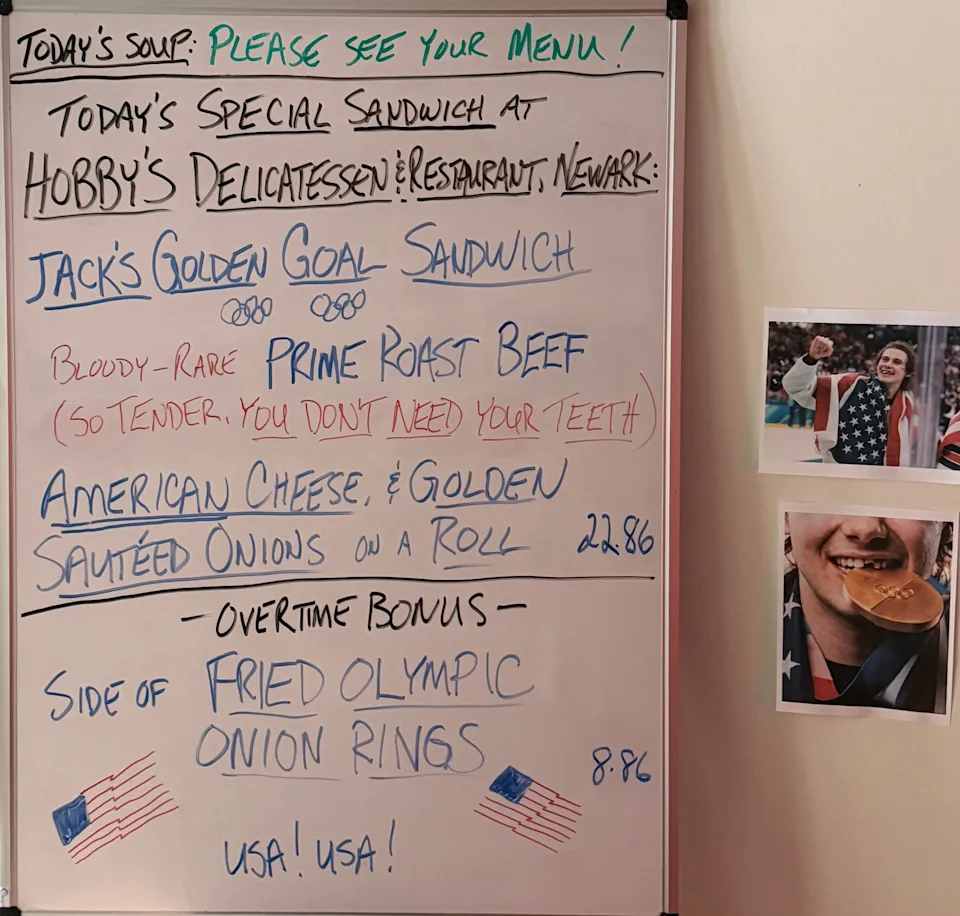
“Jack’s Golden Goal” Sandwich Becomes Newark Sensation as Hobby’s Delicatessen Honors Devils Star Jack Hughes

In New Jersey, hockey moments don’t just live on highlight reels — they land on plates.

This week in Newark, just steps from the Prudential Center, Hobby’s Delicatessen has transformed Olympic history into a deli masterpiece with the launch of the “Jack’s Golden Goal” Sandwich. The tribute celebrates New Jersey native and New Jersey Devils superstar Jack Hughes, who scored the overtime game-winning goal for Team USA on February 22, 2026, delivering the nation its first Olympic gold medal in men’s hockey in 46 years.

The result? A sandwich that’s as bold as the moment that inspired it — and a Newark food phenomenon that has quickly become a local sensation.

A Golden Goal That Echoed From Milan to Newark

When Jack Hughes buried the puck at the 1:41 mark of overtime against Canada in Milan, sealing a 2-1 victory, the hockey world erupted. The goal instantly entered Olympic lore. It elevated Hughes into a national spotlight beyond the NHL and cemented his status as one of the sport’s defining young stars.

The moment transcended hockey. It became cultural.

Hughes received a standing ovation in Pittsburgh earlier this week. He has reportedly been invited to the White House. Across New Jersey, Devils fans embraced the achievement as a point of state pride.

Now, Newark’s most iconic deli has immortalized the moment in its own uniquely Jersey way.

Inside the “Jack’s Golden Goal” Sandwich

Hobby’s Delicatessen officially introduced the sandwich on February 24, just days after Hughes’ golden moment. The creation is unapologetically classic, deeply indulgent, and unmistakably local.

The sandwich features:

  • Bloody rare prime roast beef
  • American cheese
  • Golden sautéed onions
  • Served on a soft roll

The tagline? “So tender, you don’t need teeth.”

The slogan is a direct and humorous nod to Hughes losing his two front teeth after taking a high stick during the gold medal game — a gritty detail that only added to the legend of the goal.

The deli has also introduced an upgrade option: add a side of “Fried Olympic Onion Rings” and transform the meal into the “Overtime Special.”

It’s playful. It’s clever. And it’s authentically Newark.

A Permanent Addition to Newark’s Hockey Culinary Legacy

Hobby’s owners Marc and Michael Brummer have confirmed that “Jack’s Golden Goal” is not a limited-time novelty. It will remain a permanent menu item, joining other Devils-themed staples such as the beloved “Chico Reuben,” named after Devils broadcasting icon Chico Resch.

For decades, Hobby’s has served as a pregame and postgame institution for Devils fans. Located just one block from the Prudential Center at 32 Branford Place, it is woven into the fabric of Newark hockey culture.

With the introduction of this sandwich, the deli has once again demonstrated how deeply sports and local business intersect in New Jersey.

Jack Hughes: From Newark Draft Pick to Olympic Hero

Jack Hughes’ journey from first-overall draft pick to Olympic gold medal hero has unfolded in front of Devils fans year after year.

Since being selected in 2019, Hughes has developed into the franchise centerpiece. His speed, creativity, and offensive instincts have redefined the Devils’ identity in the modern NHL era.

Now, after scoring one of the most iconic goals in recent American hockey history, his reach extends far beyond the Metropolitan Division.

For New Jersey fans, the pride runs deeper. Hughes isn’t just an NHL All-Star. He’s a Jersey success story.

The Intersection of Food and Sports in Newark

The rapid popularity of the “Jack’s Golden Goal” Sandwich underscores something uniquely New Jersey: sports celebrations here are communal, and food is central to that community.

Newark’s culinary scene has long been intertwined with Devils hockey. From arena vendors to neighborhood restaurants, big moments ripple outward into local businesses.

When Hughes scored in overtime in Milan, Newark felt it.

Within 48 hours, that feeling had a flavor.

Why This Matters for Devils Nation

As covered extensively in our New Jersey Devils section at Explore New Jersey, the Devils’ evolution has been one of growth, resurgence, and renewed expectations. Hughes’ Olympic heroics only amplify that narrative.

For a franchise building toward sustained competitiveness, having its star become a national hero reinforces brand visibility and cultural relevance.

For fans, it reinforces connection.

For local businesses like Hobby’s, it creates opportunity.

It is a rare alignment: athletic achievement, state pride, and small business creativity converging in real time.

The Golden Goal’s Lasting Impact

Hughes’ overtime strike was not just a win. It was a statement — for Team USA, for New Jersey, and for the next generation of American hockey players.

Moments like that shift perception. They inspire youth players across the Garden State. They elevate local heroes into national icons.

The fact that a Newark deli responded immediately reflects how tightly knit the hockey and community ecosystems remain.

From Milan to Newark — One Block from The Rock

For fans heading to the Prudential Center, Hobby’s sits just a short walk away. On game nights, it’s easy to imagine tables packed with Devils jerseys, Olympic highlights replaying on screens, and trays of “Golden Goal” sandwiches being served with pride.

In many ways, the sandwich is more than a tribute. It’s a snapshot of a week when New Jersey hockey captured the world stage.

The Legacy of a Goal, The Legacy of a Deli

Jack Hughes’ golden moment will live in Olympic history. It will live in Devils franchise lore. And now, it will live on a menu in Newark.

“Jack’s Golden Goal” is a reminder that in New Jersey, sports triumphs are shared, celebrated, and seasoned with creativity.

It is rare that a single play can unite a state, energize a fan base, and inspire a culinary creation in under 72 hours.

But that’s exactly what happened.

In Newark this week, victory tastes like prime roast beef, melted American cheese, and golden onions.

And for Devils fans, it tastes even better knowing it belongs to one of their own.

Analilia Mejia Secures Major Labor Endorsement in NJ-11 as Union Backing Intensifies Ahead of April Special Election

The race for New Jersey’s 11th Congressional District is accelerating, and the political alignment lines are becoming sharper. In a significant development that signals growing momentum among organized labor, Analilia Mejia, the Democratic nominee in the NJ-11 special election, has secured the endorsement of the Eastern Atlantic States Regional Council of Carpenters — one of the nation’s largest and most influential building trades unions.

The endorsement represents more than a symbolic nod. It signals institutional labor strength entering the race in a district that has historically been politically competitive and economically diverse. The special general election is set for April 16, 2026, and the stakes extend far beyond party control — this is a contest framed around working-class advocacy, fiscal priorities, and the broader ideological direction of New Jersey politics.

A Major Building Trades Endorsement in NJ-11

The Eastern Atlantic States Regional Council of Carpenters (EASRCC) represents more than 15,000 members across New Jersey and thousands more throughout the region. Its footprint spans commercial construction, infrastructure projects, and public works — sectors that directly intersect with federal policy on labor standards, infrastructure spending, and wage protections.

By endorsing Mejia, the union aligns itself with a candidate whose professional background is rooted in organized labor. Before entering the congressional arena, Mejia spent a decade as a union organizer with 32BJ SEIU, UNITE HERE, and UFCW. She has also been closely associated with advocacy efforts that led to New Jersey’s $15 minimum wage and paid sick leave expansions.

In accepting the endorsement, Mejia emphasized economic justice and wage protections, positioning herself as a continuation of labor-focused legislative priorities. The endorsement from EASRCC builds on an expanding coalition of union support that already includes 32BJ SEIU, 1199 SEIU, the SEIU New Jersey State Council, AFSCME, CWA District 1, CWA Local 1037, Rutgers AAUP-AFT, and the Rutgers Adjunct Faculty Union.

In modern New Jersey politics, labor endorsements carry structural weight. They mobilize ground operations, activate membership networks, and influence turnout in tightly contested districts.

Understanding NJ-11: Why This Seat Matters

New Jersey’s 11th Congressional District encompasses portions of Morris, Essex, and Passaic counties. It blends suburban commuter communities with working-class towns and small business corridors. The district reflects the broader tensions shaping New Jersey’s political landscape: high property taxes, infrastructure concerns, school funding debates, and public safety issues.

For labor organizations, NJ-11 represents a strategic opportunity to solidify pro-union representation at the federal level. For fiscal conservatives and government reform advocates, it represents a battleground over state and federal spending priorities.

Mejia’s campaign messaging has centered on raising wages, protecting worker rights, and building what she describes as an economy that works for all families. The carpenters’ endorsement strengthens her credibility in construction and infrastructure sectors that are heavily influenced by federal funding streams.

The Expanding Role of Organized Labor in New Jersey Elections

New Jersey has long been a labor-strong state, particularly in public sector unions and building trades. Endorsements from large unions often shape primary elections — but in a special general election, they can also influence swing voters who prioritize economic stability and job creation.

The Eastern Atlantic States Regional Council of Carpenters, under the leadership of Executive Secretary-Treasurer William Sproule, framed its endorsement as a reflection of Mejia’s alignment with middle-class job growth and economic justice.

Building trades unions traditionally focus on infrastructure investment, project labor agreements, apprenticeship programs, and prevailing wage enforcement. These priorities intersect directly with federal appropriations and congressional oversight.

With billions in federal infrastructure funding flowing through New Jersey, the composition of the state’s congressional delegation carries real economic consequences.

The Broader Political Climate: Protests and Policy Debates

Mejia’s endorsement announcement comes amid a politically charged environment in New Jersey.

Recent protests in Princeton drew crowds opposing military strikes, mirroring demonstrations in neighboring New York City. Meanwhile, over 1,500 residents and advocates are protesting a proposed ICE detention center in Roxbury that would convert a 470,000-square-foot warehouse into a facility for up to 1,500 detainees.

These developments underscore the heightened political engagement across suburban New Jersey communities. Immigration policy, federal enforcement, and civil liberties are front and center in public discourse.

In addition, fiscal spending priorities have become flashpoints in statewide debates. Critics have pointed to controversial expenditures including:

• Recreation center expansion projects featuring pickleball courts and Olympic-size pools
• Offshore wind investments that have drawn scrutiny over rising utility costs
• Funding allocations to politically connected districts
• Education funding formula disputes affecting Highlands communities
• Cultural investments such as the proposed Pompidou art museum
• Universal preschool expansion debates amid ongoing K-12 funding equity concerns

These issues shape the broader narrative voters will carry into the NJ-11 special election.

Labor endorsements, therefore, are not operating in isolation. They intersect with public debates over spending discipline, infrastructure investment, school funding fairness, and economic growth strategy.

Economic Justice Versus Fiscal Scrutiny

The contrast in NJ-11 is likely to revolve around two overarching themes:

• Expanding worker protections and public investment
• Demanding stricter fiscal oversight and prioritization

Mejia’s background as a union organizer positions her firmly within the pro-labor investment framework. Her campaign messaging emphasizes raising wages, strengthening collective bargaining protections, and safeguarding worker benefits.

Opponents and fiscal watchdogs are expected to counter with arguments centered on state spending discipline, energy policy scrutiny, and taxpayer accountability.

For voters in Morris and Essex counties — where property taxes remain a constant pressure point — economic messaging must resonate beyond party lines.

Why the Carpenters’ Endorsement Is Strategically Significant

Building trades unions carry particular weight in districts with substantial construction, infrastructure, and redevelopment activity.

New Jersey continues to experience:

• Transit-oriented development expansion
• Highway and bridge modernization projects
• School construction initiatives
• Mixed-use redevelopment in suburban downtowns

Federal representation influences how infrastructure funds are allocated and how labor standards are enforced on those projects.

The carpenters’ endorsement signals that major segments of the building trades see Mejia as aligned with their economic interests.

In close elections, turnout among union households can determine outcomes.

April 16, 2026: A High-Stakes Special Election

Special elections often produce unpredictable turnout patterns. With the general election scheduled for April 16, 2026, mobilization efforts will intensify in the coming weeks.

Union endorsements typically translate into door-knocking operations, phone banking, and coordinated messaging campaigns targeting member households.

For NJ-11 voters, the race represents a referendum not only on candidate ideology but also on the broader trajectory of New Jersey’s economic and political priorities.

Will voters prioritize expanded labor protections and federal investment alignment? Or will fiscal restraint and spending oversight dominate the conversation?

What This Means for New Jersey’s Political Landscape

The endorsement of Analilia Mejia by the Eastern Atlantic States Regional Council of Carpenters solidifies labor’s early positioning in NJ-11. It reinforces the role of organized labor as a central force in New Jersey congressional races.

At the same time, the broader climate — from ICE detention center protests in Roxbury to debates over offshore wind and school funding — ensures that this election will not occur in a vacuum.

It will unfold against a backdrop of economic anxiety, policy disputes, and deeply engaged suburban communities.

For NJ-11, April 16 is more than a date. It is a defining moment in how New Jersey’s suburban districts navigate labor priorities, fiscal debates, and federal representation in a politically charged era.

Sunset Daily News New Jersey will continue comprehensive coverage as the special election approaches, tracking endorsements, policy positions, and voter engagement shaping the future of the 11th Congressional District.

New Jersey Real Estate Market Set to Heat Up in 2026 as NYC Overflow Intensifies and Bayonne Breaks Ground on First Affordable Housing in 40 Years

If you live in New Jersey, the prediction probably feels less like a forecast and more like confirmation. The Garden State is once again being identified as one of the housing markets most likely to heat up in 2026, particularly along the outskirts of New York City. Northern New Jersey is being grouped alongside Long Island, the Hudson Valley, and Fairfield County, Connecticut — the familiar ring of regions that absorb demand when Manhattan tightens.

But this cycle is different.

This isn’t just about price arbitrage. It’s about structural migration patterns, return-to-office mandates, quality-of-life recalibration, and a steady reshaping of the regional housing ecosystem. And for those paying attention — homeowners, buyers, developers, and policymakers — 2026 may mark one of the most competitive years New Jersey has seen in recent memory.

The Return-to-Office Effect Is Real

For a brief period, the “work from anywhere” model changed everything. Buyers pushed further west, further south, further into lower-density areas because commuting didn’t matter.

Now it does again.

More companies across finance, tech, media, and healthcare are requiring employees to return to the office at least part-time. That recalibration immediately elevates the value of commuter-friendly towns with direct rail access, ferry service, or manageable drive times into Manhattan.

Enter Northern New Jersey.

Towns with Midtown Direct train lines, PATH access, or strategic highway positioning are poised for renewed buyer pressure. This includes markets in:

• Bergen County
• Hudson County
• Essex County
• Union County
• Morris County

Buyers want space and stability — but they also need realistic commuting logistics. New Jersey uniquely balances both.

New Jersey as the Practical Alternative to New York City

New Jersey consistently appears on “hot market” lists not because it’s trendy, but because it’s structurally advantageous.

We sit directly adjacent to one of the largest economic engines in the world. We offer:

• Larger homes at comparatively lower price per square foot
• Suburban neighborhoods with urban access
• High-performing public and private school systems
• Proximity to beaches, mountains, and metropolitan centers

Even though New Jersey is the most densely populated state in the nation, it still offers a sense of breathing room that many buyers no longer feel inside New York City.

Beyond logistics, lifestyle factors are accelerating outmigration from NYC. Residents cite rising costs, political fatigue, public safety concerns, school debates, and what some commentators are calling the “Mamdani factor” — shorthand for frustration over city governance and policy direction.

Regardless of political framing, the pattern is clear: people are voting with their feet.

And many are landing in New Jersey.

What This Means for Homeowners and Buyers

If you already own property in Northern New Jersey, the forecast likely signals upward pressure on home values, particularly in commuter-friendly municipalities.

Inventory remains constrained. New listings are not keeping pace with buyer demand. If migration intensifies in 2026, multiple-offer scenarios may become even more common in desirable towns.

For buyers, especially first-time entrants, competition is expected to increase. Strategic timing, mortgage readiness, and decisive negotiation will matter more than ever.

For developers and investors, land acquisition in transit-oriented locations may represent one of the strongest positioning strategies heading into 2026.

New Jersey’s Dual Narrative: Luxury Demand and Affordable Housing Expansion

While the high-demand commuter suburbs capture headlines, a parallel and equally important development is unfolding in Hudson County.

Construction is now underway on Bayonne’s first fully affordable housing complex in 40 years.

The project, known as the Bayonne Senior and Supportive Services affordable housing development, recently broke ground at 7 Oak Street under the leadership of the Bayonne Housing Authority. The six-story building will rise on a formerly vacant lot that once housed a power-generating station.

This marks a generational milestone for Bayonne.

The development will create 40 affordable units, split evenly between senior housing and supportive housing for individuals with disabilities. The project is financed through the federal Low-Income Housing Tax Credit program, with administration through the New Jersey Housing and Mortgage Finance Agency.

The Bayonne Housing Authority is partnering with the Bergen County United Way on the initiative, and completion is projected for early 2027.

This project reflects a broader dynamic in New Jersey real estate: growth must be balanced.

While suburban demand rises, municipalities must also address housing accessibility, aging populations, and supportive housing needs.

Bayonne’s Long-Awaited Affordable Development

Bayonne, often referred to as the Peninsula City, has seen significant transformation over the past two decades, particularly along its waterfront corridors. Yet fully affordable housing developments have lagged.

The groundbreaking at 7 Oak Street represents the first new supportive and senior-focused affordable housing construction in decades.

The six-story building will include:

• 40 affordable units
• 20 units designated for seniors
• 20 units designated for supportive housing
• 30 interior garage parking spaces

The parcel, formerly owned by PSE&G, had sat vacant for years before acquisition by the Bayonne Housing Authority.

Chair Vincent Lombardo noted that the project fulfills a long-standing objective to serve vulnerable populations within the community, particularly seniors and individuals with disabilities.

As suburban markets heat up, developments like this illustrate the state’s ongoing effort to maintain housing diversity and community stability.

Transit-Oriented Living Remains King

Whether discussing commuter-driven demand in Bergen County or affordable expansion in Bayonne, one theme connects everything: proximity to transportation.

In Northern New Jersey, access to:

• NJ Transit rail lines
• PATH stations
• Ferry terminals
• Major highways

directly influences pricing power and buyer urgency.

Bayonne’s strategic location near light rail access and its evolving infrastructure footprint position it well for both market-rate growth and community-based development.

The Strategic Advantage of Geography

New Jersey’s enduring advantage is geography.

We are close enough to New York City to benefit from its economic gravity, yet far enough to offer lifestyle alternatives. This dynamic has repeated itself through multiple real estate cycles — from the early 2000s boom to the post-2008 recovery to the pandemic surge.

Each time, New Jersey has functioned as the release valve when demand spills outward.

But what makes 2026 unique is the combination of:

• Return-to-office mandates
• Lifestyle-driven migration
• Limited housing inventory
• Infrastructure improvements
• Renewed suburban preference

The convergence of these factors suggests sustained, not temporary, heat.

Northern New Jersey’s Outlook for 2026

If the forecasts prove accurate, expect heightened activity in:

• Towns with direct Manhattan rail access
• Municipalities with strong school ratings
• Waterfront communities in Hudson County
• Emerging secondary commuter markets in Morris and Union counties

For sellers, preparation will be key. For buyers, readiness will be essential. For municipalities, infrastructure planning will become even more critical.

New Jersey’s real estate market does not heat up because it is fashionable. It heats up because it works.

It works for commuters.
It works for families.
It works for retirees.
It works for people seeking space without isolation.

As 2026 approaches, the Garden State once again finds itself at the intersection of demand, practicality, and geographic inevitability.

From the commuter suburbs of Northern New Jersey to the groundbreaking at 7 Oak Street in Bayonne, one reality is becoming increasingly clear:

New Jersey is not just absorbing overflow.

It is redefining the regional housing landscape.

NGA Group Inc. Relaunches MovingLabor.com Nationwide, Positioning North Brunswick as a National Hub for Hybrid Moving Technology

North Brunswick, New Jersey is once again proving that innovation in relocation services doesn’t only come from Silicon Valley or Manhattan. On February 27, 2026, NGA Group Inc., the relocation technology firm headquartered in Middlesex County, officially relaunched MovingLabor.com as a fully redeveloped, nationwide marketplace dedicated exclusively to labor-only moving services.

This is not a cosmetic refresh. It is a strategic national expansion that reflects a structural shift in how Americans move — and it firmly places New Jersey at the center of the next phase of relocation infrastructure.

The relaunch follows a strategic acquisition and complete platform rebuild. The objective is clear: create a scalable, technology-driven marketplace that serves the fast-growing segment of “DIY” movers — consumers who handle their own transportation but rely on professional labor for the heavy lifting.

For New Jersey’s real estate ecosystem — from residential brokers and property managers to developers and investors — this matters.

And it matters now.

The Rise of Hybrid Moving in a Changing Housing Market

Across New Jersey and nationwide, moving patterns have evolved. Housing costs, interest rate fluctuations, and increased consumer cost-consciousness have driven a shift toward hybrid moving models.

Consumers are increasingly choosing to:
• Rent trucks from companies like U-Haul
• Use portable storage solutions such as PODS
• Coordinate logistics themselves

But they are no longer willing to risk injury, damage, or inefficiency when it comes to lifting heavy furniture, navigating stairwells, or loading containers properly.

The result? A sharp rise in demand for labor-only moving services.

That is the exact niche MovingLabor.com now dominates.

A Nationwide Marketplace Built for the DIY Era

The newly rebuilt MovingLabor.com platform functions as a structured marketplace connecting customers with licensed, professional movers who provide labor-only services. The company has repositioned the brand around three core service pillars:

Loading and Unloading
Customers renting trucks or containers can hire professionals specifically to load or unload — minimizing damage risk and maximizing space efficiency.

Packing and Unpacking
Professional packing services reduce breakage claims and speed up transitions between properties.

In-Home Moves
Heavy furniture rearrangement, staging support, internal relocations, and downsizing logistics are now on-demand.

For New Jersey homeowners preparing to list properties — or buyers transitioning between closings — this fills a critical operational gap.

Integration with Movers.com Strengthens the Ecosystem

One of the most significant strategic advantages behind the relaunch is its integration with Movers.com, NGA Group’s long-standing marketplace for full-service moving companies.

Rather than competing internally, the two platforms now operate as complementary infrastructure:

Movers.com serves customers seeking full-service, transportation-inclusive moves.
MovingLabor.com serves customers who control transportation but require professional labor support.

Together, the platforms form a comprehensive relocation marketplace ecosystem.

This dual-market approach positions NGA Group to capture both ends of the moving spectrum — full-service and hybrid — under a unified technological umbrella.

Leadership Vision: Building a Comprehensive Moving Infrastructure

CEO Vidyadhar Garapati has framed the relaunch as part of a broader vision to create what he describes as a “comprehensive moving services infrastructure.”

That language is deliberate.

This is not simply a listing directory. It is a structured, scalable, tech-enabled marketplace designed to:

• Reduce friction in relocation transactions
• Improve consumer transparency
• Formalize the labor-only segment
• Provide licensed professionals with structured digital exposure

The hybrid moving model is no longer a niche — it is a growing category fueled by economic pragmatism and consumer control.

By rebuilding the platform from the ground up, NGA Group is positioning itself not as a participant in that trend, but as the infrastructure layer supporting it.

Why This Matters for New Jersey Real Estate Professionals

The real estate industry and relocation services are inseparable. Transaction velocity, buyer confidence, and seller timelines are directly influenced by move logistics.

For New Jersey’s housing market — particularly in high-density regions such as:

• North Brunswick
• Jersey City
• Hoboken
• Montclair
• Princeton

The demand for flexible moving solutions continues to expand.

Labor-only moving services support:

• Staging transitions
• Short-term storage swaps
• Lease-to-close timing gaps
• Downsizing and estate transitions
• Condo building elevator scheduling constraints

As more consumers seek cost-effective moving solutions, platforms like MovingLabor.com introduce scalable support without requiring a full-service contract.

That flexibility can accelerate transactions — and in real estate, acceleration matters.

Technology as the Differentiator

The redevelopment of MovingLabor.com was not incremental. It was comprehensive.

Modern consumers expect:

• Transparent pricing structures
• Streamlined booking workflows
• Verified service providers
• Scalable national coverage

The rebuilt platform reflects these expectations. Rather than operating as a fragmented regional listing, it now functions as a national marketplace with standardized digital processes.

For a New Jersey-based company to execute a national relaunch of this magnitude signals the maturation of relocation technology outside traditional coastal tech corridors.

North Brunswick’s Growing Role in Relocation Innovation

New Jersey has long been a logistical powerhouse due to its port access, highway density, and proximity to major metropolitan centers.

Now it is becoming something more.

By anchoring its operations in North Brunswick, NGA Group reinforces the region’s expanding identity as a relocation technology hub.

This development aligns with broader economic patterns in Middlesex County, where infrastructure, logistics, and tech-enabled service platforms continue to intersect.

As national housing mobility trends evolve, companies that bridge digital marketplaces with physical service networks will shape the next decade of relocation.

MovingLabor.com positions New Jersey squarely in that conversation.

The Consumer Shift Driving the Market

Why is labor-only moving growing?

Three macro drivers:

Cost Control
Full-service moves can be expensive. Hybrid models allow consumers to allocate spending more precisely.

Flexibility
DIY transportation enables schedule control, especially during tight closing windows.

Risk Management
Consumers increasingly prefer licensed labor professionals over informal gig arrangements to reduce liability and property damage.

MovingLabor.com formalizes that middle ground.

It creates a marketplace where consumers maintain autonomy without sacrificing professional support.

A Strategic Signal to the Industry

The February 27, 2026 relaunch is more than a product update.

It is a strategic declaration that the labor-only segment is no longer secondary — it is foundational.

By integrating MovingLabor.com with Movers.com, NGA Group is building layered infrastructure that accommodates every major moving scenario:

• Full-service relocation
• Hybrid truck rental models
• Container-based transitions
• Internal property shifts

Few companies operate with that breadth.

Even fewer do so from New Jersey.

What Comes Next

The relaunch marks the beginning of national scaling, not its conclusion.

As consumer housing mobility continues to respond to economic variables, relocation platforms that offer modular services will outperform rigid legacy providers.

New Jersey’s real estate market — already competitive, diverse, and geographically strategic — stands to benefit from this infrastructure.

For property owners, brokers, relocation coordinators, and housing professionals, the message is clear:

Hybrid moving is not temporary.
It is structural.
And it is expanding.

With the national relaunch of MovingLabor.com, NGA Group has positioned North Brunswick at the forefront of that transformation.

For Sunset Daily News New Jersey, this is more than a business story.

It is a signal that relocation technology innovation is happening here — and it is scaling nationwide.

HMG ePublishing Announces Author and Historian David J. Mason to Sign Books at 100th Annual Black History Month Luncheon

Literary events become historic when they intersect with cultural milestones. That convergence will take place as HMG ePublishing announces that author and historian David J. Mason will sign copies of his powerful historical work, Return to Southampton County, during the 100th Annual Black History Month Luncheon — a centennial gathering that reflects a century of remembrance, scholarship, and community reflection.

The announcement is more than a book signing. It represents a moment where historical research, public memory, and contemporary dialogue meet in one room.

Return to Southampton County: Reclaiming a Narrative of Emancipation and Service. The return to Southampton County examines the turbulent era of emancipation, the contributions of the United States Colored Troops, and the enduring struggle for freedom that continued long after the Civil War’s official end. Mason’s work delves into the lived realities of African Americans navigating the fragile promises of Reconstruction and the uneven march toward equality.

At its core, the book investigates the transition from bondage to citizenship — not as a singular moment, but as a prolonged and contested process.

By revisiting Southampton County, Mason explores how local histories illuminate national truths. His narrative highlights how communities shaped by enslavement, resistance, military service, and systemic exclusion built new identities under extraordinary pressure.

For readers across New Jersey, particularly those engaged in historical scholarship, civic dialogue, and cultural preservation, the book resonates beyond geography. It offers insight into the broader American experience of emancipation and the structural barriers that followed.

The Significance of the 100th Annual Black History Month Luncheon. The 100th Annual Black History Month Luncheon is a milestone celebration hosted by the Association for the Study of African American Life and History (ASALH), the organization founded by Carter G. Woodson. ASALH | The Founders of Black History Month

While the luncheon itself is not in New Jersey, several related centennial events are happening throughout the state this February. 

Event Details: 100th Annual Luncheon

  • Location: Washington, D.C. at the JW Marriott, 1331 Pennsylvania Ave NW.
  • Date & Time: Saturday, February 28, 2026, from 12:00 PM to 4:00 PM EST.
  • Theme: “A Century of Black History Commemorations,” marking 100 years since Woodson established “Negro History Week” in 1926.
  • Keynote Speaker: Dr. Karsonya Wise Whitehead, delivering a message titled “You Can’t Stop Black History”. ASALH | The Founders of Black History Month +4

“100 Years” Events in New Jersey

Because 2026 marks the centennial of the national observance, multiple New Jersey organizations are hosting their own “100th-anniversary” celebrations: 

  • Rutgers University Centennial Gala: A gala titled the “Black History Month Centennial Gala” was held on February 26, 2026, at Trayes Hall in New Brunswick, NJ.
  • Hamilton Township Commemoration: A “100th Anniversary of Black History Month” event took place on February 24, 2026, at the Social Profit Center in Hamilton Township, NJ.
  • Hackensack BHM Luncheon: The Hackensack Recreation Department is hosting a Black History Month Luncheon on March 6, 2026, for residents aged 18+.
  • Montclair Public Library: Hosting a series titled “Come Celebrate With Me: 100 Years of Honoring Black History” throughout February. 

Black History Month observances have evolved over decades from local commemorations into nationally recognized celebrations of African American achievement, resilience, and cultural influence. A 100th annual luncheon marks not only continuity but legacy — a testament to sustained commitment to remembrance.

Mason’s participation underscores the event’s scholarly dimension. The luncheon becomes both celebration and classroom.

By signing copies of Return to Southampton County, Mason provides attendees with the opportunity to engage directly with a historian who frames emancipation not as closure, but as an ongoing civic responsibility.

United States Colored Troops: Expanding the Historical Lens is one of the central themes of Mason’s work is the service of the United States Colored Troops. These regiments, formed after the Emancipation Proclamation, played a decisive role in the Union war effort. Their participation challenged deeply entrenched racial assumptions and redefined the meaning of citizenship in wartime America.

Yet their post-war experiences reveal the unfinished nature of freedom. Many veterans returned home to face systemic discrimination, economic marginalization, and political resistance.

By centering the USCT within his narrative, Mason emphasizes that military service did not guarantee equality — it demanded further struggle.

For modern readers, this perspective reframes traditional Civil War narratives and highlights the enduring relationship between service, sacrifice, and civil rights.

Historical Scholarship and Contemporary Relevance. Explore New Jersey’s Books coverage regularly spotlights authors who connect historical context with modern relevance. Return to Southampton County aligns with that editorial focus by demonstrating how archival research and narrative storytelling can illuminate present-day conversations about race, justice, and citizenship.

The themes Mason explores — emancipation, military service, systemic resistance, and community rebuilding — continue to shape discussions around educational access, voting rights, economic opportunity, and cultural preservation.

Historical inquiry is not static. It informs civic engagement.

Book signings and public lectures serve as bridges between scholarship and community. They transform reading from solitary reflection into collective dialogue.

For attendees at the 100th Annual Black History Month Luncheon, Mason’s presence offers:

  • Direct engagement with historical research
  • Opportunities for questions and discussion
  • Personalized signed copies of a significant work
  • Expanded understanding of Reconstruction-era narratives

These interactions deepen the reading experience and anchor historical texts within living communities.

Literary Culture in New Jersey maintains a vibrant literary culture shaped by independent publishers, university presses, local authors, and community organizations. Events like this luncheon reinforce the state’s role as a platform for serious historical conversation.

Explore New Jersey’s ongoing Books coverage highlights how literary events across the state connect readers with authors exploring subjects ranging from regional history to national civil rights movements.

The inclusion of Mason’s work within this context underscores the importance of publishing houses like HMG ePublishing in amplifying historically grounded narratives.

The Unfinished Struggle for Freedom is perhaps the most compelling dimension of Return to Southampton County is its framing of emancipation as incomplete.

While the Civil War formally ended enslavement, Reconstruction-era policies and post-war realities revealed persistent structural inequities. Mason’s research traces how newly freed individuals navigated economic instability, social hostility, and political retrenchment.

The book invites readers to consider:

  • What does freedom require beyond legal declaration?
  • How does military service shape claims to citizenship?
  • What responsibilities do communities carry in preserving historical memory?

These questions remain deeply relevant.

The Role of Historical Memory in 2026 in a digital age marked by rapid information cycles and polarized discourse, historically rigorous scholarship offers grounding. Works like Return to Southampton County reinforce the value of archival research, documented narratives, and disciplined interpretation.

Public commemorations such as the 100th Annual Black History Month Luncheon amplify that grounding by connecting scholarship to shared civic reflection.

The Future of Community-Centered Publishing is a great concept. HMG ePublishing’s announcement also highlights the evolving landscape of independent and specialized publishing. By bringing historians directly into community spaces, publishers expand the reach of scholarly works beyond academic institutions.

Author signings create accessibility. They position books not as distant academic artifacts but as living contributions to cultural dialogue.

Explore New Jersey will continue spotlighting events and publications that elevate historical understanding and foster community engagement.

As David J. Mason signs copies of Return to Southampton County at this landmark luncheon, attendees will not simply receive a book. They will engage with a narrative that challenges, informs, and invites deeper reflection on America’s evolving promise of freedom.

In a year that marks a century of Black History Month observances within this particular community, the act of gathering, reading, and remembering carries profound significance.

History is not confined to archives. It lives in conversation. It moves through communities. And through works like Return to Southampton County, it continues to shape the path forward.

MediDepot Expands Fast-Ship Medical Equipment Availability Across the Continental U.S. & Hudson Regional Health Extends Emergency Department Operations at Heights University Hospital

Access to certified medical equipment is no longer just a matter of inventory — it is a matter of timing, logistics precision, and structured fulfillment systems. MediDepot’s newly announced expansion of fast-ship medical equipment services across the continental United States represents a strategic step forward in healthcare supply chain efficiency, with significant implications for patients, caregivers, and providers in New Jersey.

As healthcare delivery increasingly moves beyond hospital walls and into homes, outpatient centers, rehabilitation facilities, and community clinics, the need for rapid deployment of durable medical equipment has intensified. MediDepot’s expansion strengthens its structured fulfillment infrastructure, enabling faster nationwide delivery while maintaining compliance standards and product certification integrity.

For New Jersey residents and healthcare providers navigating post-acute recovery, chronic care management, or mobility challenges, this development is particularly meaningful.

Why Fast-Ship Medical Equipment Matters in 2026

The healthcare landscape has shifted dramatically over the last decade. Hospitals are discharging patients earlier. Home healthcare programs are expanding. Telehealth consultations are more common. At the same time, supply chain disruptions in recent years exposed vulnerabilities in equipment distribution models.

When a patient requires a hospital bed, mobility aid, oxygen concentrator, or rehabilitation device, delays can directly impact recovery outcomes and quality of life.

MediDepot’s fast-ship model is designed to reduce that gap between prescription and delivery.

Structured Fulfillment as a Competitive Advantage

The key differentiator in MediDepot’s expansion is not simply speed — it is structured fulfillment architecture.

Structured fulfillment refers to a systematic logistics model that integrates inventory tracking, compliance verification, packaging protocols, and carrier coordination into a unified process. By refining these operational layers, MediDepot is able to:

  • Accelerate order processing timelines
  • Reduce shipping errors
  • Maintain equipment certification standards
  • Improve inventory forecasting
  • Enhance nationwide coverage consistency

This approach is especially important in the medical equipment sector, where regulatory compliance and product integrity cannot be compromised in pursuit of faster delivery.

For healthcare providers across New Jersey, dependable fulfillment reduces administrative burden and increases confidence in equipment reliability.

Meeting the Needs of Home-Based Healthcare

Explore New Jersey’s ongoing coverage of regional health and wellness trends consistently highlights the growing shift toward home-centered care models. From remote monitoring technologies to in-home rehabilitation programs, the demand for durable medical equipment delivered directly to patients has expanded dramatically.

Fast-ship capabilities support:

  • Post-surgical recovery at home
  • Chronic disease management
  • Senior mobility support
  • Temporary injury rehabilitation
  • Respiratory therapy needs

In many cases, medical equipment must arrive within days — sometimes within hours — to ensure continuity of care.

MediDepot’s expansion addresses that urgency.

Certified Equipment and Compliance Standards

Speed without certification is meaningless in healthcare distribution. MediDepot emphasizes that its expanded shipping infrastructure continues to support certified medical equipment that meets regulatory and safety standards.

For patients and providers, certification ensures:

  • Product durability
  • Compliance with federal safety regulations
  • Insurance eligibility alignment
  • Long-term usability

In a healthcare environment where insurance claims and documentation requirements are increasingly complex, maintaining certification standards is essential.

New Jersey’s Healthcare Ecosystem and Distribution Efficiency

New Jersey’s dense population and proximity to major metropolitan healthcare hubs make efficient distribution networks particularly important. The state’s healthcare system includes large hospital networks, outpatient surgical centers, rehabilitation facilities, senior living communities, and home healthcare agencies.

An expanded fast-ship infrastructure serving the continental U.S. naturally enhances availability for New Jersey patients and providers as part of that national network.

Timely equipment delivery supports discharge planning teams, case managers, and physical therapists who depend on reliable vendor partnerships to coordinate patient transitions from hospital to home.

Reducing Supply Chain Friction

Healthcare supply chain management has become a central topic in policy and operational discussions nationwide. Equipment shortages, delayed shipments, and fragmented distribution networks can create bottlenecks that affect patient care.

By strengthening its fulfillment model, MediDepot contributes to reducing friction in the broader healthcare supply chain.

Faster shipping can help:

Minimize extended hospital stays
Prevent readmission due to equipment delays
Support continuity of rehabilitation programs
Reduce emergency replacement orders

In practical terms, this translates into improved patient experience and cost containment.

Digital Ordering and Operational Transparency

Modern medical equipment distribution increasingly relies on digital platforms that allow providers and patients to track orders in real time. Structured fulfillment processes often integrate technology that enhances visibility across the shipping lifecycle.

For healthcare administrators, this level of transparency reduces uncertainty and enables proactive planning.

In a state like New Jersey, where healthcare providers operate within competitive and high-demand markets, reliable order tracking can streamline coordination between discharge teams, insurance providers, and caregivers.

Supporting Aging Populations

New Jersey’s aging population continues to grow, intensifying demand for mobility devices, home safety equipment, and long-term care solutions.

Fast access to:

  • Wheelchairs
  • Hospital beds
  • Lift chairs
  • Walkers
  • Oxygen equipment

The expansion of fast-ship availability ensures that older residents are not left waiting extended periods for equipment essential to daily living.

Economic and Operational Implications

Beyond patient care, improved distribution networks contribute to economic efficiency within healthcare systems. When equipment arrives on schedule, administrative costs decline. Fewer delays mean fewer emergency procurement orders and less reliance on temporary workarounds.

Healthcare systems benefit from predictable supply cycles, while patients benefit from continuity.

In a competitive healthcare market like New Jersey, operational excellence in logistics becomes part of the broader standard of care.

Aligning With Broader Health and Wellness Trends

Explore New Jersey’s Health & Wellness coverage regularly spotlights innovations improving accessibility, preventative care, and patient-centered services across the state.

MediDepot’s expanded shipping capacity aligns directly with these trends by addressing one of the most practical aspects of healthcare delivery — physical equipment access.

As care models evolve, infrastructure must evolve alongside them. Logistics may not always receive headline attention, but it plays a foundational role in healthcare quality.

A National Expansion With Local Impact

Although MediDepot’s announcement emphasizes continental U.S. availability, the local impact is immediate for New Jersey residents and providers.

With strengthened fulfillment operations and faster delivery timelines, the pathway from prescription to patient becomes more efficient.

For families coordinating post-surgical care, for caregivers managing chronic conditions, and for healthcare professionals overseeing rehabilitation plans, time matters.

MediDepot’s expansion represents a structural improvement in how certified medical equipment reaches those who depend on it most.

Hudson Regional Health Extends Emergency Department Operations at Heights University Hospital Amid Financial Crisis and State Scrutiny

Hudson Regional Health announced Friday that it will extend operations at the Emergency Department at Heights University Hospital into March, temporarily delaying a previously announced Feb. 28 suspension. The two-week extension moves the anticipated closure date to March 14, 2026, offering a brief reprieve for residents of Jersey City’s Heights neighborhood while intensifying debate over the future of emergency care access in the area.

The facility, formerly Christ Hospital, has become the center of a widening financial and regulatory conflict involving Hudson Regional Health leadership, Jersey City officials, state lawmakers, and the New Jersey Department of Health.

A Two-Week Extension Amid Growing Pressure

According to Hudson Regional Health, the decision to extend emergency services comes after direct requests from Jersey City officials and discussions with state health authorities. Chairman Yan Moshe agreed to personally cover approximately $1 million in operating costs during the extension period, a move the system describes as a good-faith effort to provide continuity while broader funding solutions are explored.

However, the system maintains that without additional state funding or alternative financial support, emergency services at Heights University Hospital are expected to be suspended on March 14.

The announcement does not resolve the long-term viability question — it postpones it.

Financial Losses and Systemwide Risk

Hudson Regional Health reports steep financial losses at the facility despite significant post-acquisition investment. After acquiring the hospital out of bankruptcy, the system says it invested more than $100 million into revitalization efforts. Nevertheless, it absorbed $74 million in losses and projects another $30 million deficit this year.

The financial strain is attributed to several compounding factors:

Medicaid reimbursement reductions
Reduced Charity Care funding
Rising numbers of uninsured patients
Lower-than-expected emergency room utilization

HRH leadership argues that continued losses at Heights University Hospital threaten care delivery across its broader network, including facilities in Secaucus, Bayonne, and Hoboken.

For a health system operating in an increasingly complex reimbursement environment, leadership frames the potential ER suspension as a sustainability measure rather than a retreat.

Local Leaders Push Back

The possibility of losing emergency services has drawn strong criticism from Jersey City officials and local representatives who argue that access to emergency care is non-negotiable for Heights residents.

In a joint statement issued Feb. 27, Mayor James Solomon, Councilmember Tom Zuppa, and Councilmember Ephros acknowledged that the two-week extension represents progress. However, they emphasized that it does not fulfill the long-term commitment they say HRH made to provide high-quality healthcare in the Heights community.

The group pledged continued collaboration with Gov. Mikie Sherrill, the New Jersey Department of Health, and Jersey City Health and Human Services to identify a permanent solution that guarantees emergency care access — whether through HRH or another provider.

The tone from city leadership is clear: temporary relief is not structural security.

Regulatory Compliance Questions

Adding another layer to the issue, the New Jersey Department of Health has publicly stated that Heights University Hospital remains out of compliance with state regulatory requirements.

Acting Health Commissioner Dr. Raynard Washington confirmed that while the Department was notified of the two-week extension, the hospital’s Certificate of Need application — filed in fall 2025 — remains under review. Under state law, emergency department closures require formal approval.

According to the Department of Health, shuttering all but the emergency department without legally required authorization places HRH in regulatory violation.

The state signaled it will continue exercising available enforcement options to protect public resources and ensure statutory compliance.

This regulatory backdrop introduces legal uncertainty into the timeline of any potential closure.

What Happens if Services Are Suspended?

If emergency services are suspended on March 14, Hudson Regional Health states it plans to implement transitional measures designed to reduce immediate impact:

Relocating affected staff within the broader health system
Stationing an ambulance outside the facility for two weeks
Deploying a Mobile Health Unit after the ambulance phase
Exploring redevelopment plans for a financially sustainable hospital model in Jersey City

While these measures may offer short-term support, critics argue that mobile and temporary solutions cannot replace a fully operational emergency department in a densely populated neighborhood.

Access to Emergency Care in New Jersey’s Urban Corridors

Explore New Jersey’s ongoing coverage in our Health & Wellness section consistently highlights the structural importance of accessible emergency services in urban communities.

Jersey City’s Heights neighborhood is home to thousands of residents who rely on proximity-based emergency response. Travel time to alternative emergency departments could increase during peak hours, particularly given regional traffic patterns and hospital capacity constraints.

Emergency department access directly influences:

Stroke and cardiac response outcomes
Trauma stabilization windows
Pediatric emergency intervention
Mental health crisis management

Healthcare infrastructure in Hudson County operates within a tightly interconnected system. Removing even one node can shift pressure onto surrounding facilities.

Broader Healthcare System Strain

The situation at Heights University Hospital reflects larger national and state-level pressures facing community hospitals. Medicaid reimbursement models, shifts in patient volume, rising operational costs, and capital investment demands have created sustainability challenges, particularly for facilities serving high numbers of uninsured patients.

New Jersey’s Charity Care funding structure has historically supported safety-net hospitals, but funding reductions combined with inflationary cost pressures are reshaping viability calculations.

In this context, the Heights situation represents both a localized crisis and a broader policy conversation.

Balancing Fiscal Responsibility and Public Access

Hudson Regional Health leadership frames the potential ER suspension as a difficult but financially necessary decision designed to preserve systemwide stability. City officials and residents frame it as a matter of essential public service access.

The two perspectives intersect at a central question: how should emergency care be funded in communities where reimbursement fails to match operational cost?

This debate extends beyond Jersey City. It touches on statewide healthcare infrastructure strategy and public-private healthcare partnerships.

What Comes Next

Between now and March 14, negotiations and regulatory reviews will likely intensify. State intervention, emergency funding mechanisms, or alternative operational partnerships remain possible, though no definitive solution has been announced.

For Heights residents, the coming weeks are critical.

For Hudson Regional Health, the decision carries implications for financial sustainability across its network.

For the State of New Jersey, the situation tests regulatory authority, funding frameworks, and public trust in healthcare governance.

Explore New Jersey will continue monitoring developments in this evolving healthcare story as stakeholders seek a path that balances fiscal realities with community access to emergency care.

The stakes are not theoretical. They are immediate, measurable, and deeply connected to the health and safety of one of New Jersey’s most vibrant urban communities.

Explore New Jersey will continue monitoring developments in healthcare infrastructure, patient access innovations, and wellness initiatives shaping the future of care across the Garden State.

Public Libraries Counting on Bill to Combat Huge Cost of E-Books

New Jersey’s public libraries are stepping into one of the most consequential policy battles in the modern publishing era. At stake is not simply the price of digital books — it is the sustainability of public access to knowledge in an age increasingly defined by e-books and audiobooks.

Across the state, library directors, trustees, and advocates are backing legislation designed to curb what they describe as unfair pricing and restrictive licensing practices imposed by major publishers. The issue is gaining urgency as digital content continues to consume a larger portion of library acquisition budgets, straining resources that once focused almost exclusively on physical collections.

The push is centered on New Jersey Senate Bill S1674/S4520, introduced by Sen. Andrew Zwicker, which would make it a violation of the state’s consumer fraud law for publishers to charge libraries more for digital content than what the general public pays for the same titles. In simple terms, the bill targets a pricing structure that often forces libraries to pay up to five times the consumer price for a single e-book license.

For institutions whose mission is universal access, that pricing disparity has become unsustainable.

The Hidden Economics of Digital Lending

Unlike printed books, which libraries can purchase once and lend repeatedly without expiration, digital titles operate under licensing agreements governed by publisher terms. These agreements frequently impose “metered” access limits — restrictions that cap the number of checkouts or set expiration dates after a fixed period, often two years or as few as 26 borrows.

When the license expires, the library must repurchase the same title to continue offering access.

That model transforms what was historically a one-time acquisition into a recurring expense. Library administrators report spending significant portions of annual budgets simply replacing expired high-demand digital titles instead of expanding collections or investing in new programming.

Nationally, digital content accounted for approximately 27% of library acquisition budgets in 2024. In some communities, up to 20% of annual budgets are consumed by repurchasing titles that were already paid for once.

For taxpayers, that means repeated spending on identical materials.

Why New Jersey’s Bill Matters

The proposed New Jersey legislation seeks to rebalance that equation by prohibiting pricing practices that exceed what consumers pay for digital books. By framing excessive digital pricing as a consumer protection issue, the bill aims to align library access with the broader public interest.

In addition to pricing reforms, similar legislation in other states addresses additional barriers embedded in digital contracts:

Metered Access Limits
Bills seek to prohibit publishers from imposing arbitrary checkout caps or short-term expiration windows that force frequent repurchasing.

Non-Disclosure Clauses
Some digital contracts prevent library staff from disclosing pricing or licensing terms. Reform efforts would bar these provisions, increasing transparency and collective bargaining leverage.

Operational Restrictions
Libraries sometimes face limitations that restrict interlibrary loans or prevent staff from reading digital titles aloud during storytime. Proposed reforms aim to restore these traditional functions in the digital environment.

The Connecticut Model and Collective “Trigger” Clauses

New Jersey’s effort does not exist in isolation. Connecticut passed Senate Bill 1234 in 2025, creating a model for digital library reform nationwide. That law prohibits contracts requiring libraries to repurchase digital books after a set number of checkouts or time limits.

However, to address potential legal challenges from large publishing companies, Connecticut’s law includes a “trigger” clause. It only takes effect once other states representing a combined population of at least seven million people enact similar legislation. This collective activation mechanism strengthens bargaining power while reducing the likelihood of isolated legal battles.

New Jersey’s legislation could become a critical part of that national coalition.

Digital Access and the Future of Reading in New Jersey

Explore New Jersey’s ongoing coverage of the state’s literary and cultural ecosystem consistently highlights the role public libraries play in community life. From children’s literacy programs to workforce development resources, libraries remain essential civic institutions.

As detailed in our Books section at Explore New Jersey, the transformation of reading habits toward digital platforms has reshaped how libraries operate. E-book lending platforms now serve readers who may never physically visit a branch. Audiobooks expand accessibility for visually impaired patrons and commuters. Digital collections extend reach into underserved areas.

Yet that expansion comes at a cost.

The question confronting lawmakers is whether public institutions should be subject to licensing structures that effectively treat them as premium customers rather than community service providers.

Publishers argue that digital copies do not degrade like physical books and therefore require different pricing structures to protect revenue streams. Libraries counter that public access historically fuels book discovery, author visibility, and long-term sales.

The Economic Ripple Effect

The stakes extend beyond library budgets.

If digital pricing remains unchecked, smaller municipal libraries could face difficult tradeoffs — reducing hours, limiting programming, or scaling back physical acquisitions to accommodate digital licensing expenses.

For communities across New Jersey, particularly in suburban and rural counties where libraries serve as educational hubs, that impact could be substantial.

At the same time, equitable digital access supports:

Student research and academic achievement
Job seekers relying on online learning platforms
Senior citizens accessing audiobooks
Residents without personal e-book subscriptions

Ensuring sustainable digital lending is not a niche policy debate. It is a question of educational equity and fiscal responsibility.

Balancing Innovation with Public Good

The publishing industry is navigating its own transformation as streaming-style subscription services, direct-to-consumer sales, and global digital platforms reshape revenue models. Publishers argue that licensing limits protect intellectual property and sustain author compensation.

Libraries, however, emphasize that their purchasing model already compensates publishers at higher rates than consumer sales. The issue is not payment, but proportionality and permanence.

The proposed reforms aim to modernize the balance between intellectual property rights and public access obligations.

New Jersey’s Legislative Moment

With bipartisan attention growing nationally around digital licensing reform, New Jersey stands at a pivotal moment. If Senate Bill S1674/S4520 advances, it could signal a broader shift toward redefining how digital content is treated within public institutions.

The outcome will influence not only pricing models, but also transparency standards and contractual norms in digital publishing.

For residents across the Garden State, the debate underscores a fundamental question: In an era when reading increasingly happens on screens rather than pages, how should public access be preserved?

Public libraries are not seeking special treatment. They are seeking sustainability.

As digital consumption continues to expand, New Jersey’s legislative response may determine whether libraries can continue fulfilling their mission — not just as repositories of books, but as dynamic, accessible gateways to knowledge in the digital age.

Explore New Jersey will continue monitoring this evolving story as lawmakers, libraries, and publishers navigate one of the most important policy debates shaping the future of reading in our state.

Sunset Daily News New Jersey — Technology Report—New Smart City Protocol Version Further Increases Interoperability Through DALI D4i and TALQ Zhaga Profiles

In a significant advancement for global urban technology standards, the TALQ Consortium has released Version 2.7.0 of its Smart City Protocol — a major update to the internationally recognized interface standard that continues to redefine interoperability across smart city infrastructure systems.

Announced from Piscataway, New Jersey, the latest release strengthens integration between outdoor lighting networks, IoT devices, and central management systems through enhanced support for DALI D4i and Zhaga profiles. This development reinforces TALQ’s mission to create an open, scalable ecosystem that allows cities, utilities, and infrastructure operators to deploy smart technology without being locked into proprietary systems.

Version 2.7.0 represents not just a technical update, but a strategic shift toward deeper cross-platform compatibility — a move that directly impacts municipalities investing in intelligent urban infrastructure.

What the TALQ Smart City Protocol Does

The TALQ Smart City Protocol serves as a standardized communication interface between Central Management Systems (CMS) and Outdoor Device Networks (ODN). In practical terms, it allows various smart city components — streetlights, sensors, traffic management devices, environmental monitors — to communicate seamlessly, even when produced by different manufacturers.

By maintaining an open interface architecture, TALQ empowers cities to:

• Avoid vendor lock-in
• Integrate multiple hardware ecosystems
• Scale infrastructure over time
• Modernize legacy systems gradually
• Maintain operational flexibility

The result is a unified smart city framework capable of evolving with technological innovation rather than being constrained by it.

What’s New in Version 2.7.0

The defining enhancement in Version 2.7.0 is the expanded interoperability support for DALI D4i and Zhaga profiles.

DALI D4i is a digital lighting interface specification that enables detailed performance reporting and diagnostics for luminaires and connected components. It provides structured data related to energy consumption, asset performance, runtime metrics, and maintenance indicators. By incorporating DALI D4i more comprehensively, the TALQ protocol strengthens real-time monitoring capabilities and improves predictive maintenance modeling.

Zhaga profiles, meanwhile, standardize the mechanical and electrical interfaces of LED modules and connected lighting components. This ensures interchangeability between manufacturers and supports modular smart lighting design. By embedding Zhaga profile alignment into Version 2.7.0, TALQ enhances plug-and-play compatibility across hardware vendors.

Together, these updates significantly increase:

• Device-level transparency
• Asset lifecycle management
• Data harmonization across networks
• Future-proofing of urban lighting systems

For cities building or upgrading connected infrastructure, this interoperability layer reduces long-term risk and expands procurement flexibility.

Why Interoperability Matters More Than Ever

As municipalities across the United States accelerate smart city initiatives, fragmentation remains one of the biggest obstacles to long-term success. Systems installed by different vendors often operate on isolated platforms, creating inefficiencies and limiting cross-network intelligence.

TALQ’s continued development addresses that challenge directly.

Interoperability ensures that:

• Lighting systems can integrate with environmental sensors
• Traffic networks can communicate with energy management platforms
• Infrastructure investments remain upgradeable
• Data silos are reduced
• Public resources are optimized

The release of Version 2.7.0 reinforces the principle that smart city technology must operate as a coordinated ecosystem rather than a collection of disconnected solutions.

New Jersey’s Strategic Position in Smart Infrastructure

With the TALQ Consortium headquartered in Piscataway, New Jersey, the state remains positioned at the center of global smart city standards development. New Jersey’s dense urban corridors, transportation networks, and energy infrastructure make it an ideal proving ground for scalable smart city implementation.

Local governments across the state are actively exploring:

• Smart street lighting upgrades
• IoT-enabled environmental monitoring
• Integrated traffic management systems
• Energy-efficient municipal infrastructure

The evolution of the TALQ protocol directly supports these initiatives by providing a structured, vendor-neutral communication framework.

For New Jersey municipalities, adopting interoperable standards is not just a technological choice — it is a financial and operational safeguard.

The Business and Economic Implications

Beyond technical advancement, Version 2.7.0 also carries economic implications.

Open standards create competitive markets. Competitive markets reduce costs and stimulate innovation.

When cities can source compatible hardware from multiple manufacturers, procurement becomes more strategic. Maintenance contracts become more flexible. Technology upgrades become less disruptive.

This fosters:

• Increased supplier competition
• Improved pricing transparency
• Reduced integration risk
• Accelerated deployment timelines

In the broader smart city economy, interoperability translates into measurable fiscal efficiency.

Smart Cities, Sustainability, and Long-Term Vision

Modern smart city deployments increasingly center on sustainability goals — energy efficiency, carbon reduction, and intelligent resource management.

By integrating DALI D4i data reporting into the protocol, municipalities gain access to granular energy consumption analytics. That data supports climate action reporting, infrastructure benchmarking, and operational optimization.

Zhaga-based modularity also reduces waste by enabling component-level upgrades rather than full system replacements.

The 2.7.0 release therefore aligns directly with global sustainability objectives while reinforcing technical adaptability.

A Future-Proof Urban Framework

The pace of technological change demands standards that evolve continuously. The release of Version 2.7.0 signals that the TALQ Consortium remains committed to refining the architecture that underpins smart city ecosystems worldwide.

For New Jersey and beyond, the implications are clear:

Interoperability is no longer optional.
Vendor neutrality is no longer theoretical.
Scalable infrastructure is no longer aspirational.

It is operational.

As cities continue to modernize lighting systems, deploy IoT devices, and integrate digital infrastructure, standardized communication protocols will determine whether those investments deliver long-term value or short-term complexity.

With Version 2.7.0, the TALQ Smart City Protocol strengthens the foundation upon which tomorrow’s connected cities will be built.

For continued coverage of New Jersey technology innovation and infrastructure modernization, visit the Technology & Tech section at Sunset Daily News.

Princeton Symphony Orchestra Presents Erinys Quartet to its Chamber Series

0

Princeton Symphony Orchestra Presents International Award-Winning Erinys Quartet at Trinity Church on March 19, 2026

March 19 @ 5:00 PM 11:30 PM

Princeton’s classical music calendar continues to elevate New Jersey’s cultural reputation as the Princeton Symphony Orchestra (PSO) welcomes the internationally acclaimed Erinys Quartet to its Chamber Series at Trinity on Thursday, March 19, 2026 at 7:00 PM. Fresh off their First Prize victory at the 13th Trondheim International Chamber Music Competition in Norway, the ensemble arrives in Mercer County with global momentum and critical acclaim.

For audiences across Central Jersey and beyond, this performance represents more than a single evening of chamber music. It underscores Princeton’s standing as a premier destination for world-class classical concerts and reinforces the Princeton Symphony Orchestra’s role as a driving force in New Jersey’s vibrant arts ecosystem.

A Prestigious International Win Sets the Stage

Winning the Trondheim International Chamber Music Competition is no small achievement. Held in Norway and regarded as one of the most respected chamber music competitions in the world, the event showcases elite ensembles from across the globe. The Erinys Quartet’s triumph at the 13th edition signals technical mastery, interpretive depth, and a cohesive artistic identity that resonated with an international jury.

Bringing that level of recognition to Trinity Church in Princeton transforms this Chamber Series event into a must-attend performance for classical music enthusiasts, students, and cultural leaders throughout New Jersey.

The Princeton Symphony Orchestra’s Chamber Series at Trinity

The Chamber Series at Trinity has become a cornerstone of Princeton’s intimate classical programming. Unlike large-scale orchestral performances, chamber concerts invite audiences into a more immersive musical dialogue. Listeners experience nuanced phrasing, subtle tonal interplay, and the intricate communication that defines elite string quartets.

Hosted at Trinity Church—one of Princeton’s most architecturally and acoustically resonant venues—the series offers an atmosphere that balances historic ambiance with sonic clarity. For chamber music, acoustics matter. Trinity’s warm resonance enhances string articulation while preserving dynamic detail, making it an ideal setting for a quartet of Erinys’s caliber.

By programming award-winning ensembles alongside emerging talent, the Princeton Symphony Orchestra continues to position its Chamber Series as a cultural asset not only for Princeton but for the entire state.

Who Is the Erinys Quartet?

The Erinys Quartet has rapidly ascended the international chamber music landscape. Known for precision, expressive cohesion, and interpretive sophistication, the ensemble embodies the collaborative intensity that defines premier string quartets.

Their recent First Prize win in Trondheim marks a defining milestone, elevating their profile across Europe and North America. Such competitions evaluate technical command, ensemble unity, repertoire interpretation, and artistic originality—criteria that the Erinys Quartet clearly mastered.

For Princeton audiences, this performance offers a rare opportunity to experience a rising ensemble at a pivotal moment in its global trajectory.

Why This Performance Matters for New Jersey’s Classical Scene

New Jersey’s classical music culture is both historic and evolving. From orchestral programming to chamber festivals and university-affiliated concerts, the state consistently attracts internationally recognized artists.

The Princeton Symphony Orchestra remains central to that momentum. By presenting globally decorated ensembles like the Erinys Quartet, the PSO reinforces its reputation as a forward-thinking cultural institution committed to excellence.

An Intimate Evening of Musical Dialogue

Chamber music thrives on proximity. In a quartet setting, each instrument carries equal narrative weight. Themes are passed, developed, and transformed in real time, creating a living conversation among musicians.

The Erinys Quartet’s Trondheim victory suggests not only technical superiority but interpretive synergy—an intangible quality that distinguishes memorable performances from merely competent ones.

At Trinity Church, audiences will experience that synergy firsthand. The program promises a repertoire selection reflective of the quartet’s dynamic range and artistic ambition, offering both structural rigor and emotional depth.

Strengthening Princeton’s Cultural Identity

Princeton has long served as a nexus for academic excellence and artistic innovation. The Princeton Symphony Orchestra contributes significantly to that identity, drawing audiences from across Mercer County and neighboring regions.

By featuring internationally award-winning ensembles within its Chamber Series, the PSO amplifies Princeton’s profile as a destination for serious classical engagement. It is not simply presenting concerts—it is cultivating cultural distinction.

For local businesses, hospitality venues, and community stakeholders, high-profile performances generate ancillary economic and cultural benefits. Concertgoers dine, explore, and engage with Princeton’s broader arts landscape, reinforcing the town’s status as a regional arts hub.

A Strategic Programming Decision

Inviting the Erinys Quartet following their Trondheim victory reflects strategic programming foresight. Momentum matters in classical music. Presenting artists at peak visibility enhances audience engagement and elevates institutional prestige.

The Princeton Symphony Orchestra’s leadership continues to curate programming that balances artistic integrity with international relevance. In doing so, it strengthens long-term audience loyalty while attracting new patrons eager to experience emerging global talent.

The Chamber Series as a Cultural Investment

The Chamber Series at Trinity is more than a seasonal offering—it is an investment in musical literacy and cultural enrichment. Students, educators, and aspiring musicians gain exposure to world-class artistry without leaving the state.

For New Jersey residents who might otherwise travel to New York or Philadelphia for comparable programming, events like this demonstrate that elite classical experiences are available locally.

Mark Your Calendar: March 19, 2026 at 7:00 PM

Thursday, March 19, 2026 at 7:00 PM promises an evening defined by precision, passion, and international artistry. As the Erinys Quartet brings its Trondheim-honed excellence to Princeton, audiences can expect a performance that resonates far beyond a single night.

The Princeton Symphony Orchestra’s presentation of this internationally award-winning ensemble affirms its role as a cultural steward in New Jersey’s classical music landscape. For those committed to experiencing the finest chamber music performances in Princeton and throughout the state, this event stands as a highlight of the 2026 season.

Princeton Symphony Orchestra

info@princetonsymphony.org

View Organizer Website

Outpost in the Burbs

40 South Fullerton Avenue (First Congregational Church)
Montclair, New Jersey 07042-3396 United States
+ Google Map
973-744-6560
View Venue Website

Michkov’s Overtime Magic at Madison Square Garden Lifts Flyers Past Rangers and Reignites Philadelphia’s Playoff Push

The rivalry between the Philadelphia Flyers and the New York Rangers rarely needs added drama. But on Thursday night at Madison Square Garden, it delivered a defining moment in the Flyers’ season — and it belonged to one player.

Matvei Michkov vowed he would be better down the stretch.

He backed it up in spectacular fashion.

The Flyers’ dynamic young Russian scored twice — including a jaw-dropping overtime winner — to lift Philadelphia to a 3–2 comeback victory over the Rangers, snapping an eight-game skid in games that extended past regulation. In a playoff race tightening by the day, these were not just two points. They were momentum. They were belief. They were a statement.

For fans across New Jersey tracking the Eastern Conference wild-card battle — especially with the Rangers and Flyers directly impacting divisional positioning — this game carried significant implications.

A Comeback That Could Define the Stretch Run

The Flyers didn’t start well. A fluky first-period goal from Sam Carrick — a harmless-looking shot from above the circles that somehow found its way past goaltender Sam Ersson — gave the Rangers an early lead. It was Ersson’s first action since late January, and the rust showed briefly.

New York doubled the advantage at 1:23 of the second period when Alexis Lafrenière was left uncovered in front.

Down 2–0 in one of hockey’s most hostile environments, the Flyers had a choice: unravel or respond.

They responded.

Michkov ignited the comeback with a power-play goal midway through the second period. The puck movement was sharp. The urgency was visible. The Flyers began playing north-south, simplifying their attack, dictating pace.

Just 39 seconds into the third period, Trevor Zegras tied the game off a crisp outlet from Travis Konecny — a sequence emblematic of the speed and creativity Philadelphia needs to sustain.

From that moment on, the Flyers looked like a team unwilling to let the opportunity slip.

The Overtime Winner: Superstar Skill on Full Display

Overtime at Madison Square Garden carries its own electricity. Every rush feels decisive. Every turnover fatal.

When Michkov broke in alone on Rangers goaltender Igor Shesterkin, the arena collectively inhaled.

A subtle deke. A perfectly sold fake. A composed finish through the five-hole.

Game over.

Head coach Rick Tocchet didn’t hesitate afterward.

“That second one was just a hell of a goal,” Tocchet said. “Shesterkin is a hell of a goalie. He went five-hole, he sold it. That’s the stuff he can do.”

This wasn’t just skill. It was confidence. And confidence changes seasons.

Ending the Overtime Curse

The Flyers had dropped eight straight games that went beyond regulation. In a league where parity reigns and wild-card races are often decided by single points, that trend was costly.

Ending it matters.

It matters in the standings. It matters in the locker room. It matters psychologically.

Philadelphia has been in tight games all season. The difference between a bubble team and a playoff team often comes down to composure in high-leverage moments. On Thursday, the Flyers passed that test.

Urgency in the Room: Every Game Is a Playoff Game

The math is simple. The reality is unforgiving.

With roughly 25 games remaining, the Flyers understand what lies ahead.

“They’re all playoff games for us,” Zegras said postgame.

Division opponents. Wild-card rivals. Direct point swings.

For New Jersey hockey fans monitoring both sides of the Hudson River, this stretch run is becoming must-watch hockey. The Flyers’ surge directly impacts the competitive landscape that includes the Rangers — and by extension, the broader Metropolitan Division dynamic.

The intensity is rising. The margin for error is shrinking.

Ersson’s Resolve and Defensive Growth

While Michkov will dominate headlines, Ersson’s rebound performance deserves attention.

After surrendering the early soft goal, he settled into rhythm, tracking pucks cleanly and making critical stops late. Tocchet praised the goaltender’s mental reset — a necessary trait for playoff-bound teams.

Philadelphia’s defensive structure also showed signs of maturity.

Defenseman Emil Andrae returned to the lineup after sitting out five games prior to the Olympic break. Entering the night at plus-11 — second-best on the team and top among defensemen — Andrae represents the Flyers’ developmental direction: mobile, breakout-capable, and increasingly confident.

Tocchet emphasized growth and decision-making, a reminder that this roster remains a blend of emerging talent and established contributors.

Special Teams Are Driving Results

Since Jan. 10, Philadelphia has ranked among the NHL’s best penalty-killing units, operating at an impressive 88.5 percent efficiency entering Thursday’s contest. Only three power-play goals allowed over the previous 10 games underscores a defensive commitment that travels — even into Madison Square Garden.

Even more striking: since Dec. 20, the Flyers have led the NHL in shorthanded goals.

That combination — suppressing opponent power plays while generating offense when down a man — reflects structure, aggression, and buy-in.

In tight late-season games, special teams often swing outcomes. On this night, they laid the foundation for the comeback.

A Rivalry With Ripple Effects in New Jersey

For readers of Explore New Jersey, the Flyers-Rangers clash is never isolated.

The Rangers remain one of the most visible franchises in the region, and their trajectory impacts the broader Metro Division ecosystem that includes intense cross-river rivalries and playoff positioning implications.

A Flyers surge adds pressure. A Rangers stumble reshapes the race.

This overtime thriller was not just a Philadelphia victory. It was a recalibration of expectations in the Eastern Conference.

What’s Next: Bruins Await

The Flyers now return home to face the Boston Bruins in a Saturday afternoon showdown — a 3 p.m. puck drop with postseason implications baked in.

Momentum is fragile in the NHL. But it can also be contagious.

If Michkov’s overtime masterpiece is the spark, Philadelphia’s late-season push may have just found its ignition point.

And if the Flyers are going to claw their way into the playoffs, this night at Madison Square Garden — this deke, this finish, this statement — may be remembered as the turning point.

For now, one thing is certain:

Matvei Michkov said he would be better down the stretch.

On Broadway, he was spectacular.

Big One Publisher Launches SEO-Optimized Ghostwriting Services in Edison, Elevating Structured Long-Form Content for Authors and Business Leaders

New Jersey’s publishing and literary ecosystem continues to expand, and now a Middlesex County–based company is positioning itself at the forefront of search-driven authorship. Big One Publisher, launched in 2026 and headquartered in Edison, New Jersey, has officially introduced its SEO-optimized ghostwriting services tailored specifically for structured content projects—an offering designed to bridge the gap between high-quality storytelling and measurable digital performance.

For authors, entrepreneurs, executives, and subject-matter experts seeking long-form content that performs in both bookstores and search engines, this launch represents a strategic shift in how books and branded manuscripts are conceived, structured, and developed.

A New Jersey Publishing Company Focused on Strategic Content

Edison has quietly become a hub for innovation across technology, commerce, and professional services. Now, with Big One Publisher’s latest expansion, it adds advanced content architecture and search-aligned publishing to its portfolio.

The company’s newly launched ghostwriting service is not positioned as traditional manuscript drafting alone. Instead, it focuses on structured long-form development—content intentionally designed around frameworks that improve readability, authority, and discoverability.

In today’s publishing landscape, discoverability matters. Whether a business leader is writing a thought-leadership book, a founder is building a brand narrative, or a consultant is producing an industry-defining guide, search visibility increasingly influences reach and impact. Big One Publisher’s model acknowledges that reality.

What Makes Structured Ghostwriting Different

At the core of this new service is the concept of “structured content.” Rather than drafting long-form manuscripts as linear narratives alone, Big One Publisher organizes material around strategic frameworks.

Structured planning may include:
Search-oriented subject alignment
Chapter-by-chapter keyword mapping
Thematic clustering for audience clarity
Logical hierarchy for improved reader flow
Built-in SEO considerations for digital excerpts and online discoverability

For professionals writing business books, leadership manuals, brand-led manuscripts, or storytelling-driven thought leadership projects, this approach enhances both reader engagement and long-term online performance.

In an era where book launches are amplified through blogs, podcasts, newsletters, and search engines, having a manuscript built with SEO strategy in mind is no longer optional—it is competitive advantage.

Content Types Supported by Big One Publisher

The service is tailored for multiple long-form formats, including:
Business books focused on expertise, systems, and methodologies
Brand-led manuscripts that position founders and executives as industry authorities
Narrative-driven storytelling projects
Structured thought-leadership series
Educational or instructional frameworks

This flexibility makes the offering particularly attractive to entrepreneurs and business owners across New Jersey and beyond who are building personal brands alongside their companies.

From Concept to Completion: End-to-End Development

One of the defining features of Big One Publisher’s new ghostwriting service is its comprehensive development pathway. Projects can include:

Early-stage concept evaluation to determine positioning and market relevance
Research-based drafting grounded in interviews, industry data, and client materials
Developmental shaping to ensure thematic cohesion
Editorial refinement to polish structure, tone, and clarity

Rather than functioning as a transactional writing service, the company emphasizes full-spectrum collaboration. This approach aligns with a growing demand among professionals who want strategic guidance—not just transcription of ideas.

Customization, Pricing, and Project Scope

Big One Publisher has indicated that pricing and timelines are determined based on individualized project factors. Key considerations include:

Manuscript length, including total word count and page expectations
Subject difficulty, particularly for technical, legal, or specialized industries
Research requirements, including interviews and source material depth
Editing cycles, depending on the number of revisions and refinement stages requested

By customizing scope and pricing, the company aims to accommodate a range of structured content needs—from concise executive manuscripts to expansive research-driven books.

Why This Matters in New Jersey’s Publishing Landscape

New Jersey has long held a unique position in the publishing world, situated between New York City’s traditional publishing infrastructure and the state’s own thriving independent author community.

The rise of SEO-optimized ghostwriting signals a broader evolution. Authors are no longer competing solely for bookstore shelf space. They are competing for search visibility, digital engagement, and authority positioning across platforms.

For readers exploring New Jersey’s growing literary and publishing scene through our Books coverage, Big One Publisher’s launch reflects the state’s increasing role in modern content innovation.

Professionals searching for:

  • Ghostwriting services in New Jersey
  • SEO book writing services
  • Business book ghostwriter Edison NJ
  • Structured manuscript development
  • Long-form content strategy will now find a locally based option offering specialized expertise in structured, search-aligned authorship.

Aligning Storytelling with Search Strategy

Traditional publishing has historically prioritized narrative flow and editorial quality. Digital-first publishing, however, demands a dual focus: storytelling and discoverability.

By integrating search-oriented frameworks into long-form development, Big One Publisher aims to help clients produce manuscripts that:

  • Establish authority within specific industries
  • Align with audience search behavior
  • Support long-term digital marketing strategies
  • Enhance brand positioning through structured clarity

For business leaders and entrepreneurs, this integration transforms a book from a static product into a strategic asset.

Edison’s Expanding Role in Creative Services

Edison, New Jersey, continues to grow as a center for professional services innovation. With access to major transportation corridors and proximity to New York City, the township provides a strategic base for companies serving regional and national clients.

Big One Publisher’s headquarters in Edison reinforces the township’s expanding reputation in the creative and publishing sectors. As more professionals seek publishing partners outside Manhattan’s traditional framework, New Jersey-based firms are increasingly stepping into that role.

Digital Visibility and Trust Signals

In addition to its core services, Big One Publisher encourages prospective clients to explore its website and online reviews for recent feedback. In today’s publishing environment, transparency and client validation play significant roles in decision-making.

Writers and professionals evaluating ghostwriting partnerships often consider track record, editorial rigor, and strategic clarity. By combining SEO optimization with structured manuscript design, the company aims to differentiate itself in a competitive field.

A Strategic Shift in How Books Are Built

The launch of SEO-optimized ghostwriting services reflects a broader transformation in publishing. Books are no longer isolated literary artifacts—they are components of larger ecosystems that include websites, newsletters, speaking engagements, and brand positioning strategies.

Structured content allows authors to map chapters to audience needs, align messaging with industry language, and create frameworks that extend beyond print into digital platforms.

In that context, Big One Publisher’s new service offering is not merely about ghostwriting. It is about strategic content architecture designed for measurable impact.

For professionals in New Jersey and beyond seeking to develop high-quality long-form content that performs in both reader engagement and search visibility, this Edison-based publishing company now offers a specialized pathway—one that reflects the evolving intersection of authorship, branding, and digital strategy.

Haddon Township Swears In K-9 Ivy, Ending 30-Year Hiatus — How South Jersey Police Dogs Are Transforming Law Enforcement and Community Outreach

For the first time in three decades, Haddon Township has a police dog.

On Tuesday, K-9 Ivy was officially sworn into service, marking a significant milestone not just for the Camden County municipality, but for a growing regional movement across South Jersey. In recent years, neighboring Haddon Heights and Haddonfield have established their own K-9 units, while Pennsauken has implemented a crisis response Labrador — each department leveraging working dogs in distinct yet complementary ways.

This is not simply a story about tactical law enforcement. It is a story about evolving public safety strategy, community engagement, mental health response, and the misunderstood daily life of modern police K-9s.

Across New Jersey, K-9 units are increasingly viewed as both operational assets and outreach ambassadors — disciplined professionals on duty and trusted companions off the clock.

A 30-Year Gap Closed in Haddon Township

Haddon Township’s reintroduction of a K-9 unit represents more than symbolic progress. It reflects changing policing philosophies that emphasize visibility, community presence, and specialized capability.

For 30 years, the township operated without a police dog. During that period, law enforcement demands evolved dramatically. Today’s departments face not only traditional crime response but also crisis intervention, search-and-rescue operations, narcotics interdiction, and school outreach responsibilities.

K-9 Ivy’s swearing-in ceremony signals that Haddon Township is investing in proactive tools designed to enhance both enforcement precision and public trust.

Police K-9s bring capabilities that technology alone cannot replicate — scent tracking, suspect location, evidence recovery, and rapid area searches. But increasingly, departments are recognizing that these dogs also strengthen human connections within the community.

A Regional Trend: Haddon Heights, Haddonfield, and Pennsauken

Haddon Township is not alone in embracing the K-9 model.

Haddon Heights and Haddonfield founded their K-9 units only a few years ago, reflecting a broader South Jersey trend. Meanwhile, Pennsauken introduced a crisis response Labrador — a different type of K-9 deployment focused less on enforcement and more on mental health and trauma support.

This diversification illustrates how police dog programs are no longer one-dimensional.

Traditional patrol K-9s are typically trained for suspect apprehension, tracking, and narcotics detection. Crisis response or comfort dogs, by contrast, are integrated into schools, community events, and victim assistance programs. They provide emotional stabilization during traumatic incidents and serve as bridge-builders between officers and residents.

For departments navigating modern policing expectations, K-9 units offer both operational leverage and public-facing goodwill.

Debunking the “Cage” Myth: Where Police Dogs Really Live

One of the most persistent misconceptions about police dogs is that they live in cages at stations, confined except when deployed.

In reality, the vast majority of U.S. K-9s live with their handlers as members of the family.

These dogs typically go home every day after their shift. They interact with spouses, children, and other household pets. While departments often require a secure, specialized kennel — indoor or outdoor — on the handler’s property for liability and safety purposes, this does not mean perpetual confinement.

Most K-9s split time between structured kennel space and normal home environments. On off-days, they may lounge inside the house, play with family members, or engage in enrichment activities.

The “live-with-handler” model fosters deep bonding, which is critical for effective field performance. A K-9 and handler function as a unified team; trust and communication are non-negotiable.

Only in very large agencies do centralized 24/7 kennel facilities sometimes exist — and even then, dogs are regularly exercised, trained, and monitored. They are not left isolated indefinitely.

Work as Play: The Psychology of the Working Dog

Police K-9s are typically high-drive breeds such as Belgian Malinois or German Shepherds. These dogs are selected and trained for focus, stamina, and prey-drive intensity.

What may appear as rigorous “work” to observers — tracking suspects, locating narcotics, searching buildings — is, from the dog’s perspective, a highly rewarding game.

Training programs rely heavily on positive reinforcement and reward-based motivation. Detection and tracking are instinctual behaviors refined through repetition and structured play. For many K-9s, deployment is an opportunity to engage in their favorite activity.

Understanding this dynamic is essential when evaluating K-9 welfare. These animals are not reluctantly performing tasks; they are purpose-bred and purpose-trained to thrive in structured environments.

Health, Nutrition, and Retirement Realities

Active-duty K-9s receive specialized veterinary care, premium nutrition, and consistent conditioning. Many departments rely on municipal funding supplemented by community donations to ensure optimal health standards.

However, the physical and mental demands of the job are real.

Most police dogs retire between ages seven and ten. Years of high-impact activity can lead to arthritis, chronic injuries, or stress-related conditions.

Upon retirement, the overwhelming majority of K-9s are adopted by their handlers — often for a symbolic fee such as one dollar — allowing them to transition into full-time family life.

Yet retirement introduces a challenge that is less publicly discussed: medical expenses often shift entirely to the handler. While the dog may no longer be on payroll, veterinary needs can intensify with age.

In communities like Haddon Township and neighboring municipalities, public awareness and fundraising efforts frequently support retired K-9 care, reinforcing the reciprocal bond between law enforcement and residents.

Community Outreach: The Modern K-9 Advantage

Beyond tactical utility, K-9 units are among the most effective outreach tools available to local police departments.

School visits, National Night Out events, parades, and community festivals often feature police dogs as primary attractions. Children approach officers more readily when accompanied by a dog. Conversations that might otherwise feel formal or intimidating become accessible.

Crisis response dogs — such as Pennsauken’s Labrador — extend this benefit further. In situations involving domestic violence victims, child trauma, or disaster response, a trained comfort dog can lower cortisol levels, ease anxiety, and stabilize emotional distress.

For departments navigating the dual demands of enforcement and relationship-building, K-9 programs serve as strategic bridges.

Strategic Implications for Local Law Enforcement

The resurgence of K-9 units in Camden County municipalities reflects broader statewide trends.

Law enforcement agencies are increasingly balancing three priorities:

• Tactical capability enhancement
• Community trust restoration
• Mental health crisis responsiveness

K-9 programs intersect all three.

They provide operational advantages in suspect location and evidence detection. They humanize officers in public settings. And they expand nontraditional policing functions such as emotional support.

Haddon Township’s decision to reestablish a K-9 unit after 30 years underscores a calculated investment in multi-dimensional policing.

Looking Ahead for Haddon Township

With K-9 Ivy now officially sworn in, the township enters a new era of police operations and community engagement.

Residents can expect to see Ivy at patrol deployments, public demonstrations, school visits, and local events. The program’s success will hinge not only on enforcement metrics but also on the strength of its community integration.

As neighboring municipalities continue refining their own K-9 strategies, South Jersey is emerging as a case study in how smaller departments can modernize without sacrificing community identity.

The return of a police dog after three decades is not merely nostalgic — it is strategic.

And for Haddon Township, it marks the beginning of a new chapter where discipline, partnership, and public outreach walk side by side on four paws.

Haddonfield Commons Sinkhole Settlement Approved: Borough, Camden County, and Condo Association to Share $72,000 Repair Costs

In a decisive move aimed at restoring safety and infrastructure stability in one of South Jersey’s most recognizable communities, Haddonfield Commissioners have approved a settlement agreement to address the sinkhole that formed behind Haddonfield Commons in March 2024.

The agreement, reached between the Borough of Haddonfield, Camden County, and the Haddonfield Commons condominium association, outlines a shared financial responsibility totaling $72,000 in repair costs. The measure now advances to the condominium association for ratification, marking a critical step toward final resolution and long-term remediation.

For residents, property owners, and stakeholders across Camden County, this development signals both accountability and cooperation—an example of municipal and county leadership working in concert with private associations to protect public infrastructure and property value.

Understanding the Haddonfield Commons Sinkhole

The sinkhole that emerged in March 2024 developed in the rear area of Haddonfield Commons, a well-established residential community located in the heart of historic Haddonfield. While no catastrophic damage was reported, sinkholes present inherent risks to structural integrity, pedestrian safety, and underground utilities.

In older South Jersey communities, infrastructure networks often reflect decades of layered development. Drainage systems, stormwater management, and subsurface utilities can interact in complex ways, particularly during heavy precipitation events or prolonged seasonal stress. Addressing these issues promptly is essential to preventing further deterioration.

The approved settlement formalizes a cost-sharing framework that balances fiscal responsibility among the Borough, Camden County government, and the condominium association. Rather than prolonged litigation or delayed remediation, the parties have opted for a cooperative solution that prioritizes timely repair.

Financial Breakdown and Shared Responsibility

The total repair cost of $72,000 will be divided among the Borough of Haddonfield, Camden County, and the Haddonfield Commons condominium association. While specific allocation percentages will be confirmed following final ratification by the association, the shared model reflects a recognition of overlapping infrastructure responsibilities.

In cases involving sinkholes near residential complexes, determining liability can involve evaluating stormwater systems, drainage easements, road proximity, and maintenance obligations. By entering into a settlement agreement, all parties effectively streamline what could otherwise become a protracted dispute.

For taxpayers in Haddonfield and Camden County, the agreement represents a controlled financial response rather than escalating legal expenses or deferred infrastructure risks.

Infrastructure Stability in South Jersey Communities

Across South Jersey, municipalities continue to address aging infrastructure, stormwater management challenges, and the long-term effects of changing weather patterns. From Camden County through Burlington, Gloucester, and Atlantic counties, proactive infrastructure maintenance remains a top priority for local governments.

Haddonfield’s response to the Commons sinkhole reflects broader regional trends: collaborative governance, preventative engineering solutions, and fiscal transparency. Municipalities are increasingly prioritizing infrastructure resilience—not only to safeguard residents but also to preserve property values and economic vitality.

Historic Haddonfield, with its charming downtown, established neighborhoods, and strong residential appeal, understands the importance of maintaining structural integrity across both public and private spaces.

Protecting Property Values and Community Confidence

For condominium owners at Haddonfield Commons, infrastructure concerns carry tangible financial implications. Unresolved structural issues can impact property values, insurance costs, and buyer confidence.

The approved settlement provides clarity. It demonstrates that local and county officials are committed to protecting residential communities and ensuring that unexpected infrastructure failures are addressed decisively.

In a competitive South Jersey real estate market, transparency and swift remediation play a significant role in maintaining confidence among homeowners and prospective buyers.

Borough Leadership and Regional Coordination

The decision by Haddonfield Commissioners to approve the settlement underscores a governance approach rooted in cooperation rather than conflict. By engaging Camden County early and negotiating terms with the condominium association, borough officials have advanced a solution that limits uncertainty and accelerates repair timelines.

This kind of regional coordination is particularly significant in Camden County, where municipal and county responsibilities frequently intersect. Stormwater systems, roadway drainage, and subsurface conditions rarely adhere neatly to property boundaries. Shared investment in solutions reflects the interconnected nature of modern infrastructure.

Engineering and Repair Considerations

While final engineering specifications will guide the repair process, sinkhole remediation typically involves soil stabilization, compaction, and potential reinforcement of drainage structures. In some cases, corrective measures may include improvements to stormwater flow or the installation of additional support materials to prevent recurrence.

By addressing the issue promptly and comprehensively, Haddonfield Commons and its public partners reduce the likelihood of future structural compromise.

South Jersey’s Broader Infrastructure Landscape

Throughout South Jersey, infrastructure resilience continues to shape municipal budgets and policy decisions. From road resurfacing and bridge reinforcement to drainage modernization, counties and boroughs are investing heavily in preventative maintenance.

Haddonfield’s settlement agreement reflects a proactive stance. Rather than postponing repairs or disputing responsibility, officials have aligned on a solution that prioritizes public safety and fiscal clarity.

For residents searching online for:
Haddonfield sinkhole repair
Haddonfield Commons infrastructure
Camden County infrastructure updates
South Jersey municipal repairs
Haddonfield condo news

This settlement marks a significant development in local governance and infrastructure management.

Next Steps Toward Resolution

With borough approval secured, the agreement now moves to the Haddonfield Commons condominium association for ratification. Once finalized, repair work can proceed according to the established plan.

The coordinated approach provides a roadmap for similar situations in other South Jersey communities. Infrastructure challenges, while disruptive, can be resolved effectively when public entities and private stakeholders engage collaboratively.

In a region defined by historic charm and modern growth, maintaining structural integrity is not optional—it is foundational. Haddonfield’s action demonstrates that even localized infrastructure concerns demand thoughtful, cooperative leadership.

As South Jersey continues to evolve, investments in resilience, shared accountability, and timely intervention will remain essential. The Haddonfield Commons sinkhole settlement is more than a repair agreement—it is a reflection of responsible governance and community stewardship in Camden County.

New Jersey Weather Outlook: Snow Chances Fade as Abnormal Warmth Targets Early March — Is Winter About to Lose Its Grip?

New Jersey’s winter pattern is undergoing a decisive shift. The latest model data has significantly backed off widespread snow potential over the next week, pivoting instead toward a developing stretch of abnormally warm temperatures beginning around March 5. While a few shortwaves remain in play through early March, none currently signal high-impact winter weather for the Garden State.

For residents still digging out from the February 22–23 snowstorm, this evolving forecast represents a dramatic pattern transition — from active late-season snowfall to nuisance precipitation and a likely spring preview.

As always, Sunset Daily News New Jersey continues to monitor developments closely across our Weather Report coverage, but at this time the emphasis is turning from storm tracking to temperature tracking.

February 26: Sliding Wave Brings Mainly Rain to Southern New Jersey

Today’s system is a sliding wave approaching from the west. Current projections indicate primarily rain for Southern New Jersey (SNJ), with possible light precipitation extending into portions of Central New Jersey (CNJ).

Surface temperatures in the 40s across CNJ and SNJ significantly limit snow potential. While a brief mix of wet snowflakes could occur closer to sunset under heavier precipitation rates, accumulations are not expected. The combination of above-freezing temperatures and late-February solar angle will prevent meaningful snow retention.

Northern New Jersey (NNJ) remains largely on the fringe of this system, with minimal impact expected.

February 27–28: Dry, Mild, and Snowpack Destruction

Friday and Saturday bring a welcome dry stretch and a noticeable moderation in temperatures. Highs on Saturday could reach near 50 degrees — a substantial departure from recent winter chill.

For areas that saw accumulation during the February 22–23 snowstorm, this mild air mass will accelerate snowpack melt. The combination of mid-to-upper 40s, near-50 readings, and increasing sun angle is already taking a measurable toll on remaining snow cover.

Late February sun intensity plays a significant role this time of year. Even when air temperatures hover in the 40s, solar radiation contributes to rapid surface melting — particularly on pavement and exposed ground.

March 1: Cold Front Brings Brief Wintry Potential for Northern New Jersey

Sunday introduces the next feature of interest: a potent cold front sweeping through the state.

This system may produce snow showers across Northern New Jersey, rain showers in Southern New Jersey, and a transitional mix across Central New Jersey.

Because colder air will be arriving alongside the frontal boundary, localized coatings to perhaps one or two inches are possible in the higher elevations of Northwest New Jersey (NWNJ) and parts of NNJ. However, accumulations appear limited and short-lived.

Central and Southern New Jersey are unlikely to see measurable snow. The frontal passage sets up a colder air mass Sunday night into Monday, but without significant moisture accompanying it.

March 2–3: High Pressure Likely Suppresses Precipitation

Another wave remains possible Monday into Tuesday, but the trend in guidance suggests high pressure building near or over New Jersey, effectively suppressing most precipitation southward.

A light accumulation cannot be entirely ruled out in extreme Southern New Jersey, but at this time, signals are weak and impact appears minimal.

Overall, early March begins with colder air but little in the way of organized storm systems capable of producing significant snowfall.

March 5–7: Pattern Flip Toward Abnormal Warmth

The most notable development in the forecast arrives between March 5 and March 7.

One or two waves during this window may initially present wintry characteristics, but current projections suggest any mixed precipitation would transition to rain as temperatures climb.

More importantly, these systems appear poised to establish a dominant Bermuda high pressure setup. This configuration would promote sustained southerly to southwesterly flow across New Jersey, ushering in a prolonged warm period.

If this pattern verifies, temperatures could surge well above seasonal averages:

• Interior Southern New Jersey highs potentially reaching into the 70s
• Widespread 60s across most of the state
• Sustained above-average conditions for at least a week

For early March, such readings would be notably anomalous.

Why Snow Signals Are Fading

Several atmospheric factors are working against significant snowfall in the near term:

• Increasing sun angle reduces snow accumulation efficiency
• Climatology favors transitional precipitation types in March
• Shortwaves lack sufficient strength and cold air depth
• High pressure placement limits moisture access

Late-season snowfall requires a robust cold air mass and dynamic forcing capable of overcoming solar radiation and marginal boundary-layer temperatures. Current guidance does not show that combination in the next 7–10 days.

As a result, forecasters are backing off winter storm tracking in favor of monitoring nuisance precipitation events and rainfall potential.

Could Winter Make a Comeback?

There is one wildcard on the horizon: the potential for a Sudden Stratospheric Warming Event (SSWE).

Such events can disrupt or split the Polar Vortex (PV), sometimes dislodging arctic air masses into mid-latitude regions. If a significant SSWE materializes and propagates downward into the troposphere, well-below-average temperatures could return later in March.

That level of cold would be necessary for any meaningful late-season snowfall. Average or slightly below-average temperatures would likely be insufficient, given March climatology and sun angle.

At this stage, the SSWE remains speculative and long-range. Any potential impacts would not materialize until the second half of March at the earliest.

Short-Term Impacts: Rain Over Snow

In practical terms for New Jersey residents:

• No major winter storm preparations are necessary
• A few nuisance precipitation events remain possible
• Rain is more likely than snow outside of Sunday in NNJ
• Snowpack will continue diminishing rapidly
• Warmer-than-average temperatures are likely by next weekend

While minor coatings are possible in higher elevations Sunday, widespread disruption is not expected.

Instead, the next seven days appear dominated by light rain events, frontal passages, and an emerging spring-like pattern.

What This Means for New Jersey

The shift toward warmth may provide short-term relief for commuters and municipal snow removal budgets. However, rapid snowmelt combined with rainfall could increase localized runoff concerns in poor-drainage areas.

Additionally, an early warm stretch can create false signals of spring. History reminds us that March can still deliver volatility. Whether that volatility includes a late-season arctic intrusion remains uncertain.

For now, the data is clear: winter is retreating — at least temporarily.

Sunset Daily News New Jersey will continue monitoring model trends, temperature anomalies, and any developments regarding potential stratospheric warming events as March unfolds.

If current projections hold, New Jersey may soon trade snow shovels for spring jackets — with interior Southern New Jersey possibly flirting with 70-degree readings before the calendar even turns deep into March.

Whether winter mounts a comeback later in the month remains an open question. But for the next stretch, warmth is in the driver’s seat.

Newark ICE Incident Sparks Outcry After High-Speed Chase Ends in Multi-Vehicle Crash, Injuring Three Children

Newark, New Jersey—A federal enforcement operation spiraled into chaos this week when a high-speed vehicle pursuit involving U.S. Immigration and Customs Enforcement (ICE) ended in a violent multi-vehicle crash in Newark, leaving three children seriously injured and igniting fierce debate across New Jersey about public safety, federal authority, and accountability.

The early morning incident has quickly become one of the most consequential law enforcement controversies in the state this year, raising urgent legal and legislative questions that now extend well beyond the city limits of Newark.

High-Speed Pursuit Through Residential Streets

According to local officials, ICE agents attempted to stop a gray van as part of a federal operation. When the driver allegedly fled, a pursuit unfolded through residential corridors of Newark during morning traffic hours. The fleeing vehicle ultimately collided with multiple civilian cars, including a vehicle transporting two 15-year-old girls and a 12-year-old boy.

All three children were transported to University Hospital with serious injuries. The emotional toll on the families has been immediate and profound, with relatives describing shock and fear as news of the crash spread.

The van’s driver was taken into custody following the collision and reportedly sustained injuries as well. Federal officials have indicated that the individual was the subject of immigration enforcement action, though the broader operational details have not yet been publicly disclosed.

Mayor Ras Baraka Condemns the Operation

Newark Mayor Ras Baraka responded swiftly and forcefully, criticizing ICE’s decision to engage in a high-speed pursuit in a densely populated urban area. The mayor argued that such enforcement tactics place innocent civilians at unacceptable risk, particularly during school commute hours.

Baraka has maintained that vehicle pursuit protocols exist for a reason: to prevent precisely this type of collateral harm. Under New Jersey law enforcement guidelines, high-speed chases are typically limited to situations involving violent felonies or immediate public threats. The mayor questioned whether that threshold was met.

He also noted that road conditions and traffic patterns in urban neighborhoods make pursuits especially dangerous, amplifying the potential for unintended consequences.

Executive Action and Local Oversight Measures

In the aftermath of the crash, Mayor Baraka signed an executive order intended to limit ICE access to certain city properties without a judicial warrant and to empower city employees to observe federal operations occurring within Newark. The move reflects a broader municipal strategy to assert local oversight over federal enforcement actions when public safety concerns arise.

The executive action signals a potential escalation in the ongoing tension between federal immigration enforcement and local governance in New Jersey. It also aligns with Newark’s longstanding position on safeguarding immigrant communities while emphasizing community safety standards.

Structural Questions About Federal Enforcement in Urban Areas

The Newark ICE crash is not simply an isolated traffic accident. It underscores a deeper policy dilemma: how federal agencies conduct enforcement operations within densely populated municipalities that operate under distinct public safety frameworks.

Urban law enforcement agencies frequently restrict high-speed pursuits because of the elevated risk to bystanders. When federal agencies operate under separate protocols, jurisdictional friction can occur. This incident now forces renewed scrutiny of how those protocols intersect — or conflict — with state and municipal standards.

Public safety advocates argue that aggressive vehicular pursuits in residential neighborhoods create predictable risks, particularly when children and commuters are present. At the same time, federal authorities maintain that enforcement operations sometimes require decisive action to prevent suspects from evading arrest.

The question now confronting policymakers is how to reconcile those competing priorities without compromising civilian safety.

The Legislative Angle: Could Policy Changes Follow?

Given the intensity of public reaction, the Newark ICE incident may spark legislative discussion in Trenton. Lawmakers could examine whether clearer statutory boundaries are needed when federal agencies conduct enforcement within New Jersey municipalities.

Potential areas of focus may include:
• Formal interagency coordination requirements
• Clearer notification protocols for local law enforcement
• Expanded municipal oversight authority
• Stricter pursuit limitations within high-density areas

While no immediate legislative proposals have been formally introduced, political observers expect debate to intensify as additional facts emerge.

Public Safety, Community Trust, and Political Ramifications

Beyond legal implications, the crash has broader political significance. Community trust in law enforcement depends heavily on perceptions of proportionality and restraint. Incidents involving injured children amplify public concern and intensify scrutiny.

For Governor Mikie Sherrill’s administration and state lawmakers already navigating fiscal pressures and structural budget concerns, the Newark ICE incident introduces an additional layer of governance complexity. Public safety narratives can quickly evolve into broader conversations about state-federal relationships and executive authority.

As New Jersey’s political landscape continues to shift, this episode could become a defining moment in how the state negotiates federal enforcement presence within its borders.

What Happens Next

The injured children remain under medical care, and investigations into the precise sequence of events are ongoing. Both federal authorities and local officials are expected to review operational conduct, pursuit decisions, and compliance with applicable protocols.

Legal experts suggest that the incident may result in civil litigation, independent oversight review, or policy revisions depending on investigative findings.

For now, Newark residents are left grappling with a sobering reality: a federal enforcement action that began as a targeted stop ended with multiple vehicles destroyed and three children hospitalized.

The Newark ICE high-speed chase will likely remain a central issue in New Jersey political and legislative discourse in the weeks ahead. Sunset Daily News New Jersey will continue comprehensive coverage as official reports are released, executive actions evolve, and policymakers determine whether reforms are warranted.

In a state where public safety, governance, and federal authority intersect daily, this incident may prove to be more than a headline — it may become a turning point.

Takeaways from the New Jersey Devils’ Dreary 4–1 Loss to the Pittsburgh Penguins as Playoff Hopes Fade

Takeaways from the New Jersey Devils’ Dreary 4–1 Loss to the Pittsburgh Penguins as Playoff Hopes Fade

The New Jersey Devils arrived in Pittsburgh on Thursday night with urgency but without margin for error. Entering the matchup against the Pittsburgh Penguins on a four-game losing streak and with postseason hopes already hanging by a thread, the Devils needed a response. Instead, they delivered another flat performance in a 4–1 loss that further underscored the reality of where this season now stands.

For a franchise that entered the year with playoff aspirations and expectations of growth, this stretch has become less about chasing a wild-card berth and more about evaluating structure, accountability, and direction.

A Slow Start Sets the Tone

From the opening faceoff, the Devils lacked the pace and execution required against a veteran Penguins squad playing with pride and structure. Pittsburgh controlled the neutral zone early, forced turnovers in transition, and capitalized on defensive lapses.

New Jersey’s zone exits were inconsistent, and too often the Devils were pinned deep following extended shifts. Against experienced forwards who know how to exploit soft coverage, those mistakes compound quickly.

The first period established a troubling pattern: limited high-danger chances for New Jersey and sustained offensive pressure from Pittsburgh. When you’re trying to halt a losing streak, the opening 20 minutes must send a message. Instead, it reinforced recent trends.

Offensive Struggles Continue

The Devils managed just one goal in the contest, and once again, generating sustained offensive rhythm proved difficult. Entry attempts were often disrupted at the blue line, and when they did establish zone time, shot quality remained inconsistent.

New Jersey has struggled during this skid to convert possession into legitimate scoring threats. The puck movement through the slot has lacked precision, and rebounds have gone largely uncontested.

Against Pittsburgh, the Devils’ power play had opportunities to change the momentum but failed to deliver. Clean setups were sporadic, and passing lanes were anticipated effectively by the Penguins’ penalty kill. In a league where special teams can decide tight games, inefficiency in those moments becomes costly.

Defensive Coverage and Net-Front Presence

One of the more concerning elements in this loss was defensive zone coverage. Pittsburgh’s goals reflected breakdowns in net-front communication and weak-side awareness.

In several sequences, Devils defenders were late identifying trailing attackers or failed to clear rebounds decisively. Those are not schematic issues as much as execution lapses—details that separate competitive teams from frustrated ones.

When playoff hopes are fading, it becomes critical to evaluate whether lapses are mental fatigue, structural inconsistency, or a roster imbalance. For the Devils, this stretch suggests a combination of all three.

Goaltending Under Pressure

While the final score reads 4–1, not all responsibility falls on the goaltender. Defensive breakdowns placed the Devils netminder in high-danger scenarios repeatedly. Still, when teams are searching for stability, elite saves at key moments can alter momentum.

In this game, Pittsburgh seized control before New Jersey could mount a push. The inability to stop that early surge reinforced the uphill climb the Devils now face.

Momentum and Morale

The most intangible yet noticeable factor was the energy level. With postseason odds shrinking, maintaining urgency becomes a challenge. That does not excuse lack of execution, but it provides context.

The Devils entered the night looking to restore positive momentum and reset the narrative. Instead, the defeat deepened the four-game skid and continued a stretch where confidence appears fragile.

When teams begin to press offensively while simultaneously overthinking defensively, mistakes multiply. Pittsburgh, conversely, played free and opportunistic hockey—capitalizing on New Jersey’s hesitations.

Looking at the Bigger Picture

For Devils fans and analysts tracking this late-season slide, the conversation shifts from playoff math to structural evaluation. The Metropolitan Division has remained competitive, and New Jersey’s inability to string together consistent performances during pivotal stretches has proven decisive.

Questions now center on roster construction, depth scoring, defensive reliability, and special teams adjustments. A season that once promised postseason hockey is now trending toward a period of reflection.

From a broader New Jersey sports perspective, the Devils’ struggles resonate beyond the rink. The franchise remains a cornerstone of professional sports in the state, and expectations reflect that history. A late-season collapse carries weight not just in standings but in perception.

Key Takeaways from the 4–1 Loss

First, urgency without structure yields limited results. Effort alone does not compensate for defensive misreads and neutral-zone turnovers.

Second, special teams remain a critical gap. Against disciplined opponents, missed power-play opportunities compound quickly.

Third, defensive zone communication must improve. Net-front coverage and rebound control cannot remain liabilities if the Devils aim to return to playoff contention next season.

Finally, mental resilience will define the remainder of the campaign. Even with postseason hopes dim, finishing strong matters—for player development, locker room culture, and fan trust.

What Comes Next for the Devils

With the postseason increasingly unlikely, the remaining games become evaluation tools. Young players must demonstrate growth. Veterans must set standards. Coaching adjustments must signal direction.

The loss in Pittsburgh does not define the franchise, but it does highlight where refinement is necessary. For a team that showed flashes of high-end potential earlier in the season, the challenge now is rediscovering identity and execution.

New Jersey Devils supporters searching for clarity after another difficult night will find no easy answers in a 4–1 defeat. What they will find, however, is a reminder that progress in the NHL demands consistency across all three zones, disciplined special teams play, and resilience during adversity.

The Devils headed into Pittsburgh seeking a reset. They left with another lesson—one that may shape how the organization approaches the offseason, roster adjustments, and preparation for the next chapter in New Jersey hockey.

Sherrill and Binder Deliver Stark Budget Warning: New Jersey’s Surplus Is Shrinking — But Taxes Won’t Rise

New Jersey’s fiscal picture is changing — and quickly. In a candid pre-budget briefing that set the tone for what could be one of the most consequential financial roadmaps in recent state history, Governor Mikie Sherrill, joined by State Treasurer Aaron Binder, outlined a reality that policymakers and taxpayers alike can no longer ignore: the Garden State is heading toward a structural deficit. Yet even as red ink looms on the horizon, Sherrill made one pledge unmistakably clear — taxes will not be raised.

For readers of Sunset Daily News New Jersey who follow state politics closely via our ongoing coverage in the Politics section, this moment represents more than a routine budget update. It signals the beginning of a fiscal recalibration that could define Trenton’s direction for years to come.

A Shrinking Cushion: From Surplus to Structural Deficit

The numbers displayed behind the governor told the story before she spoke. The current Fiscal Year 2026 budget, which runs through June 30, is projected to close with a surplus of approximately $6.7 billion — a comfortable buffer by historical standards. That cushion, however, is set to erode.

By the next fiscal year (July 1, 2026 – June 30, 2027), the projected surplus falls to just over $4 billion. One year later, beginning July 1, 2027, the state is projected to swing into a deficit of roughly $750 million. The red ink on the chart was intentional — a visual signal that New Jersey’s pandemic-era fiscal comfort has officially run its course.

“We’re facing a serious structural deficit,” Sherrill acknowledged.

For seasoned budget observers, the term “structural deficit” carries weight. It refers not to a temporary revenue dip or one-time imbalance, but to a recurring mismatch between ongoing revenues and recurring expenditures. In practical terms: the state is projected to spend more each year than it takes in.

However, the governor emphasized that this is not an immediate crisis. A projected shortfall two years out offers time for planning, recalibration, and reform — provided decisive action follows.

The End of Federal Cushioning

New Jersey’s recent surpluses were largely bolstered by unprecedented federal COVID relief funding. Those funds provided breathing room, allowing the state to shore up reserves, increase spending, and meet long-delayed obligations. That era is ending.

Sherrill cited the drying up of pandemic assistance and broader federal cutbacks as primary contributors to the declining surplus. Under the current political climate in Washington, she made clear, New Jersey should not anticipate additional fiscal rescue packages.

This reality underscores a broader shift in state governance nationwide: states must now operate without extraordinary federal backstops. Fiscal discipline is no longer optional; it is mandatory.

No Tax Increases: A Firm Line in the Sand

Despite the looming structural imbalance, Sherrill stated unequivocally that taxes will not increase. That declaration alone positions her administration distinctly within the evolving fiscal debate.

New Jersey residents and business owners have long cited tax burden as a primary concern. By taking tax hikes off the table — at least for now — the governor is signaling that spending adjustments, structural reforms, and operational efficiencies will carry the weight of correction.

What exactly will be cut, streamlined, or restructured remains unclear. Sherrill was deliberate in withholding specifics, repeating that detailed proposals will be unveiled during her formal budget address on March 10.

For taxpayers and municipal leaders, that date now carries significant importance.

Pension Obligations: Paying the Bill Others Deferred

One area where the governor provided clarity involves pension funding. New Jersey will contribute approximately $7 billion into its pension system this year — a substantial commitment.

Historically, both Democratic and Republican administrations deferred or underfunded pension obligations, allowing liabilities to balloon over time. The exception in recent years was former Governor Phil Murphy, who moved toward full funding after decades of partial payments.

By maintaining large pension contributions even amid tightening fiscal conditions, Sherrill appears intent on avoiding the politically easier — but financially damaging — path of deferral. That choice signals a long-term view: stabilizing pension liabilities today prevents deeper fiscal instability tomorrow.

Transparency Promised — And Scrutinized

Sherrill emphasized transparency throughout the budget process, noting that she began reviewing state finances before taking office and sought public input through an online survey that reportedly drew approximately 9,000 responses.

Transparency in Trenton has not always been the norm. In past years, final budgets were sometimes passed just hours before the June 30 constitutional deadline, with late-stage additions and limited public visibility.

Observers will watch closely to see whether this administration’s approach marks a procedural shift. A transparent, early-disclosed budget would contrast sharply with the tradition of last-minute legislative maneuvering.

The “Christmas Tree” Question

New Jersey budgets have long carried a controversial feature: so-called “Christmas Tree” items — district-specific appropriations inserted late in negotiations, often viewed as political bargaining tools.

Critics label them pork-barrel spending. Supporters call them local investment.

Will Sherrill’s inaugural budget contain such additions?

Her response: wait for March 10.

The absence — or presence — of these discretionary items will serve as a symbolic test of the administration’s commitment to structural discipline.

Is This a Crisis?

Not yet.

A projected deficit two years away does not constitute immediate insolvency. It does, however, represent a warning signal. Structural deficits, if ignored, compound. The earlier they are addressed, the less painful the corrective measures tend to be.

The real question is not whether New Jersey can manage a $750 million shortfall — it can. The question is whether the state uses the runway wisely.

What Comes Next: March 10

All eyes now turn to the governor’s March 10 budget address. That speech will provide the granular breakdown absent from Thursday’s overview:

• Specific program reductions or consolidations
• Revenue growth assumptions
• Capital investment priorities
• Education and infrastructure allocations
• Healthcare and public safety commitments
• Long-term structural reform proposals

For businesses, municipal governments, public employees, and taxpayers, those details will determine whether the administration’s no-tax pledge is sustainable without compromising essential services.

The Broader Political Context

New Jersey’s fiscal debate unfolds amid national uncertainty. Federal budget tightening, evolving economic conditions, and partisan divisions in Washington limit external assistance. That reality places greater pressure on state-level governance.

Within this environment, Sherrill’s framing of the deficit as structural — rather than cyclical — is significant. It suggests the problem cannot be solved through one-time measures or temporary revenue boosts. It demands policy design.

Sunset Daily News New Jersey Analysis

From a political standpoint, Sherrill’s early transparency move is strategic. By presenting the deficit projections upfront — well before formal budget introduction — she controls the narrative. Rather than reacting to criticism, she is preemptively defining the fiscal terrain.

Her refusal to raise taxes draws a clear boundary. Whether that boundary holds will depend entirely on the March 10 specifics.

The pension commitment reinforces fiscal credibility but narrows flexibility elsewhere. The drying up of federal funds removes margin for error. And the promise of transparency will be measured not by rhetoric but by process.

New Jersey is not in immediate fiscal collapse. But it is at an inflection point.

The era of surplus comfort is ending. Structural recalibration is beginning.

Sunset Daily News New Jersey will continue comprehensive coverage of the governor’s March 10 budget address, legislative reactions, and economic implications for residents and businesses across the state.

Morris County Introduces 2026 Operating Budget with Seventh Consecutive Year of No Tax Rate Increase, Strengthening Public Safety, Education, and Infrastructure

Morris County has officially introduced its 2026 Operating Budget, reinforcing its long-standing fiscal discipline while directing significant investments toward public safety, education, health services, and infrastructure. The Morris County Board of County Commissioners unveiled a $407.3 million introduced budget that maintains the county tax rate for a seventh consecutive year, underscoring the county’s reputation for financial stability in North Jersey.

For residents across North Jersey tracking government accountability, property tax stability, and strategic public investment, this budget positions Morris County as a statewide leader in balancing high-level services with responsible fiscal management.

A Seventh Year Without a County Tax Rate Increase

At a time when many municipalities across New Jersey continue to confront rising costs, Morris County’s 2026 budget holds the line on the tax rate once again. According to Commissioner Deborah Smith, Chair of the Board’s Budget Committee, Morris County continues to provide among the highest levels of county services in the state while maintaining the second-lowest average county tax in New Jersey based on recent Department of Community Affairs data.

The county’s year-end fund balance increased by $8 million to $77.4 million. This robust reserve position plays a critical role in maintaining Morris County’s extraordinary 50-year record of AAA bond ratings from both Moody’s and Standard & Poor’s. That rating is not symbolic—it translates into lower borrowing costs, directly saving taxpayer dollars when capital projects require financing.

In North Jersey, where infrastructure demands and population density can strain budgets, a half-century of top-tier bond ratings reflects a disciplined, long-term approach to fiscal governance.

Understanding the $407.3 Million Budget Figure

The introduced 2026 budget totals $407.3 million. However, county officials clarified that the figure is artificially inflated by $24.3 million in early authorized grant funding. When removing those early grant authorizations—which have no impact on the tax levy—the actual spending plan stands at $383 million.

For context, the comparable 2025 budget, minus early authorized grants, totaled $370.6 million. This measured year-over-year growth aligns with strategic investments rather than reactive spending, a distinction that matters in regional government finance.

Public Safety Investment Reaches $86 Million

Public safety remains the largest single priority in the 2026 operating plan. The county has allocated $86 million toward public safety, marking a $3 million increase over 2025 levels.

These funds support law enforcement operations, emergency medical services backup, and enhanced digital evidence capabilities. Commissioner Douglas R. Cabana emphasized that modern policing increasingly relies on advanced technology. The additional funding will allow the Morris County Prosecutor’s Office to expand technical capabilities, including the use of artificial intelligence tools for processing, storing, and sharing digital evidence.

In an era when digital investigations generate vast amounts of data—from surveillance footage to mobile device records—these investments ensure Morris County remains equipped to meet contemporary law enforcement demands.

Education Funding Continues to Rise

Education remains a foundational pillar of the 2026 budget. The plan includes a $1.1 million increase in education funding, highlighted by a $930,000 increase for the County College of Morris (CCM) and a $175,000 increase for the Morris County Vocational School District (MCVSD).

County College of Morris continues to rank as a top-performing institution in the state, with strong alumni salary outcomes across high-demand fields such as health care, advanced manufacturing, technology, business, and culinary arts. The college anticipates opening its Center for Entrepreneurship & Culinary Science this year and plans to launch a new Center for Health Professions Building by early 2027.

Morris County is supporting these expansions with more than $5.5 million in combined 2025 and 2026 capital funding. These investments align workforce development with regional economic needs, positioning Morris County as a driver of North Jersey’s talent pipeline.

The Morris County Vocational School District also continues to distinguish itself nationally. With student enrollment increasing by more than 30 percent following the opening of its Career Training Center, the district has expanded rapidly while maintaining high performance metrics. The 2026 budget includes a $175,000 increase in operating support, part of a five-year, $575,000 incremental funding plan.

Health and Human Services: $40.7 Million Commitment

The 2026 operating plan allocates $40.7 million to Health and Human Services. This funding sustains programs that directly impact vulnerable residents, including doubling County Emergency Assistance funding to $300,000 and dedicating $150,000 specifically for homeless prevention initiatives.

In North Jersey, where housing affordability and cost-of-living pressures remain pressing concerns, maintaining and expanding safety-net programs ensures that county government continues to support residents facing hardship.

Supporting the Largest County Park System in New Jersey

Nearly $9.4 million in the 2026 budget supports the Morris County Park Commission, which oversees the largest county park system in New Jersey. The system encompasses 20,611 acres of parkland, 39 recreational facilities, and more than 264 miles of trails.

Recent additions such as the Pompton Valley Rail Trail expand recreational access while strengthening regional tourism appeal. Investments in park infrastructure also support quality of life, environmental stewardship, and economic vitality—particularly as outdoor recreation continues to draw visitors from across the tri-state area.

A $50 Million Capital Spending Plan Focused on Infrastructure

The 2026 capital spending plan totals $50 million, including $37 million in county funding and $13 million in grants. More than 60 percent of this capital investment is directed toward infrastructure projects, including improvements to roads, bridges, rail systems, drainage systems, and park facilities.

In a county with aging infrastructure and significant commuter traffic, sustained investment in transportation and drainage systems is essential to long-term economic resilience. These capital projects not only enhance safety but also support commerce and regional connectivity.

Preparing for Historic 2026 Global Events

The 2026 budget also anticipates two globally significant events: the 250th anniversary of the United States and the FIFA World Cup. Both are expected to generate increased tourism and international attention across New Jersey and the broader region.

County officials noted that the budget includes support for initiatives that will position Morris County to showcase its historic sites, cultural attractions, and recreational assets during these celebrations.

For North Jersey residents, this preparation reflects forward-thinking governance—ensuring the county is ready to welcome visitors while maintaining essential services for local communities.

A Model of Fiscal Stability in North Jersey

Morris County’s 2026 Operating Budget demonstrates a balance of restraint and strategic growth. Maintaining a flat tax rate for seven consecutive years while expanding public safety technology, increasing educational investment, strengthening health services, and modernizing infrastructure is a notable achievement in the New Jersey fiscal landscape.

For homeowners, business leaders, and residents researching:
Morris County 2026 budget
Morris County tax rate
North Jersey infrastructure investment
Morris County public safety funding
County College of Morris expansion
Morris County capital plan

This budget offers a clear roadmap for continued stability and growth.

The Board of County Commissioners will consider the 2026 Operating Budget for final adoption at the March 25, 2026 public meeting. As Morris County continues to navigate economic shifts, population demands, and major global events on the horizon, its latest budget underscores a long-term commitment to fiscal discipline, public safety excellence, educational advancement, and infrastructure modernization—reinforcing its standing as one of North Jersey’s most stable and strategically managed counties.

U.S. News & World Report Names 14 Best Places to Live in New Jersey for 2025–2026 — Here’s What the Rankings Reveal About the Garden State’s Future

New Jersey continues to command national attention — not just for its proximity to New York and Philadelphia, but for its evolving identity as a dynamic, culturally rich, economically resilient state.

In its 2025–2026 rankings, U.S. News & World Report identified 14 locations as the Best Places to Live in New Jersey, citing the state’s lively arts scene, rich musical heritage, diverse dining culture, and expanding economic base. While no New Jersey city cracked the national top tier, the state-specific list paints a powerful portrait of a region defined by accessibility, opportunity, and momentum.

What stands out most in this year’s rankings is not luxury branding or skyline glamour — it is measurable performance: job market strength, commute efficiency, affordability metrics, infrastructure upgrades, and quality-of-life indicators.

In short, this is a data-driven affirmation that New Jersey’s cities are evolving — and thriving.

The Top 10 Best Places to Live in New Jersey (2025–2026)

The rankings weigh quality of life most heavily, with increased emphasis this cycle on job market resilience amid national economic uncertainty.

Here are the top 10 cities as ranked:

  1. Clifton
    A diverse, family-oriented North Jersey hub with an average 23-minute commute. Its suburban layout, strong school systems, and accessibility to Manhattan commuters give it structural appeal.
  2. Vineland
    Rooted in agriculture yet steadily suburbanizing, Vineland stands out for affordability. With a median home value hovering around $230,000, it remains one of the most accessible housing markets in the state. It is also home to the Garden State’s only remaining drive-in theater — a nostalgic cultural gem.
  3. Jersey City
    A waterfront powerhouse with the highest median home value on the list at approximately $564,711. Jersey City continues to redefine urban New Jersey living with luxury residential towers, a nationally recognized dining scene, and skyline views rivaling Manhattan.
  4. Bayonne
    A peninsula city offering bay views and growing residential development. Bayonne’s strategic location provides suburban amenities with close access to New York City.
  5. Elizabeth
    A historic port city known for its cultural diversity and unmatched transportation connectivity, including major highways, rail access, and proximity to Newark Liberty International Airport.
  6. Passaic
    Located roughly 10 miles from New York City along the Passaic River, this city is emerging as a residential and commercial growth corridor with multiple business districts.
  7. Union City
    One of the most densely populated municipalities in the state, Union City thrives on strong community networks and the vibrancy of Bergenline Avenue.
  8. New Brunswick
    Anchored by Rutgers University, this college town blends academic prestige with a burgeoning dining and arts scene, making it one of Central Jersey’s most energetic hubs.
  9. East Orange
    A city undergoing significant revitalization, East Orange has seen billion-dollar investments in transit-oriented development, luxury apartments, and retail corridors.
  10. Paterson
    Home to the majestic Great Falls National Historical Park, Paterson combines historical depth with one of the most celebrated Middle Eastern and Peruvian food scenes in the Northeast.

The Remaining Ranked Locations (11–14)

The list rounds out with major urban centers and iconic shore destinations:

  1. Newark
    New Jersey’s largest city continues its resurgence. With the Prudential Center, NJPAC, Newark Liberty International Airport’s state-of-the-art Terminal A, and a wave of new luxury apartments, Newark is positioning itself as both a business and residential magnet.
  2. Trenton
    The state capital blends Revolutionary-era history with green space like Cadwalader Park and a distinctive culinary calling card — thin-crust Trenton-style pizza.
  3. Camden
    Once defined by industrial decline, Camden is steadily rebuilding through riverside redevelopment projects and expanding access to the Philadelphia metro economy.
  4. Atlantic City
    An iconic Jersey Shore destination, Atlantic City remains synonymous with its historic Boardwalk — the oldest in the nation — as well as its casino economy, restaurants, entertainment venues, and beachfront lifestyle.

What the Methodology Tells Us

This year’s ranking methodology leaned heavily on quantifiable data drawn from geographic analytics, government economic data, housing metrics, and public opinion surveys conducted in early 2025.

Key ranking drivers included:

• Quality of life
• Job market strength
• Desirability
• Value and affordability
• Commute efficiency

Notably, job market weighting increased this cycle to reflect broader economic volatility. However, quality of life retained the highest priority — reinforcing the idea that residents value livability alongside opportunity.

Some observers were surprised by the absence of traditionally “luxury-branded” suburbs. That is because the rankings favored objective economic metrics over prestige perception.

In many ways, that makes this list more reflective of where momentum is actually building.

Why These Rankings Matter for New Jersey

This list is more than an annual curiosity. It offers insight into where New Jersey is heading.

Several clear themes emerge:

Urban Revitalization Is Real
Cities like Newark, East Orange, Camden, and Paterson are no longer being discussed solely in terms of past challenges. They are being evaluated on present-day growth indicators.

Transit Accessibility Drives Appeal
Many of the ranked cities benefit from strong rail access or manageable commute times to Manhattan or Philadelphia. Connectivity remains one of New Jersey’s greatest structural advantages.

Affordability Remains a Competitive Edge
While housing prices continue to rise statewide, cities like Vineland and Trenton demonstrate that relative affordability still exists within the Garden State.

Cultural Assets Matter
From Rutgers University in New Brunswick to the Great Falls in Paterson and the Boardwalk in Atlantic City, these cities are not just residential spaces — they are destinations with identity.

The Broader Economic Narrative

New Jersey’s economy sits at the intersection of finance, logistics, higher education, healthcare, technology, and entertainment. The inclusion of 14 cities across northern, central, and southern regions underscores a geographically diversified strength.

North Jersey’s commuter corridors continue to thrive due to proximity to New York City.

Central Jersey’s college towns and transit hubs blend youth-driven energy with research-based economic stability.

South Jersey’s agricultural, waterfront, and redevelopment communities are leveraging lower housing costs and cross-state accessibility.

For prospective residents, businesses, and developers, this list provides data-backed affirmation that New Jersey’s urban ecosystem remains competitive nationally.

A Snapshot of Momentum in 2025–2026

The Garden State is often defined by its density, its diversity, and its cultural complexity. These rankings capture that layered identity.

Clifton represents suburban practicality.
Jersey City embodies urban ambition.
Vineland showcases affordability and space.
Newark signals reinvention.
Atlantic City continues to balance entertainment heritage with economic transition.

Each city tells a different story — yet together they reflect a state adapting to modern demands.

As economic uncertainty reshapes national conversations about housing, employment, and mobility, New Jersey’s balanced portfolio of urban centers offers a compelling case study in resilience.

The data suggests something important: New Jersey is not simply surviving — it is recalibrating.

And as we move deeper into 2025 and beyond, the question is not whether the Garden State remains a desirable place to live.

It is how these cities will continue to evolve — and which emerging neighborhoods might break into next year’s rankings.

Sunset Daily News New Jersey will continue monitoring economic, housing, and development trends across the state, spotlighting the communities shaping the next chapter of New Jersey living.

The Garden State’s story is still being written — and according to the latest rankings, it remains one of the most compelling places in America to call home.

Flyers: Silver Doesn’t Tarnish Travis Sanheim’s Olympic Experience — And Philadelphia Is Better for It

It wasn’t the storybook ending he envisioned. But for Travis Sanheim, the Olympic journey transcended the color of the medal.

The Philadelphia Flyers defenseman returned from Milan with silver around his neck, perspective in his voice, and a renewed competitive edge forged against the world’s best. Canada fell to Team USA in the gold-medal game, but the experience — the village, the maple leaf, the family presence, the global stage — etched something deeper into Sanheim’s career narrative.

For the Flyers and the broader hockey landscape that resonates across South Jersey and the Philadelphia region, this moment matters.

It is not just about Olympic hardware. It is about growth, identity, and the type of intangible leadership that carries over into an NHL season still very much in motion.

The Olympic Stage: From Elkhorn to Milan

Sanheim’s journey to the Olympics began long before he stepped foot in Milan on February 7.

It started in Elkhorn, Manitoba — a town of only a few hundred residents. A place where community pride is personal, and dreams stretch far beyond the prairie skyline. When Sanheim arrived at the Olympic Village, the magnitude of what he had accomplished crystallized instantly.

He described walking among athletes from every discipline and country, trading pins, sharing conversations, and absorbing the surreal energy of a global sporting convergence. Then came the rink. The maple leaf stitched across his chest. His name on the back of the jersey. The realization of a lifelong pursuit.

For Flyers fans, it’s a reminder: this is a player shaped by humility and perspective. Those qualities do not fade when the medal ceremony ends.

Silver, But Not Diminished

Canada entered the tournament with championship expectations. Falling short in the gold-medal game stung. There is no competitor at that level who embraces silver as a consolation prize.

Yet Sanheim’s reflection reveals maturity.

He spoke openly about pride — about placing the medal around his neck, sharing it with family, and witnessing what the achievement meant to those who had supported him since childhood. The joy in their faces reframed the outcome.

In high-performance environments, silver can either feel like loss or legacy.

For Sanheim, it became the latter.

A Family Affair, A Community Moment

The Sanheim clan traveled from Manitoba to lend support, filling the stands with voices that have echoed through every stage of his development.

Family and lifelong friends stood in Milan just as they once stood in small-town rinks. That continuity matters. Elite athletes often credit grounding forces for sustaining longevity in professional sport. Sanheim’s roots remain deeply intact.

Back home in Elkhorn, televisions flickered with Olympic broadcasts. Photos circulated. Community pride surged. It is rare for a town of that size to witness one of its own skating on an Olympic stage.

That kind of support does not disappear when the NHL calendar resumes.

It fuels accountability.

Tournament Impact: Defensive Excellence Under Pressure

Sanheim played a defined role for Canada: stay-at-home defenseman, disciplined positioning, efficient puck movement, and sacrifice over spotlight.

He finished the tournament plus-6, a metric that underscores his reliability in high-leverage matchups. In the semifinal against Finland, he assisted on Shea Theodore’s critical third-period, game-tying goal — a pivotal moment that propelled Canada into the gold-medal contest.

Against the world’s most elite forwards, Sanheim’s gap control and defensive reads held firm.

That matters for Philadelphia.

International tournaments compress competition intensity. Every shift is amplified. Every misread is punished. To thrive in that setting requires composure and adaptability — traits that translate directly into NHL divisional battles.

Bringing Olympic Lessons Back to the Flyers

Sanheim’s commentary after returning to NHL ice was revealing.

He spoke about role sacrifice. About doing anything required to win. About preparation standards among the sport’s elite. About off-ice discipline and collective accountability.

Those are championship ingredients.

When a player experiences the Olympic ecosystem firsthand — the preparation, the culture, the margin-for-error reality — it recalibrates perspective. It reinforces professional habits.

For the Flyers, integrating those lessons into the locker room environment is invaluable.

Philadelphia’s roster continues evolving, emphasizing structure, defensive responsibility, and incremental growth. Sanheim’s Olympic experience becomes an asset within that trajectory.

Metropolitan Division Implications

As the Flyers navigate the grind of the NHL schedule, the timing of Sanheim’s return carries competitive implications.

Olympic participation often revitalizes players. Facing international speed and skill sharpens reflexes and decision-making. Exposure to varied playing styles broadens tactical awareness.

Within the Metropolitan Division’s unforgiving structure, marginal gains matter. Defensive precision in one-zone sequence can determine outcomes.

If Sanheim elevates his consistency even marginally after this experience, the Flyers benefit directly in close games.

Leadership Beyond the Letter

Leadership in hockey does not always require a captain’s “C.”

It emerges through experience and voice.

Sanheim’s journey — from Elkhorn to Olympic Village to gold-medal game — grants him credibility in conversations about preparation and sacrifice. Younger players absorb that authenticity.

He now understands firsthand the preparation standards of global superstars. He has competed alongside them. Shared ice with them. Witnessed their work habits.

That exposure can influence locker room tone without a single speech.

Silver as Motivation

Competitors remember the sting of falling short.

Silver medals often become catalysts. They sharpen focus. They reinforce hunger. They add quiet fuel to offseason training and in-season urgency.

For Sanheim, the Olympic tournament offered affirmation of capability — and motivation to elevate further.

That blend is powerful.

Flyers Fans and the Regional Hockey Pulse

Across South Jersey and the greater Philadelphia hockey corridor, fans followed the Olympic tournament closely. The region’s passion for the Flyers extends into international competition.

Sanheim’s performance strengthened the Flyers’ representation on the global stage. It reminded fans that Philadelphia’s defensive corps includes players capable of thriving in Olympic intensity.

That pride reinforces connection.

As the NHL season progresses, every shift carries amplified significance in a competitive conference landscape.

A Career Milestone That Resonates

Olympic participation is not guaranteed in a player’s career arc.

Sanheim seized the opportunity. He performed reliably. He returned with silver — and perspective.

From stepping into the Olympic Village to hearing the national anthem echo before puck drop, the experience imprints permanently.

For the Flyers, it means one of their cornerstone defensemen has gained a level of exposure and growth that cannot be simulated in regular-season play.

And for a small Manitoba town, it means an Olympic dream became reality.

Silver did not tarnish the moment.

It defined it.

Explore New Jersey will continue delivering comprehensive coverage of the Flyers’ season, tracking how Olympic lessons translate into Metropolitan Division momentum as Philadelphia pushes forward.

Devils Fall 2–1 to Sabres at Prudential Center After Emotional Night Honoring Jack Hughes & Devils Look to Bounce Back in Pittsburgh as Metropolitan Stakes Intensify

The New Jersey Devils dropped a tightly contested 2–1 decision to the Buffalo Sabres on February 25, 2026, at the Prudential Center, a night that blended pride, momentum swings, and razor-thin margins in the Metropolitan Division race.

Buffalo (33–19) capitalized on key second- and third-period moments, while New Jersey (28–28) mounted a late push that ultimately fell just short. Yet the evening was about more than the final score. It was about resilience, response, and a franchise cornerstone honored in front of a charged home crowd.

For fans across the Garden State tracking every shift, every point, and every playoff implication, this was a game that underscored how narrow the gap can be between victory and setback in the NHL.

A Tribute to Jack Hughes Sets the Tone

Before the puck dropped, the Prudential Center crowd rose in celebration of Jack Hughes, who recently scored the gold-medal-winning goal for Team USA at the Winter Olympics.

The pregame ceremony delivered one of the season’s most electric atmospheres. Hughes’ Olympic achievement elevated not only his personal legacy but the visibility of the Devils organization on the international stage. The ovation reflected pride that extended beyond Newark — it reverberated across New Jersey.

Moments like this matter. They reinforce that the Devils are not just competitive within the NHL; they are producing global-impact talent.

The challenge that followed was transitioning from ceremony to execution against a Sabres team that arrived focused and opportunistic.

Scoring Breakdown: Details That Defined the Night

Buffalo opened the scoring in the second period when Tage Thompson found space and converted, shifting momentum toward the visitors. The Devils responded with pressure but were unable to equalize before intermission.

In the third period, Peyton Krebs extended the Sabres’ lead to 2–0, forcing New Jersey into chase mode.

The Devils’ response came late.

With 2:30 remaining in regulation, Timo Meier cut the deficit to one, finishing a sequence assisted by Hughes. The building erupted. The assist served as a poetic continuation of the pregame tribute — Hughes influencing the game when the Devils needed him most.

New Jersey pushed aggressively in the final minutes, generating zone time and net-front presence, but Buffalo goaltender Ukko-Pekka Luukkonen stood firm, turning aside 27 of 28 shots.

On the opposite end, Jake Allen delivered a steady 28-save performance that kept the Devils within striking distance throughout the night.

Goaltending Stability in a One-Goal Game

In matchups decided by a single goal, goaltending becomes magnified.

Allen’s 28 saves reflected composure under layered Buffalo pressure. He managed rebounds effectively and prevented the score from expanding beyond reach during critical stretches in the second period.

Luukkonen, meanwhile, demonstrated positional discipline and calm under late-game stress. His ability to withstand the Devils’ final surge sealed the outcome.

For New Jersey, the takeaway is not concern in net. It is finishing.

Offensive Execution: Inches from a Different Narrative

The Devils generated opportunities, particularly during extended third-period shifts. Shot volume was competitive, and offensive-zone entries were structured. Yet high-danger conversions were limited.

In games against playoff-caliber opponents, the difference often lies in:

Net-front traffic
Secondary rebound positioning
Quick puck release
Power-play precision

New Jersey’s lone breakthrough came when Meier capitalized late, but the earlier inability to break through on momentum-building shifts defined the scoreboard.

At 2–1, the margin was minimal.

The performance, however, revealed a team capable of competing — and one that must refine finishing details to translate pressure into points.

Metropolitan Division Implications

At 28–28, every point carries weight.

The Metropolitan Division remains one of the NHL’s most competitive landscapes. Buffalo’s 33–19 mark underscores the caliber of opponent the Devils faced. These are not games decided by dominance; they are decided by execution windows.

New Jersey’s push for positioning requires rapid response after setbacks. The parity across the Eastern Conference means that momentum swings can shift standings quickly.

The Devils’ challenge now becomes immediate recalibration as they prepare for the next contest on the schedule.

Emotional Energy vs. Tactical Precision

The emotional high of honoring Hughes created a charged environment. Translating that energy into early scoring is always the objective, yet Buffalo’s defensive structure limited transition lanes and forced the Devils into perimeter sequences for stretches.

Hockey’s mental side is unforgiving. The ability to pivot from celebration to structured aggression separates contenders from competitors.

New Jersey displayed resilience late. The earlier breakthrough simply did not materialize.

Timo Meier’s Late Strike: A Signal of Push

Meier’s goal was more than a late tally; it was a signal that the Devils’ compete level remained intact.

Assisted by Hughes, the goal compressed the ice and reignited urgency. The final minutes saw sustained zone time and desperation puck retrieval, hallmarks of a team unwilling to concede.

Those closing sequences are building blocks. In an 82-game campaign, teams often learn more from one-goal losses than comfortable wins.

The Prudential Center Factor

The home crowd remained engaged throughout the contest. The tribute, the late goal, the final push — each moment reinforced the Devils’ deep connection with their fanbase.

The Prudential Center continues to serve as one of the NHL’s most dynamic environments when stakes intensify. As the Devils move deeper into the season, home-ice energy will remain a strategic advantage.

For fans following comprehensive Devils coverage, this game exemplifies how competitive margins shape the narrative of a season.

Immediate Focus: Response Mode

Elite teams measure themselves by response.

The Devils have demonstrated throughout the season that narrow losses do not linger long in the locker room. Video review will focus on:

Zone entry efficiency
High-danger shot generation
Power-play conversion rate
Defensive lane sealing

When adjustments are precise rather than sweeping, bounce-back performances often follow.

The Broader Picture

This 2–1 result does not define the Devils’ trajectory. It highlights the competitive reality of the Eastern Conference.

The Olympic tribute elevated the franchise’s global stature. Meier’s late goal reaffirmed offensive capability. Allen’s performance ensured stability in net.

Now, the task is converting lessons into points.

For New Jersey, the formula remains intact: pace through the neutral zone, layered forechecking, defensive cohesion, and timely scoring.

The margin between victory and defeat on February 25 was one goal.

In a league where inches matter, that difference is both a reminder and a motivator.

Explore New Jersey will continue delivering in-depth Devils analysis as the season unfolds, tracking every pivotal moment in the pursuit of postseason positioning.

The New Jersey Devils head into Pittsburgh with urgency, clarity, and a sharpened edge.

After a tightly contested 2–1 setback against the Buffalo Sabres on Wednesday, the Devils now turn their focus to a Pittsburgh Penguins squad emerging from the Olympic break and looking to rediscover rhythm. For New Jersey, this is not merely a bounce-back opportunity. It is a divisional pressure point in the Metropolitan race — and a moment to reassert structure, tempo, and identity.

As we continue our in-depth coverage of the New Jersey Devils throughout the season, this matchup carries implications well beyond two points in the standings. It is about response, resilience, and recalibration.

Resetting After Buffalo: Process Over Panic

Wednesday’s loss to Buffalo was not a systemic breakdown. It was a razor-thin margin game defined by execution details: net-front battles, transition timing, and special teams windows that narrowed quickly.

New Jersey generated quality looks but could not fully capitalize. Defensive coverage remained disciplined, and goaltending kept the contest within reach deep into the third period. In a season where parity defines the NHL, games like this often hinge on a single deflection, a missed clearance, or a power-play conversion.

For the Devils, the tape reveals correctable issues — not structural flaws.

The emphasis heading into Pittsburgh is tightening offensive zone puck management, increasing shot volume from the slot, and converting second-chance opportunities. Expect adjustments in forecheck pressure and a renewed push to establish possession early.

Pittsburgh’s Post-Olympic Variable

The Penguins enter this contest with their own storyline: shaking off post-Olympics rust. Breaks can recalibrate veterans and reset nagging injuries, but they also disrupt timing, line chemistry, and in-game rhythm.

That creates volatility.

Pittsburgh’s veteran core has historically thrived in momentum swings, but reestablishing competitive pace after extended downtime can be unpredictable. For the Devils, this is a strategic opening.

The mandate: dictate tempo immediately.

By controlling puck possession early and forcing defensive zone turnovers, New Jersey can test Pittsburgh’s game readiness before the Penguins fully settle into structure.

Metropolitan Division Pressure

Every divisional game amplifies importance in February hockey.

The Metropolitan Division remains one of the NHL’s most competitive landscapes. Point swings between contenders can shift seeding, playoff matchups, and home-ice advantage scenarios. For the Devils, games against Pittsburgh are not isolated calendar entries — they are leverage moments.

The Devils’ identity this season has centered on speed through the neutral zone, aggressive puck retrieval, and dynamic transition scoring. When that system is synchronized, New Jersey forces opponents into defensive scrambling and extended shifts.

In Buffalo, execution lagged by inches.

In Pittsburgh, inches must become advantages.

Key Tactical Adjustments to Watch

Neutral Zone Control

New Jersey thrives when its defense initiates clean breakouts and the forwards attack with layered support. Expect a renewed emphasis on quick outlets and middle-lane drive to stretch Pittsburgh’s coverage.

Special Teams Discipline

Close games demand efficient power play deployment and penalty kill precision. The Devils’ ability to convert early man-advantage opportunities could dictate emotional momentum inside the arena.

Goaltending Stability

In tight 2–1 contests, goaltending remains the stabilizer. If the Devils receive steady performance between the pipes, confidence spreads up the bench. Early saves translate into aggressive offensive posture.

Physical Engagement

Pittsburgh traditionally leans into physical forechecking at home. New Jersey’s response must be assertive but controlled — winning board battles without sacrificing defensive positioning.

Offensive Catalysts

The Devils’ scoring depth remains one of their strongest assets. When lines roll consistently and secondary scorers contribute, New Jersey becomes exceptionally difficult to contain.

The formula in Pittsburgh will hinge on:

Driving traffic to the crease
Creating layered screens
Rebounding shot attempts
Forcing high-danger scrambles

A 2–1 loss underscores the reality that one additional conversion changes the narrative entirely. Offensive assertiveness from the opening shift will be critical.

Defensive Composure in a Road Environment

Road games test communication and composure. Crowd energy, last-change disadvantages, and travel variables compound pressure.

New Jersey’s defensive corps must maintain tight gap control and eliminate east-west passing lanes that Pittsburgh exploits when fully synchronized.

Limiting odd-man rushes will be paramount.

When the Devils defend cohesively, they transition quickly. That transition fuels their offensive identity.

Psychological Edge: Response Defines Contenders

Every competitive season reveals defining characteristics.

Championship-caliber teams respond immediately after narrow losses. They correct details without overhauling systems. They absorb frustration and channel it into pace.

The Devils have shown throughout the season that adversity does not linger long. The expectation heading into Pittsburgh is a focused, high-tempo opening period that reestablishes identity.

A strong first ten minutes could reset the narrative.

Fan Momentum and Garden State Expectations

Back in New Jersey, fan engagement remains intense. Devils supporters have elevated the atmosphere at the Prudential Center all season, and that energy carries onto the road through visible fan travel and social momentum.

The appetite for postseason positioning is real.

Every divisional matchup is tracked, dissected, and debated across the state. The expectation is not merely competitive hockey — it is sustained contention.

Explore New Jersey continues to monitor each pivotal stretch in the Devils’ season, providing comprehensive coverage as momentum swings unfold.

Why This Game Matters Beyond Two Points

In an 82-game schedule, certain games feel heavier.

A bounce-back victory in Pittsburgh accomplishes multiple objectives:

Restores offensive confidence
Reinforces defensive trust
Applies pressure within the Metropolitan standings
Neutralizes narrative drift after Buffalo
Reasserts road competitiveness

It is not just about recovery. It is about recalibration.

The Road Ahead

As the Devils navigate this critical stretch, consistency becomes currency. Divisional wins compound significance late in the season.

Pittsburgh presents both challenge and opportunity — a veteran opponent recalibrating after Olympic pause against a Devils team seeking immediate response.

If New Jersey executes at its identity standard — pace, structure, pressure — the outcome shifts decisively.

For the Devils, the mandate is clear: bounce back, reclaim momentum, and reinforce Metropolitan positioning.

And in Pittsburgh, the opportunity to do exactly that awaits.

New Jersey Weather Update: Clipper Snow Fades, “White Rain” Possible Thursday, Stronger March 2–3 System Looms Before a Milder Shift

Winter is entering its sunset phase across New Jersey — but not before delivering a few more atmospheric curveballs.

An overnight clipper system slid through the Garden State, dropping a coating to roughly an inch of snow in spots before temperatures rose and erased most evidence by mid-morning. Impacts were minimal. Roads remained largely wet, natural surfaces briefly whitened, and by late morning the event was more visual than consequential.

That theme — marginal setups, fast movers, and temperature battles — will define the next several days across North Jersey (NNJ), Central Jersey (CNJ), and South Jersey (SNJ).

Here’s where things stand as we track the evolving forecast.

Overnight Clipper: A Quick Hit With Little Staying Power

The clipper that moved through overnight behaved as expected: light snow accumulation under favorable pre-dawn surface temperatures, followed by rapid melting once readings climbed.

These Alberta-style clippers are moisture-starved systems that rely heavily on timing. When they arrive during peak cold, they can produce nuisance coatings. When they arrive near or after sunrise, solar influence and rising boundary layer temperatures typically limit impact.

That’s exactly what happened.

Accumulation remained confined mostly to grassy and untreated natural surfaces. Paved roads stayed primarily wet, with only isolated slick spots early.

This event sets the tone for a week defined by marginal thermal profiles and conditional snow potential.

Thursday Afternoon–Evening: A “Conversational Snow” Setup

Attention now turns to a possible slider wave Thursday afternoon into early evening.

If this system tracks far enough north, snow showers — or even a more organized band of snow — could sweep across portions of Southern New Jersey, particularly along and south of the extended Mason-Dixon line.

But here’s the problem: surface temperatures.

Forecast highs are expected in the 38–44°F range during peak precipitation timing (roughly noon to 2 PM onset). Even if moderate snowfall rates briefly cool natural surfaces toward 32°F by late afternoon (around 4–5 PM), paved surfaces would lag significantly behind.

The practical outcome?

A scenario commonly referred to as “white rain.”

Snow may fall steadily. It may look wintry. But accumulation would be limited primarily to colder natural surfaces. Roadways would likely remain wet, potentially turning slushy only at the very end — and only in isolated spots.

Worst-case modeling from the GFS suggests:

• 2–4 inches of snow falling from the sky
• A coating to 2 inches sticking on natural surfaces
• Roads largely wet, possibly briefly slushy late

The European model (Euro) is less enthusiastic, showing lighter totals and a more suppressed track. Meanwhile, mesoscale guidance pushes the bulk of precipitation south into Delmarva with rain dominating there.

So the range for New Jersey Thursday spans:

• A complete southern miss
• Scattered snow showers
• A brief moderate band producing mainly cosmetic accumulation

This may not warrant a formal accumulation map. It could simply be categorized as passing snow showers with minimal impact.

For commuters and school administrators, this appears to be a low-risk event at this time.

Sunday Night Into Monday: Another Fast-Moving Coating?

A subtle secondary wave may ride along a cold front Sunday night into Monday morning.

This setup resembles the recent clipper — quick, limited moisture, marginal but colder air filtering in behind the boundary.

Current thinking:

• A coating to perhaps an inch overnight
• Minimal travel impact
• Mostly confined to grassy surfaces

This would wrap up what can best be described as a “meh snow” stretch — visually wintry but operationally quiet.

The more compelling signal lies just beyond.

March 2–3 (Monday–Tuesday): A More Organized Snow Signal

The Monday–Tuesday period presents a stronger synoptic setup and a more legitimate opportunity for accumulating snow across New Jersey.

Unlike the marginal Thursday wave, this system benefits from a preceding cold front Sunday night, which should lower boundary layer temperatures more effectively.

Model spread remains, but current guidance suggests:

GFS:
• Snow-dominant event Monday
• 1–3 inches for NNJ
• 2–4 inches for SNJ

Canadian:
• Front-end snow thump Tuesday
• Transition to rain Tuesday night
• Statewide 3–6 inches, possibly 4–8 in stronger bands

European:
• 1–3 inches NNJ
• 3–6 inches SNJ
• Changeover to rain late

This is not signaling a blockbuster nor a major nor’easter. However, it could represent a meaningful light-to-moderate snowfall event before winter begins to lose climatological leverage.

Key factors to monitor:

• Thermal profiles at onset
• Precipitation intensity (rate-dependent cooling)
• Timing of any rain transition
• Ground temperature retention

This system will shift from casual monitoring to serious tracking if model consistency strengthens by Friday.

For now, it is the most credible accumulation opportunity in the near term.

Late Next Week: Rain and a Milder Pattern Shift

Beyond the early-week snow potential, a larger-scale rain signal is emerging for the March 5–7 timeframe.

That system may usher in a more sustained mild period across the Mid-Atlantic and Northeast.

Forecast trends indicate:

• Temperatures climbing into the 50s
• Potential for 60°F readings March 7–11
• A 1–2 week milder regime

Warmups this time of year tend to trend warmer as lead time shortens. Increasing sun angle and expanding daylight hours work against late-season snow.

Climatology becomes an opponent.

Average highs climb through the 50s by mid-March across much of New Jersey. Snow becomes harder to accumulate without anomalously cold air masses.

Is Winter Over After March 12–15?

The wildcard remains the polar vortex region.

There are signals of additional upper-level disruption that could split or displace cold air into the eastern United States — similar to setups seen in 1993, 2014, or 2017.

If a deep trough were to establish over the Northeast or Mid-Atlantic with sufficient cold air support, late-season snow would remain possible through March 30.

If, however, temperature anomalies trend only slightly below average, that would likely be insufficient for meaningful accumulation.

By March 12–15, we should have a much clearer temperature trajectory for the second half of the month.

That window may ultimately determine whether the snow season quietly fades or makes one last attempt.

In Plain English

This morning’s snow was cute.

Thursday’s system ranges from a southern miss to cosmetic “white rain.”

Sunday night offers another quick coating opportunity.

Monday–Tuesday is the real player — potentially light to moderate accumulation before a possible rain finish.

After that, rain next week may usher in a milder stretch with 50s and possibly 60s entering the picture.

Winter is entering its sunset phase. Possibly even hospice phase.

But until March firmly takes control, New Jersey’s weather remains capable of one or two more late-season surprises.

Sunset Daily News New Jersey will continue monitoring the evolving models and synoptic signals closely. If the Monday–Tuesday system retains support into Friday, expect detailed tracking, refined accumulation zones, and impact-based forecasting as we move into the weekend.

For now, enjoy the brief white backdrops — and keep an eye on early March.

Danielsen Demands Immediate Review of State Pension Investment Tied to Delaney Hall Operator, Calls for Divestment from GEO Group

A high-stakes question about ethics, public accountability, and the stewardship of New Jersey’s state pension funds is now front and center in Trenton.

Assemblyman Joe Danielsen (D-17), Chair of the New Jersey Assembly Public Safety and Preparedness Committee, has formally called for the immediate divestment of state pension investments connected to the GEO Group — the private contractor that operates the ICE detention facility at Delaney Hall in Newark.

In a letter sent to Governor Mikie Sherrill, Danielsen demanded both transparency and action: a full accounting of how state pension funds came to be reinvested in the GEO Group after a 2018 pledge to divest, and an immediate review of whether those investments align with New Jersey’s values and legal obligations.

At issue is approximately $800,000 in state pension assets reportedly invested in the GEO Group — a corporation at the center of one of New Jersey’s most controversial detention facilities.

This development escalates an already contentious debate surrounding Delaney Hall, immigration enforcement operations in Newark, and the broader ethical implications of public pension investments.

The Core Question: Where Is New Jersey’s Pension Money Going?

State pension funds represent the retirement security of public workers — teachers, law enforcement officers, firefighters, and government employees across the Garden State. Those funds are not abstract financial instruments; they are the savings of thousands of New Jersey residents.

Danielsen’s letter raises a fundamental concern: if a prior administration pledged to divest from the GEO Group in 2018, how and why were funds subsequently reinvested?

The Assemblyman is requesting:

• Full disclosure of the decision-making timeline regarding reinvestment
• A comprehensive report on state pension fund holdings tied to GEO
• Clarification of whether fiduciary reviews were conducted
• Immediate divestment if confirmed

The broader issue extends beyond a single investment. It touches on the transparency of pension management, fiduciary oversight, and whether public funds should be connected to private detention operations operating within New Jersey’s borders.

Delaney Hall and the Political Flashpoint in Newark

Delaney Hall, operated by the GEO Group, has been the focus of intense political and public scrutiny.

The facility drew heightened attention following the May 5 arrest of Newark Mayor Ras Baraka during what was described as a fact-finding visit. That incident escalated further when the U.S. Department of Justice brought charges against U.S. Rep. LaMonica McIver (D-10), who accompanied the mayor, as well as raised concerns involving U.S. Rep. Bonnie Watson Coleman (D-12).

Danielsen, referencing those events, cited concerns about constitutional oversight authority and the ability of elected officials to conduct lawful inspections of facilities operating within their jurisdictions.

As Chair of the Public Safety and Preparedness Committee, Danielsen’s involvement carries additional weight. His committee role places him at the intersection of public safety policy, state oversight, and constitutional governance.

The controversy surrounding Delaney Hall is not merely political rhetoric — it has become a question of institutional accountability.

The 2018 Divestment Pledge and What Changed

In 2018, then-Governor Phil Murphy publicly pledged to divest state pension funds from private prison operators, including the GEO Group. That pledge aligned with broader national conversations about public pension ethics and the role of private detention contractors.

Danielsen’s letter asks a pointed question: if that pledge was made, what decision process led to reinvestment?

State pension investment decisions are typically managed through a complex structure involving treasury officials, pension boards, and external asset managers. The Assemblyman’s request signals a desire to examine whether those processes adequately reflected prior policy commitments.

Transparency in pension governance has become increasingly important nationwide, particularly as public funds are scrutinized for environmental, social, and governance (ESG) alignment.

New Jersey is no exception.

The Ethical Dimension of Public Investment

“How we invest says a lot about us,” Danielsen stated in remarks regarding the issue.

The question he raises is not purely financial. It is ethical.

Should public pension funds be invested in companies operating immigration detention facilities that are politically and legally contested within the state? Does such investment conflict with state policy positions or community sentiment?

Danielsen argues that “our residents overwhelmingly reject ICE and their tactics,” and that pension investment decisions should reflect that public stance.

This debate mirrors national discussions around pension divestment from fossil fuels, firearms manufacturers, and private prison operators. In each case, lawmakers grapple with balancing fiduciary responsibility against ethical considerations.

For New Jersey lawmakers, the Delaney Hall situation presents a uniquely local context.

Legal and Oversight Implications

Danielsen specifically cited what he described as the impairment of congressional oversight authority at Delaney Hall. Members of Congress are granted statutory rights to inspect federal detention facilities.

If those rights were obstructed, it introduces potential constitutional questions — and by extension, concerns about whether New Jersey pension dollars are indirectly connected to contested operations.

The intersection of state pension policy and federal immigration enforcement may seem indirect, but it becomes highly visible when public officials challenge facility practices and corporate operators.

The Assemblyman’s call for disclosure suggests this issue may soon become the subject of committee hearings or further legislative inquiry.

What Happens Next?

Governor Mikie Sherrill now faces pressure to respond to Danielsen’s request.

Possible next steps include:

• Formal disclosure from the State Treasury
• A review by the State Investment Council
• Legislative hearings through the Public Safety and Preparedness Committee
• Policy proposals to codify divestment restrictions

Should reinvestment be confirmed, lawmakers may seek statutory mechanisms to prevent similar occurrences in the future.

If the state ultimately divests again, it would signal a reaffirmation of the 2018 pledge and potentially strengthen New Jersey’s position in broader pension governance debates.

Broader Implications for New Jersey Law & Order Policy

The Law & Order landscape in New Jersey is increasingly intertwined with federal enforcement operations, state oversight authority, and civil rights advocacy.

Delaney Hall has become a focal point in that intersection.

Danielsen’s intervention elevates the issue beyond a local facility dispute. It reframes it as a statewide governance question involving pension accountability, ethical investment policy, and public trust.

For residents, the issue is straightforward: public pension funds are taxpayer-adjacent assets. Decisions about where they are invested must withstand both financial scrutiny and ethical review.

For lawmakers, the challenge is balancing fiduciary obligations with public sentiment and state policy positions.

Sunset Daily News Perspective

At Sunset Daily News New Jersey, we continue to track developments at the intersection of state governance, public safety, pension oversight, and institutional accountability.

Danielsen’s letter represents more than a political statement — it is a formal demand for transparency involving state-managed retirement assets.

As the situation unfolds, the response from the Governor’s Office and Treasury officials will determine whether this becomes a contained policy clarification or a broader legislative battle over pension investment standards.

One thing is clear: the stewardship of public pension funds is no longer a quiet administrative function. It is a visible, politically charged issue with implications for governance, ethics, and public confidence.

New Jersey residents — especially public workers whose retirements depend on pension stability — will be watching closely.

And as this debate continues, Sunset Daily News New Jersey will remain at the forefront of reporting on the policies, accountability measures, and institutional decisions shaping the Garden State’s future.

LUPR Selected as a Top Procurement App in Salesforce, Transforming Supplier Management and Procurement Operations Across New Jersey and Beyond

New Jersey’s innovation economy continues to accelerate, and this week it reaches a new milestone in the enterprise technology sector. LUPR Inc. has been officially recognized as one of the top procurement applications in the Salesforce AppExchange, solidifying its position as a transformative force in Supplier Relationship Management (SRM) and digital procurement strategy.

For companies across New Jersey’s construction, infrastructure, manufacturing, and public works sectors, this recognition is more than a badge of honor. It signals a shift in how supplier ecosystems are managed, how procurement risk is mitigated, and how operational efficiency is achieved in a rapidly evolving business environment.

LUPR’s SRM platform is redefining supplier relationship management by embedding transparency, accountability, and performance analytics directly into the procurement lifecycle — all within the Salesforce ecosystem.

Why This Recognition Matters for New Jersey’s Construction and Infrastructure Sectors

New Jersey’s construction and development landscape is undergoing significant expansion. From commercial buildouts to infrastructure modernization, procurement efficiency has become mission-critical. Contractors, developers, and municipal agencies rely on extensive supplier networks — and managing those relationships effectively can determine whether a project remains on schedule and on budget.

Recognition within the Salesforce AppExchange validates LUPR’s technology as a high-impact solution for organizations that depend on supplier coordination, compliance oversight, and performance measurement.

In the construction industry especially, fragmented communication between procurement teams and vendors often results in delays, cost overruns, and compliance risks. LUPR addresses this by centralizing supplier performance data, contract documentation, compliance tracking, and communication workflows within a unified SRM framework.

This is where digital procurement becomes operational infrastructure.

Transforming Supplier Relationship Management (SRM)

Traditional procurement models focus primarily on transactional processes — purchase orders, invoices, and cost control. LUPR’s approach moves beyond transaction management and into strategic supplier partnership development.

Key capabilities of the LUPR SRM platform include:

• Real-time supplier performance tracking
• Centralized compliance documentation management
• Risk mitigation and audit readiness dashboards
• Vendor onboarding automation
• Performance scorecards and accountability metrics
• Integration with Salesforce CRM workflows

By embedding procurement into Salesforce’s enterprise architecture, LUPR allows procurement leaders to align supplier performance with broader organizational KPIs. This integration enables data-driven decision-making that strengthens vendor partnerships rather than merely managing them.

For New Jersey-based firms operating in competitive construction markets, this level of procurement intelligence offers a measurable advantage.

Procurement Technology in the Era of Digital Construction

New Jersey’s construction industry is increasingly digitized. From project management platforms to BIM integration and sustainability tracking, digital transformation is reshaping how projects are planned and executed.

Procurement has historically lagged behind other construction technologies. LUPR closes that gap by bringing supplier lifecycle management into the same digital ecosystem as sales, operations, and project execution.

For general contractors and infrastructure developers across the state, this means:

• Reduced vendor onboarding time
• Improved compliance visibility
• Better supplier performance benchmarking
• Lower operational risk exposure
• Enhanced transparency across subcontractor networks

In public sector procurement, where compliance scrutiny is especially high, SRM solutions like LUPR provide structured documentation trails that simplify audits and reporting.

This matters in New Jersey, where state and municipal infrastructure investments continue to scale.

The Salesforce AppExchange Recognition

The Salesforce AppExchange is one of the most competitive enterprise application marketplaces globally. Being selected as a top procurement app signals that LUPR meets rigorous standards for innovation, performance, integration capability, and user impact.

For enterprise clients evaluating procurement software, this distinction offers immediate credibility.

Salesforce’s ecosystem supports thousands of enterprise applications, but only a limited number achieve top-tier recognition. LUPR’s inclusion highlights its effectiveness in addressing complex procurement challenges within large-scale organizations.

For New Jersey companies leveraging Salesforce for CRM, project management, or operations, LUPR’s seamless integration eliminates the friction of adopting disconnected procurement tools.

The result is unified enterprise visibility.

Strengthening Supplier Ecosystems in a Volatile Market

Global supply chain volatility over the past several years has underscored the importance of resilient supplier networks. Construction materials, specialty components, and logistics coordination have all experienced disruption.

Supplier relationship management is no longer optional. It is a strategic necessity.

LUPR’s SRM framework supports:

• Early identification of supplier performance issues
• Proactive risk mitigation
• Strategic vendor diversification
• Transparent communication channels
• Data-backed negotiation leverage

By empowering procurement teams with analytics rather than spreadsheets, LUPR shifts supplier engagement from reactive problem-solving to proactive partnership management.

This is particularly relevant for New Jersey’s commercial construction sector, where project timelines are compressed and cost volatility remains a constant challenge.

Elevating New Jersey’s Technology Leadership

New Jersey has long been recognized as a hub for pharmaceutical, logistics, and financial services innovation. Increasingly, enterprise SaaS companies are emerging as key players in the state’s economic growth.

LUPR’s recognition within the Salesforce AppExchange reinforces New Jersey’s growing footprint in enterprise technology development.

As procurement digitization accelerates nationwide, companies rooted in the Garden State are helping shape the future of supplier management and enterprise operations.

This aligns directly with Sunset Daily News New Jersey’s coverage of construction innovation, infrastructure resilience, and technology-driven growth across the region.

A Strategic Advantage for Developers and Contractors

For construction firms evaluating procurement software, the question is no longer whether to digitize supplier management — it is which platform delivers measurable ROI.

LUPR’s integration with Salesforce enables:

• Executive-level procurement visibility
• Supplier performance benchmarking across projects
• Cross-department collaboration between sales, finance, and operations
• Streamlined contract management
• Improved ESG and sustainability tracking

As sustainability and regulatory compliance become central to major New Jersey development projects, SRM platforms that track supplier certifications and compliance documentation become increasingly valuable.

Developers seeking to align with ESG reporting standards can leverage LUPR’s centralized supplier data to demonstrate responsible sourcing practices.

The Future of Procurement in New Jersey

New Jersey’s construction economy is evolving. Large-scale infrastructure projects, mixed-use developments, and municipal upgrades demand higher levels of coordination across supplier networks.

Procurement must evolve alongside project complexity.

Recognition as a top procurement app within Salesforce positions LUPR as a key technology partner in that evolution.

For companies across Monmouth County, Bergen County, Hudson County, Essex County, and beyond, this signals access to a procurement platform built for modern enterprise demands.

Supplier management is no longer back-office administration. It is strategic infrastructure.

LUPR’s advancement within the Salesforce ecosystem reflects a broader shift toward integrated enterprise solutions that unify operations, reduce risk, and enhance supplier collaboration.

As New Jersey continues investing in development, infrastructure modernization, and construction innovation, procurement intelligence will become one of the defining competitive differentiators.

And with its latest recognition, LUPR has established itself at the forefront of that transformation — delivering a Supplier Relationship Management solution engineered for performance, transparency, and growth in today’s enterprise landscape.

Sunset Daily News New Jersey will continue tracking the intersection of technology, construction, and business innovation shaping the state’s economic future — and LUPR’s rise within the Salesforce ecosystem marks a milestone worth watching closely.