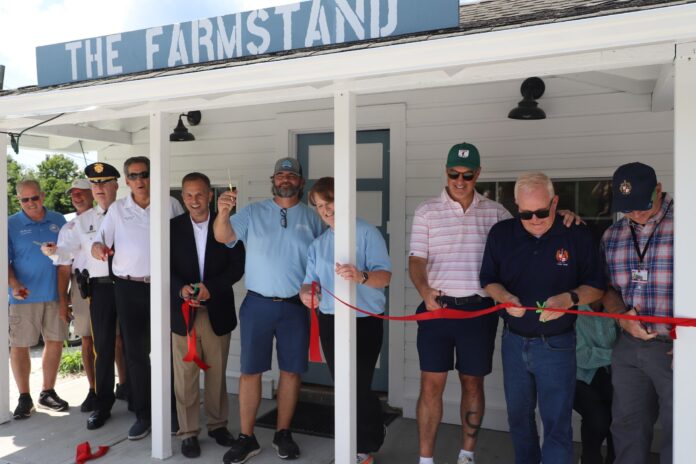

Ribbon cutting held July 31, 2026 at the Oscar Kincaid Home of History. Twenty-six years is a long time for a building to sit quiet. Long enough for a roof to sag, for memory to start slipping into legend, for a place that once anchored an entire community to become just another old structure people drove past without quite remembering why it mattered.
A Farmstand That Sat Silent for 26 Years Just Reopened Its Doors, and Its Story Runs a Century Deep
Twenty-six years is a long time for a building to sit quiet. Long enough for a roof to sag, for memory to start slipping into legend, for a place that once anchored an entire community to become just another old structure people drove past without quite remembering why it mattered. The Valley Farm Stand at the Oscar Kincaid Home of History in Boonton Township spent that exact stretch of silence, and this week, it stopped being silent. A ribbon cutting at the Powerville Road site brought Morris County Commissioner Director Stephen Shaw and Boonton Township Mayor Bill Klingener together with Historical Society of Boonton Township President Bill Rixon, Township Administrator Doug Cabana, members of the township committee, local residents, and the couple who actually made this reopening happen, Jeff and Colleen Dowling.
What makes this story worth telling in full isn’t just that an old building got fixed up. It’s that this particular stand has quietly witnessed nearly a century of how this corner of New Jersey actually lived, worked, and fed itself, long before anyone thought to call that kind of history worth preserving.
Oscar A. Kincaid Sr. builds the roadside stand as a gathering place and refreshment stop. Neighbors trade root beer and small talk, and town officials occasionally settle local disputes right there on site.
Kincaid enters the dairy business, expands the building, and installs a large walk-in cooler. Locals start calling it the milk house, tied directly to his Hillside Dairy route.
The family pivots back to general farming and the building takes on the name Valley Farm, selling sweet corn, tomatoes, peaches, apples, cider, Christmas trees, and firewood grown locally.
The stand begins carrying heirloom apples from Lyonsville pomologist Harold W. Schroeder, including Golden Russet, Fall Pippin, Black Gilliflower, and the distinctly New Jersey Maiden Blush variety.
The final harvest closes out the stand’s original run, not long before the passing of Oscar A. Kincaid Jr., who had carried his father’s farming tradition forward on an honor-system cash box for decades.
After 26 years of silence, Jeff and Colleen Dowling reopen the farmstand following a full, historically respectful restoration, beginning its next chapter as a working part of the community again.
“America’s story wasn’t written only in statehouses or on battlefields. It was also written on farms like this one, in communities like Boonton Township, by families like the Kincaids.”
Director Stephen Shaw, Morris County Commissioners“They approached the township about giving this iconic part of our community a new life, and we were pleased to work with them and our historic preservation partners to make it happen.”
Doug Cabana, Boonton Township Administrator“This has been a dream of ours that started ten years ago. We wanted a place where our family could work and spend time together, and where our children can carry that tradition forward.”
Jeff Dowling“He didn’t cut corners. He restored it the right way. We’re excited to see this historic landmark begin its next chapter.”
Bill Rixon, Historical Society PresidentThe man whose name the property still carries deserves more than a passing mention in his own story. Oscar A. Kincaid Jr. didn’t just inherit a farmstand, he spent a genuine public life shaping the county around it. He served on Boonton Township’s committee for years, including a four-year stretch as mayor in the mid-1970s, and he was a founding member of the Morris County Agricultural Development Board. Over his seventeen years on that board, it helped preserve 41 farms and more than 3,100 acres of Morris County farmland, the kind of quiet, unglamorous conservation work that keeps a region from paving over its own identity one parcel at a time. Mayor Klingener put it plainly at the ceremony, describing Kincaid as a man whose devotion to Boonton Township and Morris County ran through decades of public service most residents likely never fully connected to the little farmstand down the road.
Restoring a building this old is never just a construction project, and Jeff Dowling clearly understood that going in. The stand sat idle for over two and a half decades, exposed to exactly the kind of slow decay that swallows historic wooden structures when nobody’s maintaining them. Bringing it back the right way, rather than the fast way, meant respecting original materials and methods rather than gutting the place and rebuilding something generic wearing an old building’s name. That distinction is exactly why the Historical Society’s own president singled it out for praise rather than simply thanking the Dowlings for finishing a renovation.
The Valley Farm Stand sits on a property with a history that stretches back considerably further than the Kincaid name itself. The oldest surviving section of the Oscar Kincaid Home of History dates to roughly 1785, making it one of the oldest surviving frame structures anywhere in Boonton Township. Before the Kincaids, the property belonged to the Decker family, and John Decker is credited with expanding the house significantly back in 1837, over a century before the farmstand out front ever sold its first ear of corn.
Inside, the home holds a genuinely rare piece of folk art history most visitors would never expect to find in a working farmhouse. A distinctive plaster portrait decorates the north wall, created using a technique called spooning, where an artisan heats a pewter spoon and runs it repeatedly across barely damp plaster in continuous curling strokes, building up an intricate black and white swirling pattern purely through repetition and heat. It’s the kind of hyper-local, hands-on craftsmanship that simply doesn’t survive in most 19th-century homes, and its presence here says something about how carefully this particular property has been protected across multiple generations of ownership.
None of that funding or preservation status happened by accident. The property is individually listed on both the New Jersey and National Registers of Historic Places, and Morris County has backed it with real, sustained investment rather than a single ceremonial gesture. In 2001, the Morris County Agricultural Development Board purchased the 75-acre Kincaid farm specifically for open space and farmland preservation, taking the land itself permanently off the table for development. Since 2003, the Morris County Historic Preservation Trust Fund has awarded nearly $730,000 to the Historical Society of Boonton Township toward acquiring, stabilizing, and restoring both the Kincaid home and this very farmstand. A portion of the surrounding land now falls under the Morris County Park Commission and carries the name Kincaid Woods, a permanent, physical acknowledgment of exactly whose stewardship made all of this worth saving in the first place.
I’ll say plainly what I think this reopening actually represents, because it deserves more than a polite nod. Plenty of historic properties get a plaque, a photo opportunity, and then quietly fade back into disrepair once the ceremony ends. This one didn’t. Jeff and Colleen Dowling spent ten years chasing a dream most people would have abandoned somewhere around year three, and they did it in partnership with a township, a historical society, and a county government that all actually showed up with real money and real follow-through rather than empty proclamations. That combination, a private family’s genuine commitment matched with sustained public investment, is precisely the formula that saves buildings like this one instead of losing them to another quiet decade of decay. [Your Story Here]
The Historical Society of Boonton Township continues to own and oversee preservation of the Oscar Kincaid Home of History itself, while the Dowling family now operates the rehabilitated farmstand day to day, continuing its original purpose as a gathering place and a source of genuinely local, farm-fresh products. A hundred years after Oscar Kincaid Sr. first built a simple roadside stand for neighbors to share a root beer, the same patch of Powerville Road is back in business, carrying forward exactly the kind of unglamorous, deeply rooted community history that gives a place like Morris County its actual character.