
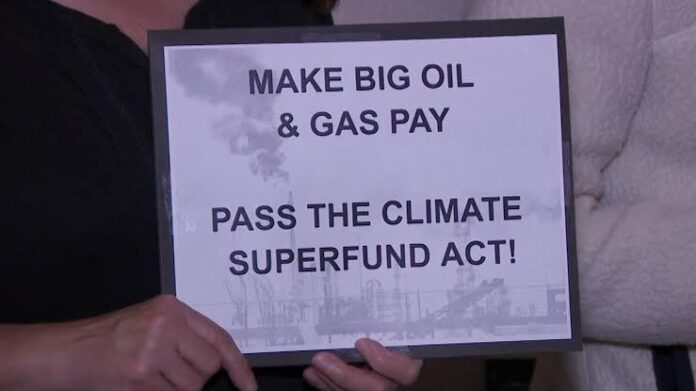

New Jersey’s long-running debate over energy policy, environmental accountability, and affordability has entered a consequential new phase as lawmakers consider legislation that could dramatically reshape how the state addresses the financial costs of climate change. The proposed Climate Superfund Act, known in Trenton as A-3735, has become one of the most closely watched and fiercely debated policy proposals of the year, drawing passionate support from environmental advocates while triggering strong opposition from business organizations, taxpayer groups, energy producers, and affordability advocates.
The legislation recently received attention during a hearing before the Assembly Environment and Solid Waste Committee, where lawmakers, stakeholders, and policy organizations continued to debate the far-reaching implications of a proposal that supporters view as a mechanism for accountability and opponents characterize as a massive financial transfer that could ultimately be borne by New Jersey consumers.
At its core, the Climate Superfund Act seeks to create a framework that would require major fossil fuel companies to contribute toward the costs associated with climate-related infrastructure projects, resiliency initiatives, flood mitigation efforts, and other public investments tied to the impacts of a changing climate. Supporters argue that companies that profited from fossil fuel production over decades should contribute financially toward addressing the environmental consequences that governments, taxpayers, and communities are increasingly being forced to manage.
Opponents, however, see the proposal through a very different lens.
Business organizations, fiscal policy groups, and many energy-sector stakeholders contend that the legislation represents a substantial economic risk at a time when New Jersey residents are already grappling with some of the highest utility costs, housing expenses, property taxes, and overall living costs in the nation. Critics argue that imposing significant financial assessments on energy producers will not occur in a vacuum. Instead, they warn that costs associated with compliance, litigation, and potential penalties could ultimately flow downstream through energy markets, potentially affecting consumers, businesses, and industries throughout the state.
The debate arrives during a period when affordability has emerged as one of the dominant political issues in New Jersey. Rising electric bills, elevated housing costs, inflationary pressures, and concerns about economic competitiveness have become central themes in legislative discussions across Trenton. From suburban commuters and small business owners to manufacturers and working families, affordability concerns continue to influence public policy conversations regardless of political affiliation.
That reality has transformed the Climate Superfund proposal into more than an environmental measure. It has become a test case for how New Jersey intends to balance environmental goals with economic realities.
Supporters of the legislation argue that the financial burden of climate-related damage already exists. They point to increasing flooding events, infrastructure upgrades, coastal resiliency projects, stormwater management systems, and environmental restoration efforts that require billions of dollars in public investment. From this perspective, the question is not whether those costs exist but who should pay for them.
Environmental advocates maintain that taxpayers should not shoulder the entire burden when fossil fuel companies generated substantial profits while contributing to conditions that now require expensive public responses. They argue that a dedicated funding source could help communities address climate vulnerabilities without relying solely on property taxes, state appropriations, or federal assistance.
The opposition coalition, however, believes the proposal introduces significant uncertainty into New Jersey’s economic environment. Business groups warn that retroactive financial assessments create concerns for companies evaluating long-term investment decisions. Critics argue that imposing massive liabilities on energy producers may discourage investment, increase operating costs, and create ripple effects that extend well beyond the targeted companies themselves.
These concerns have become particularly prominent as New Jersey continues competing with neighboring states for business investment, corporate headquarters, manufacturing projects, logistics facilities, technology companies, and energy infrastructure development.
Economic competitiveness has become an increasingly important issue for policymakers across the Garden State. New Jersey benefits from strategic geographic advantages, a highly educated workforce, world-class transportation infrastructure, and proximity to major metropolitan markets. Yet business leaders frequently cite regulatory complexity, taxation levels, and operating costs as factors that influence location decisions.
For opponents of the Climate Superfund Act, the proposal represents another variable that could influence perceptions of New Jersey’s business climate. They argue that policies perceived as punitive toward major industries could contribute to broader concerns about operating within the state.
The conversation is further complicated by New Jersey’s evolving energy strategy.
State leaders continue pursuing ambitious clean-energy objectives while simultaneously confronting reliability, affordability, and capacity challenges within the regional power grid. Policymakers are attempting to expand renewable energy generation, strengthen transmission infrastructure, support electrification initiatives, and maintain grid reliability—all while responding to public concerns about utility costs.
Recent discussions surrounding nuclear energy have added another dimension to the debate. Many policymakers increasingly view nuclear generation as an important component of a diversified energy portfolio capable of providing large-scale carbon-free electricity while maintaining reliability. As New Jersey examines long-term energy needs, questions surrounding the role of traditional fuels, renewable resources, and advanced nuclear technologies continue to shape policy discussions.
Against this backdrop, the Climate Superfund proposal has become symbolic of a broader philosophical divide regarding how environmental goals should be pursued.
One side argues that aggressive accountability measures are necessary to address decades of environmental costs and accelerate the transition toward a cleaner future. The other contends that affordability and economic competitiveness must remain central considerations when evaluating any policy that could affect energy markets or consumer costs.
For residents, the debate extends beyond legislative language and policy frameworks. The outcome could influence issues that directly affect daily life, including utility bills, infrastructure investments, economic development, job creation, and environmental resilience.
Communities throughout New Jersey are already experiencing the practical challenges associated with stronger storms, coastal flooding, aging infrastructure, and changing weather patterns. At the same time, many households remain intensely focused on affordability, particularly as they manage rising costs across multiple aspects of everyday life.
That tension explains why the discussion surrounding the Climate Superfund Act has generated such significant attention. It sits at the intersection of two priorities that New Jersey residents increasingly view as essential: environmental responsibility and economic affordability.
The committee hearing represents only one step in what is likely to be a lengthy policy battle. Additional legislative discussions, stakeholder engagement, economic analyses, and political negotiations are expected as lawmakers continue evaluating the proposal and its potential impacts.
What remains clear is that the debate reaches far beyond a single bill. It reflects larger questions about how New Jersey intends to finance climate adaptation, maintain economic competitiveness, protect consumers, and navigate the transition toward a changing energy future.
As policymakers continue weighing those competing priorities, the Climate Superfund Act stands as one of the most consequential environmental and economic proposals currently under consideration in Trenton. The decisions made in the months ahead could help define not only the state’s climate strategy but also its broader approach to balancing environmental stewardship, affordability, business investment, and long-term economic growth in one of America’s most densely populated and economically complex states.
















