
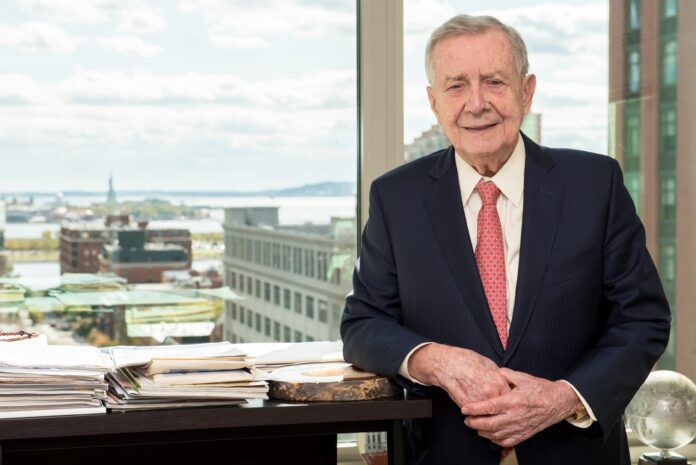

Few public figures have left a mark on New Jersey as broad, enduring, and multifaceted as Frank J. Guarini Jr. Over the course of more than a century, Guarini built a legacy that stretched from the battlefields of World War II to the halls of Congress, from international diplomacy to transformative philanthropy, and from the revitalization of Jersey City to educational institutions around the world. His passing on June 20, 2026, at the age of 101 closes a remarkable chapter in New Jersey history, but it also provides an opportunity to reflect on a life that embodied public service, civic leadership, and an unwavering commitment to community.
For generations of Hudson County residents, Guarini was more than a politician. He was a hometown success story whose influence could be felt in government, business, education, international affairs, and urban development. Long before the modern era of social media and carefully curated public images, Guarini cultivated a reputation as a larger-than-life figure whose experiences seemed almost impossible to fit into a single lifetime.
Born and raised in Jersey City, Guarini emerged from humble beginnings to become one of the most influential public servants New Jersey has ever produced. His story mirrored the aspirations of countless immigrant families who helped build Hudson County during the twentieth century. Yet his journey ultimately carried him far beyond local politics and into the center of some of the most important geopolitical, economic, and cultural developments of the modern era.
His first major chapter unfolded during World War II. Serving as a Navy officer aboard the flagship of the Pacific Fleet, Guarini participated in one of the defining conflicts of the twentieth century. His military service earned him a Navy Commendation Medal and three battle stars, honors that reflected not only courage and dedication but also a commitment to service that would become a recurring theme throughout his life. For many members of his generation, military service was a formative experience. For Guarini, it became the foundation upon which he built a lifelong dedication to public responsibility.
After returning home, he pursued an ambitious educational path that reflected both intellectual curiosity and determination. Studies at Dartmouth College, New York University School of Law, and advanced international legal institutions prepared him for a career that would eventually span law, politics, diplomacy, and business. At a time when international engagement was becoming increasingly important in a rapidly changing world, Guarini developed expertise that would later position him as an influential voice in global affairs.
His early legal career established his reputation as a skilled attorney, but public service soon called. Entering New Jersey politics, Guarini served in the State Senate, where he played an important role in shaping public policy and modernizing aspects of state government. His contributions extended beyond routine legislative work. He helped advance reforms that strengthened New Jersey’s legal framework while supporting infrastructure and development projects that would have lasting impacts on the state’s economic future.
Among those achievements was his involvement in efforts that ultimately helped bring the New York Giants to New Jersey and establish what became Giants Stadium. At the time, the move represented a transformative moment for the state’s identity and economic development. It demonstrated that New Jersey could serve as more than a commuter state between major metropolitan centers. It could host world-class institutions and attractions in its own right.
Guarini’s political career reached its highest profile during his seven terms in the United States House of Representatives. Serving on the powerful Ways and Means Committee, he became a significant participant in national conversations involving taxation, trade, education, and economic policy. His appointment to such an influential committee reflected the respect he earned among colleagues and underscored his growing influence in Washington.
Yet even as he became a national political figure, Guarini maintained a strong connection to the communities that elected him. Hudson County remained central to his identity, and many residents continued to view him not as a distant Washington politician but as one of their own. That connection explains why he remained such a beloved figure throughout Jersey City long after his congressional career concluded.
His work in Congress also opened doors to an extraordinary international career. Guarini traveled extensively on diplomatic and trade missions, interacting with leaders who shaped the course of modern history. He met and negotiated with figures including Deng Xiaoping and Boris Yeltsin, witnessed historic moments surrounding the collapse of Soviet influence in Eastern Europe, and stood near the center of global events that redefined international politics during the late twentieth century.
One of the most remarkable moments in his diplomatic career involved his support for Polish labor leader and democracy advocate Lech Wałęsa. Guarini’s efforts contributed to international recognition of Wałęsa’s work and reflected his longstanding belief in democratic institutions and international cooperation. He later witnessed firsthand the fall of the Berlin Wall, an event that symbolized the end of one era and the beginning of another.
Following his congressional service, President Bill Clinton appointed Guarini as the United States representative to the United Nations General Assembly, further cementing a diplomatic legacy that few New Jersey politicians have ever matched. His international experiences gave him a global perspective while reinforcing his belief that education, engagement, and cooperation remained essential tools for solving complex challenges.
While many public officials might have slowed down after careers in government, Guarini simply entered another chapter. Returning to New Jersey, he became deeply involved in commercial real estate development and played a meaningful role in the continuing transformation of the Jersey City waterfront. His business activities contributed to the dramatic evolution of Hudson County during a period when former industrial landscapes were being reimagined as vibrant centers of commerce, housing, culture, and economic activity.
Yet it is perhaps his philanthropic work that will prove most enduring.
Throughout his later decades, Guarini directed substantial resources toward educational institutions and civic organizations. His contributions were not symbolic gestures designed merely to place his name on buildings. Rather, they reflected a deeply held belief that education creates opportunity, expands horizons, and strengthens communities.
Institutions throughout New Jersey and beyond benefited from that philosophy. Saint Peter’s University, New Jersey City University, Dartmouth College, New York University School of Law, John Cabot University in Rome, and numerous other organizations received transformative support. Scholarships, institutes, libraries, educational programs, and international initiatives emerged from his generosity, creating pathways for students and families who otherwise might not have had access to those opportunities.
His impact at New Jersey City University is especially significant. Through the Guarini Institute for International Education and Economic Mobility and other initiatives, his vision continues to influence students seeking global experiences, educational advancement, and economic opportunity. The institute’s work reflects values that defined Guarini’s own life: international engagement, educational achievement, civic responsibility, and upward mobility.
The scale of his philanthropy became visible throughout Jersey City and Hudson County, where public buildings, academic centers, and civic institutions bear his name. Earlier this month, Guarini attended the opening of the $350 million Frank J. Guarini Justice Complex, a project made possible in part through his donation of the land upon which the facility now stands. Even at 101 years old, he remained engaged, active, and connected to the community that shaped him.
That moment now feels especially poignant. It served as a fitting final public appearance for a man whose life was defined by giving back to the place he called home.
Perhaps what made Frank Guarini such a compelling figure was the extraordinary combination of experiences contained within a single life. He was a war veteran, attorney, legislator, congressman, diplomat, businessman, developer, philanthropist, and global ambassador for New Jersey. He shared conversations with presidents, pop culture icons, world leaders, religious figures, and Nobel Prize recipients. Yet despite those experiences, he never lost sight of Jersey City or the people who supported him throughout his career.
His story reflects the possibilities of public service at its best. It demonstrates how leadership can extend beyond elections and office-holding to create lasting impacts through education, philanthropy, economic development, and community investment. While many leaders are remembered for a particular policy or political victory, Guarini’s legacy is broader. It lives in the students who received opportunities through programs he funded, the institutions he strengthened, the communities he helped transform, and the countless individuals inspired by his example.
As New Jersey reflects on the passing of one of its most accomplished public figures, Frank Guarini Jr.’s life stands as a reminder of what can be achieved through service, vision, generosity, and an enduring belief in the power of community. Few people leave behind a century of accomplishments that touch so many sectors of society. Fewer still remain beloved by their hometown throughout that journey.
For Jersey City, Hudson County, and the State of New Jersey, Frank Guarini Jr. was far more than a former congressman. He was a builder of institutions, a champion of education, a citizen of the world, and a lifelong advocate for opportunity. His legacy will continue shaping New Jersey long after the final chapter of his remarkable 101-year journey has been written.
















