
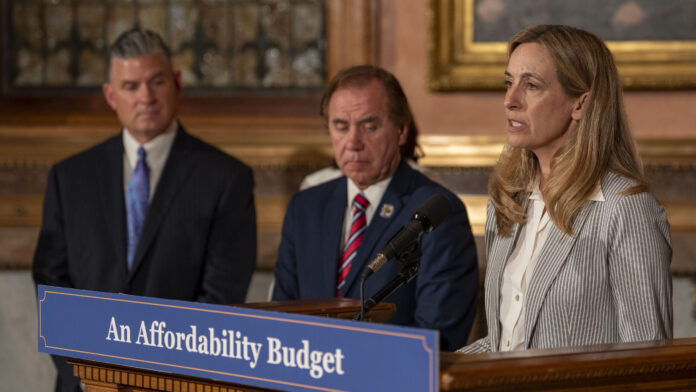

Weeks after Governor Mikie Sherrill signed New Jersey’s $60.7 billion budget, the state finally released the full list of local legislative spending tucked inside it, reopening a familiar fight over transparency even as officials point to a structural deficit that is actually smaller than it was a year ago.
New Jersey’s Budget Has a $1.4 Billion Gap and 488 Line Items Nobody Saw Until Now
New Jersey’s $60.7 billion fiscal year 2027 budget carries a structural deficit of roughly 1.4 billion dollars, meaning the state’s recurring revenue still falls short of its recurring, legally mandated obligations even after the spending plan Governor Mikie Sherrill signed on June 30th. What has drawn fresh attention weeks after that signing is not the deficit itself, which state officials have been transparent about since the budget process began, but the full, itemized list of 488 individual legislative spending projects tucked into the budget and a related supplemental bill, details that were not made public until mid-August.
A Deficit That Is Actually Smaller Than It Was
It is worth being precise about what this year’s structural deficit figure actually represents, since it is easy to read a 1.4 billion dollar gap in isolation as evidence of worsening fiscal discipline rather than what state officials say it actually reflects, real improvement. According to the Treasury Department, the structural deficit Sherrill inherited when she took office in January stood at more than 3 billion dollars, meaning this year’s budget cuts that gap by roughly half. The state’s surplus at the time of signing stood at just over 6 billion dollars, giving New Jersey a real cash cushion to draw on as it works to fully close the remaining gap between recurring revenue and recurring obligations over the coming years.
That gap exists because several of the state’s largest and most legally binding costs continue climbing faster than tax revenue alone can cover. The budget fully funds the state’s actuarially determined pension contribution at 7.2 billion dollars, honoring a commitment past administrations have frequently shortchanged, alongside 11.9 billion dollars in direct K-12 school aid under the School Funding Reform Act, 4.8 billion dollars for the state’s Medicaid program, and 3.5 billion dollars in debt service payments the state has no legal ability to defer or reduce.
Pension Contribution
$7.2 billion, the full actuarially determined payment
K-12 School Aid
$11.9 billion under the School Funding Reform Act
Medicaid
$4.8 billion to fund the program’s ongoing costs
Debt Service
$3.5 billion in mandatory state debt payments
What the 488 Line Items Actually Are
The itemized project list, formally tied to Legislative Municipal Property Tax Relief grants and related supplemental appropriations, includes resolution information covering who sponsored each item and how much it received. Of the full 488, 76 specifically trace back to a supplemental appropriations bill totaling 358.8 million dollars that lawmakers approved alongside the main budget, spending that was folded in through a separate mechanism rather than appearing in the headline budget total itself. Not every item on the list is a small, hyper-local add-on. The supplemental bill includes a 40 million dollar allocation to the New Jersey Sports and Exposition Authority tied to international events and improvements connected to the 2026 FIFA World Cup, which was played in East Rutherford, a genuinely large, statewide item sitting alongside far smaller, district specific requests.
Those smaller requests make up the bulk of what critics have labeled pork spending, funding directed toward individual senators’ and Assembly members’ home districts for projects including town hall roof repairs, park turf field replacements, sewer pipe upgrades, municipal HVAC systems, local historical society and museum grants, community center renovations, new fire trucks, upgraded police dispatch radios, and specific road paving projects.
Two Very Different Ways to Read the Same Numbers
The timing and scale of these projects have opened a familiar divide between fiscal watchdog groups and legislative leadership, one that recurs almost every budget cycle in Trenton regardless of which party controls the governor’s office. Organizations including the Garden State Initiative argue that layering 358.8 million dollars in localized spending onto a budget already carrying a 1.4 billion dollar structural deficit represents genuine fiscal risk, warning that continued drawdowns of the state’s surplus during a period of only modest revenue growth leave New Jersey more exposed to a potential credit downgrade or a future recession with less cushion available to absorb it.
Legislative leadership sees the same spending in almost entirely different terms. Their argument is that these 488 projects function as a direct form of property tax relief, since a town left to cover its own sewer repair, fire truck purchase, or municipal roof replacement without state help would very likely need to raise local property taxes to pay for it instead. Under that framing, the supplemental spending is not competing with fiscal discipline so much as substituting for a different, more painful cost that would otherwise land directly on local homeowners. Both sides, notably, are working from the same set of numbers, they simply disagree about which risk, a shrinking surplus or higher local property taxes, deserves more weight in a budget already balancing several genuinely difficult, competing obligations at once.
















