
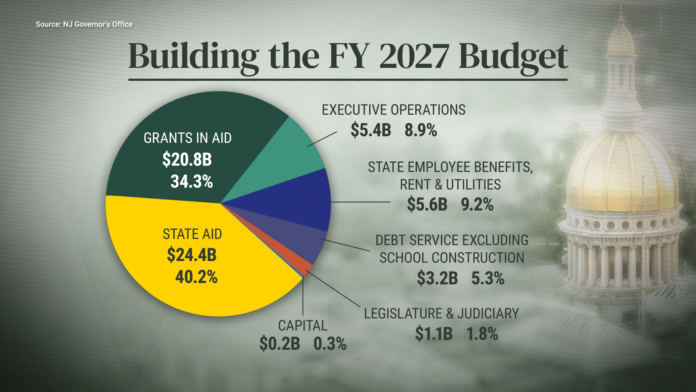

New Jersey’s Fiscal Year 2027 budget cleared its final legislative hurdles this week in the kind of compressed, late-Sunday-night committee sessions that have become a familiar ritual of Trenton’s end-of-June budget process, and the document that emerged from those negotiations tells a clear and deliberate story about Governor Mikie Sherrill’s fiscal priorities in her first full budget cycle. At $60.75 billion, the largest state budget in New Jersey’s history prioritizes a historic surplus and full pension funding over the kind of business-friendly tax relief that the state’s commercial sector had been pressing for throughout the negotiation process — a choice that has produced a budget simultaneously praised by fiscal stability advocates and condemned by business coalitions as a missed opportunity for economic growth at precisely the moment New Jersey needed one.
The single most consequential decision embedded in this budget is the size of the reserve fund Trenton chose to lock away rather than spend or return to taxpayers. Lawmakers secured a surplus in the range of $6 billion to $6.5 billion, representing more than 10 percent of the entire budget held in reserve — a figure that marks a genuine departure from the thinner margins New Jersey governments have operated with in recent budget cycles, when surpluses were frequently drawn down close to the legal minimum threshold. The rationale behind that historic cushion is explicitly defensive in nature: with federal fiscal policy increasingly unpredictable under the current administration in Washington, and with local economic conditions shifting in ways that could affect state revenue collection with little warning, Trenton’s budget architects made a calculated decision that fiscal stability itself should be treated as the budget’s primary achievement, even if securing that stability required drawing hard, sometimes unpopular lines elsewhere in the spending plan. That tradeoff is the lens through which nearly every other major decision in this budget should be understood.
The fate of the Stay NJ property tax relief program illustrates that tradeoff with particular clarity. The program, which had faced genuine threat of significant reduction earlier in the budget process, ultimately survived the final negotiation with roughly $100 million more in funding than Governor Sherrill’s original baseline proposal had allocated — a outcome that allowed legislative leaders, and Assembly Speaker Craig Coughlin in particular, to claim a meaningful political victory in preserving one of the state’s most closely watched senior relief initiatives. But that survival came with a structural catch significant enough to fundamentally change what the program actually is. To make the math work within the budget’s broader surplus-protection strategy, lawmakers aggressively narrowed the program’s income eligibility threshold, cutting the qualifying cap for senior homeowners from $500,000 down to a range of $200,000 to $250,000 depending on the specific income band. That single change dropped the program’s overall cost by hundreds of millions of dollars by carving wealthier retirees out of eligibility entirely, transforming Stay NJ from what had been pitched as a broadly universal property tax benefit into a far more tightly targeted middle-class program. For New Jersey seniors who had organized their retirement planning around the original, more generous eligibility threshold, that restructuring represents a meaningful and, for some, unwelcome recalibration of a benefit they had been counting on.
The most pointed criticism of the final budget has come from New Jersey’s business community, and the New Jersey Chamber of Commerce’s formal response reads as a direct rebuke of the spending plan’s underlying priorities. Chamber leadership has characterized the budget as one that virtually ignores economic growth as a policy objective, pointing specifically to reduced funding for small business support programs and the inclusion of new corporate tax measures as evidence that Trenton’s fiscal strategy this cycle was built around protecting the surplus rather than strengthening the state’s competitive position relative to neighboring states. That criticism carries particular weight given New Jersey’s persistent structural deficit, a gap between ongoing revenue and ongoing spending commitments that independent fiscal analysts continue to place at approximately $1.4 billion even after this budget’s surplus-building measures are accounted for. Business advocates argue that relying on corporate tax increases and restricted tax breaks to protect a historic surplus, rather than pursuing the kind of structural reforms that would close that underlying deficit while also making New Jersey more attractive to employers, simply defers a harder reckoning to a future budget cycle while making the state less competitive in the meantime. The warning embedded in that critique is explicit: employers considering whether to expand, relocate, or simply remain in New Jersey are watching how the state treats its business community in moments exactly like this one, and a budget that prioritizes government’s own fiscal cushion over conditions for private investment sends a signal that the Chamber and its members consider genuinely costly over time.
The process by which this budget reached its final form has generated its own significant controversy, separate from the substantive policy disputes over the surplus and Stay NJ. Republican lawmakers opposed the budget’s advancement specifically on transparency grounds, and the timeline behind Sunday night’s committee votes lends considerable credibility to that objection. According to state budget officials, the actual 56-page line-item appropriations document was not distributed to committee members until approximately fifteen minutes before the voting session itself began — a window that made any genuine line-by-line review of the document’s contents effectively impossible before lawmakers were asked to cast their votes. That compressed timeline matters considerably given what the document actually contains: millions of dollars in hyper-local, individually negotiated funding allocations and targeted municipal carve-outs, the kind of provision-by-provision dealmaking that critics describe as logrolling, distributed throughout the bill in ways that would typically draw careful scrutiny under normal legislative review timelines. Among the most significant of these targeted allocations is a $120 million state assistance package directed specifically at addressing Jersey City’s developing fiscal crisis — a substantial, single-municipality commitment that arrived in the final document essentially unreviewable by the committee members being asked to approve it on a fifteen-minute turnaround. Whatever the merits of that specific allocation or any of the budget’s other targeted provisions, a legislative process that structurally prevents meaningful review before a vote raises legitimate institutional questions that exist independently of whether any individual provision turns out to be good or bad policy.
Taken as a whole, the FY2027 budget reads less like a deliberate growth strategy designed to expand New Jersey’s economic base and more like a defensive fiscal shield constructed specifically to protect the state against an uncertain federal and economic environment. It fully funds the state’s pension obligations, a commitment that matters enormously for the long-term fiscal health of New Jersey’s public employee retirement system and that previous administrations have, at various points, failed to honor. It stabilizes several of the state’s most immediate fiscal pressures, including the targeted relief extended to Jersey City. But it accomplishes those objectives substantially through new corporate tax revenue and a significantly narrowed version of what had been promised as broad-based middle-class tax relief, choices that leave the business community feeling, in the words of its most prominent advocacy organization, virtually ignored at a moment when the state’s long-term economic competitiveness arguably required the opposite approach.
With this budget cycle now concluding, the more consequential question facing Trenton may not be how this particular spending plan was assembled, but what comes next. Attention should now turn toward the policy work that this budget conspicuously did not prioritize: advancing the kind of structural reforms that strengthen New Jersey’s economy, encourage sustained private investment, and improve the state’s long-term competitive position relative to New York, Pennsylvania, and the other states New Jersey employers can choose to relocate toward if the state’s business climate does not improve. Those priorities have been functionally absent from New Jersey’s budget conversation for too long, repeatedly subordinated to the kind of short-term fiscal triage that produced this year’s historic surplus. New Jersey’s employers, the businesses that create jobs, drive capital investment, and ultimately fund the tax base every future state budget will depend on, received only minimal support in this cycle’s spending priorities. Whether the Legislature and the Sherrill administration choose to treat that omission as the central unfinished business of the year ahead, rather than as a problem deferred indefinitely to the next budget cycle, will determine a great deal about whether New Jersey’s economic trajectory matches the fiscal stability this budget worked so deliberately to secure.
















