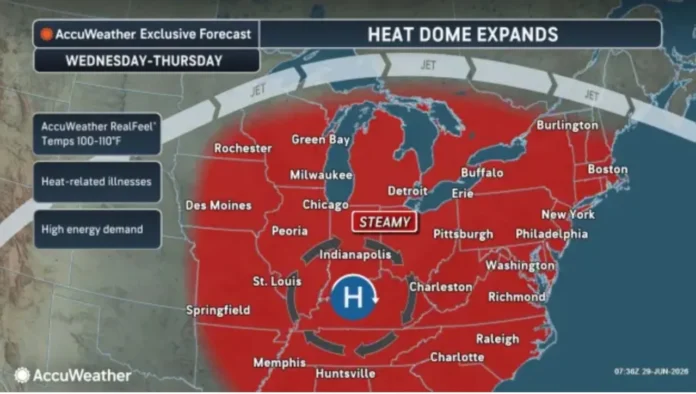

The National Weather Service has upgraded its alert for New Jersey to an Excessive Heat Warning beginning Wednesday, July 1, as a massive and unusually stubborn atmospheric ridge settles directly over the Mid-Atlantic region, locking the state into what meteorologists are describing as its most intense and dangerous heat wave in fifteen years. The warning carries the highest level of urgency the National Weather Service issues for extreme heat events, and it arrives precisely as millions of New Jersey residents are finalizing outdoor plans for the Fourth of July holiday weekend — a collision of timing that public health officials say demands genuine behavioral changes rather than routine summer caution.
The National Weather Service has upgraded the region to an Excessive Heat Warning starting Wednesday, as a massive atmospheric heat dome settles directly over the Mid-Atlantic.
Day-by-Day Forecast Details
- Wednesday, July 1: Extreme heat kicks into overdrive. Highs will rapidly climb into the mid-to-upper 90s across the state, with humidity pushing real-feel heat indexes between 100°F and 107°F. There is a minor, isolated 10% chance of a late-afternoon pop-up thunderstorm.
- Thursday, July 2: The core of the heat dome settles in. Actual air temperatures are forecast to hit 100°F to 103°F in inland areas (like Paramus and Hamilton). Peak afternoon heat index values will sit dangerously between 105°F and 110°F.
- Friday, July 3: Another brutal, triple-digit day with ambient highs near 100°F to 102°F. It will remain intensely humid. Scattered, isolated severe thunderstorms are expected to develop late in the afternoon and evening ahead of a weak cold front.
- Saturday, Independence Day (July 4): Still heavily oppressed by heat, though down slightly with highs in the mid-90s. It will start mostly sunny, but increasing clouds will trigger a 50% chance of scattered afternoon and evening thunderstorms. Keep a close eye on local radar if you have outdoor fireworks plans.
- Sunday, July 5: The worst of the heat wave finally breaks slightly. Highs will settle into a comparatively comfortable around 90°F to 92°F under partly cloudy skies.
Critical Safety Warnings
Because overnight low temperatures will stubbornly hover in the high 70s and low 80s, your body will get very little natural cooling relief at night. State health officials strongly advise staying indoors in air conditioning during peak afternoon hours, drastically increasing your water intake, and never leaving children or pets inside vehicles under any circumstances. [1, 2]
The atmospheric mechanism producing this event is worth understanding in some detail, because it explains both why this heat wave is arriving and why it is expected to persist with unusual stubbornness through the holiday weekend rather than passing through in the more typical one-to-two-day window New Jersey residents associate with summer hot spells. The upper-level jet stream, which under normal summer conditions oscillates north and south in ways that periodically usher cooler air into the Mid-Atlantic, is lifting unusually far north of New Jersey this week, building what meteorologists call a ridge over the eastern United States. That ridge began forming over Tennessee and is migrating slowly eastward, a west-to-east crawl expected to position it over the Outer Banks region by Sunday. As the ridge builds and the upper jet rises with it, the resulting atmospheric circulation acts essentially as a vacuum, drawing hot, humid air northward from the Gulf of Mexico and depositing it directly over the Mid-Atlantic at the exact moment of the year when the sun sits at its highest seasonal angle. The combination of imported tropical air mass and maximum solar radiation is what produces the specific hazy, oppressive quality that has come to define this week’s forecast — not simply heat, but heat compounded by humidity and intensified by the sun’s most direct angle of the entire year.
Temperatures will begin climbing in earnest on Wednesday, July 1, with highs rapidly reaching the mid-to-upper 90s across most of the state and humidity pushing real-feel heat index values to between 100 and 107 degrees. A minor, roughly 10 percent chance of an isolated late-afternoon pop-up thunderstorm exists, though it should not be read as meaningful relief from the day’s underlying heat profile. Thursday, July 2, marks the arrival of the heat dome’s core, with actual air temperatures forecast to reach 100 to 103 degrees in the state’s inland communities — areas including Paramus in the north and Hamilton in central New Jersey are specifically positioned to see some of the most extreme readings — while peak afternoon heat index values are projected to fall between a dangerous 105 and 110 degrees. Friday, July 3, brings another brutal triple-digit day, with ambient highs near 100 to 102 degrees and humidity remaining intense throughout, though scattered, isolated severe thunderstorms are expected to develop late in the afternoon and evening ahead of a weak approaching cold front. Independence Day itself, Saturday, July 4, will see conditions ease only marginally, with highs settling into the mid-90s; the day is expected to start mostly sunny before increasing cloud cover raises the chance of scattered afternoon and evening thunderstorms to roughly 50 percent, a forecast detail that anyone with outdoor fireworks plans should monitor closely against local radar as the evening approaches. Relief, such as it is, arrives Sunday, July 5, when the worst of the heat wave finally breaks, with highs settling into a comparatively tolerable range of 90 to 92 degrees under partly cloudy skies.
The overnight temperature pattern accompanying this heat wave deserves particular attention, because it is arguably the single most dangerous structural feature of the entire event. Under ordinary summer conditions, nighttime hours allow the human body a meaningful window to cool down, recover from a day’s heat exposure, and prepare physiologically for the next day’s temperatures. This week, that recovery window will be sharply curtailed: overnight lows are expected to remain stubbornly elevated in the high 70s and low 80s, hovering close to the dew point temperature itself, which produces what meteorologists describe as thick, saturated air that offers the body essentially no genuine cooling relief even after sunset. Across consecutive nights of this pattern, the cumulative physiological strain compounds, meaning the danger of this heat wave is not simply a function of Thursday’s or Friday’s peak afternoon numbers in isolation, but of the sustained, multi-day character of the event as a whole.
Beyond the sustained heat itself, this week’s weather pattern carries a secondary and more unusual risk that meteorologists are watching closely: the potential for an organized severe thunderstorm outbreak riding what is known among forecasters as a ring of fire pattern. Because New Jersey will sit on the northwestern side of the building ridge’s circulation for much of the week, an upper-level steering current effectively opens a corridor running from the Great Lakes region directly toward the Mid-Atlantic, and powerful complexes of thunderstorms have a documented tendency to organize and travel rapidly along exactly this kind of atmospheric highway. The 2012 derecho — the historic, fast-moving line of destructive thunderstorms that swept from the Midwest into the Mid-Atlantic in a matter of hours, leaving widespread wind damage and power outages across multiple states — formed under a comparable setup. Meteorologists caution that such storm complexes can traverse the distance from the Great Lakes to New Jersey in as little as six hours once they organize, meaning a system that does not yet exist on Tuesday night could plausibly affect the region with little advance warning later in the week. The exact track such a system might take, and whether it favors New Jersey or shifts toward New England instead, will depend on the final positioning of the ridge as the week progresses, but forecasters consider it likely that the broader Mid-Atlantic and New England corridor will see at least one such event before the pattern finally breaks.
The public health guidance accompanying this forecast reflects an honest acknowledgment that not every New Jersey resident has the option of remaining indoors through the most dangerous hours of the day. Construction crews, landscaping companies, delivery drivers, agricultural workers, and countless others whose jobs require outdoor labor cannot simply opt out of Wednesday through Saturday’s peak heat regardless of how extreme the forecast becomes, and state health officials and meteorologists have framed their safety guidance accordingly: the goal is not blanket avoidance of the outdoors, which is unrealistic for a significant share of the workforce, but a deliberate, sustained effort to stay as cool and hydrated as each individual’s specific situation reasonably allows. That means understanding the practical difference between heat exhaustion and heat stroke well before symptoms appear rather than during an emergency. Heat exhaustion typically presents as heavy sweating, weakness, cold or clammy skin, a rapid but weak pulse, nausea, and dizziness, and generally responds to moving into shade or air conditioning, loosening clothing, and sipping water. Heat stroke is the far more dangerous escalation, marked by a body temperature above 103 degrees, hot and dry or unusually flushed skin, a rapid and strong pulse, confusion, slurred speech, or loss of consciousness, and constitutes a genuine medical emergency requiring immediate 911 contact rather than home treatment.
State officials have emphasized several specific precautions for the days ahead. Anyone able to limit outdoor exposure during the peak afternoon hours, generally from late morning through early evening, should do so, retreating to air-conditioned spaces whenever possible given that this week’s overnight low temperatures will not provide the natural cooling relief New Jersey residents typically rely on between hot days. Water intake should increase substantially beyond ordinary habits, with officials cautioning against waiting for thirst to develop before drinking, since thirst itself is a lagging indicator of dehydration rather than an early warning sign. And officials have reiterated, in the starkest possible terms, that children and pets must never be left inside parked vehicles under any circumstances during this stretch of weather, given how rapidly interior vehicle temperatures climb even with outdoor air in the 90s, let alone the triple digits this week’s forecast anticipates.
For New Jersey residents finalizing Fourth of July weekend plans, the practical takeaway from this forecast is straightforward: Wednesday through Saturday represents a genuinely dangerous, sustained heat event rather than a typical few uncomfortable summer afternoons, and any outdoor plans — fireworks viewing, beach trips, backyard gatherings, parades — should be built around the early morning or evening hours when temperatures are at their lowest, with contingency planning in place for both the extreme afternoon heat and the possibility of fast-developing severe thunderstorms riding in from the west with little warning. Conditions are expected to moderate by Sunday, July 5, and forecasters anticipate posting a fuller, more detailed holiday weekend outlook by Wednesday as the ridge’s exact positioning becomes clearer. Until then, the guidance for the state’s nearly nine million residents remains consistent: prepare for the most extreme and sustained heat New Jersey has experienced in a decade and a half, and treat the week’s forecast with the seriousness that an Excessive Heat Warning is specifically designed to convey.