
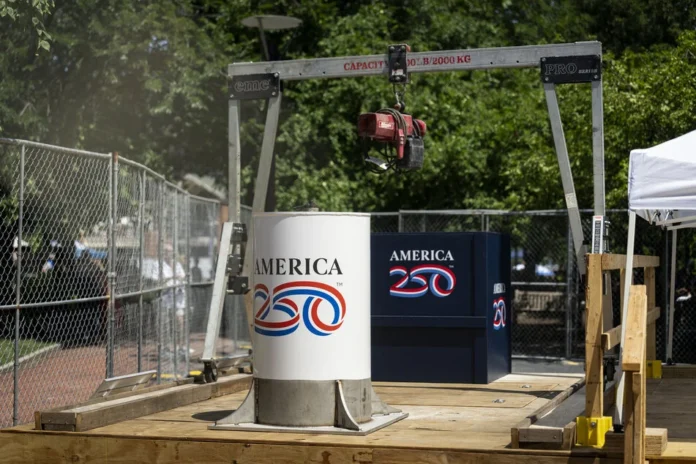

On the morning of July 4, 2026, a 900-pound stainless steel cylinder was lowered ten feet into the ground in Independence Mall in Philadelphia, sealed beneath a 1,100-pound stainless steel bell jar that creates an air pocket to mitigate water intrusion, and covered with a capstone inscribed with the information that whoever eventually opens it — in the year 2276, on the occasion of America’s 500th birthday — will need to understand what they are looking at and why it is there. The capsule is called America’s Time Capsule, and its burial was mandated by a 2016 Act of Congress that created the nonpartisan America250 commission and specified that the capsule be buried in Philadelphia — the city where the Declaration of Independence was adopted in 1776 and where, two and a half centuries later, the physical location of that history made it the obvious, perhaps inevitable choice for where the nation would leave a letter to its descendants. The capsule will not be opened again until the United States celebrates its 500th birthday, which means that no living person in 2026, and almost certainly no living person in any generation that can claim family continuity with the current one, will see what is inside.
The engineering that Michael Berilla and his team at the National Institute of Standards and Technology devoted to ensuring the capsule survives 250 years of underground time reflects a seriousness of institutional purpose that the phrase time capsule does not always suggest. The cylinder’s cylindrical rather than rectangular shape was chosen specifically because corners and edges are structural failure points over long periods — the seamless curve is more resilient across centuries. The interior was sealed at 35 percent relative humidity, moist enough to prevent contents from drying out and disintegrating, dry enough to prevent the decay that excessive moisture produces. The burial depth of ten feet protects against temperature fluctuation, storm surge, and the ordinary environmental variables that would otherwise degrade the contents over generations. Berilla, whose team previously built encasements for historical documents intended for indoor preservation, was working in longer timescales than his prior projects required. He noted publicly that Philadelphia would have to be six feet underwater for the capsule to face any genuine risk of water intrusion — and that if Philadelphia is six feet underwater in 2276, the people opening the capsule will have considerably larger concerns.
The location of the burial is marked by a capstone and, above ground, by a new sculpture installed at the site: a large segmented snake modeled on Benjamin Franklin’s 1754 “Join, or Die” woodcut cartoon, the first political cartoon published in an American newspaper, which Franklin created to urge the colonial assemblies toward unified action against French and Native American threats and which became, during the Revolution, one of the most potent symbols of colonial unity and resistance. Using that image to mark the physical location of a time capsule buried to be found in 2276 is a piece of curatorial intelligence that the selection committee presumably recognized: the same call for unity that Franklin expressed in 1754, and that the Revolution answered in 1776, is embedded in the monument that will guide the excavation of 2276.
New Jersey’s contribution to the capsule reflects a deliberate choice that Representative Bonnie Watson Coleman, who served as the lead House sponsor for the time capsule legislation, characterized as a decision to prioritize message over artifact. The state’s 119th Congressional delegation debated several alternatives before arriving at what is now sealed ten feet below Independence Mall: a stainless steel plate, inscribed with a greeting on its front face and the state motto in eight languages on its reverse. The front reads: New Jersey sends greetings to the people of 2276, expressing the hope that the values that guide us in 2026 — liberty, opportunity, cooperation, love and respect for one another — continue to shape society 250 years from now. The reverse displays Liberty and Prosperity — New Jersey’s official state motto, adopted in 1777, the year after independence — in eight languages, chosen to reflect the state’s position as one of the most linguistically diverse places in the United States and one of the most diverse in the world.
The alternatives the New Jersey delegation considered before settling on the steel plate reveal something about the specific comedy and seriousness of the deliberation that states brought to a project whose instructions — send something that will represent your state to people who will not exist for 250 years — are simultaneously simple and impossible to fully satisfy. Pork roll, also known as Taylor Ham in certain parts of the state, was advanced as a submission with the argument — offered by Representative Rob Menendez with stated confidence — that it would probably still be edible in 250 years. Representative Josh Gottheimer objected strenuously. Memorabilia honoring Bruce Springsteen and Whitney Houston was also discussed, a gesture toward New Jersey’s extraordinarily deep musical legacy that the delegation ultimately concluded was too culturally specific to serve as the state’s primary message to a future that may not share 2026’s reference points. The steel plate and its multilingual motto survived these deliberations as the option that could speak across the maximum number of possible futures: whatever language the people of 2276 speak, whatever they know or don’t know about Taylor Ham, whatever their familiarity with the Born to Run album, the words liberty, opportunity, cooperation, love and respect for one another translate.
The diversity of what other states chose to submit gives the New Jersey approach its context. California, looking maximally forward, submitted an AI chatbot’s prediction for what the state will look like in 2276 — highways gone, grizzly bears returned, and the state having seceded to form a Pacific Federation with Oregon, Washington, and British Columbia. Maine submitted a bone from an endangered North Atlantic right whale, a submission whose implications for what the whale’s population status will be in 2276 the donor presumably considered. Maryland attempted to submit Old Bay seasoning and was told that organic materials subject to decay could not be included in the archival environment; Old Bay’s exclusion from America’s Time Capsule is, depending on one’s perspective, either a loss for posterity or the correct institutional decision. Utah submitted 100 cards featuring historical citizens, 13 coins, eight documents, eight pins, two granite disks, and a booklet — the most maximalist submission of any state. Arizona nano-etched the full texts of the Declaration of Independence and the United States Constitution onto a single stainless steel coin, an approach to document preservation through miniaturization that would have impressed the Founders.
The federal contributions add their own register. A pocket Constitution signed by all nine sitting Supreme Court Justices is sealed inside, alongside a crystal from the 2026 New Year’s Eve ball drop in Times Square, a letter from the Architect of the Capitol, a contribution from the Library of Congress that includes a molecular data storage device encoding synthetic DNA that carries Francis Scott Key’s handwritten Star-Spangled Banner lyrics, Thomas Jefferson’s rough draft of the Declaration of Independence, and a three-dimensional rendering of Abraham Lincoln’s hand — three of the most consequential documents and artifacts in American history preserved in a biological rather than paper medium, on the theory that synthetic DNA is among the most stable information storage formats available and may be more legible to the people of 2276 than any paper document could be. The letter Berilla wrote and sealed inside on behalf of his engineering team reads, in part: Greetings from the living, breathing hearts and hands of 2026. We will have long since returned to dust, but our devotion, pride, and unwavering hope for what our world could become are alive right here inside this steel.
The National Park Service has incorporated details about the capsule’s existence and location into its institutional succession plans, to be passed down through the organization’s administrative history across the generations between now and 2276, ensuring that the knowledge of what is buried under the snake sculpture in Independence Mall is not lost in the way that time capsules buried without institutional continuity are sometimes lost. The project is not unprecedented in American history — President Gerald Ford opened a century safe in 1976 that had been created 100 years earlier, and the Bicentennial time capsule of 1976 is scheduled to be opened in 2076 — but it is unprecedented in scale, engineering rigor, and the explicit ambition to speak not to a specific known audience but to a genuinely unknown future America whose language, technology, political organization, and physical geography may differ from the current one in ways that the most creative speculation in 2026 cannot fully anticipate. New Jersey’s eight-language motto is, in that context, not only a gesture toward the state’s current diversity but a pragmatic hedge: at least one of those eight languages should still be recognizable to whoever excavates the capstone in 2276 and reads the greeting that the 119th Congressional delegation from the Garden State left for them.
















