
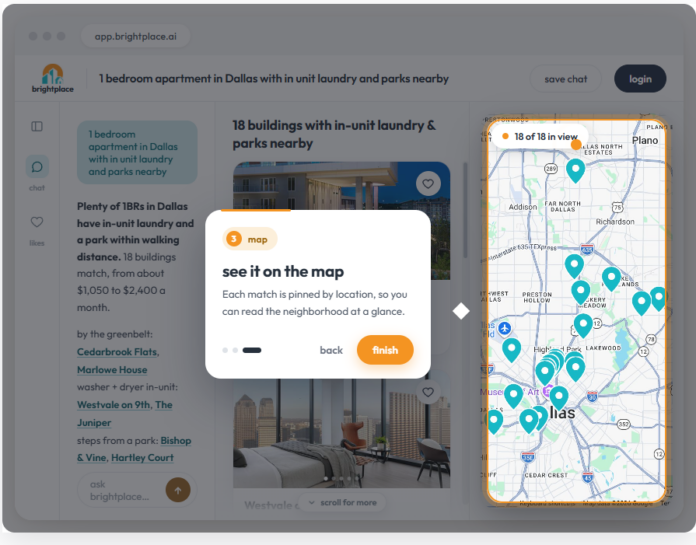

The apartment search process that most renters in the New York metropolitan area and across the country experience today has not changed in its fundamental architecture since the mid-2000s: a large listing platform aggregates available units, a renter enters parameters into a series of filters — price range, number of bedrooms, pet policy, amenity checkboxes — and the platform returns a ranked list of results that correspond to those filters. The renter then manually examines each result, reads descriptions and reviews of variable reliability, attempts to estimate total monthly costs from advertised rents that frequently exclude mandatory fees, and tries to triangulate neighborhood character, commute time, and lifestyle fit from static photographs and promotional copy written by the landlord. The entire model is built around the assumption that searching for an apartment is fundamentally a filtering problem — a process of progressive exclusion from a large inventory down to a manageable shortlist.
Brian Lichtenberger, the CEO and founder of brightplace, is building on the premise that this assumption is wrong, and that the generation of renters who are now conducting apartment searches with an expectation shaped by large language models and conversational AI will find the filter-based listing site increasingly inadequate as an experience. brightplace, the company he founded and that is incorporated in Delaware with its principal place of business at 221 River Street in Hoboken, New Jersey, launched publicly in April 2026 as what the company describes as the apartment rental industry’s first AI-native discovery platform — a system built not to filter a list of apartments toward a renter’s stated parameters but to understand what a renter actually wants and explain tradeoffs across dozens of dimensions that a checkbox filter cannot capture. The company has now been selected for the inaugural cohort of the RET Ventures PropTech AI Accelerator, the first accelerator program launched by RET Ventures, the venture capital firm whose strategic investor network includes more than 50 institutional real estate owners and operators managing over $600 billion in real estate assets.
The technological foundation of brightplace is a proprietary platform called IntentOS, which sits between the apartment supply side of the market — operator listings, unit data, lease terms, mandatory fees, property descriptions — and the demand side, where renters are expressing what they want in natural language rather than in structured filter inputs. IntentOS takes the supply data from operator websites and application software interfaces, restructures it into a machine-readable format that captures not just the unit specifications but the neighborhood context, cost-of-living intelligence, commute data, resident reviews, and property character profiles that determine whether a specific apartment actually fits a specific renter’s life, and makes that structured data available to the platform’s AI Rental Advisor for real-time conversational processing. The result is a system that can receive a query like — to use the example from the company’s own product descriptions — “Moving to Charlotte in three weeks with my family and dog, looking for a two-bedroom within fifteen minutes of my job at Wells Fargo, need parking and a dog-friendly neighborhood,” and return not a filtered list but a set of specific recommendations that explain why each option fits, how each one compares on the dimensions the renter specified, and what tradeoffs each involves relative to the others.
The financial intelligence component of the Rental Advisor addresses one of the most persistent specific frustrations of the apartment search process: the gap between advertised rent and actual monthly cost. Mandatory fees — parking fees, pet fees, amenity fees, required renter’s insurance, trash collection fees, package locker fees, and the array of other charges that have become standard in multifamily lease structures — can add hundreds of dollars per month to a unit’s effective cost without appearing in the advertised price that listing platforms display. The brightplace Rental Advisor, which added a full financial intelligence capability in its June 10 update, now evaluates these costs across its inventory and presents renters with the actual monthly financial burden of each option rather than the marketing-facing rent figure. The timing of this financial intelligence launch arrived against a specific and relevant backdrop: Harvard’s Joint Center for Housing Studies released its America’s Rental Housing 2026 report citing 22.7 million cost-burdened U.S. renter households — approximately half of all renters nationally — with 12.1 million spending more than half their gross income on rent. For a platform explicitly designed to give renters a clearer picture of what an apartment actually costs, that backdrop makes the financial intelligence component more than a feature enhancement.
The most recent product launch from the company, brightplace Connect — announced June 16 — extends the IntentOS intelligence layer into an agentic architecture that enables the platform to be called not just by individual renters using the brightplace consumer product directly, but by any AI agent or downstream application that needs to conduct apartment searches on a user’s behalf. The specific implication of this capability is that a renter who begins their apartment search in ChatGPT, Claude, Perplexity, or any other AI assistant — a behavior the company describes as already common and increasing — can have that assistant call brightplace’s Rental Advisor to execute the actual search, evaluate real-time supply, check unit availability, and schedule tours, all without the renter navigating to a separate listing site. The architecture reflects a specific and plausible theory about how consumer behavior in apartment search is evolving: as general-purpose AI assistants become the starting point for more types of decision-making, platforms that position themselves as the intelligent backend infrastructure for rental discovery — rather than competing for consumer attention on a dedicated listing website — may be better positioned for the direction that demand is actually moving.
The operator-side value proposition that IntentOS enables is the business model dimension that makes the RET Ventures accelerator partnership particularly strategically significant. RET Ventures’ investment thesis is organized around technologies that improve the economics of residential real estate ownership and management at institutional scale, and its strategic investor network of 50-plus institutional owners and operators represents the specific customer base that brightplace needs to access to build the listing supply data that makes its Rental Advisor more comprehensive and more useful than a platform with limited operator integrations. The intent data that IntentOS generates as renters interact with the Rental Advisor — the specific preferences, tradeoffs, price sensitivities, neighborhood comparisons, and decision factors that renters express in natural language during a search — is, in brightplace’s framing, the “missing layer” between an operator’s marketing investment and its leasing outcomes. When an operator knows that a specific renter is comparing two particular neighborhoods based on commute time and pet policy, the operator can respond with relevant information targeted to those specific criteria rather than with generic outreach. The commercial argument for IntentOS is that renter intent, captured and structured in real time, is more valuable to operators trying to improve leasing conversion than the generic lead data that traditional listing platforms provide.
Lichtenberger, who has two prior company exits both built at the intersection of data infrastructure and industry transformation, is building brightplace as a bootstrapped operation with a small team of AI-first engineers — a financial and operational posture that is uncommon for a company with the product architecture ambition brightplace is pursuing, but that reflects the specific market timing argument the company’s accelerator selection validates. RET Ventures partner Christopher Yip’s characterization of the accelerator’s thesis is direct: AI is reshaping how renters discover their next home and how operators connect with demand, and brightplace is building for that future from the ground up. The company’s Hoboken address, at 221 River Street — one of the most actively managed real estate markets in the Hudson County corridor — gives it operational proximity to exactly the kind of dense, high-turnover multifamily market where AI-assisted rental search would have its most concentrated practical impact, and where the specific frustrations of the existing listing platform experience — hidden fees, inadequate neighborhood intelligence, generic filter-based results — are most directly felt by the renters the Rental Advisor is designed to serve.
For New Jersey renters navigating a rental market that has been among the most expensive and most competitive in the country for the past several years, the practical availability of a tool that surfaces real costs rather than advertised rents, explains neighborhood tradeoffs in conversational language, and connects transparently to other AI tools they are already using represents a meaningful shift in the information asymmetry that has historically favored operators and listing platforms over individual renters. Brightplace is available at brightplace.ai.
















