
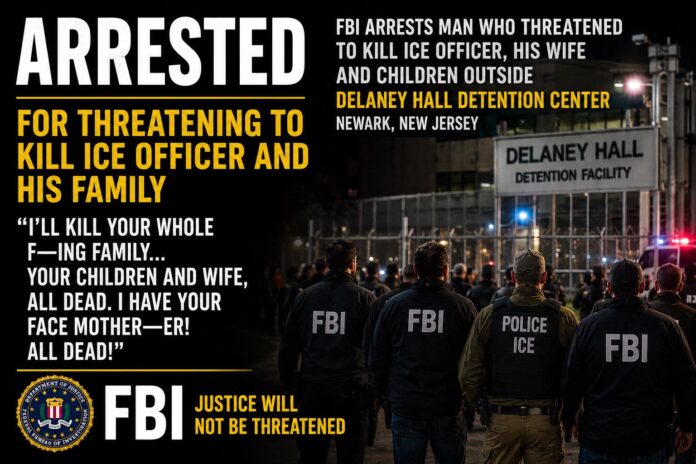

As tensions surrounding Newark’s Delaney Hall immigration detention facility continue to dominate political and public debate across New Jersey, federal authorities have announced a significant development that underscores just how volatile the situation has become. According to federal officials, the FBI has arrested an individual accused of making violent threats against a U.S. Immigration and Customs Enforcement officer and members of that officer’s family during the ongoing demonstrations connected to the detention center.
The arrest marks a dramatic escalation in a conflict that has evolved far beyond a local protest. What began as demonstrations over conditions inside the privately operated detention facility has transformed into one of the most politically charged confrontations currently unfolding in New Jersey, drawing the attention of federal agencies, state officials, advocacy organizations, law enforcement personnel, elected leaders, and activists from across the political spectrum.
Federal officials allege that the suspect issued direct threats targeting an ICE officer and the officer’s family members during the height of the demonstrations surrounding Delaney Hall. The arrest was announced by Acting United States Attorney General Todd Blanche, who stated that threats directed at federal law enforcement personnel and their families would be treated as serious criminal matters.
The announcement comes after more than a week of increasingly intense confrontations surrounding the facility, which has become a flashpoint in the national immigration debate. Demonstrations outside Delaney Hall have attracted hundreds of participants, including immigrant-rights advocates, community organizers, elected officials, labor activists, religious leaders, and counter-protesters supporting federal immigration enforcement efforts.
What makes the Delaney Hall situation particularly significant is that it represents the intersection of multiple contentious issues facing New Jersey and the nation simultaneously. Questions surrounding immigration enforcement, detention standards, private prison operations, public safety, protest rights, federal authority, state authority, and community oversight have all converged at a single location in Newark.
The conflict initially intensified after allegations emerged from detainees, family members, and advocacy groups claiming that individuals housed inside the facility were participating in hunger strikes and labor actions to protest conditions. Organizers alleged that detainees were raising concerns about food quality, medical treatment, communication access, and living conditions within the center.
Federal officials and facility operators strongly disputed many of those claims, maintaining that detainees were receiving appropriate care and services in accordance with federal detention standards. The competing narratives quickly fueled a growing confrontation outside the facility as supporters gathered to demand greater transparency and access.
As demonstrations grew larger, the atmosphere surrounding Delaney Hall became increasingly tense. Protesters formed human chains, attempted to block transportation vehicles, and staged continuous demonstrations outside facility entrances. Federal agents responded with enhanced security measures aimed at maintaining access and operations at the site.
Several confrontations resulted in arrests, allegations of excessive force, accusations of obstruction, and claims of misconduct from both sides. Videos and photographs from the scene circulated widely across social media platforms and national news outlets, further amplifying public attention and political polarization surrounding the facility.
The situation eventually reached a point where New Jersey officials sought a different approach to maintaining order around the detention center.
Governor Mikie Sherrill and Attorney General Jennifer Davenport announced measures designed to reduce tensions, including arrangements that shifted primary perimeter security responsibilities away from federal tactical teams and toward the New Jersey State Police. State authorities established designated demonstration zones intended to separate competing groups while preserving the ability to engage in lawful protest.
Those changes followed days of confrontations that had raised concerns about the potential for further violence.
Despite those efforts, the rhetoric surrounding Delaney Hall has remained intense.
Supporters of federal immigration enforcement argue that ICE personnel are carrying out legally authorized responsibilities and deserve protection from threats, intimidation, and interference. They contend that demonstrations crossing into obstruction, harassment, or violence undermine lawful government operations and place officers at risk.
Immigrant-rights advocates, meanwhile, maintain that vigorous public scrutiny remains necessary to ensure accountability, transparency, and humane treatment within detention facilities. They argue that peaceful protest plays a vital role in bringing attention to concerns that might otherwise remain hidden from public view.
The latest arrest illustrates the increasingly difficult challenge facing authorities as they attempt to distinguish between protected political expression and criminal conduct.
The overwhelming majority of individuals participating in demonstrations have engaged in lawful activities protected by constitutional rights of speech and assembly. However, federal officials emphasize that direct threats of violence against public servants and their families fall outside those protections and will be aggressively investigated.
The arrest announcement also highlights a broader trend seen in politically charged disputes throughout the country, where heated rhetoric can sometimes escalate beyond protest and into alleged criminal threats. Law enforcement agencies at every level have increasingly devoted resources toward monitoring and investigating threats directed at public officials, government employees, judges, election workers, and law enforcement personnel.
In the case of Delaney Hall, federal authorities appear determined to send a message that threats targeting officers or family members will result in swift action.
For New Jersey residents following the unfolding situation, the arrest serves as another reminder that the dispute surrounding Delaney Hall has evolved into far more than a localized disagreement over detention operations. It has become a symbol of larger national arguments surrounding immigration policy, public accountability, law enforcement authority, and the role of protest in a democratic society.
The facility itself remains at the center of multiple ongoing controversies. Legal disputes involving operational permits continue to move through the courts. Political leaders continue debating oversight authority and facility access. Advocacy organizations continue pressing for additional transparency regarding conditions inside the detention center. Federal officials continue defending the facility’s operations and security measures.
Meanwhile, state authorities remain focused on preventing further confrontations outside the facility as competing demonstrations continue.
The arrest announced this week does not resolve any of the underlying disagreements that have fueled the Delaney Hall controversy. If anything, it underscores how deeply entrenched those disagreements have become.
What is clear is that the events unfolding in Newark are no longer being viewed as an isolated local issue. They have become part of a much broader national conversation about immigration enforcement, civil liberties, public safety, and political activism.
As investigations continue and legal proceedings move forward, Delaney Hall remains one of the most closely watched and politically significant locations in New Jersey. The latest arrest adds another chapter to a rapidly evolving story that continues to draw attention from state leaders, federal agencies, advocacy groups, and residents across the Garden State.
For now, authorities are urging all participants—regardless of political viewpoint—to exercise their rights peacefully and lawfully as the debate surrounding Delaney Hall continues to unfold.
















