

For the New Jersey Devils, the summer of 2026 is shaping up to be far more than a routine offseason. It is becoming a defining moment for a franchise that entered last year with Stanley Cup aspirations, only to find itself watching the postseason from home while competitors continued their pursuit of hockey’s ultimate prize.
The disappointment of missing the playoffs has not been met with patience. Instead, every move emerging from the organization suggests urgency. With the 2026 NHL Entry Draft approaching on June 26 and a rapidly evolving trade market beginning to take shape across the league, newly appointed General Manager Sunny Mehta appears determined to reshape the roster aggressively rather than rely on incremental improvements.
For a franchise built around one of the NHL’s most talented young cores, standing still is no longer viewed as an option. The Devils possess elite offensive talent, promising prospects, significant trade assets, and a fan base eager to see the organization take the next step. The question now is not whether changes are coming, but how dramatic those changes might ultimately become.
One of the first signs that transformation is underway arrived with the unexpected departure of assistant coach Jeremy Colliton. The organization announced on June 18 that Colliton would be leaving the Devils to pursue other business opportunities, ending a tenure that quietly produced some of the league’s most effective special teams results.
While assistant coaching changes rarely generate major headlines, Colliton’s exit carries substantial significance inside hockey circles. Under his guidance, New Jersey’s power play became one of the NHL’s most dangerous offensive weapons. Operating at a remarkable 25.2 percent efficiency rate, the Devils finished among the league’s elite power-play units, ranking fourth overall during his tenure.
That success was especially important considering the roster’s offensive makeup. With dynamic playmakers and finishers capable of exploiting even the smallest defensive mistakes, the power play often served as the engine that drove New Jersey’s attack. Replacing Colliton will not be a simple matter of filling a vacancy. The Devils now face the challenge of maintaining one of their greatest strengths while simultaneously attempting to improve other areas of the roster.
His departure also follows the recent dismissal of goaltending coach Dave Rogalski, further illustrating that significant organizational restructuring is underway. Even though head coach Sheldon Keefe remains behind the bench, much of the support structure surrounding him continues to evolve.
At the same time, excitement continues to build around one of the organization’s most intriguing young players.
Lenni Hämeenaho returned to North America carrying more than just valuable international experience. He returned carrying gold.
The talented Finnish prospect played a significant role in helping Team Finland capture the 2026 IIHF World Championship, adding another major accomplishment to a rapidly growing résumé that has already generated considerable excitement throughout the Devils organization.
Championship experience is often difficult to quantify when evaluating prospects, but organizations consistently value players who have demonstrated an ability to perform under pressure and contribute to winning environments. Hämeenaho now arrives at training camp carrying exactly that type of pedigree.
Perhaps even more encouraging for Devils fans is the mindset he has reportedly brought back from the tournament. Rather than viewing international success as a destination, Hämeenaho appears to view it as motivation. Team observers and development staff have consistently noted his growing confidence, maturity, and determination to establish himself as a permanent NHL player.
His emergence comes at an important time. Organizations that contend consistently often benefit from young, cost-controlled talent entering the lineup and making meaningful contributions. If Hämeenaho can translate his international success into NHL readiness, he could become one of the most significant internal additions available to the Devils this season.
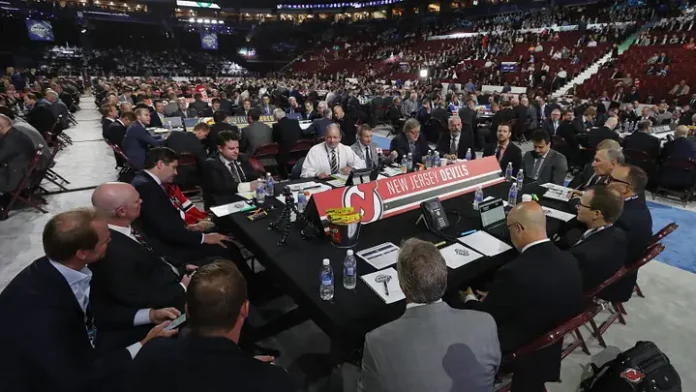
While prospect development remains important, attention throughout the hockey world is increasingly turning toward Buffalo, where the 2026 NHL Draft could dramatically alter the trajectory of the franchise.
New Jersey currently owns the twelfth overall selection, along with four additional picks spread throughout the draft. On paper, the position provides access to some of the most intriguing young talent available. Yet many around the league increasingly believe the Devils may view that selection differently.
Rather than using the pick to draft another teenage prospect, there is growing speculation that New Jersey could utilize the twelfth overall choice as part of a larger trade package designed to acquire immediate NHL help.
That possibility reflects the organization’s competitive timeline.
Jack Hughes remains one of the NHL’s most dynamic offensive stars. Nico Hischier continues to provide elite two-way leadership. Jesper Bratt remains among the league’s most creative playmakers. The foundation necessary to compete already exists. What remains unclear is whether management believes another prospect can help them win soon enough.
If the answer is no, the twelfth overall selection immediately becomes one of the most attractive trade assets available on the market.
The Devils’ remaining selections also offer opportunities to strengthen the organization’s prospect pipeline. Among the names generating considerable attention is Finnish defenseman Samu Alalauri, a highly regarded U20 standout whose defensive analytics have placed him among the most effective young blueliners in his age group.
His combination of positioning, defensive awareness, puck retrieval skills, and reliability has made him one of the most intriguing second-round possibilities available. Should he remain available when New Jersey selects at number forty-four, he could represent tremendous value for an organization that continues to prioritize long-term defensive depth.
Yet as draft discussions continue, the louder conversation centers around potential trades.
Few organizations enter this offseason with as many fascinating roster decisions as New Jersey.
The Devils possess an abundance of talent on the blue line, particularly among right-handed defensemen. While depth is typically viewed as a luxury, it can also become a valuable source of trade capital.
Much of the attention has centered on Šimon Nemec and Dougie Hamilton.
Nemec remains one of the organization’s most talented young defensemen and is approaching important contract discussions. Hamilton, meanwhile, continues to be one of the NHL’s most productive offensive defensemen when healthy.
Because both players carry significant value, rumors continue to suggest that one could potentially become part of a larger package aimed at securing a top-six scoring winger.
The logic is straightforward.
The Devils already possess substantial defensive talent. What they may need more urgently is another elite offensive weapon capable of complementing Hughes, Hischier, Bratt, and the rest of the forward group.
Among the names frequently linked to New Jersey are Jordan Kyrou and Jason Robertson, two forwards capable of dramatically changing the complexion of an offense.
Kyrou brings elite speed, transition play, and scoring ability. Robertson offers one of the most complete offensive packages in hockey, combining finishing, playmaking, hockey intelligence, and consistency. Either acquisition would immediately elevate expectations throughout the organization.
Whether either player ultimately becomes available remains uncertain, but the very existence of those discussions highlights the aggressive mindset currently surrounding the Devils’ front office.
Perhaps no position remains under greater scrutiny than goaltending.
For all of the organization’s offensive firepower and defensive potential, instability in net remains one of the most frequently discussed concerns among analysts, executives, and fans.
Jacob Markstrom arrived with expectations of providing veteran stability and dependable performance. Instead, the results failed to meet those expectations. Consequently, speculation surrounding his future has intensified dramatically as the offseason unfolds.
Reports indicate the Devils are actively evaluating every available option. Those possibilities range from exploring potential trade partners to investigating broader restructuring opportunities that could create both cap flexibility and a fresh start at the position.
Goaltending remains one of the most difficult areas to address in professional sports. Elite options rarely become available, and when they do, competition is fierce. Nevertheless, it appears increasingly clear that New Jersey is unwilling to ignore the issue.
The broader picture emerging from Newark is one of urgency, ambition, and calculated risk.
The Devils are not rebuilding. They are not starting over. They are not waiting patiently for another generation of prospects to mature.
Instead, they appear committed to maximizing the prime years of their current core while aggressively seeking opportunities to improve wherever possible.
The departures of key staff members, the rise of promising prospects like Lenni Hämeenaho, the strategic value of the twelfth overall draft pick, ongoing trade discussions involving major roster pieces, and continued questions surrounding the goaltending position all point toward a franchise actively searching for answers.
For Devils fans, the coming weeks may prove among the most consequential of the Sunny Mehta era.
The 2026 NHL Draft represents an important milestone, but it may ultimately be remembered as just one piece of a much larger transformation. Whether through trades, roster restructuring, prospect promotions, coaching additions, or significant acquisitions, the Devils are entering a pivotal period that could shape the organization for years to come.
One thing is becoming increasingly clear: New Jersey is not approaching this offseason cautiously. The organization appears ready to make bold decisions, embrace difficult choices, and pursue the aggressive moves necessary to return to playoff contention and reestablish itself among the NHL’s elite franchises.
















