
What began as a localized protest outside a federal immigration detention center in Newark has now escalated into one of the most politically explosive and emotionally charged confrontations unfolding anywhere in the United States. Over the course of just several days, the atmosphere surrounding Delaney Hall transformed from a relatively peaceful demonstration into a national flashpoint involving hunger strikes, allegations of medical neglect, tactical federal deployments, clashes between protesters and ICE agents, elected officials demanding access, arrests, retaliatory transfer accusations, and growing fears throughout New Jersey’s immigrant communities about what comes next.
The images emerging from Newark this week no longer resemble an isolated detention-center dispute.
They resemble a state wrestling publicly with the human consequences of America’s modern immigration system.
Outside Delaney Hall, demonstrators have now spent nearly a week maintaining a continuous presence in solidarity with approximately 300 detainees participating in what organizers describe as a mass hunger and labor strike inside the facility. According to detainees, family members, advocates, volunteers, and lawmakers who have since inspected portions of the center, the strike was triggered by worsening conditions that detainees allege include rotten food, inadequate medical treatment, high rates of illness transmission, denial of basic hygiene supplies, and increasingly punitive treatment toward individuals who speak publicly about conditions inside.
The federal government strongly disputes many of those allegations.
But the situation outside the facility has now evolved far beyond competing press statements.
Late Wednesday night into Thursday morning, tensions erupted into violent clashes between federal agents and demonstrators after protesters attempted to block the facility’s driveway using homemade shields, wooden pallets, mattresses, barricades, and traffic cones in an effort to prevent law enforcement vehicles from entering or exiting the complex.
Federal agents wearing tactical gear moved aggressively to clear the roadway.
Witnesses described protesters being struck with batons, sprayed with pepper spray, dragged away from barricades, and pushed back as heavily armed federal reinforcements sealed off the surrounding perimeter. By Thursday morning, masked agents and federal vehicles had established an overwhelming security presence around the detention center, effectively transforming the surrounding area into a militarized zone.
The confrontation marked a dramatic escalation from the atmosphere that existed only days earlier.
Last week, activists, volunteers, clergy members, legal observers, and families of detainees gathered outside Delaney Hall in what many participants described as a largely peaceful solidarity encampment. Volunteers distributed water, coordinated legal support, erected tents, and organized around calls for transparency and humanitarian oversight.
That changed rapidly after word spread that one detainee — Martin Soto — was allegedly being targeted for transfer following public criticism from his wife, Gabriela Soto, regarding conditions inside the facility.
According to advocates, the possibility of Soto’s removal triggered immediate fears among detainees and protesters that ICE was retaliating against organizers involved in the hunger strike.
Soon afterward, demonstrations intensified.
Then the situation exploded nationally.
The protests drew high-profile political attention from some of New Jersey’s most prominent Democratic leaders, including Governor Mikie Sherrill, Senator Andy Kim, Representative LaMonica McIver, Senator Cory Booker, and New York Congressman Adriano Espaillat.
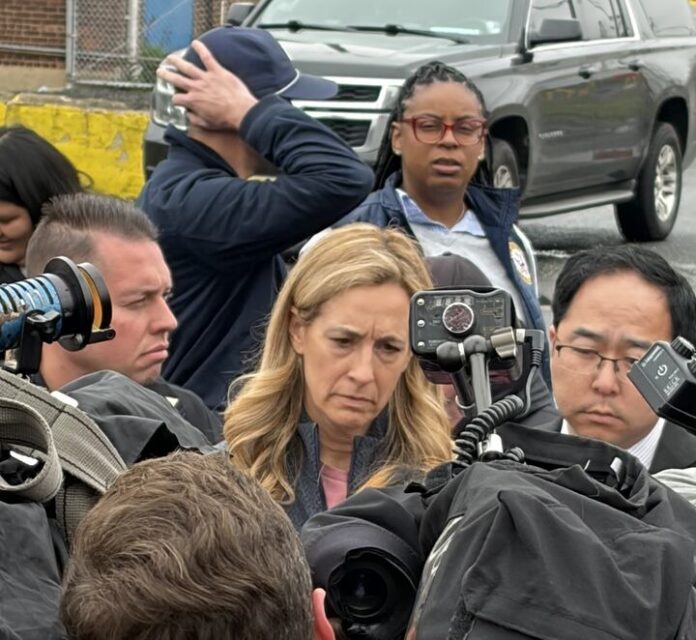
The political stakes surrounding Delaney Hall escalated even further after reports emerged that Governor Sherrill had been denied entry into the facility during an attempted inspection visit and Senator Andy Kim was pepper-sprayed while attempting to help de-escalate tensions outside the gates.
Those incidents dramatically elevated public scrutiny.
Soon afterward, Senator Booker and Congressman Espaillat were ultimately granted access to inspect the facility directly. Following conversations with detainees, both lawmakers described what they witnessed as “dire conditions,” including allegations involving a pregnant detainee being denied necessary medical care.
Congressman Espaillat further alleged that retaliatory measures had been taken against detainees participating in the strike, including suspension of family visitation access, termination of video calls, and the transfer of at least thirteen strike organizers out of the facility.
The Department of Homeland Security has categorically denied many of the allegations surrounding Delaney Hall, including claims regarding unsafe conditions, medical neglect, or the existence of a widespread hunger strike.
Federal officials also defended agents’ use of force during the overnight confrontations, arguing officers responded only after protesters allegedly threw objects and sprayed personnel with unidentified substances.
DHS Secretary Markwayne Mullin dismissed accusations surrounding detention conditions, publicly stating, “The fact is, we’re giving them the calories they want. This isn’t Holiday Inn.”
But outside Delaney Hall, the rhetoric coming from protesters, volunteers, detainees’ families, and advocates reflects an entirely different reality.
Few individual stories have become more symbolic of the escalating conflict than that of Martin Soto.
The 30-year-old Kearny resident has now emerged as one of the central figures in the growing controversy surrounding Delaney Hall after being unexpectedly transferred to the Elizabeth Detention Center amid escalating protests.
In interviews following his transfer, Soto described what he characterized as a deceptive and physically aggressive removal process carried out by ICE agents.
“The guards tricked me,” Soto said following the transfer. “They showed me a sheet of paper with the word ‘release’ on it and told me I could change into the clothes I was wearing when they arrested me. They made it seem like I could leave, like they were finally freeing me, but moments later, they handcuffed me, chained me, and forcefully shoved me into a white van.”
Soto alleged that his wrists, ankles, chest, and arms were injured during the process.
He further described being temporarily returned inside the facility after protesters blocked the vehicle from exiting the main gate before later being transported through another exit point.
“On the way out, the ICE agent who was driving pointed to the area where the protestors were,” Soto said. “A woman was on the floor, agents were pulling at her clothes, she was screaming. The guard then looked over his shoulder and told me, ‘You see this, this is all your fault.’”
His wife, Gabriela Soto, has since become one of the most visible public voices criticizing conditions inside Delaney Hall.
Her demonstrations outside the facility helped amplify national attention surrounding the hunger strike and reportedly intensified concerns among detainees that organizers were being specifically targeted.
Another incident further inflamed tensions this week after Adam Marshall — an Army veteran and volunteer who had become a familiar presence outside Delaney Hall — was detained by ICE during the latest clashes.
Marshall had reportedly been helping distribute water and serve as a volunteer medic during demonstrations.
According to witnesses, federal agents surged through a protest blockade and specifically targeted Marshall while he was positioned across the street assisting injured demonstrators.
He was later released in Rutherford following what supporters described as a brief but violent detention.
After receiving medical evaluation at a hospital, Marshall issued a statement expressing solidarity with detainees inside Delaney Hall.
“I am grateful for all those who have shown support for me during my brief but intense arrest by ICE,” Marshall wrote. “I want to express my deep solidarity with the people detained in Delaney Hall, who are on the sixth day of hunger and labor strikes.”
“Their illegal detention, torture and separation from their families is a crime against the laws of New Jersey and a crime against humanity,” he continued.
“I call on fellow pacifists and veterans to stand with our migrant brothers and sisters and to reject war abroad.”
As explosive as the Delaney Hall confrontation has become, many advocates argue the detention-center crisis represents only one part of a much larger immigration reality now unfolding throughout New Jersey.
Across the state, fear and uncertainty are expanding well beyond undocumented populations alone.
Temporary Protected Status recipients are increasingly facing growing instability as the Trump administration continues efforts to terminate TPS protections for numerous countries. TPS allows individuals from nations experiencing war, disaster, or severe instability to legally remain and work inside the United States temporarily, though the status does not automatically provide a pathway toward permanent residency or citizenship.
According to previous reports from FWD.us, approximately 20,000 TPS holders currently reside in New Jersey, with particularly large populations originating from El Salvador and Haiti.
Now, many fear those protections could soon disappear.
One longtime TPS recipient from El Salvador described losing her job after renewal paperwork delays prevented her from receiving an updated work authorization card despite legally living and working inside the United States since 2001.
After decades building a life in New Jersey, she now depends heavily on family support while facing uncertainty surrounding future protections.
The Supreme Court is expected to rule by July on whether the administration may proceed with ending TPS protections for certain nations — a decision that could affect nearly one million people nationally.
At the same time, additional immigration policy changes are creating new barriers for legal permanent residency itself.
Under proposed procedural changes, many green card applicants may soon be required to leave the United States entirely and apply from abroad rather than adjusting status while remaining inside the country.
That shift could fundamentally reshape immigration pathways that families, students, workers, and employers have relied upon for decades.
In 2024 alone, more than 800,000 individuals adjusted immigration status while already living inside the United States.
Now, many could face years-long separations, international processing delays, employment disruption, and family instability.
Taken together, the escalating crisis at Delaney Hall has become something larger than a single protest.
It has become a collision point.
A collision between federal immigration enforcement and local political resistance.
Between humanitarian concerns and national security rhetoric.
Between legal procedure and emotional human consequence.
Between policy and visibility.
For New Jersey specifically, the confrontation carries unique weight.
The state has long positioned itself as one of the nation’s most immigrant-connected regions, with communities deeply shaped by generations of migration, labor, cultural diversity, and mixed-status households. What happens at Delaney Hall therefore resonates far beyond Newark itself.
The images emerging from outside the facility — tactical agents, barricades, arrests, lawmakers confronting federal authorities, hunger strikes, chained detainees, volunteers dragged into vans, and families pleading for information — have now become part of a much larger national conversation surrounding immigration enforcement, detention oversight, and civil liberties in America.
And for many New Jersey residents watching the situation unfold in real time, the defining question is no longer whether Delaney Hall represents a political crisis.
It is how much further that crisis is willing to go.