

Ask a New Jersey parent what actually sold them on a school and the answer rarely starts with test scores anymore. It starts with culture, mentorship, and whether their kid walks out ready for what comes next. These four institutions built their entire pitch around exactly that.
Four New Jersey Schools Betting That Character Building Matters as Much as the Transcript
Ask a New Jersey parent what actually sold them on a school and the answer rarely starts with test scores anymore. It starts with culture, mentorship, and whether their kid walks out ready for what comes next. These four institutions built their entire pitch around exactly that.
Choosing a school in New Jersey used to come down to a fairly narrow set of questions, class size, AP course counts, where the graduating class ends up in the fall. That calculus has genuinely shifted. Parents across the state are increasingly weighing something harder to quantify but easier to actually feel once you’re standing in the building, whether a school builds resilience and independence alongside rigor, or just piles on coursework and calls it preparation. Four institutions in particular have leaned hard into that distinction, and each one makes its case a little differently.
Trinity Hall
An independent, all-girls Catholic college preparatory school built around leadership and initiative.
Trinity Hall runs an all-honors curriculum inside a genuinely technology-rich classroom environment, backed by small class sizes and a faculty that clearly gets recruited for more than credentials alone. The academic program leans into interdisciplinary work, including a full four-year engineering track and a physics-first science model that builds scientific literacy earlier than most college preparatory programs attempt.
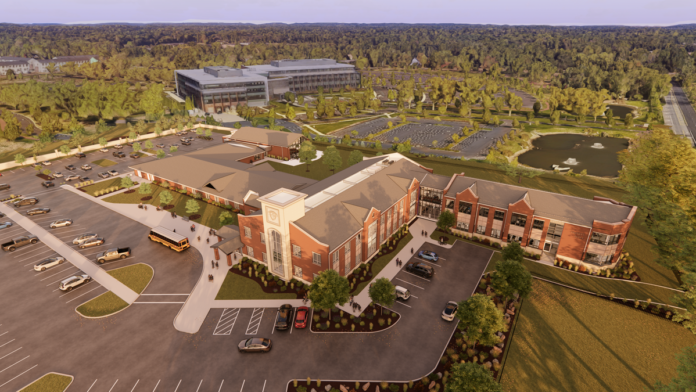
The school just opened a newly constructed academic wing and expanded community space for the 2025 to 2026 school year, adding a dedicated arts conservatory that now houses an award-winning program running two full theater productions annually, a student orchestra, and serious studio and industrial arts offerings. The athletics program competes at junior varsity and varsity levels against public, parochial, and independent schools throughout Monmouth County and beyond.
The results back up the pitch. The Class of 2026 walked away with roughly $10 million in merit scholarships collectively, with graduates matriculating into Ivy League schools and honors programs nationwide.
Morristown Beard School
A co-educational day school for grades 6 through 12, built around self-discovery alongside academic rigor.
Morristown Beard’s 22-acre campus backs up its athletic tradition with more than 20 varsity sports, a genuinely broad offering for a school this size. What actually separates the academic side is a set of four specialized learning centers built to reinforce a specific teaching philosophy rather than sit as marketing bullet points, the Center for Innovation and Design, the Center for Academic Writing, the Center for Teaching and Learning, and the Center for Quantitative Reasoning.
That structure reflects a deliberate bet that students learn best when they’re pushed to find their own academic voice rather than follow a single standardized track. Independent thinking and leadership development sit at the center of that approach, treating the campus itself as a place built for exploration rather than a fixed curriculum delivery system.
Seton Hall University
A premier Catholic university operating since 1856, blending urban access with a close-knit campus community.
Named for Elizabeth Ann Seton, the first American-born saint, Seton Hall has spent more than a century and a half shaping students in mind, heart, and spirit rather than treating those as separate goals. The university’s 58-acre South Orange campus sits just 14 miles from New York City, close enough to give students genuine access to internships and employment opportunities in the city without sacrificing the tight-knit community feel of a traditional college campus. The university also runs a nationally ranked law school in Newark and a state-of-the-art health sciences campus spanning Clifton and Nutley.
With more than 10,000 students enrolled, Seton Hall’s academic offerings have expanded well past traditional liberal arts programming into interdisciplinary fields like financial technology, data analytics, international economics, and digital media, continually adapting to match where actual industry demand is heading. Beyond academics, the university fields 14 Division I athletic programs competing in the Big East Conference, and a recent independent study found Seton Hall contributes more than $1.6 billion annually to New Jersey’s economy while supporting close to 10,000 jobs statewide.
Ranney School
A co-educational college preparatory school serving students from age 3 through grade 12.
Ranney’s 60-acre campus commits hard to hands-on STEM education, with robotics labs, a working greenhouse, a community garden, and an outdoor classroom that all push learning past the walls of a traditional science lab. That commitment gets reinforced by dedicated physics, engineering, and biology labs, along with a specialized engineering curriculum developed in partnership with the University of Texas, a genuinely uncommon collaboration for a K-12 institution.
Design thinking and collaborative research start remarkably early, with the Lower School’s fifth-grade Capstone project asking ten-year-olds to complete a full year-long community service initiative capped by student presentations reflecting on their own personal growth. The curriculum keeps expanding into genuinely current territory too, with new artificial intelligence courses like Learn and Create with AI and Hands-On Machine Learning preparing Upper School students with both technical skill and the ethical grounding to actually navigate that technology responsibly.
Financial literacy runs through all three divisions, anchored by a finance lab equipped with 12 Bloomberg terminals, the same tools used inside real financial institutions, and Upper School students can walk away with an actual finance certificate before graduation. The whole approach reflects a whole-child philosophy, pairing academic rigor with intentional social-emotional growth so students don’t just fit into the community, they stand out inside it.
Here’s my honest read on why these four schools deserve to be grouped together rather than just alphabetically listed side by side. Every one of them made a genuine structural bet that character and readiness can’t just be bolted onto a rigorous curriculum after the fact, they have to be built into the actual architecture of the school, a Circle of Support, dedicated learning centers, a values-based mission statement backed by a real endowment and economic footprint, or a whole-child philosophy wired into everything from a fifth-grade Capstone to a Bloomberg terminal. [Your Story Here] That’s a genuinely harder thing to build than another AP course, and it’s exactly the kind of investment that tends to show up years later, not on a report card, but in how a graduate actually handles the first real challenge nobody warned them about.
















