
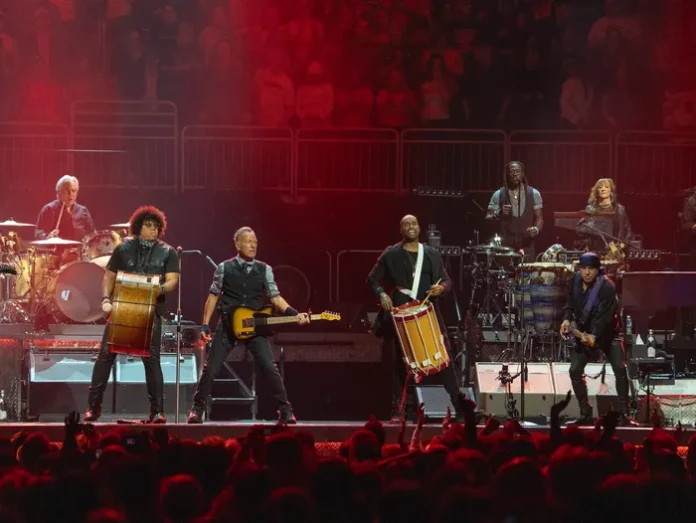

When Bruce Springsteen returns to New Jersey, it is never just another concert. It is a recalibration of place, identity, and purpose, where music becomes something larger than performance and the stage becomes a platform for reflection, urgency, and connection. On April 20, 2026, inside the Prudential Center in Newark, Springsteen and the E Street Band delivered a three-hour set that did exactly that—transforming a homecoming show into one of the most talked-about live music events of the year across New Jersey music.
This was not a nostalgia run. It was not a greatest hits tour dressed up in familiar language. The “Land of Hope and Dreams” American Tour arrived in Newark with intent, and from the opening moments, that intent was unmistakable. The show opened with “War,” immediately setting a tone that was confrontational, direct, and rooted in the present. From there, the energy surged into “Born in the U.S.A.” and “Death to My Hometown,” songs that have long carried weight but felt newly sharpened in this context.
The presence of Tom Morello added a distinct dimension that defined the night. Joining the band for a significant portion of the set, Morello did not simply contribute guitar parts—he injected a different kind of electricity into the performance. His playing brought a sharper edge, a sense of unpredictability, and a tonal contrast that elevated the arrangements without disrupting the identity of the E Street Band. On songs like “The Ghost of Tom Joad” and “American Skin (41 Shots),” his influence was particularly pronounced, turning already powerful compositions into something even more immediate and visceral.
What unfolded over the course of 27 songs was a setlist that leaned heavily into thematic cohesion rather than conventional pacing. This was a show constructed with purpose, where each song contributed to a larger narrative about America, its contradictions, and its possibilities. Tracks like “Streets of Minneapolis” and “Long Walk Home” carried a sense of urgency that extended beyond the music itself, reflecting a willingness to engage directly with the moment rather than retreat into abstraction.
At the same time, Springsteen maintained the balance that has defined his live performances for decades. The intensity of the messaging was countered by moments of connection and release, whether through the communal energy of “Hungry Heart” or the layered storytelling of “The Promised Land.” These transitions were not accidental. They are part of what makes a Springsteen show distinct—the ability to move between reflection and celebration without losing coherence.
Midway through the set, the performance shifted into a more introspective space with a solo acoustic rendition of “House of a Thousand Guitars.” In a venue as large as the Prudential Center, stripping the sound down to its essentials created a moment of focus that drew the entire room inward. It served as a reminder that even within a production of this scale, the core of Springsteen’s work remains rooted in songwriting and delivery.
The latter half of the show built toward a sustained crescendo, with “The Rising,” “Badlands,” and “Land of Hope and Dreams” forming a sequence that felt both expansive and tightly controlled. These are songs that have become pillars of Springsteen’s live catalog, yet in Newark they carried a renewed sense of immediacy, amplified by the context of the tour and the energy of the crowd.
The encore sequence reinforced the dual identity of the performance. “American Land” opened the final stretch with a sense of movement and momentum, followed by “Born to Run,” a song that continues to function as both a signature moment and a communal release. “Dancing in the Dark” brought a shift in tone, lighter but no less engaged, before “Tenth Avenue Freeze-Out” closed the main arc with its traditional tribute to Clarence Clemons and Danny Federici, grounding the night in the band’s history.
The final statement came with “Chimes of Freedom,” a cover that extended the thematic arc of the evening into a broader reflection on resilience and expression. It was a deliberate choice, closing the show not with spectacle, but with a message that aligned with everything that came before it.
What makes this Newark performance particularly significant is not just the execution, but the reaction it generated. The show has sparked a wide range of responses, from those who viewed it as a powerful, focused statement to those who questioned the tension between its themes and the realities of large-scale touring. That divergence is, in many ways, part of the point. Springsteen has never been an artist who operates in a space of consensus. His work invites interpretation, debate, and, at times, discomfort.
Within the arena, however, the response was immediate and unmistakable. The crowd engaged with the performance on multiple levels, from the collective energy of the sing-alongs to the quieter, more reflective moments that drew sustained attention. The sound quality, the pacing, and the interplay between band members all contributed to an experience that felt both expansive and tightly focused.
For New Jersey, the significance of this performance extends beyond a single night. Springsteen’s connection to the state is foundational, and each return carries with it a sense of continuity and evolution. The Prudential Center, as a venue, becomes more than a stage in these moments. It becomes a focal point where local identity and global relevance intersect, where a New Jersey artist continues to shape conversations that extend far beyond state lines.
The timing of the show adds another layer to its impact. Coming in the same week as Springsteen’s appearance at the American Music Honors in West Long Branch, where he engaged in collaborative performances that highlighted his range and influence, the Newark concert serves as a centerpiece in a broader period of visibility and activity.
In the context of New Jersey’s music scene, this performance reinforces the state’s position as a critical node in the national and international touring circuit. It demonstrates that the region is not only capable of hosting major events, but of anchoring them in a way that adds meaning and context. When artists of this scale perform in New Jersey, they are not simply passing through. They are engaging with a place that has its own history, its own audience, and its own expectations.
Springsteen’s April 20 performance at the Prudential Center stands as a reminder of what live music can achieve when it is approached with intention. It is not just about the setlist, the duration, or the scale of the production. It is about the ability to create a shared experience that resonates beyond the confines of the venue, carrying forward into conversation, reflection, and, ultimately, memory.
In Newark, on that night, the music did not exist in isolation. It connected past and present, artist and audience, place and purpose. That is what defines a true homecoming, and it is why this performance will continue to be discussed as one of the most significant moments in New Jersey’s live music calendar this year.
















