
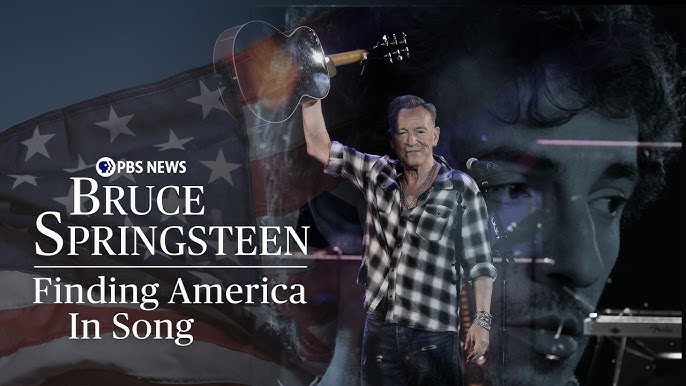

The Bruce Springsteen Center for American Music opened to the public on the campus of Monmouth University in West Long Branch in early June, and by the time the Fourth of July arrived, PBS had already produced the special that gives the institution its broader cultural argument. The two events — the center’s opening and the July 3 premiere of Bruce Springsteen: Finding America in Song, a 30-minute PBS NewsHour documentary hosted by co-anchor Geoff Bennett — were not coincidental. They were designed together, timed together, and together constitute one of the more significant moments in the ongoing effort to understand where Bruce Springsteen fits not just in American music history but in American cultural and civic history at the specific moment the country is marking a quarter-millennium of existence.
The center itself is the physical context that makes the special comprehensible. For 25 years — first as a fan-driven collection that began in 2001, then as an official repository when Springsteen formally designated it as such in 2017, then through a decade of operation at Monmouth University before the new building — the institution has been working to preserve and organize the material record of one of the most extensively documented creative careers in popular music: the notebooks and lyric drafts, the recordings and unreleased sessions, the photographs and periodicals, the oral histories and films and artifacts that together constitute what Robert Santelli, the center’s founding executive director, describes as Springsteen’s role in the greater story of American music. The new 32,000-square-foot building at 400 Cedar Avenue on the Monmouth University campus, designed by COOKFOX Architects of New York, realizes that archival mission in a physical form commensurate with its scope. The approximately $50 million project, funded entirely through private donations and grants, includes exhibition galleries, research archives, more than a dozen immersive interactive installations, and a 241-seat Soundstage equipped with Dolby Atmos audio technology designed to host concerts, lectures, and the introductory documentary film directed by award-winning filmmaker Thom Zimny that visitors watch before moving into the main exhibits. The center was renamed in January 2026 — from the Bruce Springsteen Archives and Center for American Music to simply the Bruce Springsteen Center for American Music — a change that reflects the institution’s expanded mission to use Springsteen’s body of work as a gateway to the full breadth and diversity of the American musical tradition rather than solely as a single-artist memorial.
The PBS special filmed on location at the new center gives that expanded mission its most visible public articulation.
Bennett’s conversation with Springsteen — a rare extended interview in which the artist discusses his creative process, his relationship with American civic life, and his reflections on aging and performance — is organized around three interlocking themes that together constitute the argument the center’s own curators have been building into the institution’s programming since its founding.
The first is the anatomy of Springsteen’s songwriting: the deliberate shift he made, after the vivid, poetry-dense verbal excess of his early work on Greetings from Asbury Park, N.J., toward the stripped, economically precise character studies of Darkness on the Edge of Town — a shift motivated, as Springsteen has described it in multiple contexts, by the recognition that the people he wanted to write about were not people who appeared in their own stories as vivid, articulate, lyric protagonists.
They were factory workers, veterans, people navigating economic disruption with the specific, wordless competence that daily survival requires. His job was to render their dignity visible without imposing his own language onto their experience. Jon Landau, Springsteen’s longtime manager, appears in the special alongside Santelli to contextualize that songwriting shift within the broader post-industrial economic history of the period — the specific moment in American life when the industrial economy that had defined working-class identity for three generations began its structural contraction, and when the people most directly affected by that contraction were least represented in the cultural output of the country whose changes were displacing them.
The second theme, which the PBS special handles with the directness that Springsteen himself tends to prefer on this subject, is what he calls critical patriotism — a formulation that he uses to describe his specific relationship with America as a country he loves enough to criticize, whose failures he considers it an artist’s civic obligation to document, and whose promises he has spent five decades measuring against its documented performance. The clearest test case for this argument, and the one the special addresses explicitly, is Born in the U.S.A. — the 1984 song that became one of the best-selling recordings in American history while being consistently and persistently misread as a straightforward declaration of national pride. Springsteen has been clarifying the song’s actual content for more than four decades: it is a protest about the treatment of Vietnam War veterans, written from the perspective of a man who went to fight a war the country sent him to and returned to find that the country’s social and economic infrastructure had nothing meaningful to offer him in exchange. The song’s music, with its drum machine patterns and synthesizer swells and the specific sonic register of 1984 arena rock, sends signals that contradict its lyrics to an audience primed to hear exactly what that sound is telling them to hear. The gap between what the song says and what most listeners heard it saying is itself a statement about how American patriotic feeling functions: it prefers the sound of affirmation to the content of accountability.
Springsteen’s articulation of the critical patriotism concept in the PBS special is continuous with the position he has maintained throughout his career — that the artist’s function in a democracy is not to celebrate the country’s image of itself but to measure that image against the actual experience of the people living within it, and to transmit the gap between those two things back to an audience that might otherwise not encounter it. That position has made him politically controversial at specific moments — when he performed at Barack Obama’s campaign events, when he spoke about issues the Boss-as-brand had previously been considered above — and has also produced the body of work that the Monmouth University center exists to preserve and study. The songs that hold up as documents of American life at the end of the 20th century are not the ones that celebrated the country’s self-image. They are the ones that looked at the factory closing, the failed marriage, the highway driving away from a life that didn’t work out, and rendered those experiences with the precision and the compassion that serious art brings to the subjects that official culture tends to leave unexamined.
The third theme of the PBS special concerns mortality and the continued fact of performance. Springsteen, who turned 76 this year, has been confronting the specific losses of his generation — the peers, the bandmates, the people who shared the early years when the future was still uncertain and everything was still being invented — in his recent work, most explicitly on the 2020 album Letter to You, which engaged directly with the deaths of three original members of his Castiles, his first teenage band. His framing of continued performance in the special is characteristically unsentimental: he describes touring not as a refusal of aging but as a specific and ongoing spiritual ritual, a conversation with his audience that has been running for more than 50 years and that he has no intention of discontinuing simply because the participants are older than they were when it started. The audience at a Springsteen show in 2026 is not the audience of 1978, in the specific physical sense — many of the same individuals are there, but they are different people than they were, and so is he, and the conversation between them reflects all of that accumulated shared history while continuing to generate new content.
For New Jersey residents, the opening of the Bruce Springsteen Center for American Music at Monmouth University marks a specific transition in how the state’s most internationally recognized living artist is formally honored within his home region. The Jersey Shore’s connection to Springsteen has always been experiential and local — the circuit of clubs along the Shore where he played in the early years, the specific geography of Asbury Park and the surrounding Monmouth County communities that appears in his songs as a recurring and evolving landscape, the fact that Born to Run was largely written in a house near the Monmouth University campus where the center now stands. That experiential and local connection now has a permanent institutional complement: a 32,000-square-foot building equipped with archival research facilities, a Dolby Atmos performance space, and exhibition galleries designed to help visitors understand how the music made at the Jersey Shore became a document of the American experience. Monmouth University President Patrick F. Leahy’s characterization of the center at its opening — that music has always been one of the most powerful teachers in American life, and that the new center is a destination where American music in all of its forms can be preserved, studied, and celebrated — situates the institution not as a fan destination alone but as a serious academic and cultural resource whose presence strengthens the region’s claim to a specific and important place in American cultural history.
The PBS special Bruce Springsteen: Finding America in Song is available to stream free on the PBS NewsHour arts page and across PBS digital platforms, including the PBS app and WFYI Public Media Passport. The Bruce Springsteen Center for American Music at Monmouth University is located at 400 Cedar Avenue in West Long Branch, New Jersey. Timed admission tickets are required and are available through the center’s website at springsteencenter.org, where information about ongoing exhibitions, research archive access, and the performance theater’s programming schedule is also maintained.
















