
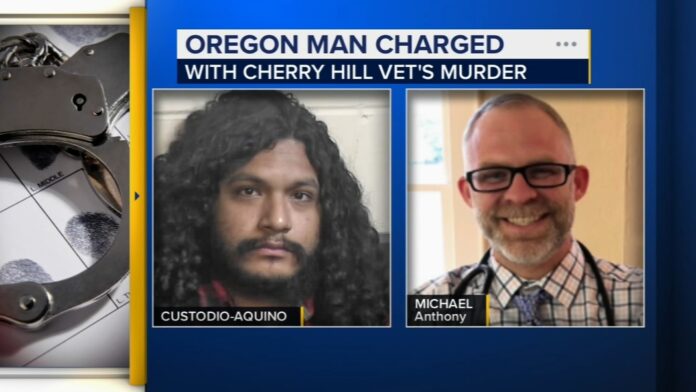

The guilty plea entered this week in Camden County Superior Court marks a significant milestone in one of South Jersey’s most heartbreaking and widely followed homicide cases, bringing a measure of accountability to a tragedy that stunned both the veterinary profession and communities throughout New Jersey.
Nearly eighteen months after the fatal stabbing death of Cherry Hill veterinarian Dr. Michael Anthony, prosecutors secured a guilty plea from the man accused of carrying out the killing. Twenty-eight-year-old Cristian Custodio-Aquino of Portland, Oregon admitted responsibility for the murder and now faces a mandatory prison sentence that will keep him incarcerated for decades.
The case has drawn widespread attention not only because of the brutal nature of the crime, but because investigators revealed what prosecutors described as a deliberate, targeted act fueled by personal obsession and romantic jealousy.
The plea agreement brings an end to the criminal proceedings surrounding the killing and spares Dr. Anthony’s family, friends, colleagues, and loved ones from enduring a lengthy trial. Yet the details that emerged throughout the investigation paint a disturbing picture of premeditation, fixation, and a calculated plan that ultimately ended the life of a respected medical professional whose impact extended far beyond his veterinary practice.
For many throughout South Jersey, the case remains a painful reminder of how quickly personal conflicts can escalate into irreversible violence.
Dr. Michael Anthony was known throughout the region as a dedicated veterinarian committed to the care and well-being of animals and the families who loved them. Those who knew him described a compassionate professional whose work represented more than a career. Veterinary medicine was his calling, and his commitment to helping animals earned him the respect of clients, colleagues, and the broader community.
His death sent shockwaves throughout Camden County and beyond.
What initially appeared to be an incomprehensible act of violence gradually became clearer as investigators pieced together evidence, digital records, communications, and witness testimony that revealed a deeply personal motive behind the killing.
According to information presented by prosecutors, the defendant had previously been involved in a romantic relationship with the individual who was, at the time of the homicide, involved with Dr. Anthony.
Investigators concluded that the victim became the focus of the defendant’s anger and resentment because of that relationship.
The motive described in court was not financial. It was not random. It was not the result of a spontaneous confrontation.
Instead, authorities characterized the killing as an intentional act rooted in jealousy and personal fixation.
Perhaps most troubling was the evidence uncovered during the investigation that prosecutors cited as indicators of planning and preparation.
Court records revealed that Custodio-Aquino allegedly erased the contents of his cellphone approximately four hours before the fatal attack occurred on December 10, 2024. Investigators viewed the digital wipe as evidence of an attempt to conceal future actions and eliminate potentially incriminating information.
The discovery became one of several pieces of evidence supporting the prosecution’s argument that the homicide was carefully considered rather than impulsive.
Further evidence recovered during the investigation added another disturbing layer to the case.
After the killing, detectives discovered that the defendant had saved a screenshot containing information related to Dr. Anthony’s funeral and memorial services.
The significance of that discovery resonated throughout the investigation and subsequent court proceedings, reinforcing prosecutors’ contention that the victim had been specifically targeted and that the defendant remained focused on the aftermath of the crime even after it had been committed.
As investigators assembled evidence, prosecutors built what appeared to be an increasingly strong case for first-degree murder.
Faced with the evidence gathered by law enforcement and the potential consequences of a trial conviction, Custodio-Aquino ultimately chose to enter a guilty plea.
The plea represents more than a legal resolution.
For many families affected by violent crime, guilty pleas provide certainty in situations where lengthy trials can extend emotional trauma for months or even years. While no criminal proceeding can reverse the loss suffered by those closest to Dr. Anthony, the admission of guilt eliminates uncertainty regarding responsibility for the crime.
The agreement also guarantees a substantial prison sentence.
Under the negotiated terms presented in court, Custodio-Aquino is expected to be formally sentenced on July 9, 2026. The sentence includes thirty years in state prison without the possibility of parole.
That provision is particularly significant.
New Jersey’s criminal justice system reserves mandatory parole ineligibility periods for the most serious offenses, ensuring that individuals convicted of certain violent crimes serve substantial portions of their sentences before becoming eligible for release.
In this case, prosecutors sought and secured a resolution that requires the defendant to remain incarcerated for the full thirty-year term without any opportunity for early parole.
The sentence reflects the severity of the crime and underscores the state’s commitment to pursuing accountability in cases involving deliberate acts of lethal violence.
The case also highlights the increasingly important role digital evidence plays in modern criminal investigations.
From cell phone activity and deleted communications to electronic records and online behavior, investigators today have access to a wide range of tools that help reconstruct events leading up to crimes and establish motive, intent, and planning.
In this investigation, digital evidence became a critical component of the prosecution’s case, helping authorities establish a timeline and better understand the defendant’s actions before and after the homicide.
Law enforcement agencies throughout New Jersey continue to invest heavily in digital forensic capabilities as technology becomes increasingly intertwined with nearly every aspect of daily life.
The successful resolution of this case demonstrates how those investigative tools can assist prosecutors in building comprehensive cases that support successful prosecutions and plea agreements.
For the community, however, the legal outcome is only one part of the story.
The loss of Dr. Michael Anthony continues to be felt by family members, friends, coworkers, clients, and countless pet owners who trusted him with the care of their animals.
Veterinarians occupy a unique place within communities. They become part of family milestones, emergencies, celebrations, and difficult moments. They guide pet owners through some of life’s happiest experiences and some of its most emotional decisions.
The death of a veterinarian impacts not only immediate loved ones but often hundreds or even thousands of individuals who relied on that professional expertise and compassion.
As the case moves toward sentencing, many throughout Camden County are reflecting on both the tragedy of the loss and the importance of justice being served.
The guilty plea does not erase the pain created by the crime. It does not restore a life that was taken far too soon. It does not diminish the grief experienced by those who knew and loved Dr. Anthony.
What it does provide is accountability.
It provides an official acknowledgment of responsibility.
It provides certainty regarding the outcome of the criminal case.
And it provides a measure of closure for a community that has spent nearly two years seeking answers following a devastating act of violence.
When sentencing takes place next month, the legal chapter of this case will largely come to a close. The legacy of Dr. Michael Anthony, however, will continue to live on through the countless lives he touched, the animals he cared for, and the community that continues to remember him.
For New Jersey, the case stands as a sobering reminder of the devastating consequences of obsession, jealousy, and violence, while also demonstrating the determination of investigators, prosecutors, and the justice system to pursue accountability for victims and their families.
















