
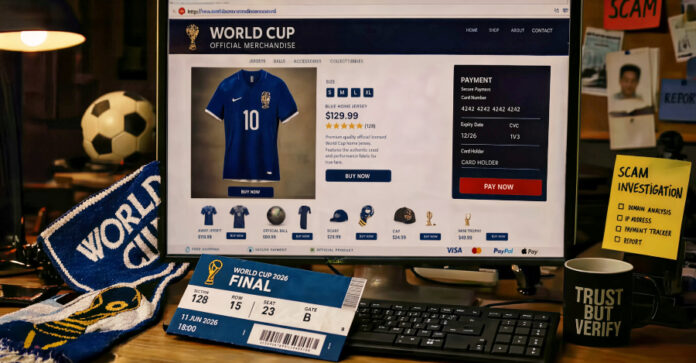

As New Jersey prepares to welcome the world for FIFA World Cup 2026, another international event is already underway—one that has nothing to do with soccer and everything to do with cybercrime. FIFA World Cup 2026 Cybercrime Surge: Why New Jersey Fans Are Becoming Prime Targets for a Global Wave of Scams, Malware, and Account Theft
Long before the first whistle blows and before millions of supporters descend upon the New York-New Jersey region, security researchers, federal investigators, financial institutions, and cybersecurity experts are warning that an unprecedented wave of digital fraud is already targeting World Cup fans. What was expected to become the largest sporting event in history has simultaneously become one of the largest opportunities ever created for online criminals.
The warnings are becoming impossible to ignore.
According to recent cybersecurity investigations, organized criminal networks have launched thousands of fraudulent websites, social media scams, fake ticket marketplaces, banking malware campaigns, and account theft operations designed specifically to exploit the enormous demand surrounding FIFA World Cup 2026. With New Jersey positioned at the center of the global soccer universe and MetLife Stadium set to host some of the tournament’s most important matches, local residents, businesses, visitors, and fans are increasingly finding themselves in the crosshairs of sophisticated cybercriminal organizations operating around the world.
The scale of the problem reflects the scale of the tournament itself.
FIFA World Cup 2026 is expected to be the largest World Cup ever staged. The competition will feature an expanded field of nations, more matches than any previous tournament, and billions of viewers watching from every corner of the globe. Demand for tickets, travel packages, accommodations, hospitality experiences, merchandise, transportation, and event information has reached extraordinary levels.
That demand has created a perfect environment for fraud.
Cybersecurity analysts estimate that more than 150 million ticket requests have been generated for approximately six million available seats throughout the tournament. That massive imbalance between supply and demand has fueled a sense of urgency among supporters desperate to secure tickets, accommodations, and access to once-in-a-lifetime experiences.
Criminal organizations understand this dynamic perfectly.
They know fans are willing to act quickly.
They know supporters fear missing out.
They know many consumers will bypass normal caution when they believe tickets or travel opportunities could disappear within minutes.
As a result, cybercriminals have built an entire underground economy around the World Cup.
One of the most alarming discoveries involves what security researchers have identified as a sprawling network of FIFA-themed phishing operations designed to impersonate legitimate World Cup websites. Investigators have identified thousands of fraudulent domains registered specifically to deceive supporters seeking official information, tickets, accommodations, and tournament services.
At the center of many of these operations is a sophisticated international cybercrime infrastructure that security experts have nicknamed the “Ghost Stadium” network.
Unlike the amateur scams of previous years, these operations are highly professional.
The fraudulent websites replicate official ticketing systems down to the smallest details. Seating charts, venue maps, login screens, purchase confirmations, customer service portals, and checkout processes are recreated with astonishing accuracy. In many cases, the counterfeit websites appear virtually identical to the legitimate platforms they are imitating.
Artificial intelligence has dramatically accelerated the effectiveness of these schemes.
Modern scammers can now generate convincing website copy, customer support responses, promotional materials, and marketing campaigns in seconds. AI-powered tools enable criminals to build professional-looking platforms faster than ever before while maintaining a level of polish that would have required significant resources only a few years ago.
The result is an environment where even experienced internet users can struggle to distinguish legitimate sites from fraudulent ones.
For New Jersey residents planning to attend matches at MetLife Stadium or participate in World Cup-related activities throughout the region, the threat extends far beyond fake ticket sales.
Cybercriminals are increasingly utilizing a tactic known as typosquatting.
This strategy involves registering domain names that closely resemble legitimate websites while incorporating subtle spelling errors that many users fail to notice. A single misplaced letter, an added character, or a slightly altered web address can redirect users to malicious platforms designed to harvest personal information.
Many supporters never realize they have landed on a fraudulent website.
The pages load correctly.
The branding appears authentic.
The logos look official.
The checkout process feels familiar.
By the time victims discover the deception, their financial information may already be compromised.
Social media has emerged as another major battleground.
Security researchers have identified thousands of fraudulent accounts posing as FIFA representatives, ticket brokers, hospitality providers, travel consultants, merchandise vendors, and fan groups. These fake profiles often infiltrate public discussions where supporters exchange information about tickets, accommodations, and match-day planning.
The fraudsters then begin offering “exclusive opportunities,” discounted tickets, premium hospitality access, or limited-time deals that appear impossible to pass up.
Many victims are lured through direct messages.
Others encounter sponsored advertisements.
Some discover fraudulent links shared inside fan communities where trust already exists.
The sophistication of these campaigns continues to increase because scammers understand human psychology as well as they understand technology.
One of the most concerning developments involves credential harvesting.
Many World Cup-themed scams are no longer focused solely on stealing credit card numbers. Instead, attackers increasingly seek access to entire user accounts.
Fake login portals are designed to mimic legitimate FIFA authentication systems. Users attempting to access tickets, update account information, or reset passwords unknowingly provide their credentials directly to cybercriminals.
Once attackers gain access to those accounts, they can steal legitimate tickets, modify account details, lock out rightful owners, and resell purchased inventory on secondary markets.
The consequences extend well beyond a single event.
Many consumers reuse passwords across multiple platforms. A stolen FIFA login may also provide a gateway into email accounts, financial services, streaming platforms, retail accounts, and other sensitive systems.
Security experts are also warning consumers not to rely solely on visual security indicators when browsing websites.
For years, internet users were encouraged to look for the padlock icon that indicates an encrypted connection. Today, cybercriminals routinely obtain security certificates for fraudulent websites, allowing malicious platforms to display the same indicators as legitimate businesses.
In other words, a padlock icon alone no longer guarantees safety.
Perhaps the fastest-growing threat is now occurring on mobile devices.
As fans search for ways to watch matches, receive updates, place sports wagers, access tournament information, or stream live content, cybercriminals are distributing malicious applications disguised as World Cup resources.
Many of these apps appear harmless.
Some advertise free streaming.
Others promise exclusive match coverage.
Some claim to offer real-time statistics, ticket management tools, or betting opportunities.
Behind the scenes, however, these applications may contain advanced banking malware capable of monitoring user activity, capturing passwords, intercepting text messages, recording login credentials, and bypassing security controls.
Once installed, the malware often requests broad device permissions that allow attackers to observe activity without the user’s knowledge.
These attacks are particularly dangerous because they target the same smartphones consumers use for banking, digital wallets, travel reservations, transportation services, and communication.
For World Cup visitors arriving in New Jersey next year, smartphones will likely become the primary tool for navigating transportation systems, accessing tickets, making purchases, locating venues, and coordinating travel plans.
That dependence creates significant opportunities for cybercriminals.
The implications extend beyond individual consumers.
Hotels, restaurants, transportation providers, tourism operators, event organizers, retailers, and hospitality businesses throughout New Jersey are also facing heightened risks.
Cybercriminals frequently target businesses during major events through phishing campaigns, fake vendor invoices, fraudulent reservation requests, business email compromise schemes, and ransomware attacks.
As World Cup preparations accelerate across the region, cybersecurity has become as important as transportation planning, venue readiness, and visitor accommodations.
The New York-New Jersey host region is expected to attract millions of visitors, billions of dollars in economic activity, and unprecedented international attention. That visibility makes the area one of the most attractive targets for digital criminals seeking financial gain.
Yet despite the growing threat, there are practical steps fans can take to protect themselves.
Consumers should verify website addresses carefully before entering personal information, avoid purchasing tickets through unknown sellers, use strong unique passwords, enable multi-factor authentication whenever possible, and download applications exclusively through official app stores.
Unexpected messages promising ticket opportunities, travel discounts, or urgent account actions should always be approached with skepticism.
Supporters should independently verify communications through official channels rather than relying on links embedded in emails, text messages, or social media posts.
Most importantly, fans should remember that urgency is often the scammer’s most powerful weapon.
The pressure to act immediately is frequently the first sign that something is wrong.
The excitement surrounding FIFA World Cup 2026 is unlike anything New Jersey has experienced in generations. The tournament represents a transformational moment for the region, bringing global attention, international visitors, economic growth, cultural exchange, and unforgettable sporting memories.
MetLife Stadium will become one of the focal points of the soccer world.
Communities throughout New Jersey will welcome supporters from dozens of nations.
Businesses across the state will benefit from increased tourism and international exposure.
But as preparations continue, another reality must also be acknowledged.
Cybercriminals have already begun their tournament.
The battle for consumer trust, financial security, and digital safety is underway months before the first match begins.
For New Jersey residents preparing to embrace the excitement of FIFA World Cup 2026, awareness may be the most valuable ticket of all. The world is coming to New Jersey, and while millions of fans will arrive to celebrate the beautiful game, countless scammers are already working overtime to exploit the enthusiasm surrounding it.
The best defense is preparation, vigilance, and understanding that in today’s connected world, protecting your digital identity has become just as important as protecting your ticket to the match.
















