
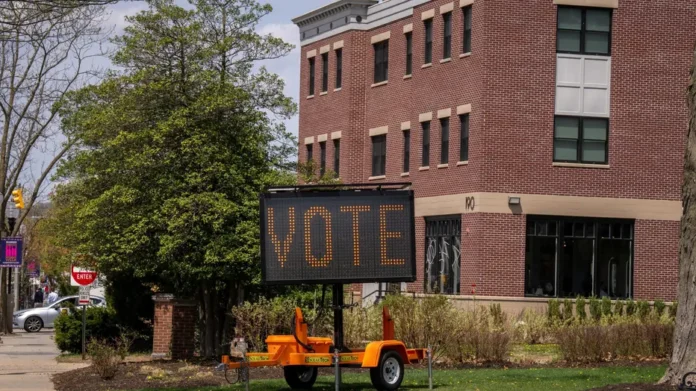

New Jersey voters are heading to the polls today in what is rapidly becoming one of the most consequential primary election days the state has experienced in years. Across all 21 counties, residents are casting ballots that will help shape not only the state’s political future but potentially the balance of power in Washington. Yet while campaigns have spent months building toward Election Day, another issue has emerged over recent weeks that is impossible to ignore: the escalating controversy surrounding Delaney Hall in Newark.
The result is a remarkable convergence of politics, public policy, immigration enforcement, congressional oversight, state authority, and voter engagement. On one side of today’s story are the candidates competing for nominations in races that will determine New Jersey’s representation in the United States Senate and House of Representatives. On the other is a detention center that has evolved from a local issue into one of the most discussed political flashpoints in the state.
Taken together, the two stories have created an unusually intense political environment as New Jersey voters make decisions that could influence both state and national conversations for months to come.
Polls opened statewide at 6:00 a.m. and will remain open until 8:00 p.m., giving voters the opportunity to select the Democratic and Republican nominees who will advance to November’s general election. While primary elections often attract lower turnout than general elections, the stakes this year are unusually high. The outcomes will help determine who represents New Jersey in Congress during a period marked by fierce debates over immigration policy, economic priorities, federal spending, infrastructure investment, public safety, healthcare, housing affordability, and the evolving relationship between state and federal government.
The race for the United States Senate headlines the statewide ballot.
Incumbent Senator Cory Booker is seeking another term and faces no opposition in the Democratic primary. Republicans, however, are choosing among multiple candidates competing for the opportunity to challenge Booker in November. The contest has generated significant attention among party activists and political observers as Republicans seek to position themselves for what could become one of the state’s most closely watched federal races later this year.
Beyond the Senate contest, every congressional district in New Jersey is drawing attention for different reasons.
Perhaps nowhere is the competition more intense than in the state’s 12th Congressional District. The retirement of longtime Representative Bonnie Watson Coleman has created one of the most crowded and competitive Democratic primary battles in recent memory. With a large field of candidates seeking to succeed one of New Jersey’s most recognizable political figures, the race has become a major test of competing visions for the future of Democratic leadership within the state.
Candidates have spent months traveling throughout the district, building coalitions, raising funds, and attempting to distinguish themselves in a crowded political environment. The winner will emerge from a field that reflects the diversity, complexity, and evolving priorities of modern New Jersey politics.
Meanwhile, in the 7th Congressional District, political attention has centered on a very different set of circumstances.
Representative Tom Kean Jr. remains a significant figure within New Jersey Republican politics, but recent concerns surrounding his health have generated considerable speculation. While details remain limited, the uncertainty has added another layer of intrigue to a district already expected to play a major role in determining congressional control. Democratic candidates competing for the opportunity to challenge Kean have intensified their efforts in the final days leading up to today’s vote, recognizing the importance of a district that remains one of the state’s most closely watched political battlegrounds.
Yet despite the importance of these races, much of the conversation throughout New Jersey today extends beyond traditional campaign issues.
The ongoing conflict surrounding Delaney Hall has transformed into a central political issue that candidates, elected officials, advocacy organizations, and voters alike are being forced to confront.
What began as concerns regarding conditions inside the Newark detention facility has evolved into a broader debate touching on immigration policy, detention practices, federal authority, local governance, civil liberties, public safety, and governmental transparency. As demonstrations, legal challenges, congressional visits, law enforcement deployments, and media scrutiny have intensified, Delaney Hall has become one of the most politically charged locations in the state.
The issue now intersects directly with today’s election.
Several federal lawmakers appearing on today’s ballot have become deeply involved in efforts to investigate conditions at the facility. Members of New Jersey’s congressional delegation have demanded access, called for increased oversight, pushed for independent inspections, and raised questions regarding detainee treatment. Those actions have elevated Delaney Hall from a regional concern into a statewide political issue with implications reaching far beyond Newark.
The facility’s growing prominence has also exposed deep divisions regarding immigration enforcement.
Supporters of stronger federal enforcement efforts argue that detention facilities play a necessary role within the immigration system and emphasize the federal government’s responsibility to enforce immigration laws. Critics contend that expanded detention operations require stronger oversight, greater transparency, and more accountability regarding conditions inside facilities operated under federal contracts.
Those competing perspectives have become increasingly visible throughout the primary campaign season.
At the center of the controversy remains Newark Mayor Ras Baraka, whose involvement has helped draw national attention to the dispute. Following his highly publicized arrest during efforts to gain access to the facility, Baraka has continued pressing for greater scrutiny while pursuing legal strategies aimed at challenging Delaney Hall’s continued operation.
City officials have focused heavily on questions involving municipal permits, local authority, and operational compliance. The administration argues that the facility’s current operation raises significant legal concerns that deserve judicial review. Those arguments are expected to play a major role in the next phase of litigation and political debate.
Governor Mikie Sherrill has likewise found herself navigating increasingly complex territory.
Her decision to deploy New Jersey State Police to maintain order around the facility reflected concerns regarding public safety following days of protests, demonstrations, and confrontations. State officials have repeatedly emphasized the importance of protecting constitutional rights while simultaneously preventing violence and maintaining public order.
That balancing act has become increasingly difficult as tensions surrounding the facility continue escalating.
The conflict has also expanded into federal courtrooms. The Department of Justice’s legal challenge involving New Jersey’s policies on immigration cooperation has transformed what might have remained a local dispute into a broader test of state-federal relations. Legal experts expect questions involving federal authority, immigration enforcement, executive powers, and state sovereignty to remain at the forefront of the debate moving forward.
For voters heading to polling places today, these issues form part of a much larger political landscape.
The primary election arrives at a moment when New Jersey faces numerous challenges and opportunities. Economic development, transportation infrastructure, housing affordability, environmental protection, education funding, healthcare access, public safety, workforce development, and immigration policy all remain significant concerns for residents across the state.
The candidates appearing on today’s ballot have offered differing approaches to those issues, giving voters an opportunity to shape the direction of future policy debates. Yet regardless of who emerges victorious tonight, it is clear that many of the questions dominating public discussion will remain unresolved long after votes are counted.
Delaney Hall is likely to remain one of those issues.
As legal proceedings continue, congressional oversight expands, advocacy efforts intensify, and federal authorities defend ongoing operations, the facility has become emblematic of larger debates unfolding throughout the country. Questions regarding immigration enforcement, detention practices, government accountability, public transparency, and the relationship between federal and local authority are unlikely to disappear anytime soon.
For New Jersey voters, today’s primary election represents more than a routine political exercise. It serves as a snapshot of a state grappling with some of the most significant issues facing the nation. The decisions made in voting booths today will help determine who carries those debates forward into Washington and who will be responsible for representing New Jersey’s interests during an increasingly consequential period in American politics.
By tonight, nominees will emerge. Campaigns will pivot toward the general election. New alliances will form. New rivalries will develop. Yet even as election results dominate headlines, the broader conversations shaping New Jersey’s future—from congressional representation to immigration policy and beyond—will continue unfolding.
In many ways, today’s primary is not the conclusion of a political season. It is the beginning of the next chapter.
















