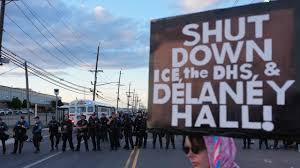

The political, legal, and humanitarian battle surrounding Delaney Hall has entered a decisive new phase, transforming what was once a localized dispute into one of the most consequential public policy confrontations currently unfolding in New Jersey. As Newark Mayor Ras Baraka prepares to unveil a new legal strategy aimed at permanently shutting down the facility, pressure continues mounting from elected officials, faith leaders, immigrant advocates, civil rights organizations, and community groups who argue that conditions inside the detention center demand immediate transparency, independent oversight, and accountability.
At the same time, federal officials remain equally determined to defend the facility’s operations, setting the stage for an escalating conflict that increasingly reflects a broader national debate over immigration enforcement, detention policy, federal authority, state sovereignty, local governance, and the role of private prison corporations in administering immigration detention facilities.
Located along Newark’s industrial corridor on Doremus Avenue, Delaney Hall has become one of the most heavily scrutinized facilities in the nation over the past several weeks. What began as demonstrations over detainee treatment and facility conditions has evolved into a multi-layered conflict involving lawsuits, executive orders, congressional oversight efforts, law enforcement deployments, municipal permit disputes, hunger strikes, faith-based advocacy campaigns, and competing interpretations of governmental authority.
The latest developments suggest the conflict is far from nearing resolution.
Mayor Baraka is expected to formally outline Newark’s next legal steps as city officials continue pursuing arguments that Delaney Hall lacks the municipal approvals and operating permits necessary to function under its current configuration. City leaders have consistently maintained that local permitting requirements were not properly satisfied before the facility reopened under expanded federal immigration detention operations, creating what they believe is a significant legal vulnerability for the GEO Group-operated center.
The anticipated legal strategy represents the most direct municipal effort yet to challenge Delaney Hall’s continued operation.
Newark’s position has remained consistent throughout the dispute. City officials argue that regardless of federal immigration policy, facilities operating within municipal boundaries must comply with applicable local regulations, inspections, permitting requirements, and safety standards. The city maintains that questions surrounding compliance remain unresolved and warrant judicial intervention.
The legal challenge arrives as tensions between New Jersey officials and federal authorities continue intensifying.
Adding another layer of complexity, the U.S. Department of Justice has initiated legal action against New Jersey Governor Mikie Sherrill regarding executive actions that critics argue limit cooperation with federal immigration enforcement efforts. That lawsuit has elevated the Delaney Hall dispute beyond a municipal conflict, transforming it into a broader confrontation between federal enforcement priorities and state-level resistance efforts.
The result is a growing legal battlefield that now stretches from Newark City Hall to the Governor’s Office and ultimately into federal courtrooms.
Meanwhile, conditions surrounding the facility itself remain heavily controlled following days of demonstrations, confrontations, and arrests that drew national attention.
The nightly emergency curfew established around Delaney Hall remains fully in effect. State and local law enforcement agencies continue enforcing restrictions within a half-mile radius of the detention center, maintaining a significant security presence throughout the surrounding area. Doremus Avenue remains subject to strict access controls, with pedestrian traffic prohibited and vehicle entry limited to authorized personnel and individuals with verified business purposes.
Law enforcement officials have repeatedly stated that perimeter violations and curfew violations will continue resulting in immediate enforcement action.
The security measures were implemented following several days of escalating unrest that saw confrontations between protesters and law enforcement officers, property damage, arrests, and growing concerns regarding public safety. While recent evenings have remained relatively calmer compared to the most volatile periods of unrest, authorities have made clear that the security posture will remain in place until conditions stabilize further.
Yet while public attention has focused heavily on events occurring outside Delaney Hall, the issues inside the facility continue driving much of the controversy.
The hunger and labor strike initiated by detainees remains one of the most significant developments shaping public perception of the facility. Participants have continued raising concerns regarding living conditions, healthcare access, food quality, sanitation standards, and treatment within the detention center.
Advocates representing detainees have amplified allegations involving inadequate medical care, contaminated food, questionable water quality, and insufficient accommodations for medically vulnerable individuals. These claims have fueled growing demands for independent inspections and expanded oversight.
Federal officials and facility operators have disputed many of those allegations, maintaining that detainees are receiving appropriate care consistent with applicable standards. Nevertheless, concerns raised by detainees, attorneys, advocacy organizations, and elected officials have continued generating intense scrutiny.
One of the most significant developments involves reports that ongoing pressure from congressional representatives has resulted in the release of certain medically vulnerable detainees. While advocates view those releases as evidence that serious health concerns exist within the facility, federal officials have characterized detention decisions as routine case-specific evaluations.
The releases have done little to reduce calls for broader oversight.
Increasingly, those demands are coming not only from political leaders and advocacy groups but also from New Jersey’s faith community.
In recent days, faith organizations throughout the state have emerged as influential voices in the growing debate. The National Action Network and the New Jersey Coalition of Latino Pastors and Ministers have joined together in calling for increased transparency, independent review mechanisms, and greater public accountability regarding operations at Delaney Hall.
Their involvement highlights the expanding coalition of organizations seeking answers regarding conditions inside the detention center.
Faith leaders argue that regardless of political affiliation or immigration policy preferences, fundamental questions involving human dignity, healthcare access, family contact, due process, and humane treatment deserve serious attention. Their requests focus not on partisan positioning but on ensuring that independent reviews can assess conditions objectively and transparently.
The participation of religious organizations also reflects the increasingly diverse nature of opposition surrounding the facility.
What initially began as activism driven primarily by immigration advocates has broadened considerably. The conversation now includes elected officials, civil rights organizations, clergy members, community leaders, healthcare advocates, legal experts, and residents concerned about government accountability and public transparency.
That coalition continues growing as the controversy evolves.
The Delaney Hall dispute has also become a symbol of larger questions facing New Jersey and the nation.
Supporters of continued operations argue that immigration detention remains a lawful federal responsibility and that facilities such as Delaney Hall are essential components of the nation’s immigration enforcement infrastructure. They contend that federal authorities possess broad constitutional powers regarding immigration matters and that detention facilities serve legitimate governmental purposes.
Critics counter that detention operations must remain subject to rigorous oversight, public accountability, and basic humanitarian standards. They argue that transparency is essential whenever individuals are held in government custody, particularly within facilities operated by private corporations under lucrative federal contracts.
Those competing perspectives increasingly define the public debate.
For many observers, Delaney Hall has become more than a detention center. It has evolved into a focal point for broader conversations involving immigration policy, governmental power, civil liberties, corporate accountability, public safety, healthcare access, faith-based advocacy, and the relationship between local communities and federal institutions.
Every new development appears to reinforce that reality.
As legal challenges move forward, federal lawsuits advance, oversight efforts expand, and faith organizations continue calling for independent review, Delaney Hall remains at the center of one of the most consequential public policy conflicts currently unfolding in New Jersey.
The coming days could prove pivotal.
Mayor Baraka’s anticipated legal strategy may significantly influence the facility’s future. Ongoing federal litigation could reshape the balance of authority between Washington and New Jersey. Congressional oversight efforts may generate additional scrutiny. Faith leaders are expected to continue pressing for transparency and independent inspections. Detainee advocacy efforts remain active. Law enforcement agencies continue maintaining extensive security operations.
What happens next at Delaney Hall will likely have implications extending far beyond Newark.
The outcome could shape future debates involving immigration detention, municipal authority, federal contracting practices, private prison operations, and state-federal relations not only in New Jersey but across the country.
For now, Delaney Hall remains at the center of an extraordinary convergence of legal, political, humanitarian, and civic forces. The questions being asked there today reach beyond a single facility. They touch on how governments exercise authority, how communities demand accountability, how institutions respond to scrutiny, and how society balances enforcement responsibilities with concerns about transparency, dignity, and human rights.
As New Jersey watches events continue to unfold, Delaney Hall remains one of the state’s most closely observed and fiercely debated public issues, with no indication that the controversy surrounding the facility will fade anytime soon.