

What began as a protest over detention conditions inside Newark’s Delaney Hall Immigration Detention Center has now evolved into one of the most visible and politically charged public demonstrations New Jersey has witnessed in recent years. As hundreds of demonstrators, counter-protesters, elected officials, law enforcement agencies, immigration advocates, and federal authorities continue to clash over the future of the facility, Delaney Hall has become the focal point of a much larger national debate involving immigration policy, detention standards, federal authority, public accountability, and civil liberties.
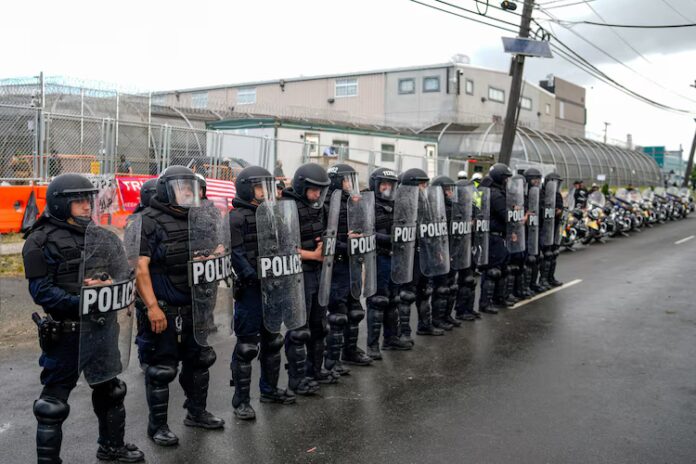
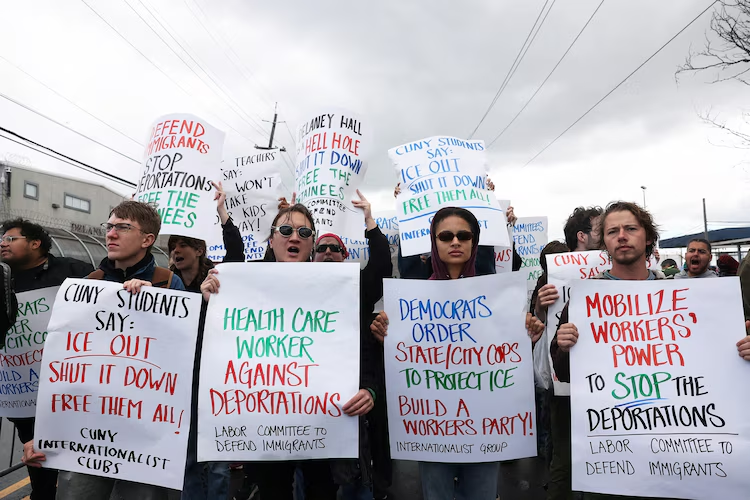
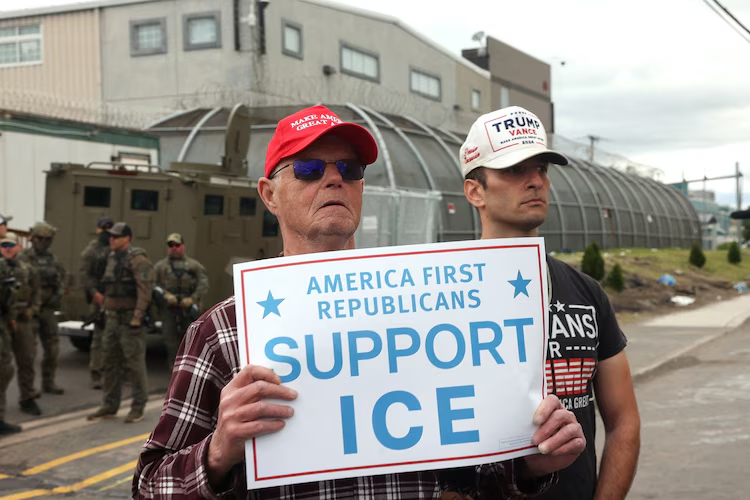
The situation reached a new level of intensity this weekend as rival demonstrations officially materialized outside the facility, transforming a previously tense protest environment into a highly controlled standoff overseen by the New Jersey State Police. By Saturday morning, approximately 200 anti-ICE demonstrators had gathered near the detention center while roughly 75 pro-ICE supporters assembled nearby to express support for federal immigration enforcement efforts. The opposing groups, separated by extensive police barricades and designated protest zones, spent much of the day exchanging chants, slogans, and competing messages across a heavily monitored security perimeter.
The deployment of the New Jersey State Police represents the latest chapter in a week-long escalation that has attracted national media attention and intensified scrutiny of conditions inside the privately operated detention facility. State officials moved aggressively to establish order following several days of confrontations between demonstrators and federal agents, incidents that included arrests, allegations of excessive force, the use of chemical irritants, and growing concerns that the situation could spiral into a larger public safety crisis.
Throughout Saturday, state troopers restricted vehicle traffic along portions of Doremus Avenue while installing extensive metal barricades designed to create physical separation between opposing groups. The strategy reflects an effort by state authorities to prevent direct confrontations while preserving constitutionally protected rights to peaceful assembly and free expression.
Governor Mikie Sherrill and Attorney General Jennifer Davenport ordered the transition to state-controlled public safety operations following negotiations that resulted in federal immigration personnel withdrawing from exterior perimeter duties. Under the arrangement, New Jersey State Police assumed responsibility for crowd management, traffic control, and public safety operations surrounding the facility while federal authorities continued overseeing detention operations inside the complex.
State officials described the newly established demonstration areas as protected zones intended to lower tensions and reduce the likelihood of further violence. The designated spaces provide separate areas for supporters and opponents of federal immigration enforcement while allowing demonstrations to continue under controlled conditions.
Not everyone agrees with the approach.
Some grassroots activists and immigration advocacy organizations argue that the extensive police presence and restricted access zones effectively limit the visibility and impact of their demonstrations. They contend that moving protesters farther away from the facility reduces public awareness of the concerns that originally sparked the movement and makes it more difficult to maintain pressure on federal authorities.
Supporters of the state’s actions, however, argue that the measures were necessary following several days of escalating confrontations that threatened public safety and risked drawing larger crowds into potentially volatile situations.
At the heart of the controversy remains the growing dispute over conditions inside Delaney Hall.
The current unrest traces its origins to allegations made by detainees and advocacy groups during Memorial Day weekend. According to those accounts, hundreds of detained migrants participated in a coordinated hunger and labor strike designed to draw attention to what they described as unacceptable living conditions within the facility. Participants and their supporters cited concerns involving food quality, medical access, ventilation systems, and overall treatment of detainees.
Family members and advocacy organizations quickly amplified those complaints, organizing demonstrations outside the facility and demanding independent inspections.
As public attention intensified, allegations expanded beyond the original concerns. Civil rights advocates and attorneys representing detainees claimed that facility personnel responded to the strike with retaliatory measures that included lockdowns, restrictions on communication privileges, and the use of force against participants.
Those allegations have become central to the ongoing controversy.
The Department of Homeland Security has categorically disputed the accusations, maintaining that Delaney Hall operates in compliance with federal detention standards and receives regular oversight. Federal officials insist that detainees are provided appropriate meals, medical services, and housing conditions. According to DHS statements, reports describing systematic mistreatment are inaccurate and fail to reflect conditions inside the facility.
Federal authorities have also disputed descriptions of the original unrest, characterizing portions of the disturbance as detainee-on-detainee conflicts rather than organized labor actions.
The competing narratives have created an environment in which nearly every development becomes subject to intense political interpretation.
Outside the facility, the emergence of organized counter-protests has further complicated an already volatile situation.
Saturday’s pro-ICE demonstration drew supporters from conservative organizations, immigration enforcement advocates, and individuals who argue that federal agencies are being unfairly criticized while attempting to enforce existing immigration laws. Participants described their presence as a show of support for federal officers operating under increasingly difficult circumstances.
The counter-rally was organized in part by groups advocating stronger border enforcement and stricter immigration policies. Organizers argued that federal personnel deserve public backing and expressed concern that political leaders have increasingly challenged the authority of immigration enforcement agencies.
The appearance of members associated with far-right organizations added another layer of controversy to the day’s events. Reports from multiple media outlets indicated that individuals linked to extremist political groups were present during portions of the demonstration, drawing criticism from immigration advocates and further intensifying political tensions surrounding the facility.
Despite the emotionally charged atmosphere, no significant new violence was reported during Saturday’s demonstrations.
That relative calm stands in contrast to earlier confrontations that generated widespread attention. During previous demonstrations, protesters formed human chains intended to block transport vehicles entering and exiting the facility. Those actions led to forceful dispersal efforts, arrests, and allegations that chemical irritants were used against protesters, journalists, and observers.
The images and video footage from those incidents rapidly circulated across social media platforms and national news outlets, transforming a local protest into a broader national story.
The dispute has also evolved into a significant political conflict involving elected officials at multiple levels of government.
Several Democratic lawmakers have publicly demanded increased transparency regarding conditions inside Delaney Hall and sought access to inspect the facility firsthand. Efforts by elected officials to enter the detention center have become points of contention, with federal authorities and political leaders offering sharply different interpretations regarding access and oversight responsibilities.
The debate extends beyond immediate operational concerns and reflects broader disagreements about immigration enforcement policies, private detention facilities, federal authority, and state oversight powers.
Adding another layer of complexity is an ongoing legal dispute involving the facility itself.
The City of Newark continues pursuing legal challenges related to the reopening and operation of Delaney Hall. Municipal officials argue that the facility resumed operations without securing required local approvals and permits. That litigation remains active, with court-ordered mediation expected to continue in the coming weeks.
The outcome of that legal battle could have significant implications not only for Delaney Hall but also for future relationships between municipalities, private detention operators, and federal immigration agencies.
For now, however, the immediate focus remains on maintaining stability outside the facility while questions surrounding detainee conditions, public accountability, and federal immigration policy continue to generate passionate responses from all sides.
As rival demonstrations continue, state officials face the difficult task of preserving public order while respecting constitutional rights and navigating one of the most politically sensitive issues in modern American public life.
Delaney Hall has become far more than a detention center.
It now stands at the center of a statewide and national conversation about immigration, governance, public transparency, civil liberties, law enforcement authority, and the role communities play in shaping policy debates. Whether the tensions surrounding the facility ultimately subside or continue to escalate, the events unfolding in Newark are likely to remain a defining New Jersey story throughout the summer as policymakers, advocates, residents, and federal officials continue wrestling with questions that extend far beyond the facility’s fences.
















