
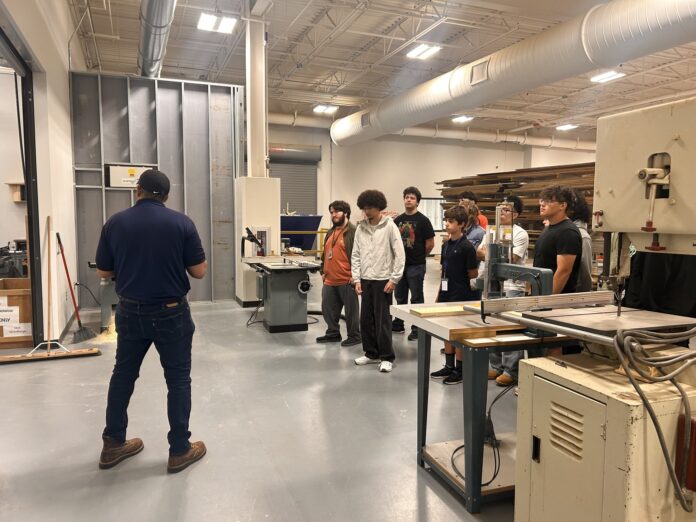

At a time when the United States faces an accelerating skilled labor shortage, rising concerns over workforce development, and growing questions about how younger generations will enter stable middle-class careers without crushing debt, a powerful community event in South Jersey offered a very different vision for the future of education and opportunity. Inside the Cumberland County Technical Education Center in Millville this spring, vocational learning stopped being an abstract policy discussion and became something tangible — measured in pine boards, hand tools, mentorship, teamwork, and the unmistakable sound of young people discovering what building something with their own hands actually feels like.
The April 16 partnership event at the Cumberland County Technical Education Center, commonly known as CCTEC, brought together union carpenters, educational advocates, youth mentors, and dozens of local students for an immersive evening centered around skilled trades exposure, practical learning, and career pathway awareness. Organized through a collaboration involving Big Brothers Big Sisters of Cumberland & Salem Counties, Maplewood Shop, and the Carpenter Contractor Trust connected to the Eastern Atlantic States Regional Council of Carpenters, the initiative transformed a technical education environment into a living demonstration of how workforce development and mentorship can intersect in meaningful ways.
Sixty-five young participants from the Big Brothers Big Sisters mentoring program attended the workshop alongside their adult mentors, creating an atmosphere that blended education, guidance, community engagement, and career exploration into one coordinated experience. Throughout the evening, students participated in a hands-on woodworking project where they learned how to safely use tools, perform layout calculations, measure materials accurately, and cut pine boards using hand saws before assembling their own keepsake boxes under professional supervision.
What may appear on the surface to be a simple woodworking exercise actually represented something much larger unfolding throughout New Jersey and across the country: a growing movement to reintroduce skilled trades as viable, respected, technologically evolving, financially stable career paths for younger generations who increasingly face uncertainty about the long-term value of traditional four-year college models.
The event also reflected a changing cultural conversation around vocational education itself. For years, technical trades were often marginalized within broader educational narratives that overwhelmingly emphasized university pathways as the primary definition of professional success. Today, however, the labor market is forcing a reevaluation of those assumptions. Industries tied to construction, infrastructure, carpentry, electrical work, HVAC systems, welding, manufacturing, and mechanical trades are confronting severe labor shortages driven by demographic shifts, retirements, and years of declining workforce entry.
The generation exiting the trades is currently larger than the generation entering them, creating an urgent economic challenge that is beginning to reshape how schools, unions, workforce organizations, and community groups approach youth engagement. Events like the Millville workshop are increasingly viewed not simply as educational outreach but as long-term strategic investments in rebuilding skilled labor pipelines.
For the students attending the event, the experience provided exposure to concepts rarely replicated in conventional classroom environments. Rather than learning through passive instruction alone, participants engaged directly with physical materials, measurements, safety procedures, and collaborative problem-solving. They left not just with a completed keepsake box, but with firsthand exposure to craftsmanship, precision, and the satisfaction of creating something tangible from raw materials.
Maplewood Shop played a major operational role in making the evening possible by supplying portable woodworking stations, hand tools, instructional guidance, and project materials. Known for developing mobile educational woodworking experiences, the organization specializes in bringing practical construction learning directly into schools, community centers, and youth environments where hands-on technical education opportunities may otherwise be limited.
Meanwhile, the Carpenter Contractor Trust helped connect the event to broader workforce development goals tied to the union carpentry sector. Organizations associated with union apprenticeship systems have increasingly prioritized youth outreach as part of larger efforts to rebuild awareness surrounding trade careers that offer strong wages, healthcare benefits, pensions, structured advancement pathways, and long-term job stability without requiring massive student debt burdens.
The Eastern Atlantic States Regional Council of Carpenters has been particularly active in supporting initiatives aimed at introducing younger generations to modern construction careers before they make post-graduation decisions. Industry leaders understand that many teenagers remain largely unaware of how technologically advanced, financially rewarding, and professionally sustainable today’s skilled trades careers can actually be.
That disconnect has become especially important in New Jersey, where infrastructure investment, logistics expansion, transportation modernization, warehouse development, mixed-use construction, renewable energy projects, and large-scale redevelopment initiatives continue generating significant labor demand across multiple trades sectors. Workforce shortages increasingly threaten project timelines and long-term economic growth, making early career exposure programs more valuable than ever.
Yet one of the most important aspects of the Millville event extended beyond the trades themselves. The partnership with Big Brothers Big Sisters added an entirely different layer of impact centered around mentorship, confidence-building, and long-term personal development.
For more than a century, Big Brothers Big Sisters has operated as one of the country’s most recognized youth mentorship organizations, connecting adult volunteers with children who benefit from additional guidance, support, encouragement, and positive role models. The organization’s “Bigs” and “Littles” structure creates one-to-one mentorship relationships designed to strengthen self-esteem, improve educational engagement, and help young people build resilience while navigating difficult circumstances.
Many children participating in the program come from under-resourced households, single-parent homes, or environments where access to professional exposure and career networking opportunities may be limited. Events like the CCTEC workshop create experiences that combine mentorship with practical skill-building, exposing students to industries and career possibilities they might not otherwise encounter directly.
The atmosphere inside the event reportedly reflected far more than a technical lesson. Students worked alongside mentors, learned from professionals, collaborated with peers, and participated in an environment built around encouragement rather than pressure. Organizers emphasized that the evening was intentionally designed to create positive early experiences associated with craftsmanship, problem-solving, and teamwork.
That approach mirrors a broader educational shift taking place nationwide as schools and workforce advocates increasingly recognize the importance of experiential learning environments. Students often engage more deeply when they can physically interact with concepts instead of solely consuming information through lectures or standardized testing models. Skilled trades education naturally lends itself to that dynamic because progress becomes visible in real time through physical construction and measurable outcomes.
The keepsake boxes themselves ultimately became symbolic of something much larger than a beginner woodworking exercise. They represented confidence, participation, creativity, accomplishment, and exposure to possibilities that many students may never previously have considered. In a labor market increasingly hungry for skilled workers, those early moments of discovery matter.
Events like the one hosted in Millville also challenge lingering misconceptions about vocational pathways. Modern union trades increasingly involve advanced technology, digital blueprint systems, precision engineering, sustainability integration, infrastructure modernization, and highly specialized technical expertise. The stereotype of skilled labor as outdated or limited continues fading as younger workers discover the complexity and sophistication embedded within today’s construction and manufacturing sectors.
For New Jersey specifically, the long-term importance of workforce pipeline development continues growing more urgent. The state’s economy depends heavily on transportation infrastructure, logistics operations, commercial development, residential expansion, public works investment, and industrial modernization. Without enough trained workers entering those sectors, economic growth itself can face significant limitations.
The Millville initiative demonstrated how local partnerships may play a crucial role in solving those challenges. By bringing together educators, unions, nonprofits, mentors, and community organizations, the event created a model for how workforce development can begin earlier, feel more accessible, and connect directly to real-world opportunity.
As policymakers, schools, labor organizations, and employers continue debating the future of education and workforce preparation, the scene inside CCTEC offered a practical reminder that career inspiration often starts not with policy speeches or recruitment campaigns, but with direct experience — a measuring tape in hand, a pine board on a workbench, guidance from a mentor nearby, and a young person realizing for the first time that building something meaningful might also mean building a future.
















