
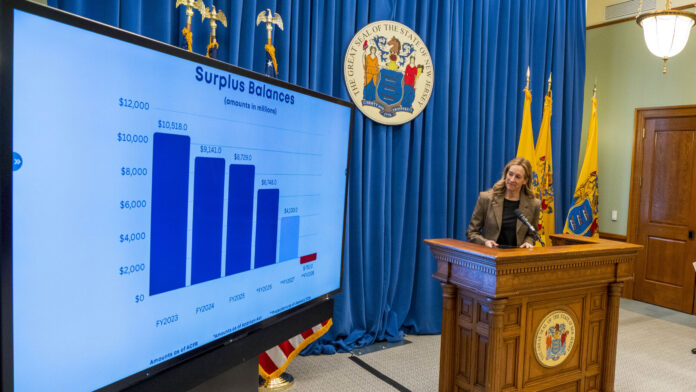

As New Jersey moves deeper into one of the most consequential budget seasons in recent years, attention is increasingly focused not on committee rooms or public hearings, but on the intensive behind-the-scenes negotiations taking place among Governor Mikie Sherrill, legislative leadership, and key budget stakeholders. With statutory deadlines approaching and critical committee meetings already scheduled for next week, state leaders are now working through the weekend in an effort to reach a comprehensive budget agreement that could shape New Jersey’s fiscal direction for years to come.
The latest developments signal that negotiations have entered a decisive stage. Multiple discussions continue among senior officials as policymakers attempt to bridge differences on spending priorities, tax policy, long-term obligations, affordability initiatives, and the future structure of several high-profile state programs. While public details remain limited, insiders familiar with the negotiations increasingly describe the talks as moving toward a workable framework capable of securing support from both the executive branch and legislative leadership.
At the center of many conversations is the future of StayNJ, one of the most closely watched affordability initiatives in the state. Originally designed to help older residents remain in New Jersey by reducing property tax burdens, the program quickly became a major political and fiscal focal point due to questions surrounding long-term funding mechanisms, eligibility structures, and projected costs. As lawmakers continue reviewing the broader state spending plan, discussions surrounding potential modifications to StayNJ have emerged as one of the most significant issues still awaiting resolution.
Sources familiar with the negotiations indicate that a potential compromise could include adjustments designed to improve the program’s long-term sustainability while preserving its central objective of helping residents remain in their homes as property taxes continue to rise. Policymakers appear focused on finding a balance between affordability relief and fiscal responsibility, a challenge that has become increasingly important as New Jersey continues navigating economic uncertainty, inflationary pressures, infrastructure demands, and growing service costs.
At the same time, another major issue drawing attention involves proposals to strengthen limitations surrounding legislative earmarks and discretionary spending allocations. The debate reflects broader discussions taking place across the country regarding transparency, accountability, and the distribution of public resources. Advocates of stronger caps argue that tighter controls can improve public confidence in the budgeting process while ensuring that taxpayer dollars are allocated according to clearly defined priorities and measurable outcomes.
Supporters of additional safeguards contend that stronger oversight mechanisms can help focus state spending on strategic investments such as transportation infrastructure, education, public safety, economic development, healthcare, housing initiatives, environmental projects, and workforce development programs. Critics, however, caution that excessive restrictions could limit lawmakers’ ability to respond to unique local needs and emerging community priorities.
These debates underscore the complexity of constructing a state budget in one of the nation’s most diverse and economically significant states. New Jersey’s annual budget process impacts virtually every aspect of daily life, from public schools and higher education institutions to transportation networks, healthcare systems, public safety agencies, environmental initiatives, economic development programs, and municipal services.
The stakes are particularly high this year as New Jersey continues confronting a rapidly evolving economic landscape. State officials must account for shifting revenue projections, changing federal funding environments, growing demands on public services, and emerging opportunities associated with technology, manufacturing, healthcare innovation, logistics, clean energy, and infrastructure modernization.
Beyond the immediate fiscal considerations, this year’s negotiations are unfolding during a period of significant transition across state government. Governor Sherrill’s administration has sought to establish priorities that emphasize affordability, economic competitiveness, infrastructure investment, and long-term fiscal planning. Legislative leaders, meanwhile, are balancing statewide objectives with the concerns of local communities facing their own challenges related to housing costs, transportation needs, healthcare access, education funding, and economic development.
The willingness of key decision-makers to continue negotiations throughout the weekend highlights the urgency surrounding the process. Rather than allowing unresolved issues to spill into formal hearings next week, leaders appear determined to develop a framework capable of advancing through committee review while minimizing the risk of last-minute disruptions. Such an approach reflects a broader recognition that prolonged uncertainty can create challenges not only for lawmakers but also for municipalities, agencies, school districts, nonprofit organizations, and businesses that depend on timely budget decisions.
Current scheduling plans indicate that budget-related activity will intensify rapidly once lawmakers return to formal proceedings. Committee meetings are expected to play a critical role in reviewing final budget language, evaluating amendments, and preparing legislation for consideration by the full Legislature. The compressed timeline leaves little room for significant delays, increasing pressure on negotiators to resolve remaining disagreements as quickly as possible.
For residents across New Jersey, the budget discussions represent more than a political exercise. The decisions made during the coming days will influence property tax relief programs, public transportation investments, education funding levels, healthcare services, economic development incentives, infrastructure improvements, environmental initiatives, public safety resources, and countless other programs that shape everyday life throughout the state.
The negotiations also serve as a reminder of New Jersey’s unique position within the national economy. As one of the most densely populated states in the country and home to major industries ranging from pharmaceuticals and financial services to logistics, technology, telecommunications, healthcare, and advanced manufacturing, New Jersey faces budget challenges and opportunities that often require sophisticated policy solutions.
Political observers note that successful budget agreements often emerge during precisely these types of intensive negotiation periods, when leaders move beyond public positioning and focus on practical solutions capable of earning broad support. While disagreements remain, the continued engagement among principals suggests a shared understanding of the importance of reaching consensus before the formal legislative calendar accelerates next week.
As discussions continue through the weekend, attention throughout Trenton remains fixed on whether negotiators can finalize the remaining pieces of a comprehensive agreement. If successful, lawmakers could enter next week’s hearings with a clearer roadmap toward final approval. If negotiations stall, additional debates could emerge during committee proceedings and floor sessions later in the month.
For now, however, momentum appears focused on compromise. Behind closed doors, policymakers are working to reconcile competing priorities while crafting a budget that addresses affordability concerns, maintains fiscal discipline, supports economic growth, and positions New Jersey for continued investment and opportunity. The coming days will determine whether those efforts produce the consensus needed to move the state’s next budget across the finish line and into the next chapter of New Jersey’s economic and legislative future.
















