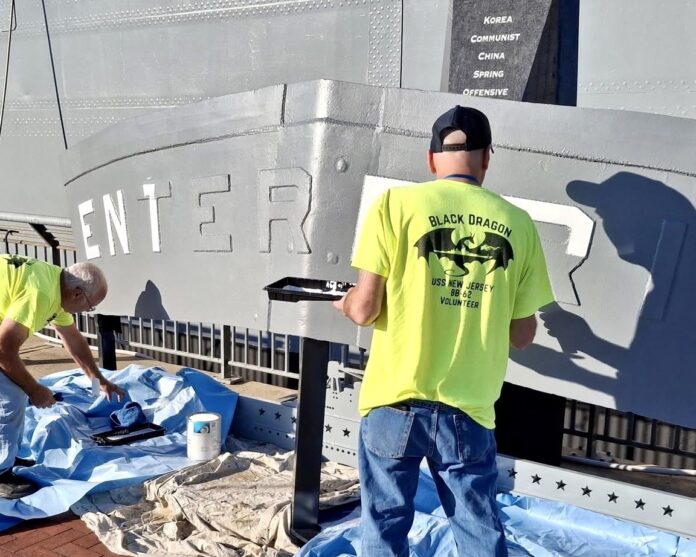

On a day dedicated to recognizing service, commitment, and civic pride, New Jersey’s cultural landscape offers a defining example of what volunteerism looks like at its highest level. Volunteer Recognition Day is not simply a moment of acknowledgment—it is a window into the engine that sustains one of the region’s most significant historic institutions. At the center of that story stands the Battleship New Jersey, a landmark that has evolved far beyond its identity as a preserved naval vessel to become a living, working monument powered by the dedication of hundreds of individuals who give their time, skill, and passion to keep history fully alive.
The Battleship New Jersey is often described as a museum, but that designation only captures part of its reality. It is, in practice, an immersive, dynamic environment where history is not confined to exhibits or glass cases, but experienced through restored spaces, guided interpretation, and ongoing preservation work that continues in real time. What makes that possible is not just infrastructure or funding—it is people. Specifically, it is a volunteer network that has, over the lifetime of the museum, contributed more than 750,000 hours of service aboard the ship.
That number is significant not only in scale, but in meaning. It represents decades of sustained effort, a collective investment of time that has shaped every accessible corridor, every restored compartment, and every educational interaction experienced by visitors. It is the difference between a static artifact and a living institution. The impact of those hours is not abstract—it is visible, tangible, and woven into the very fabric of the ship.
Each year, more than 200 volunteers step into roles that span the full operational spectrum of the Battleship New Jersey. Some are engaged in hands-on restoration, applying technical expertise to preserve the structural and mechanical integrity of the vessel. Others contribute through research, uncovering historical details that deepen the accuracy and richness of the ship’s interpretive programming. Many serve as the face of the experience itself, guiding visitors, sharing stories, and ensuring that every guest encounter reflects both knowledge and authenticity.
This diversity of roles reflects a broader truth about volunteer-driven institutions: they are not sustained by a single type of contribution, but by a network of complementary efforts that together create a cohesive and effective operation. At the Battleship New Jersey, that network functions with a level of coordination and commitment that rivals professional organizations, yet it is built on a foundation of voluntary service.
Volunteer Recognition Day brings that reality into focus, but it also highlights the ongoing nature of the work. Preservation is not a completed task—it is a continuous process. The scale of a historic vessel like the Battleship New Jersey demands constant attention, from routine maintenance to specialized restoration projects that require both time and resources. Every section of the ship presents its own challenges, whether it involves structural upkeep, environmental control, or the careful conservation of historically significant materials.
This is where the relationship between volunteers and support systems becomes critical. While the dedication of volunteers provides the labor, expertise, and presence that drive daily operations, the tools, materials, and infrastructure required to sustain that work depend on broader community engagement. Contributions directed toward the ship are not abstract donations—they are direct investments in the ability of volunteers to continue their work effectively. They enable access to the resources necessary to maintain standards, expand restoration efforts, and enhance the visitor experience.
The Battleship New Jersey exists within a larger ecosystem that defines the state’s cultural identity, one that is continuously highlighted through platforms like Explore New Jersey’s arts and culture coverage. Within that ecosystem, the ship stands as both a historical anchor and a living example of how preservation can be both participatory and evolving. It demonstrates that cultural institutions are not sustained by history alone, but by active engagement in the present.
What distinguishes the Battleship New Jersey is the way it integrates that engagement into its core structure. Volunteers are not peripheral—they are central. Their presence shapes not only the operational capacity of the ship, but its character. They bring a level of authenticity and personal investment that cannot be replicated through traditional staffing models. Their stories, their knowledge, and their connection to the mission all contribute to an experience that feels immediate and genuine.
This dynamic also reinforces the broader value of volunteerism within cultural institutions. It challenges the perception that preservation is solely the responsibility of organizations or governing bodies, instead positioning it as a shared endeavor. It invites individuals to become active participants in the stewardship of history, transforming passive appreciation into direct contribution.
On Volunteer Recognition Day, that invitation becomes both acknowledgment and call to action. It recognizes the individuals who have already committed their time and energy, while also emphasizing the ongoing need for support—whether through volunteering, financial contributions, or simply increased awareness of the work being done. The scale of the ship and the scope of its preservation needs ensure that there is always more to be accomplished, more to restore, and more to share.
For those who have visited the Battleship New Jersey, the impact of this work is immediate. It is felt in the accessibility of spaces that might otherwise remain closed, in the depth of information provided during tours, and in the overall sense that the ship is not frozen in time, but actively maintained and interpreted. For those who have yet to experience it, the story of its volunteers offers a compelling reason to engage—not just as visitors, but as participants in a larger effort to preserve a piece of living history.
The significance of Volunteer Recognition Day, in this context, extends beyond a single institution. It serves as a reminder of the role that individuals play in sustaining the cultural and historical assets that define a region. It highlights the capacity for collective action to achieve outcomes that would be difficult, if not impossible, through formal structures alone.
At the Battleship New Jersey, that capacity is on full display. It is measured not only in hours, but in outcomes—in restored spaces, in informed visitors, and in the continued presence of a landmark that might otherwise have faded into history. It is a testament to what can be achieved when dedication meets purpose, and when individuals choose to invest their time in something larger than themselves.
As the state continues to celebrate Volunteer Recognition Day, the message emerging from the decks of the Battleship New Jersey is both clear and compelling: history is not self-sustaining. It requires effort, commitment, and a willingness to act. The volunteers who have contributed more than 750,000 hours have already demonstrated what that looks like. The opportunity now is to ensure that their work continues, supported by a community that recognizes its value and is ready to carry it forward.