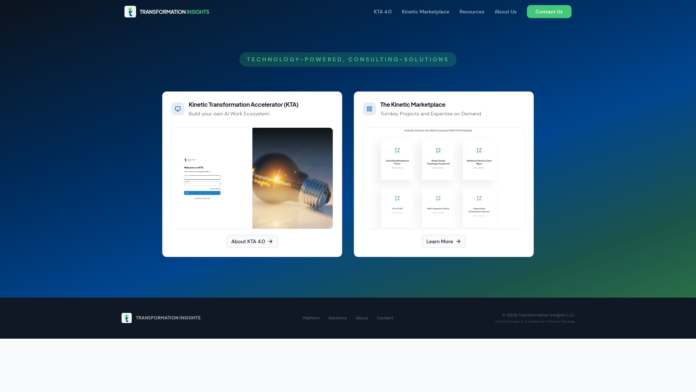

Transformation Insights, an organizational consulting and software firm founded by Nathan Gampel, has launched KTA 4.0, short for Kinetic Transformation Accelerator, a software as a service platform the company describes as an AI consultant in a box. Rather than hiring an expensive human consulting team to monitor employees and track business goals, companies can now subscribe to the platform starting at $99 a month, with the software functioning as an automated project manager and corporate strategist built directly into a company’s daily operations.
At the center of the platform sits an AI co-manager named Rozzy, an assistant built to work directly alongside a company’s existing team, monitoring daily tasks and automatically prioritizing upcoming workloads without requiring constant human oversight. That real time monitoring capability is designed specifically to eliminate the traditional status meeting entirely, since the AI tracks what every team member is working on continuously, removing the need for the kind of manual project status updates and recurring check-in meetings that have long been a fixture of corporate life.
Transformation Insights built the platform to remain genuinely flexible on the technical side as well, describing KTA 4.0 as LLM agnostic, meaning it isn’t locked into a single underlying AI technology. Companies using the platform can seamlessly test and switch between different background AI models, including offerings from OpenAI and Google’s Gemini, depending on which specific model best fits a given task at any given moment. On the security side, the platform maintains HIPAA and SOC 2 compliance, giving businesses a genuine level of assurance that they can feed the AI confidential corporate data, financial histories, and internal strategic plans without exposing that information to unnecessary data leak risk.
The genuinely significant question surrounding a platform like KTA 4.0 involves exactly which jobs it’s built to replace, and the honest answer is considerably more specific than a blanket claim that AI is coming for everyone’s job. Tools like this are not designed to replace software developers, creative designers, or engineers. Instead, they’re specifically targeted at administrative overhead, the roles whose primary function centers on coordinating other people, tracking deadlines, and compiling progress reports rather than producing original creative or technical work themselves.
Project managers represent one of the clearest examples of that targeting. Rather than a human spending hours tracking who finished which task, assigning next steps, and updating digital dashboards by hand, the AI handles that same workflow monitoring automatically, detecting bottlenecks and reassigning tasks without needing a person to manually oversee that process. Operations administrators face similar exposure, since tasks like scheduling sync meetings, chasing down employees for status updates, and compiling weekly productivity reports for upper management are precisely the kind of repetitive coordination work this software is built to absorb entirely. Junior strategy consultants represent perhaps the most direct target of all, since companies have traditionally paid substantial hourly fees to consulting firms specifically for entry level staff to organize data and build presentation decks, work an AI consultant in a box can now perform instantly for a flat monthly subscription instead.
Companies like Transformation Insights generally frame this shift using the language of augmentation rather than elimination, arguing that removing tedious administrative work frees employees to spend more time on genuinely high value, creative, or strategic contributions instead. That framing carries real appeal, and there’s a legitimate case to be made that automating repetitive coordination tasks does let skilled workers spend more of their time on the parts of their job that actually require human judgment. At the same time, the underlying corporate budget math tells its own, considerably more blunt story. If a software platform genuinely allows five managers to accomplish work that previously required ten people, the financial incentive for executives to downsize those departments and capture the resulting savings is substantial, regardless of how the transition gets publicly framed internally or externally.
What remains genuinely uncertain is exactly how this plays out role by role and industry by industry, since the specific mix of jobs affected will likely vary considerably depending on how deeply a given company integrates a platform like KTA 4.0 into its existing operations. What does seem clear, though, is that treating a tool like this as simply another piece of software to install and forget carries real risk. Getting genuine value out of an AI co-manager requires actively managing it much the way a company would manage an actual staff member, verifying its output, understanding its limitations, and staying genuinely engaged with what it delivers rather than assuming automation alone guarantees good results. For businesses considering KTA 4.0 or similar platforms, that distinction between blind adoption and genuinely thoughtful integration may end up mattering more than the technology itself in determining whether the tool actually delivers on its promise.