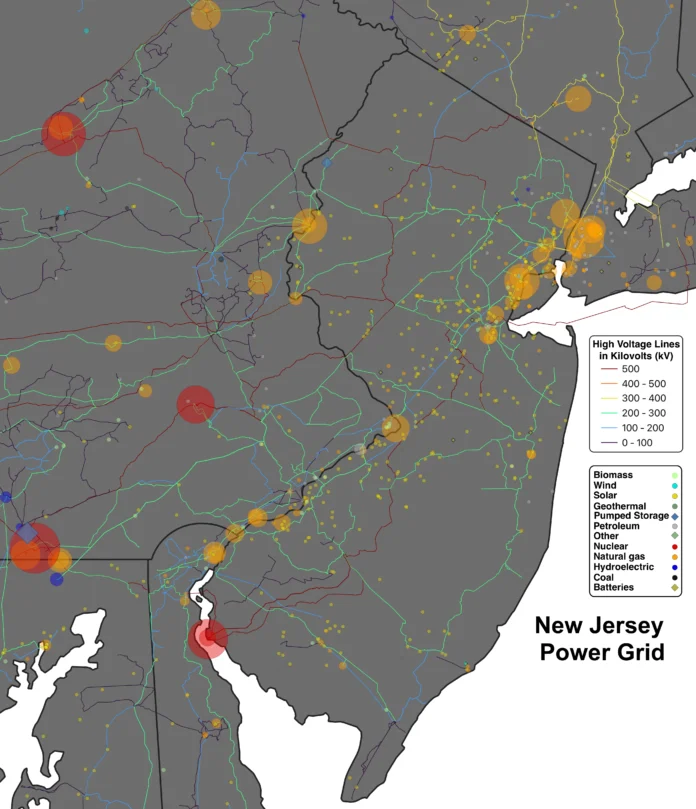

New Jersey residents are about to see a direct, measurable drop in their energy costs, thanks to a newly enacted grid law requiring utility companies to eliminate a redundant financial incentive program and redirect the resulting savings straight back to local ratepayers. The law, Bill A2757, was signed by Governor Mikie Sherrill on July 7, 2026 as part of a broader energy cost relief package, and it specifically closes a loophole tied to the Federal Power Act that had been quietly padding utility profits at ratepayers’ expense for years.
Sponsored by Assembly members Andrea Katz, Clinton Calabrese, and Ellen Park, the law eliminates a specific transmission incentive known as a return on equity bump, an additional profit margin New Jersey utilities had been collecting simply for participating in the regional power grid, regardless of whether that participation actually improved service or reliability for customers. New Jersey Rate Counsel Brian Lipman testified that removing this unnecessary incentive will save state electric customers exactly $60 million annually, a genuinely significant figure that translates directly into lower bills across the state’s entire residential customer base once the law takes full effect.
This new grid law arrives as one piece of a broader three bill energy package Governor Sherrill signed the same day, with the other two companion measures specifically targeting how the state’s rapidly growing AI data center industry gets billed for its share of grid costs. Rather than allowing the substantial infrastructure upgrades needed to support these power hungry facilities to get quietly folded into everyday ratepayers’ bills, the companion legislation establishes rigid new rate setting structures requiring large data centers to shoulder those upgrade costs themselves. That approach reflects a broader shift many advocates have been pushing for as data center development accelerates across the state, the idea that facilities driving genuinely significant new demand on the grid should help pay directly for the infrastructure that demand requires, rather than spreading those costs evenly across households that had no role in creating the strain in the first place.
Beyond this specific grid reform, New Jersey residents should also watch for a handful of related announcements tied to the same broader energy package. As an immediate bridge while these structural grid reforms phase in over time, the state announced a one time $25 credit that will appear on all 3.6 million residential electric bills next month, giving every household a direct, near term benefit well before the law’s longer term savings fully materialize. Moderate and low income households stand to receive additional relief on top of that baseline credit, with an extra $150 credit delivered through the state’s existing assistance program, targeting support specifically toward the households where rising energy costs tend to create the most genuine financial strain.
The legislation also introduces meaningful new oversight requirements for the state’s largest utility companies. Under the new law, major providers including PSE&G and JCP&L now need direct state approval before initiating certain categories of transmission projects, a requirement designed to prevent the kind of unchecked infrastructure spending that previously got passed along to ratepayers with minimal scrutiny. The New Jersey Board of Public Utilities is expected to release further guidance outlining the specific review timelines utilities will now need to follow before moving forward with these projects.
Rounding out the broader energy rollout, the state is also pursuing a substantial expansion of its Community Solar Energy Program, aiming to support up to 3,000 megawatts of new solar capacity statewide. That expansion reflects a genuine shift toward a more localized, solar driven approach to adding grid capacity, one that leans on distributed rooftop and community solar generation rather than relying entirely on large scale, centralized infrastructure investment to meet the state’s growing electricity demand. Taken together with the new data center rate structures, that solar expansion points toward a broader philosophy shaping New Jersey’s current energy policy, one where the parties creating the most new demand on the grid, whether that’s a massive data center or the grid itself needing new generation capacity, increasingly bear direct responsibility for funding the infrastructure their demand requires, rather than quietly shifting that cost onto ordinary households paying their monthly electric bill.
For New Jersey ratepayers, the combination of this new grid law’s $60 million in annual savings, next month’s one time bill credits, tighter utility oversight, and the state’s continued push toward distributed solar capacity adds up to a genuinely multifaceted approach to bringing down energy costs, one that addresses both the immediate sticker shock many households have felt in recent years and the longer term structural questions about who should actually be paying for the grid’s continued expansion.