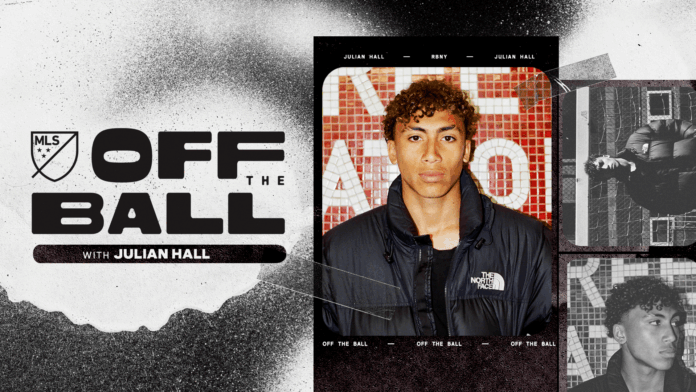

In a region where sports narratives are often defined by legacy franchises, historic rivalries, and global expectations, a new story is emerging just across the Hudson—one that feels distinctly modern, deeply local, and impossible to ignore. At the center of it is Julian Hall, the teenage phenom redefining what early success looks like in Major League Soccer and injecting a new level of energy into the New York Red Bulls’ identity.
Hall’s rise isn’t just impressive—it’s historically significant. At only 18 years old, he has already etched his name into league record books as the youngest player in MLS history to score five or more goals within the first six appearances of a season. That kind of immediate impact doesn’t just turn heads; it shifts expectations, not only for the player but for the club and the region rallying behind him.
For New Jersey and New York alike, this is more than a breakout story.
It’s a signal that the pipeline of elite soccer talent in the tri-state area is not only alive but thriving, and that the next generation of stars is being forged right here, within reach of fans who are increasingly invested in the global growth of the sport.
What makes Hall’s ascent particularly compelling is how deeply rooted it is in place. His connection to New York City isn’t a backdrop—it’s a defining force.
Growing up surrounded by the relentless pace, diversity, and street-level culture of the city, Hall developed not just technical skill but a creative instinct that translates seamlessly onto the pitch. Soccer, for him, wasn’t introduced in isolation; it was absorbed organically, shaped by pickup games, neighborhood competition, and the constant influence of a city where global cultures intersect daily.
That upbringing is evident in the way he plays. There’s a fluidity and confidence to his movement, an ability to read space and dictate tempo that feels instinctive rather than coached. It’s the kind of style that resonates with modern MLS fans—dynamic, fearless, and adaptable—and it aligns perfectly with the evolving philosophy of the New York Red Bulls as they continue to push toward a more aggressive, youth-driven model.
Yet Hall’s story isn’t confined to highlight reels or statistical milestones. It extends into the cultural fabric of the region. Ask him about New York, and the conversation quickly shifts from goals and assists to everyday rituals—like his go-to bagel order, a detail that might seem minor but speaks volumes about authenticity. It’s that blend of elite performance and grounded personality that makes him relatable, particularly to younger fans who see in him a version of themselves, only accelerated onto a professional stage.
For Explore New Jersey readers, there’s an added dimension to this narrative. The New York Red Bulls call Red Bull Arena home, placing one of MLS’s most exciting young stars just minutes from Newark, Jersey City, and Hoboken. This geographic proximity transforms Hall’s rise from a distant headline into a local experience. Fans don’t have to watch from afar—they can be part of it in real time, inside a venue that has become a cornerstone of the region’s sports and entertainment landscape.
The atmosphere at Red Bull Arena has evolved alongside the team, reflecting a broader shift in how soccer is consumed in the United States. It’s no longer niche or secondary; it’s immersive, communal, and increasingly central to the identity of younger audiences. Hall’s emergence accelerates that momentum, offering a focal point for fans who are eager to connect with a player whose career is just beginning but already feels consequential.
From an organizational standpoint, the timing couldn’t be more strategic. The New York Red Bulls have long emphasized development, investing in youth academies and international scouting to build a sustainable competitive model. Hall represents the payoff of that approach—a player who not only meets expectations but exceeds them in ways that elevate the club’s profile league-wide.
His early success also introduces a new layer of narrative intrigue within Major League Soccer itself. As MLS continues to expand its global footprint, players like Hall become essential ambassadors for the league’s future. They embody a hybrid identity: locally developed yet globally competitive, culturally grounded yet internationally relevant. That duality is precisely what MLS needs as it positions itself among the world’s premier soccer competitions.
There’s also a broader economic and cultural ripple effect to consider. Rising stars drive attendance, merchandise sales, and media engagement, all of which contribute to the overall vitality of the sport within the region. For New Jersey, having a player of Hall’s caliber anchored at Red Bull Arena reinforces the state’s role as a critical hub for major sporting events and emerging talent.
And then there’s the intangible element—the sense of momentum that comes with witnessing the early stages of a potentially transformative career. Fans who attend matches now aren’t just watching a game; they’re participating in the origin story of a player who could define an era for the club and leave a lasting imprint on the league.
What stands out most about Hall, beyond the statistics and accolades, is his trajectory. This isn’t a plateau moment; it’s a launch point. The combination of technical skill, mental composure, and cultural authenticity suggests a ceiling that extends far beyond his current achievements. For the New York Red Bulls, that represents both an opportunity and a responsibility—to nurture, protect, and amplify a talent that has the potential to reshape the club’s future.
For the region, it’s an invitation. An invitation to engage more deeply with the sport, to support a local team that is building something meaningful, and to witness firsthand the evolution of a player who embodies the spirit of New York while playing on New Jersey soil.
In a sports landscape often dominated by established narratives, Julian Hall offers something rare: a story that feels fresh, immediate, and entirely its own. And as his journey continues to unfold, one thing is becoming increasingly clear—this is no longer just a promising start. It’s the beginning of something that could define the next chapter of soccer in the region.