
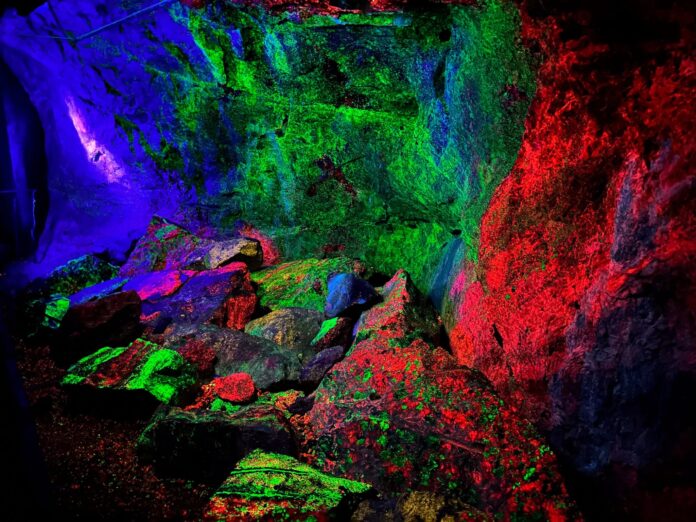

The small borough of Ogdensburg, NJ is one that few people stop to see, but that sits atop one of the world’s most scientifically interesting features. For years, the public has been able to see inside one of these mines, as the Sterling Hill Mining Museum has had its entrance inside the heart of a mine that once produced some of the world’s highest quality zinc (and eventually shut down in 1986) open to the public. Instead of the mine’s history fading away underground, it was decided that the mine had scientific value that could be used; the museum now sees regular visitors from outside of New Jersey every summer.
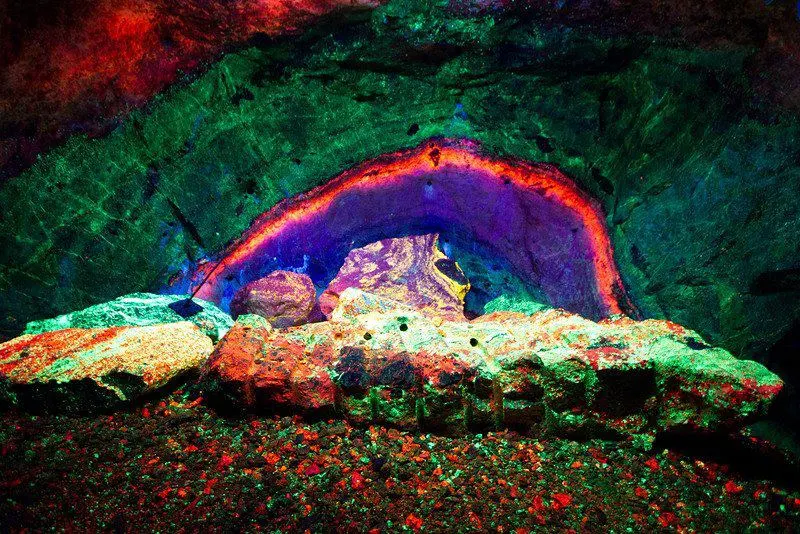
What sets this particular mine, along with it’s sister Franklin, in the nearby Sterling Hill area aside is the sheer amount and type of minerals that could be found there. Known as the Fluorescent Mineral Capital of the World, the area takes pride in the fact that over 350 different types of minerals have been identified, with almost 90 being able to fluoresce when struck by an ionizing source such as UV light. Even on the surface, it would be a startling sight to see minerals that are able to put on such a dazzling show, but seeing it in a mine two hundred feet underground would be a sight to behold.
This dazzling show is what the museum has dubbed the Rainbow Tunnel, where in the 1987 a group of museum organizers excavated a 240 foot long tunnel to specifically show off the fluorescent minerals that are found in the area. When walking through the tunnel, museum guides will turn off the standard lights, and instead turn on bright shortwave UV lights that make the tunnel walls put on a show. In a matter of seconds, the dull grey rock on the walls seemed to be set on fire, as the minerals within it all glowed with a bright array of colors. From the fiery red calcite to the vibrant green willemite (one of the primary zinc ores), the tunnel looked less like a cave and more like a glowing aquarium.
The discovery of this peculiar glow is actually something that the workers of the mine had stumbled upon before the organizers ever thought to make a show of it (the mine had actually been noted to have these peculiar properties even before it started being worked). In the deep tunnels the workers would occasionally see, when sparks from their equipment would strike the tunnel walls, strange flashes of color lighting up their faces. After the spark had run out, the glow would fade as well, leaving the miners to wonder what the cause of it was. Even today, the same kind of flash would light up the tunnels, though now it was done intentionally when workers and organizers wanted a show for the visitors.
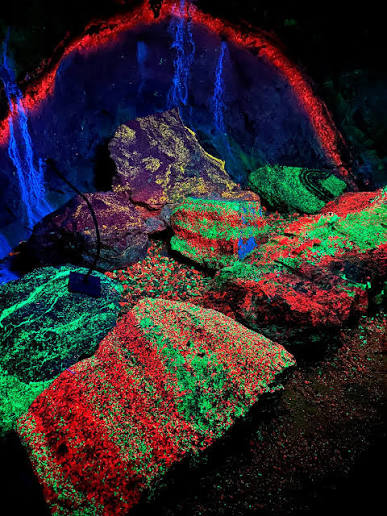
Getting to see the show inside the Rainbow Tunnel is part of a larger guided experience that the mine has to offer, as the two hour underground walking tour is actually closer to an educational experience as well. The 1.3 mile (approximately 1,300 feet long) tunnel that houses the tour is mostly straightforward, with the only hazards of the tour being the uneven ground. None of the usual mine tour tropes of mine cars, ladders, or rocky floors are to be found on the trail, instead being replaced by a wide open, generally flat trail that is easily navigated by wheel-chair or stroller-friendly paths. In this respect, the underground tour has a sort of accessibility to it that most similar experiences in the area lack, as it is more family-friendly than most. The temperature inside the mine is kept to an average of 56 degrees Fahrenheit year-round, meaning that it functions almost like an air-conditioned room during the hottest parts of the summer (though in practice visitors are still encouraged to bring a light jacket even during the hottest times of year).
The tour itself actually emphasizes more on the actual history of the mine, not the fluorescent minerals. Along the trail, guides show off various pieces of mining equipment used in the 20th century, and the tour goes through some of the old underground lamp rooms and looks down to see some of the larger areas of the main shaft station, which was the heart of operations underground at the mine. The trail winds through galleries that were first excavated as early as the 1830s, and one of the more interesting parts of the tour is the Zobel Hall, the changing room for the workers. Here, wire baskets are still suspended from the ceiling by chains, in the same manner that water-drenched clothes had been hung to dry before the workers went back into the tunnels. These little glimpses into the day to day life of miners who had to brave these conditions add a much needed grounding into the experience rather than just the mineral and engineering displays.
The guided tour ends when visitors exit back to the surface, but the museum complex is home to the Warren Museum of Fluorescence, where over 700 types of minerals, crystal, and even other objects that had been found to fluoresce were displayed in various shows using specialized lighting. While inside the mine the minerals had been able to dazzle, this collection serves as a chance to see what else can glow with the help of ultraviolet lighting (in addition to showing some of the other uses for the property of fluorescence). For those hoping to take something from this experience home with them, the visitors of the mine have the option to visit the Mine Run Dump, where some of the old industrial rock piles from the processing areas were available to dig through for any interesting minerals. A separate outdoor building housed a darkroom, allowing rock hounds to have a chance to test out the minerals they had found using specialized ultraviolet lights to confirm that they would glow when at home.
For most families who decide to visit, there is actually very little to worry about in regards to getting tickets or tours. As the mine tours are popular on warm summer weekends, the most important recommendation for most who want to visit is arriving fifteen to thirty minutes early in order to get tickets. Unlike most other museums and attractions, it is not possible to reserve tickets online and the public entrance is only opened at the visitor’s center when the tours begin, making that extra time especially important.
Few museums in New Jersey can offer the kind of insight into industrial history that the Sterling Hill Mining Museum is able to, and the ability to create such an underground display of fluorescent minerals is what has kept people coming back thirty years after the mine was shut down and its zinc reserves officially depleted. This former site of industry has seen a rebirth of sorts, as it has found itself transformed into a subterranean classroom for both mineralogy and history. In the present day, the mine still has the ability to transform, with the press of a switch, its walls into a dazzling neon display of color.
















