Home Blog Page 82

Barry Manilow The Last Newark Concert

0

A Farewell Fit for a Legend as Barry Manilow Brings His Final Newark Performance to Prudential Center

April 14 @ 8:00 PM 11:30 PM

Newark is preparing to host one of the most emotionally significant concerts in its modern entertainment history as Barry Manilow returns to the city for a once-only celebration billed as The Last Newark Concert. On Tuesday, April 14, at 7 p.m., the internationally beloved singer, songwriter, and performer will take the stage at Prudential Center for what is being presented as his final live appearance in Newark—a milestone moment for both the artist and the city that has welcomed generations of iconic performers.

For longtime fans and newcomers alike, this evening represents far more than a greatest-hits show. It is the closing chapter of a relationship between a legendary performer and a New Jersey audience that has embraced his music across decades, formats, and cultural shifts. Manilow’s return brings together nostalgia, gratitude, and celebration in one carefully crafted farewell experience.

Audiences can expect a sweeping, emotionally charged setlist that spans the full arc of Manilow’s remarkable career. From the tender vulnerability of “Mandy” and the timeless anthem “I Write the Songs” to the romantic optimism of “Looks Like We Made It” and “Can’t Smile Without You,” the evening is designed to honor the songs that have become woven into the personal soundtracks of millions of lives. Of course, no Manilow performance would be complete without the infectious, theatrical energy of “Copacabana (At the Copa),” a song that continues to ignite audiences and define his unmistakable stage persona.

What makes this Newark appearance especially powerful is its framing as a true farewell. Manilow’s performances have long been known for their warmth and connection, built on an artist-to-audience relationship that feels personal even inside massive arenas. His live shows blend polished orchestration, dynamic lighting, and seamless transitions between ballads and high-energy numbers, but the emotional center of every performance remains his storytelling and sincere connection to the crowd.

Over the course of his career, Barry Manilow has quietly assembled one of the most durable catalogs in popular music history. His songs have transcended radio eras, chart formats, and generational shifts, remaining relevant through film, television, live performance, and cultural memory. His ability to write melodies that linger and lyrics that speak to vulnerability, commitment, and hope has made his work deeply personal for listeners of all ages.

The Last Newark Concert arrives at a moment when large-scale live music events in New Jersey are enjoying renewed national attention. Prudential Center, now firmly established as one of the state’s premier entertainment destinations, continues to attract historic tours, final performances, and legacy artists whose careers have shaped popular culture. Manilow’s farewell appearance joins a growing list of unforgettable nights that have defined the venue’s identity within the broader regional live music scene.

For fans following the ever-expanding concert calendar across the state, this performance stands out as one of the most meaningful dates of the season. Readers looking to explore additional upcoming concerts, touring artists, and major festival moments can discover more highlights through Explore New Jersey’s dedicated music coverage, which continues to spotlight the performers and venues shaping the Garden State’s live entertainment landscape.

From a production standpoint, the show is expected to reflect the refined presentation Manilow has perfected over years of international touring. His band and vocal ensemble remain central to the experience, delivering rich arrangements that allow each song to unfold with clarity and emotional depth. The pacing of his concerts—moving from intimate piano-led moments to full-ensemble showstoppers—creates a narrative flow that mirrors the emotional journey of his career.

The farewell theme also offers fans a rare opportunity to reflect on the extraordinary breadth of Manilow’s legacy. Few artists have maintained such enduring relevance while remaining firmly rooted in the core values of songwriting and performance. His influence stretches well beyond pop radio, inspiring performers, composers, and producers who continue to draw from his melodic sensibility and commitment to emotional authenticity.

Presale access for the show begins Thursday, January 29, from 10 a.m. to 10 p.m. Eastern Time, with general public ticket sales opening Friday, January 30, at 10 a.m. Demand is expected to be exceptionally strong, driven not only by Manilow’s devoted fan base, but by the unmistakable significance of a final Newark appearance.

When Barry Manilow steps onto the Prudential Center stage on April 14, the night will serve as a collective thank-you—an opportunity for fans to celebrate the songs that have marked weddings, graduations, heartbreaks, and lifelong memories. In a city that continues to shape New Jersey’s cultural identity, The Last Newark Concert will stand as a powerful reminder that some voices, and some songs, never truly fade—they simply take their final bow in front of the audiences who loved them most.

Live Nation Entertainment

1 (800) 653-8000

View Organizer Website

The Prudential Center

25 Lafayette St
Newark, New Jersey 07102 United States
+ Google Map
(973) 757‑6000
View Venue Website

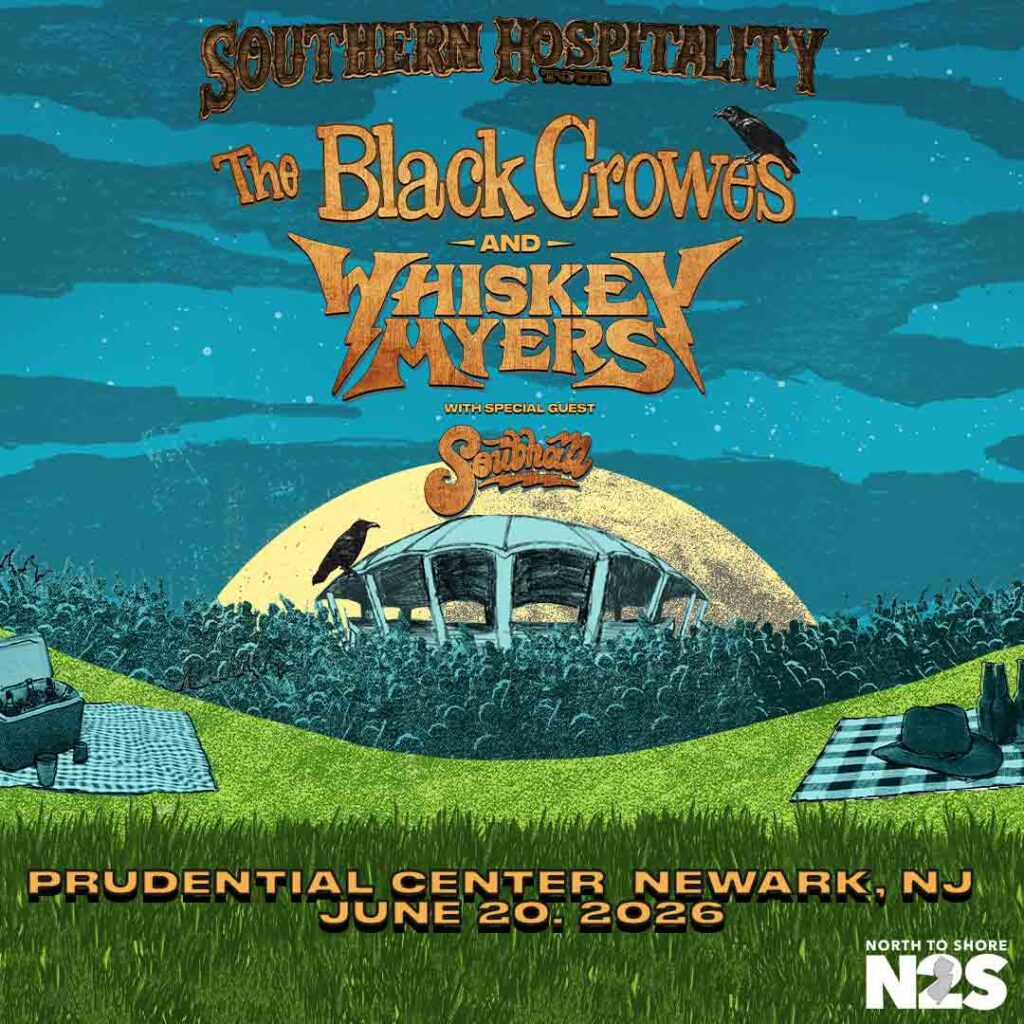
The Black Crowes and Whiskey Myers

0

A Summer Rock Reckoning in Newark as The Black Crowes and Whiskey Myers Ignite the North to Shore Festival Stage

June 20 @ 5:00 PM 11:30 PM

On Saturday, June 20, Newark becomes the epicenter of modern American rock as The Black Crowes and Whiskey Myers take over Prudential Center for one of the most anticipated nights of the North to Shore Festival. Scheduled for a 7 p.m. start, the pairing brings together two fiercely independent, road-tested bands whose live reputations have been built not on spectacle, but on volume, sweat, swagger, and an unshakable devotion to the raw power of guitar-driven music.

This is not a nostalgia tour. It is a collision of eras, attitudes, and audiences—an unapologetic celebration of what rock and roll still does best when it is played loud, honest, and without compromise.

For The Black Crowes, the Newark appearance lands during one of the most remarkable late-career surges in modern rock. Fresh off their first GRAMMY nomination in more than three decades and a recent nomination for the Rock & Roll Hall of Fame, the band arrives with renewed urgency and a catalog that has only grown more influential with time. The Robinson brothers continue to lead a lineup that refuses to soften its edges, delivering the blues-soaked, rhythm-driven sound that first made them one of the defining American rock bands of their generation.

Live, The Black Crowes remain fiercely unpredictable. Their sets are known to stretch and breathe, driven by deep grooves, extended instrumental sections, and spontaneous shifts that reflect the band’s roots in classic soul, Southern rock, and gritty barroom blues. Fans can expect a career-spanning performance that moves effortlessly between era-defining staples like “She Talks to Angels” and “Hard to Handle” and the lean, hard-hitting new material that has defined their latest creative chapter. Songs from their recent releases, including Happiness Bastards and A Pound of Feathers, showcase a band not content to trade on reputation, but intent on proving that its voice still belongs in the present tense.

What makes a Black Crowes show resonate, particularly in an arena setting like Prudential Center, is the band’s ability to make even the largest rooms feel personal. Their sound strips rock back to its essential elements—gritty guitar interplay, loose-but-locked-in rhythm sections, and vocals delivered with conviction rather than polish. The result is a performance that feels less like a production and more like a living, breathing jam session scaled up for thousands.

Sharing the bill is Whiskey Myers, a band whose rise has been fueled almost entirely by relentless touring and organic fan support rather than mainstream radio cycles. With nearly 3,000 live shows behind them, the Texas-based group arrives in Newark as one of the most battle-tested and consistently explosive live acts in modern Southern rock.

Whiskey Myers’ sound blends the emotional grit of outlaw country storytelling with the muscular weight of classic rock and Southern jam traditions. Their music carries echoes of the Allman Brothers’ groove-driven exploration and the crushing, riff-forward impact of Led Zeppelin, while maintaining a modern edge that keeps their songs firmly rooted in today’s cultural landscape. The band’s latest release, Whomp Whack Thunder, captures a group operating at full throttle—confident, focused, and unafraid to lean into both melody and volume.

On stage, that energy translates into a set built for movement. Driving rhythms, soaring choruses, and tightly wound guitar work create a physical response in the crowd, turning large-scale venues into communal release valves for fans who crave authenticity over perfection. Their ability to command massive rooms has already earned them landmark appearances at venues like Red Rocks and high-profile tour stops alongside some of the most iconic names in rock history.

What makes this North to Shore Festival stop especially compelling is how naturally these two bands complement one another. The Black Crowes bring the deep roots of American blues and soul-inflected rock, while Whiskey Myers injects modern Southern fire and arena-ready urgency. Together, they create a full-spectrum rock experience—one that moves from groove-heavy swagger to full-blown, riff-driven catharsis.

The setting only amplifies the impact. Prudential Center, located in the heart of downtown Newark, has become one of New Jersey’s most important live entertainment destinations, anchoring major cultural events that draw audiences from across the state and the greater New York metropolitan area. As part of the North to Shore Festival, the show reflects the broader vision of positioning New Jersey as a premier home for large-scale music experiences that blend national touring talent with regional cultural energy.

For fans who closely follow the state’s growing live performance scene, this event stands as one of the most significant rock bookings of the summer. Readers looking to explore more upcoming concerts, artist spotlights, and festival highlights across the Garden State can find expanded coverage through Explore New Jersey’s dedicated music section, which continues to spotlight the venues and performers shaping New Jersey’s evolving soundscape.

Beyond the headliners, the evening represents something increasingly rare in modern touring schedules: a major arena show built around musicianship, spontaneity, and live risk. Both bands are known for reshaping their setlists, stretching arrangements, and letting the moment dictate the performance. That approach ensures no two nights feel the same—and it is precisely what keeps longtime fans returning and first-time listeners instantly converted.

For anyone searching for rock and roll in its most honest form—unfiltered, emotionally charged, and unapologetically loud—June 20 offers a rare opportunity. When The Black Crowes and Whiskey Myers step onto the Prudential Center stage, the night will not be about trend lines or algorithms. It will be about guitars pushed to their limits, voices raised with conviction, and a reminder that the heart of rock still beats strongest when it is played live, without safety nets, and with everything on the line.

Live Nation Entertainment

1 (800) 653-8000

View Organizer Website

The Prudential Center

25 Lafayette St
Newark, New Jersey 07102 United States
+ Google Map
(973) 757‑6000
View Venue Website

Tab Benoit: Soul of the Swamp

0

A Swamp-Born Sound Returns to New Jersey as Tab Benoit Brings His Soul of the Swamp Tour to The Newton Theatre

July 9 @ 8:00 AM 5:00 PM

On Thursday, July 9, at 8 p.m., one of the most unmistakable voices in modern roots and blues music returns to a New Jersey stage when Tab Benoit brings his Soul of the Swamp Tour 2026 to The Newton Theatre, delivering an evening built on raw musicianship, deep Southern storytelling, and the uncompromising spirit that has defined his career for more than three decades. Tickets for this highly anticipated summer performance go on sale this Friday at 10 a.m., and demand is expected to be strong for what is shaping up to be one of Sussex County’s most significant live music events of the year.

For longtime fans and new listeners alike, Benoit’s return to New Jersey represents far more than a nostalgic tour stop. It is the continuation of a creative resurgence for an artist whose influence has quietly shaped modern blues and Americana while remaining fiercely independent of commercial trends. Known equally for his uncompromising sound and his outspoken commitment to environmental protection in the Louisiana wetlands, Benoit has built a reputation as a musician who allows authenticity to lead every artistic decision.

The Soul of the Swamp Tour reflects that philosophy in its purest form. Benoit performs exactly as he always has—without digital effects, processing, or studio polish. What audiences hear is the unfiltered connection between guitar, amplifier, and performer. It is a stripped-down approach that places every nuance of touch, phrasing, and tone at the center of the experience, allowing the music to breathe in real time. In an era dominated by layered production and digital manipulation, Benoit’s live performances stand out for their honesty and immediacy.

Over the course of a career that includes more than 20 releases, Benoit has become widely respected for a sound that blends swamp blues, Southern soul, and roots-driven rock into something instantly recognizable. His early recordings produced enduring radio staples such as “Nice and Warm” and “Cross the Line,” songs that introduced listeners to a voice often compared to the emotional weight and grit of classic Southern soul legends, while his guitar work earned praise for its individuality and refusal to mimic blues clichés.

That signature voice and style remain firmly intact today. In 2024, Benoit returned with his first new studio recording in more than a decade, releasing I Hear Thunder, an album that marked a confident and deeply personal reemergence. Rather than revisiting past formulas, the record delivered a collection of songs rooted in reflection, resilience, and the lived experience of an artist who has spent years balancing creative life with activism and personal renewal. For many fans, the album confirmed what Benoit’s live audiences have known for years—his artistic evolution is far from finished.

The July 9 performance in Newton will draw heavily from that extensive catalog, weaving newer material into the songs that established his reputation in the 1990s and early 2000s. Setlists on the Soul of the Swamp Tour are built to feel organic rather than scripted, allowing space for extended guitar passages, spontaneous moments between band members, and the emotional pacing that comes only from musicians deeply connected to their material.

Joining Benoit on this tour is Sgt. Splendor, whose supporting set brings an energetic and modern counterpoint to the evening’s roots-driven foundation. The pairing creates a well-rounded night that bridges generations of blues and rock-influenced music, highlighting how the genre continues to expand without losing its emotional core.

The Newton Theatre provides a fitting setting for an artist whose performances thrive on intimacy and connection. The historic venue’s close sightlines and natural acoustics allow Benoit’s guitar tone and vocals to reach the audience without distraction, reinforcing the feeling that each song is being delivered directly rather than filtered through production spectacle. For many concertgoers, it is exactly this kind of environment that transforms a show into a memory.

Benoit’s presence in New Jersey also arrives during a moment of renewed attention on the state’s live performance scene, where theaters and independent venues continue to attract nationally recognized touring artists seeking spaces that value musicianship over scale. Audiences interested in exploring additional concerts, festivals, and artist appearances across the Garden State can discover a wide range of upcoming performances through Explore New Jersey’s music coverage, which highlights how New Jersey’s venues are increasingly becoming essential stops for respected touring artists.

Beyond his work on stage, Benoit’s identity as a wetlands activist has become inseparable from his music. He has long used his platform to advocate for the protection of Louisiana’s rapidly disappearing coastal ecosystems, often speaking openly about the cultural and environmental cost of their loss. That commitment is reflected in both his songwriting and his onstage presence, where the themes of land, heritage, and responsibility quietly run beneath the surface of his performances.

The Soul of the Swamp Tour does not attempt to recreate the past. Instead, it offers a living portrait of an artist who continues to refine his voice, deepen his storytelling, and challenge himself creatively while staying grounded in the traditions that shaped him. Benoit’s guitar style remains unmistakably his own—sharp, expressive, and rhythmically alive—while his vocals carry the emotional weight of experience rather than nostalgia.

When Tab Benoit steps onto the stage at The Newton Theatre on July 9, audiences will not simply be attending a concert. They will be stepping into a living conversation between roots and modern expression, between environmental conscience and personal reflection, and between an artist’s past and the music he continues to create in the present. For New Jersey blues and roots fans, it is an opportunity to experience one of the genre’s most genuine voices in a setting built for exactly the kind of connection his music demands.

Skylands Performing Arts Center (SkyPAC)

(973) 940-6398

View Organizer Website

The Prudential Center

25 Lafayette St
Newark, New Jersey 07102 United States
+ Google Map
(973) 757‑6000
View Venue Website

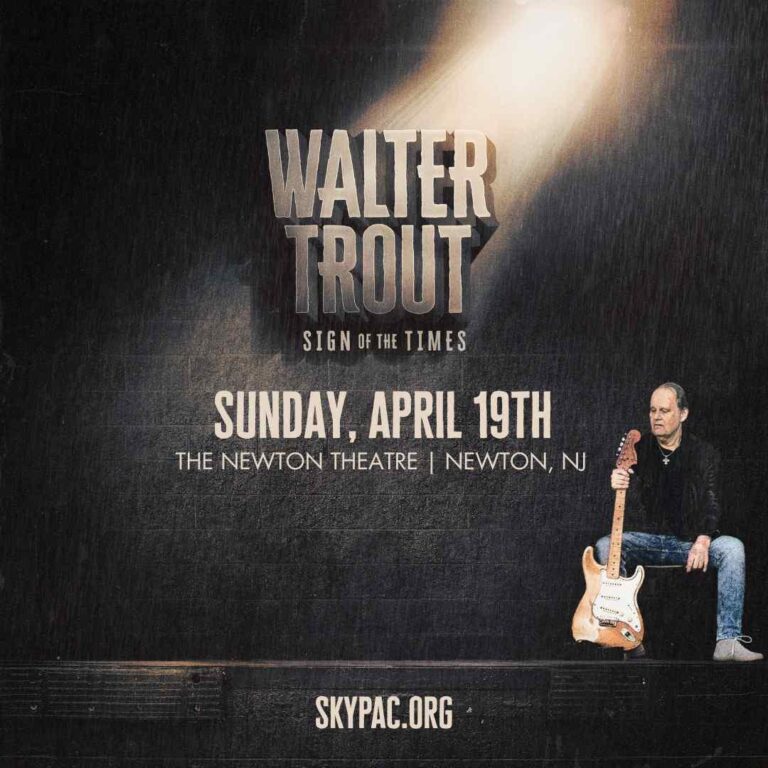
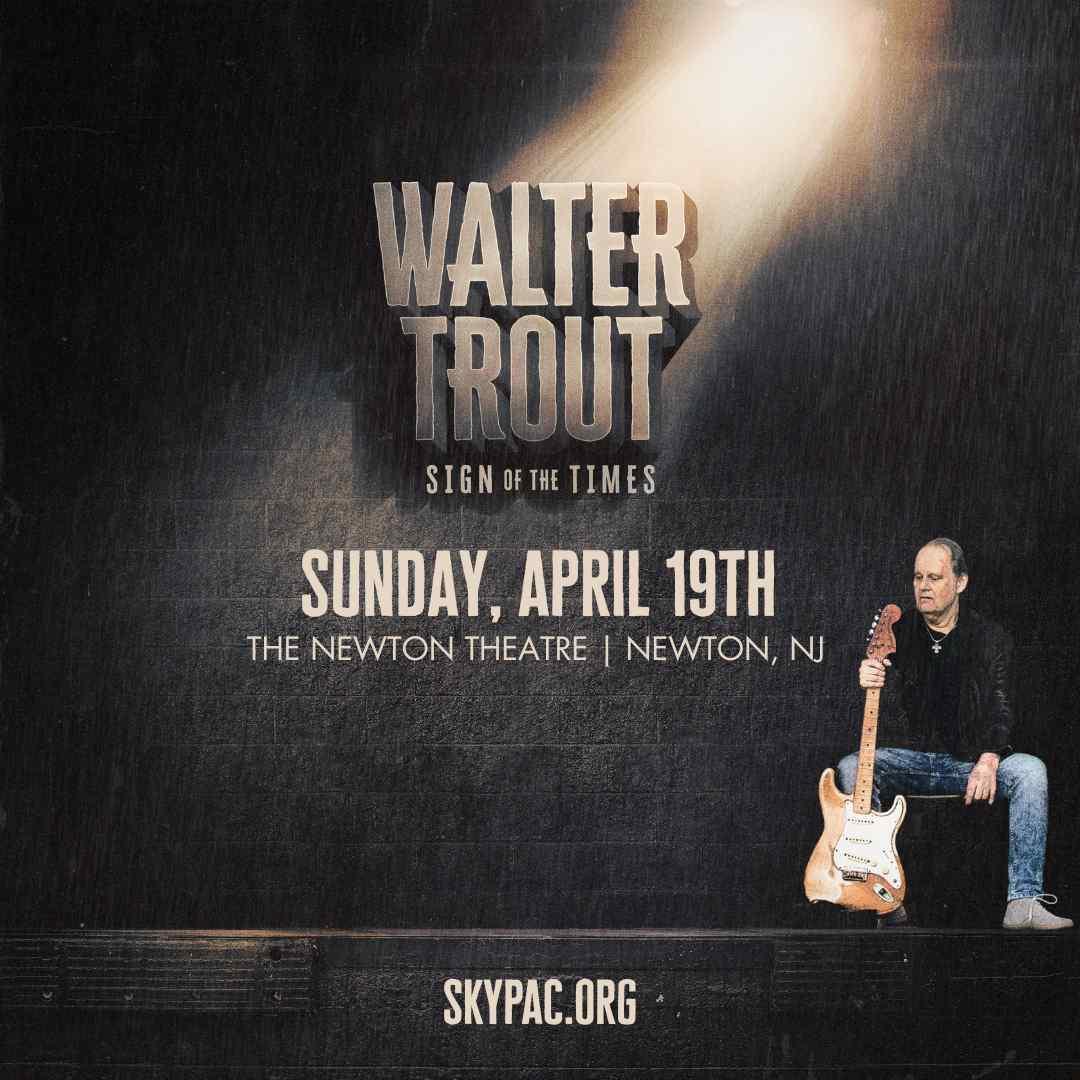
Walter Trout

0

From the Jersey Shore to the World Stage, Walter Trout Brings His Most Urgent Tour to The Newton Theatre

April 19 @ 8:00 PM 11:30 PM

Few artists in modern blues-rock have built a career as uncompromising, enduring, and emotionally direct as Walter Trout, and this spring, New Jersey audiences will have the rare opportunity to experience his most powerful work yet when the Sign of the Times Tour arrives at The Newton Theatre on Sunday, April 19 at 7 p.m. Tickets go on sale this Friday at 10 a.m., marking one of the most anticipated live blues events of the season in Sussex County and well beyond.

For longtime fans and new listeners alike, this tour represents more than a standard concert stop. It is the live extension of a new creative chapter for an artist whose career has spanned more than five decades and whose voice has always stood apart in a genre often defined by tradition. Trout’s latest album, Sign of the Times, is a deeply personal, fiercely honest collection of songs shaped by the world unfolding around him. It captures anxiety, resilience, frustration, and hope through blistering guitar work and raw, unfiltered storytelling that feels especially resonant in today’s cultural climate.

Yet what continues to define Walter Trout’s legacy is his refusal to tell audiences what to believe. Throughout his career, he has remained a street-level observer rather than a political messenger, allowing listeners to find their own meaning inside the music. Sign of the Times does not prescribe answers. Instead, it opens space for reflection, catharsis, and emotional release—qualities that have always separated Trout from artists chasing trends or headlines.

The upcoming appearance at The Newton Theatre places this music inside one of northern New Jersey’s most intimate and respected performance venues. Known for its acoustics and close-range sightlines, the historic theatre provides a setting that allows Trout’s playing and songwriting to connect directly with the audience, without spectacle overshadowing substance. For a guitarist celebrated for both precision and emotional intensity, the venue becomes an ideal canvas for extended solos, dynamic shifts, and the quiet moments that make his live shows as powerful as his recordings.

Trout’s career path remains one of the most remarkable stories in contemporary blues and rock. Before establishing himself as a globally recognized solo artist, he sharpened his sound alongside two of the most influential forces in modern blues history—first with Canned Heat and later with John Mayall and the Bluesbreakers. Those years shaped his technical command and deepened his understanding of the blues tradition, but his solo work ultimately defined his identity. Over time, Trout evolved into a songwriter whose material confronts personal struggle, survival, social tension, and the fragile space between despair and hope.

That evolution carries added significance for New Jersey audiences, because Walter Trout’s story is also a local one. He hails from Ocean City, New Jersey, and has long carried his Jersey roots into his international career. For fans across the state, his return to perform on a New Jersey stage represents more than a tour stop—it is a homecoming of one of the region’s most respected musical voices.

The Sign of the Times album has been widely recognized as one of Trout’s most emotionally charged releases, blending hard-edged blues-rock with introspective songwriting that confronts uncertainty and change head-on. Musically, the record showcases his signature combination of muscular riffs, fluid phrasing, and expressive bends, supported by arrangements that leave room for vulnerability as well as power. Lyrically, the songs explore isolation, anger, endurance, and the complicated search for meaning in a world that often feels fractured.

On stage, those themes become even more immediate. Trout’s live performances are known for their intensity and authenticity. He does not dilute his sound or his message for comfort. Instead, he leans into the emotional weight of the material, inviting the audience into the same reflective space that shaped the songs. Longtime concertgoers describe his shows as immersive experiences, where storytelling, improvisation, and personal connection unfold naturally between songs and solos.

The Newton Theatre performance also underscores New Jersey’s growing reputation as a destination for nationally and internationally recognized touring artists in intimate, community-centered venues. From classic blues and roots music to contemporary rock and genre-blending performers, the state’s live music calendar continues to expand in both depth and diversity. Readers exploring upcoming concerts and artist appearances across the state can discover additional performances and festival highlights through Explore New Jersey’s dedicated music coverage, which continues to spotlight the evolving soundscape of the Garden State.

For Walter Trout, the Sign of the Times Tour stands as a reflection of both where he has been and where his music continues to go. After more than half a century as a working musician, he remains creatively restless and emotionally open, refusing to coast on reputation or nostalgia. His songwriting continues to evolve, his guitar playing remains fearless, and his connection to audiences feels as personal as ever.

When the lights go down at The Newton Theatre on April 19, the evening will not simply celebrate a legendary career. It will showcase an artist still responding to the world in real time—through songs that carry the weight of experience, the urgency of the present moment, and the unmistakable voice of one of New Jersey’s own blues-rock icons.

Skylands Performing Arts Center (SkyPAC)

(973) 940-6398

View Organizer Website

The Prudential Center

25 Lafayette St
Newark, New Jersey 07102 United States
+ Google Map
(973) 757‑6000
View Venue Website

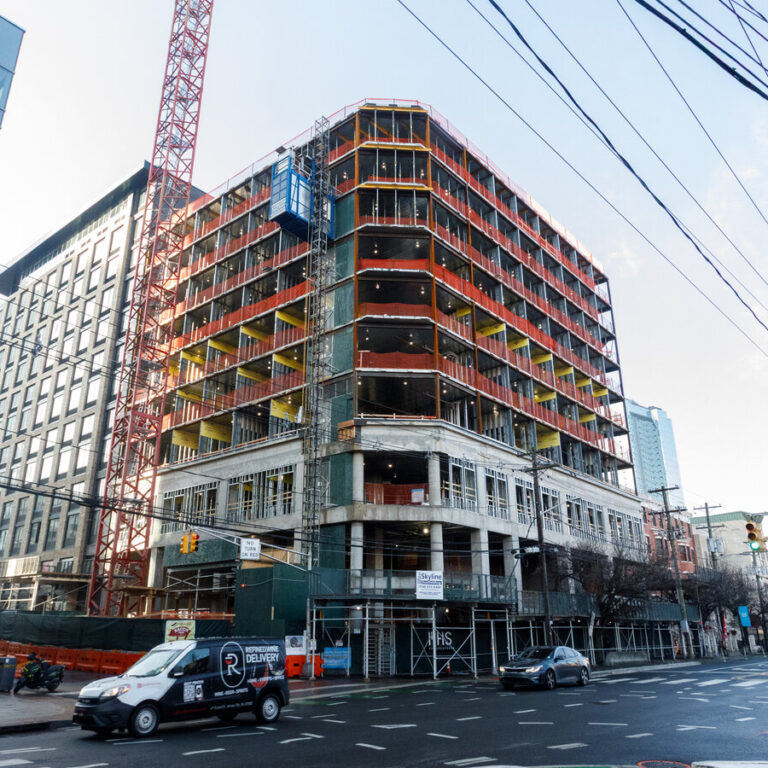
Two Sky-High Showpieces Redefine Boutique Living in Jersey City Heights at The James

A new standard of elevated urban living has arrived in Jersey City Heights as The James, a striking six-residence boutique condominium at 433 Central Avenue, officially releases its two crown jewels—Penthouse 4 and Penthouse 5—offering buyers a rare opportunity to secure full-floor homes with sweeping Manhattan skyline views in one of the neighborhood’s most design-forward new developments.

With the building’s two-bedroom residences already sold, these final penthouses represent the last chance to own within a tightly curated, low-density property that blends architectural refinement, smart-home innovation, and direct access to one of Jersey City’s fastest-rising residential corridors.

The James is being represented by JC Luxury Group at SERHANT., a development-focused real estate team that has rapidly built a reputation along New Jersey’s Gold Coast for launching and leasing high-impact residential projects. Industry observers say the team’s growing influence mirrors a larger shift in buyer demand toward thoughtfully designed, lifestyle-driven buildings that emphasize both quality and location.

According to JC Luxury Group’s Alexander Calle, the project was conceived specifically for the evolving Jersey City Heights market—where buyers increasingly expect the sophistication of luxury construction paired with the neighborhood energy and accessibility that make the Heights one of the region’s most competitive submarkets.

Perfectly positioned along Central Avenue, The James places residents at the center of the Heights’ retail, dining, and cultural core, while still offering fast, practical access to Hoboken, Manhattan, and major transit corridors. The address itself has become a key selling point, with walkable streets, neighborhood restaurants, and everyday conveniences just steps from the front door.

Architecturally, the building reflects a design-forward collaboration led by Hampton Hill and interior design studio walkTHIShouse. The result is a modern, restrained aesthetic that emphasizes clean lines, premium materials, and light-filled living spaces. One of the building’s most coveted features is its direct elevator-to-residence access—an amenity rarely found in boutique-scale developments in this part of Jersey City, and one that immediately sets a private, elevated tone for daily life.

Crowning the structure is an expansive shared rooftop deck that delivers unobstructed panoramic views of the Manhattan skyline, stretching from Billionaire’s Row and the Empire State Building to the World Trade Center. The rooftop is designed to function equally well for entertaining and quiet evening retreats, offering residents an outdoor extension of their living space high above the city.

Inside the final two homes, Penthouse 4 and Penthouse 5 introduce a full-floor living experience that is increasingly difficult to find in new urban construction. Both residences feature open layouts framed by floor-to-ceiling windows, allowing natural light to flood every room while maximizing skyline visibility. White oak chevron flooring runs throughout the homes, anchoring the interiors in understated elegance and craftsmanship.

Penthouse 5 further distinguishes itself with a private rooftop terrace reserved exclusively for the residence. The east-facing outdoor space delivers dramatic, unobstructed views of Manhattan, making it a natural setting for morning coffee, sunset gatherings, or intimate evening entertaining under the city lights.

The penthouses are equipped with a comprehensive suite of modern lifestyle and technology features designed to enhance comfort, security, and efficiency. LED-lit cove walls create subtle architectural accents, while heated floors in the primary bathrooms elevate everyday routines. Ecobee smart thermostats allow residents to manage energy usage remotely, and built-in ceiling speakers support seamless whole-home audio.

Security and access systems are also fully integrated. Swiftlane video intercom technology provides residents with modern entry control and monitoring, reinforcing the building’s emphasis on privacy without sacrificing convenience.

Across the building, every residence includes solid core doors, in-unit washer and dryers, and energy-efficient tankless hot water heaters—features that reflect both long-term durability and sustainability-conscious design. These practical elements, often overlooked in luxury marketing, have become increasingly important to buyers evaluating long-term operating costs and overall quality of construction.

Beyond the private residences, The James has been designed to elevate daily life through a series of carefully curated shared amenities. In addition to the rooftop deck, residents have access to a landscaped rear patio that offers a quieter, more intimate outdoor setting. A secure package room supports modern delivery needs, while dedicated bike storage caters to residents who prioritize alternative transportation and active lifestyles.

One of the building’s most distinctive offerings is an on-site Pilates studio located within the ground-floor retail space. This wellness-focused amenity allows residents to access fitness programming without leaving the building—an increasingly desirable feature for buyers who value time efficiency and health-conscious living.

From a market perspective, The James enters the Heights at a moment when buyers are becoming more selective and design-savvy. As new construction price-per-square-foot averages in the neighborhood continue to rise, this boutique project positions itself as a compelling value proposition—delivering elevated finishes, private elevator access, full-floor layouts, and skyline views that are typically reserved for much larger and higher-density developments.

Real estate professionals tracking the area say the appeal of The James lies not only in its features, but in its scale. With just six total residences, the building offers a sense of exclusivity and community that larger towers struggle to replicate—an increasingly attractive proposition for buyers seeking privacy without sacrificing proximity to urban life.

For readers following the evolving residential landscape through Sunset Daily’s coverage of New Jersey real estate, The James represents a clear example of how boutique development is reshaping expectations in Jersey City Heights.

Surrounded by a vibrant mix of local boutiques, restaurants, bars, and cultural destinations, and supported by convenient bus routes, nearby highways, and access to the 9th Street Light Rail Station, the location reinforces the project’s core promise: luxury living anchored in a highly livable neighborhood.

With only two homes remaining—Penthouse 4 and the rooftop-equipped Penthouse 5—The James stands as one of the most refined new residential offerings currently available in Jersey City Heights. For buyers seeking full-floor living, panoramic skyline views, smart-home integration, and an amenity-rich boutique environment, the final penthouses present a rare opportunity to claim a front-row seat to one of New Jersey’s most dynamic urban skylines.

New Jersey’s $58.4 Billion Construction Surge Signals a Transformational Two Years for Transit, Housing, and Critical Infrastructure

New Jersey is preparing to enter one of the most ambitious construction and infrastructure investment cycles in its modern history, with state and regional spending projected to reach a record-setting $58.4 billion across the 2026–2027 period—an unprecedented surge that is already reshaping transportation corridors, housing development, public safety planning, and the long-term outlook for manufacturers, distributors, and construction firms statewide.

The scale of the spending reflects a strategic pivot toward utility modernization, transit reliability, and large-scale redevelopment projects designed to support population growth, climate resilience, and economic competitiveness. At the center of that effort are major upgrades to NJ Transit stations and rail infrastructure, projects that state transportation leaders say are critical to restoring reliability along some of the Northeast Corridor’s most congested routes.

Among the most closely watched projects is the long-troubled Portal North Bridge over the Hackensack River, one of the most notorious bottlenecks in the region’s rail network. The new bridge is now entering its final phase of construction, with a second major rail “cutover” scheduled for fall 2026. Once completed, the modernized crossing is expected to dramatically improve reliability for thousands of daily riders traveling between North Jersey and Manhattan, eliminating the mechanical and alignment failures that have plagued the century-old structure for years.

Transportation planners view the Portal North Bridge replacement as a defining milestone in the broader modernization of New Jersey’s rail system, particularly as ridership patterns continue to evolve after years of hybrid work and shifting commuter demand.

While transit infrastructure is commanding statewide attention, redevelopment activity is accelerating along the Jersey Shore as well. In Middle Township, a long-idle and familiar roadside landmark—the former Islander Family Fun Park along Route 47—is poised to give way to a major residential redevelopment. Plans call for approximately 400 new housing units on the property, representing one of the most significant private investments in the corridor in years.

Local officials say the project reflects a broader regional push to increase housing supply while reinvigorating underutilized commercial parcels. For Cape May County, the redevelopment also signals a transition toward year-round residential and workforce housing, rather than seasonal, tourism-only land use.

At the same time, infrastructure safety and aging public assets remain front and center across the state.

In Irvington, a major fire recently tore through a cannabis dispensary, injuring two firefighters and raising new questions about building safety, code enforcement, and emergency preparedness for rapidly expanding retail sectors. Fire officials have emphasized the complexity of modern commercial occupancies, particularly those involving security systems, fortified structures, and specialized storage environments that can complicate firefighting operations.

Elsewhere, officials are confronting the future of one of the region’s oldest and most iconic crossings—the Washington Crossing Bridge connecting Mercer County with Pennsylvania. Now more than 120 years old, the bridge has been deemed structurally deficient, placing it squarely in the crosshairs of long-term capital planning. Engineers are weighing whether continued rehabilitation is financially viable or whether full replacement will ultimately be necessary.

Transportation authorities acknowledge that decisions surrounding the bridge will carry significant regional implications, affecting freight movement, tourism, daily commuting, and emergency response access across the Delaware River corridor.

As New Jersey undertakes this sweeping wave of investment, state leaders are increasingly factoring climate resilience and extreme weather readiness into project design, materials selection, and scheduling—an approach shaped by intensifying winter storms, coastal flooding, and prolonged heat events. These evolving conditions continue to drive interest in statewide weather reporting and climate tracking, which many planners now rely on when modeling construction timelines and infrastructure durability.

Behind the public-facing projects, the scale of New Jersey’s capital pipeline is already triggering major strategic shifts for the businesses that build and support the state’s infrastructure.

For manufacturing and distribution leaders, 2026 is shaping up to be a pivotal year for aligning capital investment with long-term growth and operational resilience. New credits and incentives introduced in 2025 have made facility upgrades, production equipment, and automation investments more financially attractive than at any point in recent years, while also placing new pressure on executive teams to make disciplined, multi-year decisions.

The introduction of Qualified Production Property provisions under the federal OBBBA framework has created fresh opportunities for manufacturers seeking to modernize plants, expand capacity, and reposition operations closer to domestic supply chains. Industry advisors say the greatest benefit will go to companies that treat capital planning as a multi-cycle strategy rather than a short-term response to market conditions.

Supply chain diversification is also becoming a defining theme for New Jersey’s manufacturing and distribution sector. Many companies are actively restructuring supplier networks to reduce dependence on single-region sourcing and to build redundancy into critical materials and components. At the same time, digital platforms for demand forecasting, inventory optimization, and logistics visibility are rapidly becoming standard tools across the sector.

Artificial intelligence, automation, and advanced analytics are increasingly deployed to reduce operational errors, improve response time, and provide real-time insights into production and delivery performance. For many firms, technology investment is no longer a discretionary expense—it is a competitive necessity in an environment shaped by tight labor markets and volatile global trade conditions.

The construction industry itself is entering 2026 with both opportunity and pressure.

Many of the same incentives available to manufacturers—including bonus depreciation, Section 179 expensing, and, for certain contractors, research and development credits—are enabling construction firms to accelerate investments in heavy equipment, digital project management platforms, and field technology. However, the growing complexity of public and private infrastructure projects is also raising expectations from lenders, sureties, and public agencies.

Financial transparency and project-level reporting are now viewed as baseline requirements. Contractors are increasingly adopting advanced cash-flow monitoring systems, multi-year forecasting tools, and scenario-based planning models that allow them to respond more quickly to material pricing volatility, tariff exposure, and shifting labor availability.

With public projects accounting for a larger share of upcoming work, firms are also under pressure to demonstrate strong internal controls and consistent performance metrics, particularly when bidding on multi-year transportation and utility contracts.

Workforce development remains one of the most persistent challenges—and one of the most strategic opportunities—facing the construction sector.

As veteran tradespeople continue to retire, contractors are investing in digital upskilling programs designed to bridge traditional craft expertise with emerging technologies such as automated surveying, drone-based site inspection, and real-time project collaboration platforms. Succession planning is becoming more formalized across many firms, with leadership teams focused on cultivating supervisors and project managers capable of navigating both technical execution and data-driven decision-making.

The convergence of infrastructure spending, private redevelopment, and industry modernization is reshaping how New Jersey’s economy prepares for the next decade.

From the final construction phase of the Portal North Bridge and the transformation of Route 47 in Middle Township, to the urgent evaluation of century-old bridges and evolving fire safety challenges, the state’s infrastructure agenda is expanding well beyond traditional road and rail projects.

For manufacturers, distributors, and contractors, 2026 represents far more than a busy construction season. It marks a turning point in how organizations align capital, technology, workforce strategy, and financial discipline with a rapidly evolving public investment landscape.

The opportunities ahead are substantial. But as New Jersey moves into one of the largest building cycles in its history, success will depend on the ability of both public agencies and private businesses to pair innovation with rigorous planning, transparent execution, and long-term risk management—ensuring that record investment translates into durable, resilient infrastructure for the communities it is meant to serve.

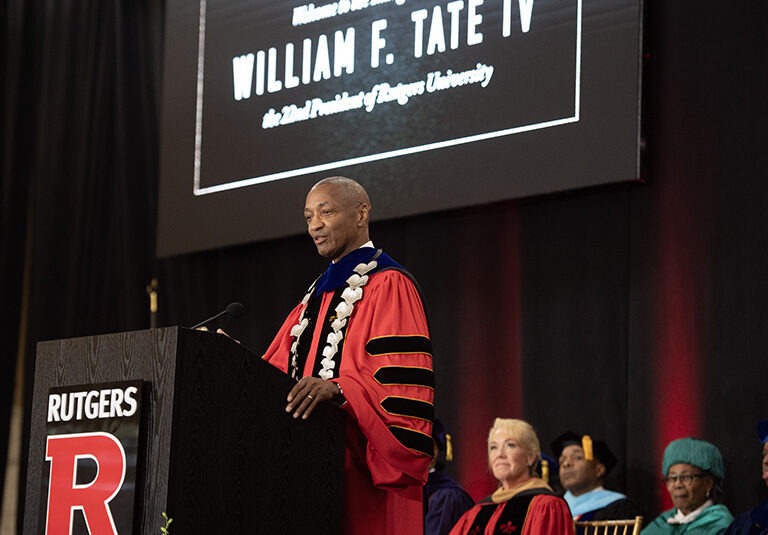
A New Era at Rutgers Begins as President William Tate Maps an Ambitious Future for New Jersey’s Flagship University

When William F. Tate IV stepped into office this summer as Rutgers University’s 22nd president, he arrived with a clear sense of purpose and an equally clear understanding of what the state expects from its flagship public institution. A nationally respected social scientist and former president of Louisiana State University, Tate brings to New Jersey a career shaped by research, public service, and an unwavering belief in the power of education to transform lives at scale.

Now leading one of the nation’s largest and most complex public university systems, Tate is positioning Rutgers for a period of strategic growth centered on social mobility, research excellence, and deeper partnerships across New Jersey’s health, business, and public sectors. His appointment comes at a pivotal moment for the university, as higher education faces shifting federal funding priorities, changing student demographics, and increasing pressure to demonstrate measurable public impact.

Raised in Chicago’s historic Bronzeville neighborhood on the city’s South Side, Tate credits his upbringing with shaping both his intellectual curiosity and his commitment to public education. He often points to a family culture rooted in learning, debate, and service. His paternal grandmother, an educator, encouraged exploration well beyond the classroom, guiding him toward informal learning environments such as science museums and cultural institutions. His mother worked in an academic medical center and regularly brought home professional journals, introducing him early to the language of medicine, research, and evidence-based inquiry. His father, who worked in the scientific supply industry before entering the nonprofit sector, nurtured a love of science and argument, filling the home with microscopes, telescopes, and spirited discussions.

Those early experiences were reinforced through a Catholic school education that emphasized discipline, civic responsibility, and the value of contributing to the greater good. Combined with the vibrant exchange of ideas among classmates and friends, Tate developed a lifelong appreciation for reasoned debate, storytelling grounded in evidence, and the pursuit of ideas that move communities forward.

That philosophy aligns closely with what first drew him to Rutgers. During the national search process, Tate says he was struck by the breadth and depth of the university’s faculty and academic programs, as well as by the institution’s unique position within a densely populated, economically diverse state. Rutgers, in his view, stands on the edge of a defining opportunity—one that allows it to expand access, elevate academic excellence, and deliver tangible benefits to residents across every region of New Jersey.

The challenges ahead, however, are substantial. New Jersey’s demand for higher education excellence is uncompromising, particularly when it comes to affordability and workforce preparation. Tate has made it clear that Rutgers must continue to serve as a primary engine of social mobility, ensuring that students from all backgrounds and zip codes can access a world-class education without being priced out of opportunity.

A cornerstone of his strategy centers on strengthening Rutgers’ academic competitiveness while preserving its broad public mission. That includes expanding honors education, enhancing the business school, and maintaining strong investment in the humanities, social sciences, and professional programs. Equally important, he emphasizes the recruitment and retention of exceptional faculty and staff who can sustain the university’s teaching and research excellence well into the future.

Health and biomedical research represent another major pillar of Tate’s vision. Through its partnership with RWJBarnabas Health, Rutgers continues to build a national model for evidence-based cancer care and advanced research in cancer, brain health, and cardiovascular science. Tate sees this collaboration as a defining opportunity to elevate the university’s national standing while directly improving health outcomes for New Jersey residents.

At the same time, the university must navigate ongoing uncertainty tied to federal funding levels and global enrollment shifts. Tate has emphasized that flexibility in the university’s funding model is essential. Rutgers, he says, must be prepared to adapt to changing public investment patterns without shifting the burden onto students. Protecting affordability remains a non-negotiable priority.

Despite concerns facing higher education nationally, Rutgers has seen encouraging enrollment trends. International enrollment, often vulnerable to global and policy changes, has rebounded, with fall enrollment exceeding the previous year by more than six percent. For Tate, this signals both the global appeal of Rutgers and the importance of sustaining an inclusive, internationally engaged campus environment.

Longer-term, Tate has outlined an ambitious set of institutional benchmarks. He believes Rutgers can significantly improve its national profile across its campuses, with aspirations to move New Brunswick into the top ten among public universities, Newark into the top thirty, and Camden into the top forty. These goals are driven by a comprehensive focus on reducing attrition, improving graduation rates, and strengthening the university’s already strong record of social mobility.

Research growth will be a central driver of that progress. During his tenure at LSU, Tate oversaw notable increases in funded research activity, and he intends to pursue similar momentum at Rutgers. The university already secures close to one billion dollars annually in research funding, and despite recent federal policy shifts, research expenditures continued to rise in fiscal year 2025. Tate sees Rutgers’ research mission as deeply intertwined with the real needs of New Jersey, spanning food security, environmental and coastal resilience, cancer prevention and treatment, biomedical innovation, drug discovery, engineering, education, and social policy.

In Tate’s view, the true measure of research excellence is not only academic prestige, but public relevance. The people of New Jersey, he often notes, are visible in the very questions Rutgers researchers are working to answer.

Looking ahead, students and faculty can expect a sharper focus on external partnerships designed to move ideas from laboratories and classrooms into communities and industries. Tate has called for more aggressive collaboration with New Jersey’s business leaders, government agencies, and health care systems to accelerate innovation and create applied opportunities for students and scholars alike.

One of the most visible new student-focused initiatives under his leadership is the launch of the Edge Fund, a scholarship program designed to recognize and support students whose talents and contributions elevate the university in ways that may fall outside traditional academic metrics. Artists, coders, writers, innovators, and competitors in non-revenue sports will be eligible for support, reflecting a broader definition of excellence and impact across campus life.

As Rutgers enters this new chapter, Tate’s presidency arrives at a moment when the university’s academic, research, and athletic identities are increasingly intertwined in shaping its public profile. Readers following the evolving story of the Scarlet Knights and campus life can explore ongoing coverage through Explore New Jersey’s Rutgers Scarlet Knights section, which highlights how leadership, competition, and community continue to shape the university’s statewide presence.

For Tate, however, rankings, funding totals, and national visibility remain secondary to a deeper objective: creating sustainable cycles of opportunity. His vision centers on graduates who leave Rutgers equipped to serve their communities, build careers in New Jersey and beyond, and contribute innovations that improve daily life across the state.

In an era defined by rapid social, technological, and economic change, William Tate is positioning Rutgers not simply to keep pace, but to lead—anchored in access, driven by research, and focused squarely on the future of New Jersey.

Autonomous Snow Blower Goes Viral in Chester as New Jersey Endures One of Its Coldest Stretches in Years

A futuristic snow-clearing robot carving a pristine path through a sprawling Chester driveway has captured the attention of millions across the country—just as New Jersey finds itself locked in a dangerous deep freeze and facing another active stretch of winter weather.

The viral video, now surpassing seven million views across social platforms, shows an autonomous Yarbo snow blower methodically clearing an estimated 6,000-square-foot residential driveway during the height of Winter Storm Fern in late January. While the machine works uninterrupted through heavy snowfall and gusting winds, the homeowner remains comfortably indoors, monitoring the operation remotely.

Behind the camera is well-known technology reviewer Tom Moloughney, host of the popular YouTube channel State of Charge, who documented the real-world performance of what is being described as one of the first consumer-ready autonomous snow blowers to reach the market.

The unit featured in the video is a first-generation Yarbo robotic snow blower with a price tag hovering around $5,000. Designed to operate independently once programmed, the machine uses onboard sensors, obstacle detection technology, and GPS-guided navigation to follow custom routes defined by the homeowner.

What viewers did not immediately see on screen was the extensive preparation required before the robot could begin clearing snow on its own. Moloughney explained that the installation process took close to 30 hours, including full assembly, mapping and programming the perimeter of the driveway, configuring chute direction, and carefully adjusting settings to accommodate the property’s slopes and changing elevations.

Once configured, however, the system runs continuously while snow is falling. The robot navigates around obstacles, adjusts its clearing path in real time, and automatically returns to its docking station to recharge before resuming work—creating a near-hands-free experience for the homeowner.

The video has triggered a statewide conversation about how automation could reshape winter maintenance in New Jersey, particularly in regions where repeated storms, ice accumulation, and extreme cold place heavy demands on homeowners and municipal crews alike.

Several viewers initially assumed the technology was part of a government pilot program or a public works upgrade. In reality, the system remains a privately owned consumer product, highlighting what may eventually become scalable for larger applications such as condominium associations, school campuses, and even municipal Department of Public Works operations.

Industry analysts say the interest generated by the Chester video reflects a broader shift in how homeowners view outdoor maintenance technology. Autonomous lawn equipment has already become more common, but winter-specific robotics capable of operating safely in snow, ice, and low-visibility conditions represent a much more complex engineering challenge.

The timing of the viral moment could not be more fitting. New Jersey is currently enduring one of its harshest prolonged cold stretches in recent memory, with meteorologists ranking the ongoing run of below-freezing days among the five longest such streaks on record for the state.

As of Sunday, February 1, temperatures across much of New Jersey are struggling to climb out of the 20s. Actual daytime readings are hovering between 22 and 27 degrees in many inland communities, while persistent winds are driving wind-chill values into the single digits—and in some areas, below zero.

Along the coast, conditions are even more severe. A Wind Advisory remains in effect for portions of southern and coastal New Jersey, including Cape May County, where wind gusts are approaching 50 miles per hour. In addition, a Coastal Flood Advisory continues for Atlantic and Cape May counties through the early afternoon hours, with minor tidal flooding expected in vulnerable shore communities.

The brutal cold is being fueled by a powerful system now pushing offshore, drawing frigid air across the region and maintaining dangerous exposure conditions for anyone spending prolonged time outdoors.

For residents tracking the rapidly changing situation, local and regional updates are being monitored closely through Sunset Daily’s ongoing New Jersey weather coverage, which provides community-specific outlooks and storm developments throughout the state.

Looking ahead, the coming days offer little immediate relief.

Monday, which also marks Groundhog Day, is expected to remain sunny but bitterly cold. High temperatures are forecast to reach only the low 30s, generally between 30 and 33 degrees across most of New Jersey.

By Tuesday, clouds are expected to increase, and daytime highs may finally push into the mid-30s. Forecasters say temperatures between 34 and 36 degrees could bring an end to the current multi-day streak of sub-freezing highs—a milestone many residents will welcome after weeks of persistent cold.

However, winter weather is far from finished.

Meteorologists are closely monitoring two separate weather systems that could bring additional snow to the region later this week. The first potential disturbance may arrive Wednesday, bringing scattered snow showers or light accumulations. A second system, still developing offshore and over the central United States, could impact New Jersey again on Friday, raising the possibility of another round of snow before the weekend.

Overnight conditions remain especially dangerous. Tonight’s forecast calls for clear to partly cloudy skies, with temperatures plunging into a frigid range between 8 and 14 degrees across much of the state. With lingering wind, frostbite can occur in a matter of minutes for exposed skin.

The combination of extreme cold, repeated snow threats, and high winds is forcing many residents to rethink how they handle winter maintenance—especially older homeowners and those with large properties.

That is precisely where the Chester driveway video has struck a nerve.

While a $5,000 autonomous snow blower remains out of reach for most households today, the footage offers a compelling glimpse into what winter preparedness may look like in the coming decade. Advocates of automation argue that robotic equipment could eventually reduce physical strain, lower injury risk, and help municipalities manage staffing shortages during prolonged storm cycles.

At the same time, experts caution that current systems still require extensive setup, technical familiarity, and regular monitoring—making them best suited for early adopters rather than mass deployment, at least for now.

Still, as New Jersey continues to battle a relentless winter and prepares for another potential round of snow later this week, the sight of a tireless robot carving through drifts in Chester has become a powerful symbol of how technology may soon reshape even the most physically demanding parts of everyday life.

You can watch the viral video of the Yarbo robot in action here and on Tom Moloughney’s YouTube channel, State of Charge, or see the news coverage from ABC7NY

How the Robot Navigates NJ Terrain

The machine, specifically the Yarbo S1 model, uses a combination of advanced sensors and satellite data to handle complex residential properties. 

  • RTK-GPS Navigation: It uses dual-antenna Real-Time Kinematic (RTK) GPS for centimeter-level accuracy. This requires a base station (the “Data Center”) with a clear 120° view of the sky to maintain a strong signal.
  • AI Vision & Smart Sensors: To avoid obstacles like pets, cars, or pedestrians, it uses binocular cameras, ultrasonic sensors, and a millimeter-wave radar. It features an automatic pause safety function that stops the unit until a safe distance is reached.
  • Route Planning: Through the Yarbo app, users map out specific “work zones” and “no-go zones.” The robot’s AI then calculates the most efficient path and adjusts the chute angle to throw snow exactly where you’ve designated. 

Performance Specs

According to specifications from Yarbo.com and Lowe’s, the unit is built for heavy-duty winter work. 

Feature Specification
Cleaning Width24 inches
Intake Height12 inches per pass
Throw Distance6 to 40 feet
Slope CapacityUp to a 36% (21°) incline
Battery Life~90 to 120 minutes per charge
Weather RatingIPX5 (operates down to -13°F/-25°C)

Buying Options

The 

Yarbo S1 is a modular system, meaning you can swap the snow blower for a lawn mower or leaf blower module. 

Merchant ProductPrice
YarboYarbo 2-Stage Snow Blower$4,599 $4,999
Lowe’sYarbo Snow Blower Robot$4,999
Best BuyYarbo Mower & Snow Blower$6,199

A Busy Sunday on New Jersey Campuses Highlights the State’s College Sports Depth as Rutgers Hits the Road

While national headlines continue to focus on professional sports and marquee television matchups, New Jersey’s college athletics scene is quietly delivering one of its most active and revealing weekends of the winter season. From conference rivalries and championship-level programs to nationally ranked teams chasing postseason momentum, February 1 offers a full slate of meaningful competition across the state, underscoring why New Jersey remains one of the most diverse and competitive college sports markets in the region.

In-State Games Today (Feb 1)

Recent Local News

The spotlight within the state comes at an interesting moment for Rutgers men’s basketball, which is navigating a demanding West Coast swing as part of its Big Ten schedule. The Scarlet Knights are in the middle of a critical stretch away from Piscataway, continuing their road trip with a highly anticipated matchup against UCLA on February 3. The trip follows a narrow and hard-fought loss at USC, where Rutgers fell by just three points in a tightly contested game that showcased the team’s ability to compete deep into the final minutes against elite conference opponents.

That cross-country challenge provides important context for what is happening back home today. Across New Jersey, college programs are firmly in the heart of their conference races, with positioning, confidence, and postseason implications already beginning to take shape. It is the kind of weekend that reflects the depth of college competition highlighted throughout Explore New Jersey’s dedicated college sports coverage, where the state’s universities continue to make an impact well beyond local gyms and campuses.

One of the day’s most anticipated in-state matchups comes in Lawrenceville, where Rider University hosts Saint Peter’s in a classic MAAC rivalry showdown at Alumni Gymnasium. The early afternoon men’s basketball game brings two familiar conference opponents together in a setting known for producing tight finishes and emotionally charged crowds. For both programs, games like this carry added weight as they fight to establish momentum and climb the league standings ahead of the MAAC tournament.

In South Orange, women’s basketball takes center stage as Seton Hall welcomes Creighton to Walsh Gymnasium. The matchup places two disciplined, well-coached programs on the same floor in a contest that blends defensive execution with fast-paced transition play. For Seton Hall, home games during the winter schedule remain critical opportunities to secure conference wins and continue building a résumé that reflects consistent competitiveness within one of the nation’s strongest women’s basketball landscapes.

Piscataway becomes the focal point for gymnastics fans as Rutgers hosts Penn State at Jersey Mike’s Arena in a mid-afternoon meet that features two programs known for technical precision and deep rosters. Gymnastics continues to grow as one of Rutgers’ most visible and fan-driven sports, and home meets have become destination events for families, alumni, and students eager to experience a high-energy, performance-driven atmosphere that differs from traditional court sports.

Men’s volleyball also steps into the spotlight as New Jersey City University hosts Nazareth in a match that highlights the rapid expansion and competitive evolution of collegiate men’s volleyball across the Northeast. The NJCU program has steadily built a reputation for disciplined play and developmental growth, and matches like this offer important opportunities for young rosters to sharpen their execution against non-conference opponents.

At Princeton, the campus transforms into a multi-sport hub with a full slate of invitational competition taking place throughout the day. Women’s water polo faces Siena in a matchup that continues Princeton’s push to strengthen its national profile in a rapidly growing sport, while men’s tennis welcomes Liberty in a dual match that emphasizes depth, endurance, and tactical discipline. These events reflect Princeton’s long-standing commitment to Olympic and non-revenue sports, providing competitive platforms for athletes whose seasons often unfold outside the mainstream spotlight.

The weekend also arrives on the heels of several notable achievements that continue to elevate New Jersey’s college athletics narrative. Rutgers wrestling delivered a statement performance Friday night in Lawrenceville, defeating Rider 21–12 to retain the Big Ten–MAAC Trophy. The victory further reinforces Rutgers’ position as one of the nation’s most respected wrestling programs and highlights the team’s consistency across weight classes as it pushes toward postseason competition.

At Princeton, excellence extends well beyond today’s invitational schedule. The women’s swimming and diving team officially clinched the 2026 dual meet title after completing a sweep of Harvard and Yale in the annual HYP series. The accomplishment serves as a powerful reminder of Princeton’s dominance in the Ivy League and its ability to sustain elite performance year after year through both depth and technical development.

Back on the hardwood, Rutgers men’s basketball continues to search for road success as it navigates one of the most demanding travel stretches on its schedule. The narrow loss to USC underscored the team’s resilience and late-game composure, and the upcoming meeting with UCLA presents another opportunity to test itself against a national brand in a challenging environment. For a roster still defining its identity within a grueling Big Ten schedule, the West Coast trip represents a critical learning curve that could shape the remainder of the season.

Taken together, February 1 paints a vivid picture of just how active and influential New Jersey’s college sports ecosystem has become. From conference rivalries in packed gymnasiums and emerging Olympic sports to nationally ranked programs asserting themselves on larger stages, today’s slate reinforces the idea that meaningful college competition is happening across the state every weekend.

As professional sports dominate the national conversation, New Jersey’s campuses continue to quietly deliver some of the region’s most compelling athletic storylines. Whether it is a rivalry game in Lawrenceville, a gymnastics showcase in Piscataway, a championship-caliber swim program in Princeton, or a high-profile road test for Rutgers basketball, college athletics in the Garden State remain deeply woven into the fabric of the winter sports season.

New Jersey Enters a Pivotal Transition as Sherrill Takes Office, Special House Election Begins, and Cursive Writing Returns to Classrooms

From Trenton’s first days under a new governor to an active congressional race and a statewide education policy shift, New Jersey’s political and civic landscape is moving rapidly in several directions at once.

New Jersey is stepping into a consequential new chapter as Governor Mikie Sherrill begins her administration under immediate public scrutiny, voters cast ballots in a fast-moving special congressional election, and state leaders finalize a sweeping change to classroom instruction that will bring cursive writing back into schools across the state.

Sherrill, who was sworn in only days ago, is already navigating an early test of her leadership style and commitment to transparency, as questions continue to surface surrounding access, fundraising influence, and donor visibility connected to inaugural events and celebrations.

While no administration avoids the realities of political fundraising, advocates for open government and ethics reform are pressing for clearer disclosure surrounding who attended high-profile inaugural gatherings, how access to the new governor was structured, and whether major financial contributors received preferential opportunities to interact with senior officials during the transition period.

For many observers, the controversy is not centered on the legality of the events themselves, but on perception and precedent. New Jersey voters have grown increasingly sensitive to the relationship between money and power, particularly in a state with a long history of high-profile corruption prosecutions and ethics scandals involving both political and business leaders.

Sherrill, who built much of her public reputation on a message of integrity and pragmatic reform, now faces pressure to set an early tone for her administration. Political analysts say how the governor responds in the coming weeks—particularly regarding transparency practices, public records access, and donor reporting—could shape public confidence well beyond her first year in office.

The moment is especially significant because the governor’s early decisions will also influence a legislature and party infrastructure preparing for a demanding national election cycle. With heightened public attention already focused on campaign finance and access to power, the administration’s handling of inaugural scrutiny may become a benchmark for how future large-scale political events are managed in the state.

At the same time, New Jersey voters are already participating in another critical test of the state’s political direction.

Early voting is currently underway in the special election to fill the U.S. House seat vacated by Sherrill when she assumed the governorship. The accelerated election schedule has compressed campaign timelines, forcing candidates to mobilize supporters, volunteers, and field operations at an unusually fast pace.

Turnout during early voting is being closely watched by party leaders and national strategists alike. The district has long been considered a bellwether for suburban voter sentiment, particularly on issues such as public safety, education funding, infrastructure investment, and national political leadership.

With control of Congress expected to remain narrowly divided, even a single House seat in New Jersey carries national implications. Campaign messaging in the district has focused heavily on affordability, healthcare access, and restoring public trust in government institutions—an emphasis that mirrors voter concerns being tracked statewide.

Local organizers say early participation appears to be fueled by strong interest among voters who view the special election not merely as a procedural replacement, but as an opportunity to influence the broader direction of federal policy during a volatile political period.

The overlap between Sherrill’s inauguration and the special election has also created an unusual political environment, where statewide leadership change and federal representation are being debated simultaneously by many of the same voters. That dynamic is helping keep attention sharply focused on the evolving state of New Jersey’s broader political climate, an issue closely followed across Sunset Daily’s ongoing coverage of state politics.

Beyond the political transition and electoral activity, state leaders are also making a decisive move in public education policy that will affect classrooms in every community.

New Jersey has officially joined a growing national trend by reintroducing mandatory cursive writing instruction in public schools, becoming one of 26 states to adopt or reinstate formal handwriting requirements aimed at strengthening foundational literacy and practical life skills.

Under the new policy, students will again be taught how to write in cursive as part of the standard curriculum, reversing years of reduced emphasis on handwritten communication in favor of digital learning tools and keyboard proficiency.

Education officials supporting the change argue that cursive instruction plays a meaningful role in cognitive development, reading fluency, and historical literacy. Students who cannot read cursive, they note, often struggle to interpret primary source documents, handwritten records, and archival materials that remain essential to civic education and historical understanding.

Advocates also point to research suggesting that handwriting instruction improves fine motor coordination, memory retention, and language processing, particularly in early elementary grades. In classrooms increasingly dominated by screens and standardized digital testing platforms, supporters say cursive offers an important counterbalance that reinforces neural connections involved in learning and comprehension.

The policy shift has also been welcomed by many educators who say students frequently lack basic handwriting confidence, especially after years of pandemic-era remote learning and heavy reliance on tablets and laptops.

At the same time, some districts are now evaluating how to integrate cursive instruction without adding to already crowded academic schedules. Administrators are reviewing teacher training needs, curriculum materials, and grade-level benchmarks to ensure consistency across districts with varying resources.

For parents, the return of cursive is being framed not as a nostalgic throwback, but as a practical tool. In everyday life, students still encounter handwritten forms, signatures, contracts, and personal correspondence—skills that digital literacy alone cannot fully replace.

Together, these developments reflect a broader moment of recalibration for New Jersey.

The state is adjusting to new executive leadership under Governor Sherrill, weighing public expectations around transparency and donor access at the highest levels of government. Voters are actively shaping the composition of New Jersey’s congressional delegation through a closely watched special election. And educators are rethinking how fundamental skills should be taught in an era dominated by technology.

While each issue stands on its own, they intersect around a common theme: trust in institutions and preparedness for the future.

Whether through ethical standards in government, engagement at the ballot box, or classroom policies designed to strengthen long-term learning, New Jersey’s leaders and residents are signaling that the next phase of the state’s civic life will be defined by both accountability and adaptation.

As the governor’s administration settles in, early voting continues, and schools prepare to roll out new instructional requirements, the coming months are likely to offer an early preview of how New Jersey will navigate the political, educational, and public expectations shaping the years ahead.

February 2026 Turns New Jersey Into a Winter Entertainment Capital

From Ice Sculptures to Lunar New Year Lights. February in New Jersey no longer belongs solely to quiet weekends and short daylight hours. Across the state in 2026, winter becomes a full-scale cultural season, blending global celebrations, live music, outdoor adventure, professional sports, and immersive family experiences into a calendar that rivals any warm-weather lineup. From North Jersey arts venues to Shore boardwalk challenges and historic parks along the Delaware River, February is shaping up to be one of the most dynamic months of the year for residents and visitors alike, continuing the statewide momentum highlighted throughout Explore New Jersey’s entertainment coverage.

New Jersey offers a diverse range of winter activities in February 2026, from cultural festivals and live music to outdoor adventures and professional sports. 

Festivals & Cultural Events

Outdoor & Nature Activities

  • Seal and Winter Waterfowl Walk: Join the American Littoral Society in Highlands on February 20, 2026, to observe local winter marine life and migratory birds.
  • Winter Warrior Challenge: A competitive athletic event held on the Ocean City Boardwalk on February 14, 2026.
  • Guided Winter Hikes:
    • Cheesequake State Park: A 2-mile guided nature walk through winter ecosystems on February 7, 2026.
    • Plainsboro Preserve: A guided “Winter Walk” along the preserve’s Red Trail on February 14, 2026.
  • Winter Markets: Visit the Grow It Green Winter Market at the Convent Train Station in Morristown every Sunday, including February 8, 2026

Sports & Recreation

Family-Friendly Museum Exhibits

  • Washington’s Birthday Celebration: Visit Washington Crossing State Park on February 15, 2026, for historical demonstrations including blacksmithing and musket firing.
  • Sue the T. rex Experience: A full-scale replica of the famous dinosaur is on display at the Liberty Science Center in Jersey City through May 2026.
  • Rutgers Geology Museum Open House: Explore fossils and minerals for free on February 7, 2026, in New Brunswick. 

The month opens with a strong focus on culture and live performance, beginning in Newark with a major Lunar New Year celebration that places music, heritage, and community at center stage. On February 7, the New Jersey Symphony brings the Year of the Horse to life at the New Jersey Performing Arts Center with a full evening experience that begins with a Cultural Exchange Festival at 6 p.m., followed by a family-friendly concert designed to bridge generations and traditions. The pre-concert festival invites guests to explore food, art, and cultural demonstrations, transforming the lobby into an interactive global showcase before the orchestra takes the stage.

One night earlier, on February 6, live blues takes over South Orange as the Winter Edition of the South Orange International Blues Festival arrives at the South Orange Performing Arts Center. Featuring nationally recognized performers such as King Solomon Hicks and Eliza Neals, the event delivers a powerful blend of contemporary blues and classic influences in one of Essex County’s most intimate and acoustically rich theaters. For local audiences, the winter festival edition has become a must-attend moment on the regional live music calendar, offering a high-energy counterpoint to the quieter winter concert season.

In central New Jersey, winter’s creative edge takes on a visual twist during the Winter Fire and Ice Festival in Cream Ridge on February 1 and 2. The seasonal event transforms the community into a cold-weather playground of glowing fire displays, detailed ice carvings, and family-oriented winter activities. Visitors can move through illuminated installations, watch artists carve frozen sculptures in real time, and enjoy an atmosphere that blends small-town charm with festival-scale production.

February also brings a powerful celebration of culture, identity, and community to Newark with Wakanda Ball 2026, scheduled for February 14 at Express Newark. The event honors Black love, creativity, and collective expression through fashion, music, and social connection, offering an immersive Valentine’s Day alternative rooted in culture and empowerment. For many attendees, the evening has become as much about creative community building as it is about celebration.

For those who prefer their February experiences outdoors, New Jersey’s natural spaces and waterfronts offer a surprising range of winter-only encounters. On February 20, the American Littoral Society leads a Seal and Winter Waterfowl Walk in Highlands, guiding participants along the coast to observe seasonal marine life and migratory birds that populate the shoreline during colder months. The walk provides rare opportunities to spot seals and winter seabirds while learning about conservation efforts and regional ecosystems.

On Valentine’s Day, February 14, athletic competitors and spectators gather in Ocean City for the Winter Warrior Challenge on the boardwalk. The high-energy endurance event pushes participants through physically demanding courses against the backdrop of the Atlantic Ocean, delivering one of the Shore’s most distinctive winter traditions and proving that the boardwalk remains a year-round destination.

Nature lovers can also explore the state’s preserved landscapes through guided winter hikes offered throughout the month. On February 7, Cheesequake State Park hosts a two-mile guided walk through its diverse winter ecosystems, highlighting forest, marsh, and transitional habitats in a quieter, wildlife-rich season. One week later, on February 14, visitors can join a guided winter walk along the Red Trail at the Plainsboro Preserve, where naturalists introduce participants to seasonal plant life, animal tracking, and winter landscape changes that often go unnoticed during warmer months.

Even in colder weather, New Jersey’s local food and artisan scene continues to thrive. The Grow It Green Winter Market operates every Sunday at the Convent Train Station in Morristown, including February 8, bringing fresh produce, baked goods, prepared foods, and handcrafted items directly to the community in a cozy, indoor setting that keeps local agriculture and small businesses visible year-round.

Sports fans also have plenty to mark on their calendars as February transitions into a high-profile winter sports stretch. Professional hockey remains a major draw, with the New Jersey Titans hosting the Northeast Generals at the Middletown Sports Complex on February 27 in a matchup that highlights the region’s growing reputation for high-level junior hockey. Looking ahead on the calendar, the New Jersey Devils welcome the Calgary Flames to Prudential Center on March 12, continuing a season that keeps downtown Newark energized well beyond football and basketball schedules.

For winter thrill-seekers, snow sports remain in peak condition across northern New Jersey. Mountain Creek Resort in Vernon and Campgaw Mountain in Mahwah both operate at full winter capacity throughout February, offering skiing, snowboarding, and tubing experiences that provide easy access to winter recreation without leaving the state. Families and first-time skiers continue to take advantage of lessons and terrain designed for all skill levels, reinforcing New Jersey’s growing winter sports culture.

Those looking to escape the cold entirely can step inside Big SNOW at American Dream, where year-round indoor skiing and snowboarding create a climate-controlled winter playground. The facility’s unique SNO-GO biking experience adds another layer of novelty, allowing riders to glide down snow-covered slopes on specially designed bikes, offering a distinctly modern twist on traditional snow sports.

February’s calendar also delivers standout family and educational experiences designed to bring history and science to life. On February 15, Washington Crossing State Park hosts its annual Washington’s Birthday Celebration, featuring historical demonstrations such as blacksmithing, period cooking, and live musket firing. The event immerses visitors in Revolutionary-era life and remains one of the state’s most popular winter history programs.

In Jersey City, Liberty Science Center continues to host the Sue the T. rex Experience through May 2026, giving families the opportunity to encounter a full-scale replica of one of the world’s most famous dinosaurs. The exhibit blends hands-on science education with visual spectacle, making it a top destination for winter school breaks and weekend outings.

Meanwhile, in New Brunswick, the Rutgers Geology Museum opens its doors for a free public open house on February 7, inviting visitors to explore fossils, minerals, and geological specimens collected from around the world. The long-running museum program offers an accessible and engaging way for families and students to connect with earth sciences in an intimate academic setting.

Taken together, February 2026 reveals a New Jersey winter defined not by limitation, but by creative opportunity. Whether drawn by orchestral celebrations, live blues, cultural festivals, wildlife exploration, endurance challenges, winter markets, or immersive museums, residents and visitors alike will find a state fully activated by entertainment, discovery, and community. In a season once considered off-peak, New Jersey is proving that winter can be one of its most vibrant and rewarding times to explore.

Malinowski Warns of Global Dark-Money Influence as New Jersey’s 11th District Special Primary Enters Final Stretch

At a packed weekend organizing kickoff in Morris County, former congressman Tom Malinowski delivered a blunt message to volunteers and supporters: the political fight unfolding in New Jersey’s 11th Congressional District is no longer being waged only by local campaigns and national parties, but by a rapidly expanding network of well-funded outside groups operating far beyond the state’s borders.

Speaking during a Saturday morning canvass launch at county Democratic headquarters, Malinowski told the crowd that many of the phone calls now flooding voters in the district are being generated from overseas call centers, complete with prepared scripts designed to attack his record and shape perceptions ahead of next week’s special Democratic primary.

“They’ve got call centers in India making phone calls to people with scripts,” Malinowski said, drawing both laughter and visible concern from the roughly 75 people gathered in the room.

He joked that his last name is often mispronounced on those calls—but quickly shifted the focus to what he described as a far more serious issue: the growing power of political spending that cannot be easily traced back to its original sources.

According to Malinowski, the contest to replace outgoing Representative Mikie Sherrill has become a real-world stress test for how dark money is deployed in competitive congressional races.

“This is a test case now for the midterm elections and the role dark money plays in our politics,” he told supporters.

Malinowski is one of 11 Democrats vying in Thursday’s special primary election to become the party’s nominee in New Jersey’s 11th District. The winner will advance to the general election scheduled for April 16. With the district considered one of the most closely watched suburban seats in the state, the outcome is already drawing national attention from advocacy groups, industry-aligned political organizations and outside spending networks.

The former lawmaker is attempting a return to Congress after previously serving in New Jersey’s 7th District. This time, he is seeking to represent a different region of the state—an unusual but increasingly common move as redistricting reshapes political maps and candidate opportunities.

While his own political comeback is drawing interest, Malinowski’s remarks made clear that his campaign now views the broader influence of outside money as one of the defining issues of the race.

In recent weeks, he has been the target of a costly advertising and messaging effort funded by the American Israel Public Affairs Committee, commonly known as AIPAC. Malinowski has repeatedly criticized the campaign, arguing that several of its claims are misleading or taken out of context.

One of the most controversial assertions, particularly amid today’s heightened national debate over immigration enforcement, is an allegation that Malinowski supports Immigration and Customs Enforcement. The claim is tied to a 2019 vote he cast while serving in Congress in support of a border-related funding measure. Malinowski has emphasized that every Democratic member of New Jersey’s House delegation voted the same way at the time.

He described the ad campaign as a flat-out distortion and warned supporters that it may represent only the opening phase of a broader strategy.

According to Malinowski, political organizations aligned with emerging industries—particularly cryptocurrency and artificial intelligence—are already preparing to invest heavily in similar negative advertising efforts in this year’s congressional contests. Rather than backing candidates directly, he said, these groups are increasingly focused on tearing down perceived obstacles to their policy agendas.

He cautioned that the pattern will not stop with this special election and could soon affect nearly every high-profile Democratic race in the state.

“This kind of spending is going to hit all of us,” he said, adding that even sitting U.S. senators are unlikely to be immune as outside groups expand their political footprint.

The warning carried particular weight inside the room, where one of New Jersey’s newest and most prominent political figures was seated just a few feet away.

Senator Andy Kim, who was elected to the U.S. Senate after previously serving three terms in the House, was the featured speaker at the event—and used the occasion to formally endorse Malinowski’s candidacy.

The two men were elected to Congress in 2018 and had known each other even before their first campaigns. Now, in 2026, Kim is publicly backing Malinowski as Democrats attempt to hold the open seat in a district that has become increasingly competitive.

Kim offered a candid explanation for his support.

“I need somebody who can just come in and just start kicking ass right away,” he said.

His endorsement underscored a central theme of Malinowski’s campaign: experience. With the special election calendar compressed and the general election following quickly, Democratic leaders are signaling that institutional knowledge and immediate effectiveness in Washington are critical advantages.

Whoever wins the April general election is expected to be seated in Congress shortly thereafter, with little time for orientation or legislative acclimation. Kim made clear that he believes Malinowski’s previous tenure would allow him to step directly into committee work and district advocacy without a learning curve.

The event also became a forum for broader national concerns, particularly immigration policy, which remains one of the most polarizing issues in federal politics.

Kim told the crowd that he believes the current administration is beginning to feel public and political pressure over the scope and tone of its enforcement strategy.

“They are feeling the pressure… the administration is feeling it,” Kim said, pointing to what he described as rising backlash from communities and lawmakers alike.

The discussion reflected a wider debate now shaping Democratic messaging across New Jersey, where suburban voters are increasingly focused on governance, accountability, and the influence of national political forces on local representation. The convergence of immigration policy, campaign finance, and outside political spending has turned the 11th District race into a closely watched bellwether.

For Malinowski, the concern is not simply about one campaign or one district.

He framed the special primary as an early warning for how future elections may unfold across the country—where sophisticated funding operations, offshore call centers and targeted negative messaging campaigns become standard tools for shaping outcomes without meaningful public transparency.

As New Jersey voters prepare to cast ballots next week, the race is rapidly becoming part of a larger conversation about election integrity, accountability and political influence—issues that continue to dominate coverage across Sunset Daily’s ongoing reporting on state and national politics.

In a district long associated with high turnout and close margins, the final days before the primary are now unfolding against a backdrop of national pressure, international campaign infrastructure and growing anxiety over how unseen money is reshaping the democratic process itself.

Mike Griot Presents 3rd Annual South Orange International Blues Festival Winter Edition

0

A Winter Blues Takeover Comes to South Orange as a World-Class Festival Returns for Its Most Powerful Edition Yet

February 6 @ 4:30 PM 11:30 PM

On Friday night, February 6, 2026, South Orange becomes the heartbeat of the regional blues scene as the third annual South Orange International Blues Festival: Winter Edition transforms the South Orange Performing Arts Center into a high-voltage celebration of sound, storytelling, and soul. Beginning at 7:30 p.m., this signature winter showcase promises far more than a concert. It delivers a full-spectrum journey through modern and traditional blues, curated with precision and passion by internationally respected bassist, producer, and cultural tastemaker Mike Griot.

In just three years, the Winter Edition of the South Orange International Blues Festival has grown into one of North Jersey’s most anticipated live music experiences, drawing devoted blues fans from across New Jersey and the greater New York City region. Its reputation is built on a simple but powerful idea: bring together exceptional artists who honor the roots of the blues while fearlessly expanding its boundaries. That philosophy has placed the festival firmly within the growing spotlight of New Jersey’s live performance culture highlighted throughout Explore New Jersey’s music coverage, which continues to showcase how the state’s venues are becoming essential platforms for world-class touring and emerging artists alike.

This year’s Winter Edition is designed to feel immersive and emotionally charged from the first note to the final encore. Audiences can expect an evening shaped by deep-pocket grooves, blistering guitar work, powerhouse vocals, and the kind of musical chemistry that only comes from artists who live and breathe the language of the blues. The lineup spans generations, styles, and geographic influence, creating a dynamic flow that moves seamlessly from raw acoustic traditions to electrified, modern blues-rock.

Leading the evening is King Solomon Hicks, one of the most exciting contemporary blues voices to emerge from Harlem’s storied music community. A gifted guitarist, vocalist, and composer, Hicks developed his sound while growing up immersed in a culture shaped by jazz, gospel, and classic blues. His award-winning album Harlem announced him as a major new presence on the national scene, earning industry recognition for its confident songwriting and expressive musicianship. On stage, Hicks blends fluid guitar phrasing with rich, commanding vocals, creating performances that feel both deeply rooted and unmistakably current. His ability to bridge traditional blues structures with jazz and R&B influences gives his live sets a rhythmic complexity that resonates with seasoned blues fans and first-time listeners alike.

Adding a powerful regional voice to the lineup is BLUES People, a New York and New Jersey-based band whose music captures the grit, urgency, and emotional honesty at the heart of modern American blues. Built on decades of collective experience, the group has earned a reputation for explosive live performances and uncompromising originality. Their debut album, The Skin I’m In, brought national attention to their songwriting, which confronts urban life, social struggle, and personal resilience through tightly arranged, groove-driven compositions. Recent victories at the International Blues Challenge have solidified their standing as one of the most compelling blues acts in the region, and their return to a New Jersey stage for this festival signals a homecoming moment for fans who have followed their rapid rise.

Eliza Neals brings a strikingly different but equally powerful dimension to the Winter Edition. An award-winning pianist, vocalist, producer, and bandleader, Neals is widely recognized for her commanding stage presence and fearless creative voice. With formal training in opera and mentorship from Motown songwriting legend Barrett Strong Jr., her musical foundation is both disciplined and deeply expressive. Neals fuses blues, rock, and soul into a high-impact performance style defined by emotional intensity and theatrical delivery. Her recordings receive daily national airplay, and her live shows have earned praise from some of the most influential names in blues and rock. With a rare three-and-a-half-octave vocal range and a reputation for unforgettable performances, Neals brings a modern, genre-blurring energy that expands the festival’s sonic reach.

Rounding out the lineup is New Moon Acoustic Blues, a trio dedicated to preserving and reawakening the earliest voices of the blues tradition. Led by guitarist and singer Karl Schwarz, the group focuses on high-energy acoustic blues inspired by Hill Country, Delta, and Piedmont styles. Joined by veteran guitarist Jack O’Hara and master percussionist Mark Ambrosino, the band recreates the raw emotional power of pre-electric blues while delivering performances filled with rhythmic drive and spontaneous interaction. Their set offers a powerful contrast to the festival’s electric acts, grounding the evening in the historical foundations that continue to influence every modern blues artist on the bill.

The guiding force behind the festival is Mike Griot, whose international career as a bassist and producer spans blues, jazz, soul, gospel, and hip-hop. His professional collaborations include Grammy-nominated and Grammy-winning artists across multiple genres, reflecting a creative versatility that has become central to his work as a curator. For South Orange audiences, Griot is also a familiar and deeply respected figure. He founded SOPAC’s acclaimed “In the Loft” performance series and has served for many years as the driving force behind its popular “Blues in the Loft” programs, helping to establish the venue as one of New Jersey’s most trusted homes for authentic, high-caliber blues programming. A longtime resident of South Orange and Orange, Griot’s commitment to community and cultural access has earned him widespread recognition for leadership in the arts.

What distinguishes the South Orange International Blues Festival from typical concert events is its intentional storytelling arc. The evening is carefully structured to highlight how blues continues to evolve while remaining anchored to its roots. Audiences are invited to experience not only virtuosity, but also narrative—songs shaped by history, migration, identity, hardship, and celebration. Each artist contributes a unique chapter to that larger story, creating a cohesive festival experience rather than a simple lineup of performances.

The Winter Edition also reflects a broader resurgence of intimate, artist-focused live music experiences across New Jersey. Smaller theaters and performing arts centers are playing an increasingly vital role in connecting local audiences with globally respected talent, offering the kind of close-range, emotionally immersive performances that large arenas simply cannot replicate.

In addition to the artistic experience, SOPAC continues to reward community support through its membership program. Patrons who hold Advocate-level memberships or higher receive access to discounted ticket pricing, reinforcing the venue’s commitment to keeping world-class live music accessible to the community it serves.

As winter settles over North Jersey, the third annual South Orange International Blues Festival: Winter Edition offers a powerful reminder of music’s ability to cut through the cold with warmth, connection, and shared experience. On February 6, South Orange will not simply host a concert. It will host a living celebration of the blues—its past, its present, and its rapidly unfolding future—brought vividly to life by artists whose voices continue to shape the sound of modern American music.

Meet the Artists

King Solomon Hicks 

King Solomon Hicks is a guitar phenom known for his mastery as a guitarist, vocalist, and composer. He grew up immersed in Harlem’s vibrant music scene, drawing inspiration from legendary musicians. He won the 2021 Blues Music Award for Best Emerging Artist with his acclaimed album “Harlem”. He has performed alongside legends like Buddy Guy, Tony Bennett, and Jeff Beck. His music blends blues, jazz, and R&B with a modern touch that reflects both tradition and innovation.  


Blues People 

BLUES People is a dynamic NY/NJ blues band known for their powerful musicianship and early comparisons to legends like The Meters and Buddy Guy. They released their debut album “The Skin I’m In” in 2024, which was nominated by BLUES BLAST MAGAZINE as Best New Artist Debut Album. The band members bring decades of experience, having supported major artists like Sue Foley and Bo Diddley Jr., and they won the North Jersey Blues Society International Blues Challenge in 2023 and 2024. BLUES People explores modern American blues through original songs that reflect urban life and struggle. Their fierce commitment to authenticity and roots makes them a standout force in contemporary blues. 
Eliza Neals 

Eliza Neals is an award-winning musician, pianist, producer, and bandleader whose powerhouse vocals and fiery stage presence are redefining modern blues-rock. A graduate with a BA in opera and protégé of Motown legend Barrett Strong Jr. (I Heard It Through the Grapevine, Papa Was a Rolling Stone), Eliza fuses blues, rock, and soul into unforgettable songs heard daily on SiriusXM’s B.B. King’s Bluesville. Praised by icons like Buddy GuyMick JaggerJoe Louis Walker, and Walter Trout, she’s been invited four times to the Mustique Blues Festival, where Mick Jagger called her “a voice I soon won’t forget.” Recent honors include two 2024 Independent Blues Awards (“Road Warrior” plus “Best Blues-Rock Song” for Candy Store), 2024 Music Connection’s Hot 100 Unsigned Artist, and the 2018 Detroit Black Music Award for Blues Artist of the Year. With a three-and-a-half-octave range and a fearless creative spirit, Eliza Neals continues to break boundaries and electrify audiences worldwide. 
New Moon Acoustic Blues 

New Moon Acoustic Blues is a high energy traditional blues outfit led by guitarist and singer Karl Schwarz. The band performs all manner of Acoustic Blues typified by artists such as the Reverend Gary Davis, Robert Johnson and RL Burnside. Joining Karl on stage, his good friend on guitar, Mr. Jack O’Hara, who’s many musical credits include the late BB King and Lightning Hopkins. New Moon Acoustic Blues’ own, Mark Ambrosino, bringing a smooth and dynamic percussive accompaniment, who’s musical credits include Whitney Houston, Michael Brecker and Ray Charles, the trio brings a wonderful high energy to classic acoustic blues styles. New Moon Acoustic Blues never fails to resurrect on stage the powerful feelings of Hill Country, Delta and Piedmont Blues.

Festival Curator: Mike Griot 

MIKE GRIOT has criss-crossed the world for several decades as a sought-after bass player in a variety of musical genres including, blues, soul, jazz, gospel, and hip-hop.  His diverse credits include Grammy-nominee SUE FOLEY (blues), UK-soul pioneer OMAR (soul), Grammy-nominee RUSSELL GUNN (jazz), Grammy-winner HEZEKIAHWALKER (gospel),
GANGSTARR/GURU’s JAZMATTAZZ (hip hop) and dozens of globally-recognized artists.

Griot is proud to have founded SOPAC’s “In the Loft” series, and has served for many years as curator of its “Blues in the Loft” events. He has received the 2014 HANDS Community Leadership Award… and is a proud, longtime resident of both South Orange and Orange.

South Orange Performing Arts Center (SOPAC)

(973) 313-2787

View Organizer Website

The Prudential Center

25 Lafayette St
Newark, New Jersey 07102 United States
+ Google Map
(973) 757‑6000
View Venue Website

February Frenzy Ignites Across New Jersey as Brackets, Banners and Breakout Performances Redefine the High School Winter Sports Race

February is “bracket season” for New Jersey high school sports, as winter teams push toward state championships and individual milestones. 

February has arrived with its unmistakable sense of urgency across New Jersey gyms, arenas and wrestling rooms, signaling the true start of bracket season for high school athletics. From packed basketball bleachers to championship wrestling mats and postseason qualification deadlines, winter sports are now shifting from regular-season rhythm to the relentless pursuit of hardware, history and individual milestones. It is the most revealing stretch of the calendar, when contenders separate themselves and programs with championship culture begin to assert their identity across the state’s ever-competitive high school sports landscape featured throughout Explore New Jersey’s dedicated high school sports coverage.

On the hardwood, county tournaments are already reshaping the postseason conversation. Traditional powerhouses and emerging challengers alike are navigating single-elimination pressure in marquee events such as the Bergen Jamboree, Essex County Tournament, Passaic County Tournament and Somerset County Tournament, all of which are deep into their opening rounds. Early statement performances have set the tone. Seton Hall Prep delivered one of the weekend’s most commanding outings with a decisive 90–62 victory over West Side in the Essex County opener, showcasing depth, pace and offensive balance that immediately positioned the Pirates as a team no bracket will want to face. In another high-profile result, Christian Brothers Academy produced a gritty, playoff-style 50–44 win over Rumson-Fair Haven, a performance that reinforced its ability to control tempo and execute in late-game situations.

With the New Jersey State Interscholastic Athletic Association cutoff date for state tournament qualification set for February 14, the margin for error has nearly vanished. Programs across the state are managing lineups, minutes and health carefully as they prepare for seeding meetings on February 17, where postseason paths will be finalized and championship aspirations officially charted.

Beyond basketball, February’s calendar carries equal weight for the state’s winter sports community. Wrestling, one of New Jersey’s most tradition-rich and fiercely competitive high school sports, is building toward its marquee individual showcase as the State Individual Championships return to Boardwalk Hall in Atlantic City from March 12 through March 14. The lead-up has already produced nationally relevant storylines. Delbarton continues to make noise well beyond state borders, while Delaware Valley recently delivered a pivotal dual-meet victory over Warren Hills, a result that further tightened the competitive picture among the state’s top programs.

Individual achievements have also highlighted the depth of New Jersey’s winter sports talent. On the bowling lanes, Belvidere’s Ethan Zmyewski and Barnegat’s White captured individual titles at the New Jersey Singles Classic, adding to the growing list of athletes across the state using February competition to elevate their postseason resumes. Ice hockey enters a crucial administrative phase as well, with February 1 marking the opening of the NJSIAA state tournament entry period, setting the postseason in motion for rinks across North Jersey, Central Jersey and the Shore.

This year’s winter season has also underscored the broader impact of high school athletics beyond wins and losses. A New Jersey high school athletic trainer was recently recognized statewide for life-saving action after reviving a student-athlete who had stopped breathing during competition, a powerful reminder that behind every result on the scoreboard is a network of professionals dedicated to student safety and well-being. Off the field, the NJSIAA announced that beginning this spring, the baseball state championships will move to a new host venue, a logistical change designed to enhance the championship experience for athletes, families and fans. Meanwhile, South Plainfield High School earned recognition from Niche as one of the top 100 high schools in New Jersey for sports in the Class of 2026 rankings, further highlighting the statewide commitment to athletic excellence.

Yet no storyline this week captured the momentum of New Jersey’s evolving sports landscape more vividly than the continued rise of girls wrestling, led by a rapidly emerging dynasty from Trenton.

At the Colonial Valley Conference Girls Wrestling Championships in Robbinsville, Trenton High delivered another emphatic statement, securing its third consecutive team championship and reinforcing its place as one of the most formidable programs in the state. Competing in the third year of a girls-only CVC championship format, the Tornadoes amassed 200.5 team points and claimed three individual titles, clinching the team race before the finals even began. Hamilton finished second with 163 points, while Steinert claimed third with 135.5 in a tightly contested team battle behind the dominant champions.

Trenton’s finals run opened with authority. At 114 pounds, Heaven Sykes turned back top-seeded Lara Bahr of Princeton in just over a minute, securing the title with a decisive headlock finish. Moments later, Princessstorm Woody continued her remarkable career by capturing her third consecutive CVC championship, ending the 120-pound final in a stunning 16 seconds. One weight class later, Noelsymar Estrada completed Trenton’s trio of champions by earning a third-period pin at 132 pounds, sealing the Tornadoes’ hold on the podium.

The consistency of Trenton’s success is no accident. Built on a thriving youth feeder program and a coaching staff that has cultivated both confidence and discipline, the program continues to produce athletes who understand the demands of championship competition. Woody, already one of the state’s most accomplished wrestlers, emphasized the team’s shared mindset after the finals, noting the group’s commitment to improvement throughout the season and its determination to make history with a third straight conference title. Estrada echoed the same sentiment, describing Trenton wrestling as a lifestyle defined by accountability, preparation and pride.

While Trenton controlled the team race, the individual tournament showcased the expanding depth of talent across the CVC. Lawrence senior Marina Velazco delivered one of the day’s most electric performances, earning Outstanding Wrestler honors at 126 pounds after pinning Hamilton’s Salma Abdelnabi in a spirited final. Lawrence also produced champions at 100 pounds through Stella Kramer and at 185 pounds with Tanvi Madisetti, matching Trenton with three individual winners.

Steinert added two champions of its own as Rowan Lacy-Cancel captured the 138-pound title and Ella Johnson claimed the 165-pound championship, with Johnson continuing to build an elite résumé as one of the state’s highest-ranked competitors. Additional titles went to Princeton’s Evelyn Xiao at 107 pounds, Notre Dame’s Julie Toribio at 144, Ewing’s Alexandra Neuberger at 152, and Hightstown’s Gabi Sanon-Jules at 235. Toribio’s narrow victory in a high-scoring, late-dramatic final over Ewing’s Raymonda Kamara stood out as one of the tournament’s most technically impressive bouts.

By day’s end, Trenton placed in the top six across half of the weight classes, a statistical reflection of its depth and consistency. Head coach Rob Prunetti credited the team’s exceptional freshman class and the leadership of returning wrestlers for accelerating the program’s growth, describing this season’s group as the most promising roster the program has assembled to date.

The broader significance of the CVC championships extends far beyond a single weekend. The continued expansion of girls wrestling across New Jersey is reshaping winter sports culture statewide, creating new pathways for student-athletes and rapidly producing high-level competition that rivals long-established programs on the boys’ side. The atmosphere inside Robbinsville High School offered a glimpse into that future, with packed mats, intense finals and athletes performing on a stage that continues to grow in visibility and respect.

As February pushes deeper into its defining weeks, New Jersey’s winter sports scene stands at full throttle. Basketball teams are racing toward qualification cutoffs, wrestlers are positioning themselves for Atlantic City, bowlers and hockey players are securing postseason opportunities, and emerging programs like Trenton girls wrestling are rewriting expectations across the state. Brackets may determine champions, but February remains the month that reveals who is truly built to endure the pressure of New Jersey’s unforgiving postseason stage.

Basketball: County & State Tournaments 

  • Tournament Time: Most major county tournaments—including the Bergen JamboreeEssex CountyPassaic County, and Somerset County—are currently underway.
  • Key Results: Seton Hall Prep (No. 16) dominated West Side 90–62 in the Essex County opener, and CBA (No. 5) recently pulled off a 50–44 statement win over Rumson-Fair Haven.
  • The Road to State: The NJSIAA cutoff date for state tournament qualification is February 14, with seeding meetings scheduled for February 17. 

Wrestling & Winter Sports

  • Atlantic City Bound: The Individual State Wrestling Championships are set to return to Boardwalk Hall in Atlantic City from March 12–14.
  • Heavyweight Battles: No. 1 Delbarton is currently making national noise, while No. 14 Delaware Valley recently surged past Warren Hills in a key dual meet.
  • Bowling Milestones: Belvidere’s Ethan Zmyewski and Barnegat’s White recently secured individual titles at the N.J. Singles Classic.
  • Ice Hockey: Today, February 1, marks the start of the NJSIAA entry period for the state tournament. 

Unique & Noteworthy News

  • Life-Saving Action: A New Jersey high school athletic trainer is being hailed as a hero for life-saving actions that revived a player who stopped breathing during a recent event.
  • Baseball Venue Change: The NJSIAA announced that starting this spring, the baseball state championships will move to a new host site.
  • Academic/Athletic Honors: South Plainfield High School was recently named one of the top 100 NJ high schools for sports by Niche for 2026

For 2026, the NJSIAA winter state tournament schedules are officially set. While specific team matchups won’t be final until the seeding meetings in mid-February, you can mark your calendar with these key dates: 

🏀 Basketball (Boys & Girls)

Brackets will be finalized during the seeding meeting on February 17, 2026

  • Public Round 1: Feb 24 (Groups 2 & 4) and Feb 25 (Groups 1 & 3).
  • Non-Public Round 1: Feb 26 (Group A) and Feb 27 (Group B).
  • Sectional Finals: March 6–9.
  • State Finals: March 12 (Non-Public) and March 14–15 (Public) at Rutgers University

🤼 Wrestling

The road to Atlantic City is slightly later this year to accommodate other events at Boardwalk Hall. 

  • Team Sectional Finals: Feb 11 (Public).
  • Team State Finals: Feb 15 at Rutgers University.
  • Individual Districts: Feb 28.
  • Individual Regions: March 6–7.
  • Individual State Championships: March 12–14 at Boardwalk Hall, Atlantic City

🏒 Ice Hockey

Seeding will be determined on February 17, 2026

  • Public Round 1: Feb 23.
  • Non-Public/Girls Round 1: Feb 24.
  • State Semifinals: March 4 (Codey & Mennen Arenas).
  • State Finals: March 9 at the Prudential Center in Newark. 

🏃 Other Winter Sports

  • Swimming State Finals: Feb 22 at Rutgers University.
  • Winter Track Meet of Champions: March 8 at Ocean Breeze.
  • Bowling Sectionals: Feb 21. 

You can track live updates and unofficial power points for your specific school on the NJSIAA Brackets Page or NJ.com High School Sports

New Leadership at the Helm: Deborah Visconi Steps Forward to Guide New Jersey’s Hospitals Through a Defining Moment

At a pivotal time for health care across the Garden State, Deborah Visconi, president and chief executive officer of Bergen New Bridge Medical Center, has officially begun her term as 2026 chair of the New Jersey Hospital Association, assuming the role during the Association’s annual meeting in Princeton on January 29.

The appointment places one of New Jersey’s most respected hospital leaders at the forefront of a statewide organization that has shaped health policy, hospital collaboration, and community care for more than a century. Founded in 1918, the New Jersey Hospital Association now represents nearly 400 member organizations spanning the full spectrum of care, including hospitals, health systems, and post-acute providers united by a shared mission to improve health outcomes for residents in every corner of the state.

Visconi succeeds Mark Stauder, the recently retired chief operating officer of Hackensack Meridian Health, who served as the Association’s 2025 chair. Her transition into the role marks a continuation of steady leadership at a moment when New Jersey’s hospitals face some of the most complex operational, financial, and workforce challenges in decades.

Widely recognized across the state’s business and health care communities, Visconi brings deep experience from her leadership of Bergen New Bridge Medical Center in Paramus, the state’s largest hospital. With 1,070 licensed beds, the public safety-net facility plays a uniquely critical role in the regional and statewide care network. Its comprehensive service footprint includes round-the-clock emergency care, expansive behavioral health programs, substance use disorder treatment services, and long-term care operations that collectively support some of New Jersey’s most medically and socially vulnerable populations.

Her professional reputation has been shaped by years of navigating large-scale public hospital operations while maintaining a strong focus on patient access, community health partnerships, and financial sustainability. That background is especially relevant as hospitals statewide confront significant external pressures, including proposed federal Medicaid funding reductions and the potential loss of health insurance coverage for hundreds of thousands of New Jersey residents.

In her remarks surrounding the installation, Visconi acknowledged the magnitude of the challenges facing hospitals and health systems, citing the growing impact of federal policy changes, ongoing workforce shortages, and escalating operational costs. At the same time, she underscored the collective strength of New Jersey’s hospital community, emphasizing the resilience of institutions that continue to care for approximately 15 million patients each year.

Those services are delivered by a statewide workforce of roughly 162,000 highly skilled health professionals, supported by more than $7 billion in annual community investment across New Jersey. According to Visconi, those numbers reflect far more than scale—they demonstrate a long-standing commitment to accessible, affordable, and equitable care that remains deeply embedded in the culture of the state’s health system.

“These incredible impacts are the product of our collective values, which are unshakeable – quality, affordable, accessible, equitable care for all New Jerseyans,” Visconi said. She described hospitals as a constant presence within their communities and reaffirmed the responsibility of the health care sector to serve as a stabilizing force during times of social, political, and economic uncertainty.

Her leadership arrives as New Jersey’s health care landscape continues to evolve rapidly, shaped by advances in digital health technology, new models of outpatient and community-based care, and growing public expectations around culturally responsive services. These shifts, along with the financial and workforce realities facing hospitals, have become central themes across statewide discussions surrounding innovation, access, and sustainability within the broader health ecosystem highlighted through Explore New Jersey’s ongoing coverage of health and wellness initiatives.

Alongside Visconi’s installation, the New Jersey Hospital Association announced its full slate of 2026 board officers, reflecting leadership from a diverse range of hospital systems and regions across the state. The newly appointed vice chair is Rob Brenner, president and chief executive officer of Valley Health System. Serving as treasurer is Patricia O’Keefe, president of Morristown Medical Center and senior vice president and chief nursing executive for Atlantic Health System. The role of secretary will be held by Eric Carney, president and chief executive officer of Monmouth Medical Center and Monmouth Medical Center Southern Campus, both part of RWJBarnabas Health.

Together, the leadership team represents hospitals serving urban, suburban, and regional populations, reinforcing the Association’s statewide perspective as it works to align policy advocacy, operational collaboration, and workforce development across New Jersey’s health care infrastructure.

The organization’s strategic direction was further reinforced by Cathy Bennett, president and chief executive officer of the New Jersey Hospital Association, who addressed members during the annual meeting. Bennett described the current environment as one shaped by relentless pressures, including reimbursement challenges, workforce strain, rapidly changing technology, and heightened social and political tensions affecting communities throughout the state.

Despite these realities, she emphasized that the fundamental purpose of New Jersey’s hospitals remains unchanged. Every facility, she noted, continues to operate with a commitment to care for all who seek treatment and to provide opportunity for those who choose careers in health care.

Bennett also outlined several priority areas that will guide the Association’s advocacy and operational support efforts in the year ahead. These include maintaining access to essential hospital services in every community, strengthening and stabilizing the health care workforce, ensuring sustainable financing models that allow hospitals to invest in future innovation, closing persistent equity gaps through culturally responsive care delivery, and preserving public trust at a time when health systems are increasingly scrutinized by both policymakers and the public.

For Visconi, the opportunity to guide the Association comes at a moment when leadership must balance urgent fiscal realities with long-term transformation. Her experience overseeing New Jersey’s largest public hospital—while advancing behavioral health access, emergency services, and long-term care—positions her to bring a practical, patient-centered perspective to statewide conversations on policy, funding, and system redesign.

As New Jersey continues to confront rising demand for services, demographic change, and evolving models of care delivery, Visconi’s chairmanship represents a defining chapter for the state’s hospital community. With collaboration, stability, and equity at the center of her message, her leadership signals a renewed commitment to protecting the role of hospitals as anchors of public health, economic vitality, and community trust throughout the Garden State.

Electric Horsepower and Hybrid Precision: How the World’s Top Supercar Brands Are Quietly Rewriting Performance for 2025

From Italy to Britain to Germany, the next generation of elite performance machines is no longer defined by raw combustion alone, as Ferrari, Lamborghini, McLaren, and Porsche lead a technological shift that is reshaping speed, sustainability, and the future of driving.

The supercar world is undergoing one of the most profound transformations in its history, and 2025 stands as the moment when hybrid and electric technology fully steps out of the experimental phase and into the center of high-performance engineering.

For decades, the global supercar conversation revolved around engine displacement, redline limits, and the unmistakable soundtrack of naturally aspirated and turbocharged powerplants. That identity is not disappearing. Instead, it is being fundamentally reengineered.

Leading manufacturers are now blending advanced electrification, lightweight battery systems, and intelligent software into vehicles designed not only to deliver extreme speed, but to redefine how performance is created, controlled, and experienced.

Across the industry, Ferrari, Lamborghini, McLaren, and Porsche are no longer treating hybrid systems as transitional technology. In 2025, electrification has become an essential performance tool, capable of producing instant torque, sharper throttle response, improved traction management, and more efficient energy recovery at speeds once reserved for race circuits.

What is emerging is a new definition of power—one where acceleration is not just explosive, but precise, repeatable, and digitally optimized.

Ferrari’s 2025 performance strategy reflects a broader shift toward electrically assisted drivetrains that enhance, rather than replace, its combustion heritage. Hybrid systems are now engineered to work seamlessly with high-revving internal combustion engines, using electric motors to fill torque gaps, sharpen corner exits, and reduce turbo lag to nearly imperceptible levels. Engineers are focusing on ultra-compact battery packaging and weight distribution, ensuring that the added technology strengthens balance and handling rather than compromising agility.

The result is a driving experience where power delivery becomes smoother, faster, and more predictable at extreme speeds—while overall emissions and fuel consumption continue to drop.

Lamborghini’s approach is equally aggressive, but unmistakably dramatic in execution. The brand is leaning heavily into hybridization as a way to preserve the emotional intensity of its vehicles while complying with increasingly demanding global emissions standards. For 2025 models, electric motors are not simply supplementary. They actively contribute to torque vectoring, launch control, and real-time stability systems, giving drivers greater control under full throttle while maintaining the sharp, theatrical personality the brand is known for.

Rather than muting performance, electrification is amplifying it.

McLaren, long associated with cutting-edge materials science and motorsport-derived technology, is positioning hybrid systems as an extension of its lightweight engineering philosophy. In 2025, the company is investing heavily in advanced carbon structures and next-generation battery modules that minimize mass while maximizing power density. Engineers are using electric assistance to enhance mid-corner acceleration and improve consistency over long, demanding driving sessions, a focus clearly influenced by endurance racing and track performance benchmarks.

This technology allows McLaren to deliver faster lap times without increasing vehicle weight in the traditional way, creating cars that feel sharper, more responsive, and more technically refined.

Porsche, meanwhile, continues to build on its long-standing expertise in electrification and performance integration. Its 2025 lineup further blurs the line between road car and race car, using hybrid architecture to refine drivability in real-world conditions. Electric motors provide instant torque at lower speeds, while combustion engines remain optimized for sustained high-speed output. Software now plays an equally important role, coordinating power flow, regenerative braking, and adaptive chassis systems in real time.

In practical terms, this means drivers experience stronger acceleration out of corners, improved traction on variable surfaces, and greater overall efficiency without sacrificing the long-distance performance capabilities Porsche customers expect.

Perhaps the most important change unfolding in 2025 is not what drivers see on the spec sheet, but what they feel behind the wheel.

Hybrid and electric systems allow manufacturers to deliver performance that is more usable. Torque arrives instantly and consistently. Power delivery becomes easier to manage at the limits of grip. Vehicle dynamics systems can react in milliseconds, adjusting torque distribution between axles and wheels to maintain stability under extreme loads.

This is a fundamental departure from the old supercar formula that relied almost entirely on mechanical grip and driver input. The modern supercar is now a deeply integrated digital machine—one that blends software intelligence with physical engineering to extract more speed from less energy.

Sustainability, once considered incompatible with ultra-high-performance vehicles, is also becoming a central engineering target. Advanced battery chemistry, lightweight composite materials, and low-friction driveline components are being deployed not as public relations gestures, but as tools to unlock better performance per unit of energy.

Manufacturers are also reevaluating production processes, sourcing, and lifecycle efficiency, recognizing that the future of the supercar must be aligned with evolving global regulatory frameworks and consumer expectations. In the United States and New Jersey, shifting emissions rules, safety standards, and technology regulations are playing an increasingly visible role in how high-performance vehicles are engineered, tested, and approved for road use—an issue that continues to intersect with broader transportation and public safety policy covered regularly in Sunset Daily’s law and order reporting.

At the same time, electrification is reshaping how luxury and performance intersect.

Cabin technology is now tightly integrated with performance systems. Digital interfaces display real-time energy flow, power distribution, and regenerative braking data. Adaptive driving modes adjust throttle mapping, suspension stiffness, steering response, and battery usage profiles simultaneously. Drivers are no longer selecting simply “sport” or “track” modes—they are choosing comprehensive performance ecosystems optimized for different environments and driving objectives.

This shift is also opening the door for entirely new design possibilities.

Without the same packaging constraints imposed by traditional drivetrains, designers and engineers can reposition components, improve airflow, and rethink weight distribution across the chassis. The outcome is improved aerodynamic efficiency, lower centers of gravity, and more aggressive underbody airflow management—key factors in modern high-speed stability and cornering performance.

From an industry perspective, the move toward electrified supercars is not merely reactive to regulation. It is strategic.

Manufacturers understand that younger luxury buyers and future collectors expect technological leadership alongside heritage and craftsmanship. A supercar in 2025 is judged not only by how fast it accelerates, but by how intelligently it manages power, how seamlessly it integrates digital systems, and how responsibly it approaches environmental impact without diminishing emotional appeal.

For New Jersey enthusiasts and collectors, this transformation means access to vehicles that deliver extraordinary speed with greater everyday usability and long-term relevance. Hybrid and electric performance systems reduce the compromises traditionally associated with ownership—offering quieter operation when desired, improved efficiency in urban environments, and more consistent performance during spirited driving.

Yet make no mistake: the soul of the supercar is not disappearing.

The roar of combustion engines, the visceral feedback of steering systems, and the thrill of high-speed acceleration remain central to the experience. What is changing is the architecture beneath it all. In 2025, electricity is no longer an alternative to performance. It is the technology that enables the next level of it.

As Ferrari, Lamborghini, McLaren, and Porsche continue to push the boundaries of what hybrid and electric systems can achieve, the supercar is evolving into something more sophisticated, more sustainable, and arguably more thrilling than ever before. The future of elite performance is no longer defined solely by cylinders and exhaust notes. It is being shaped by code, electrons, and engineering precision—and 2025 marks the year that transformation becomes impossible to ignore.

New Jersey’s Legal Landscape Comes Into Sharp Focus as DUI Defense Expands in Edison, a High-Profile Wrongful Death Lawsuit Moves Forward, and a New Legal Career Book Challenges the Profession’s Status Quo

New Jersey’s legal community is experiencing a moment of rare convergence, as three very different developments—one centered on criminal defense on Main Street, another unfolding in a South Jersey courtroom after a deadly confrontation, and a third reshaping how attorneys think about their own careers—collectively reveal how rapidly the practice of law is evolving across the state.

In Middlesex County, the Law Office of Andrew S. Maze is significantly strengthening its DUI defense services for drivers in and around Edison Township, responding to what defense attorneys say is a steadily more aggressive enforcement climate and increasingly complex prosecution strategies. The firm’s expanded focus reflects the reality that a modern DUI case in New Jersey is no longer a simple traffic matter. Instead, it often involves layered evidentiary challenges, digital records, forensic testing disputes, and administrative consequences that can follow a driver long after a courtroom appearance.

Local defense practitioners point out that drivers facing DUI charges in Edison now confront a system that blends municipal court procedures with license penalties, ignition interlock requirements, employment consequences, and insurance complications that can reshape a person’s life within weeks of an arrest. The Maze office has emphasized customized defense planning built around the individual facts of each case, including the validity of traffic stops, the calibration and administration of breath testing devices, the handling of blood or urine samples, and whether officers followed proper protocols during roadside testing.

Legal professionals in the region say that this type of tailored advocacy has become increasingly essential, especially as courts place heavier reliance on technical evidence and procedural precision. Even small errors—such as the timing of observations, the chain of custody for testing equipment, or the language used in police reports—can materially affect how a case unfolds. By expanding its DUI defense resources in Edison, the firm is positioning itself to meet a rising demand for representation that is both legally rigorous and strategically flexible, particularly for first-time defendants who may be navigating the criminal justice system for the first time.

While defense work continues to grow in North Jersey, a deeply personal and high-profile civil case in South Jersey is placing renewed attention on business accountability and public safety obligations.

The family of Oron Carl “Snook” Beebe, Jr., a Mt. Ephraim resident who died following an altercation in a Walgreens parking lot, has filed a sweeping wrongful death lawsuit against multiple parties, including the pharmacy where the incident occurred, a nearby tavern that both men had reportedly visited earlier in the evening, the man accused of causing Beebe’s fatal injuries, and the alleged attacker’s parents.

The civil complaint centers on a violent confrontation that allegedly began after both Beebe and the accused assailant had patronized Bobby Ray’s Black Horse Tavern before crossing paths in the Walgreens parking lot. Luke Humphrey of Collingswood, who is currently facing a criminal manslaughter trial related to the incident, is named as a defendant in the civil action alongside the two businesses and his parents.

For the Beebe family, the lawsuit is not only about monetary damages. It is about uncovering what they argue were preventable failures in oversight, security, and responsible operations that may have contributed to the chain of events that led to Beebe’s death.

Wrongful death litigation involving multiple commercial defendants often turns on whether property owners and businesses met their legal duties to patrons and the public. Attorneys familiar with such cases explain that the court will closely examine issues such as whether alcohol service was handled responsibly, whether warning signs of escalating behavior were ignored, and whether the physical layout and monitoring of parking areas created conditions that allowed the incident to occur without timely intervention.

The inclusion of both the pharmacy and the tavern highlights a broader legal strategy increasingly seen in complex civil actions across New Jersey—casting a wider net of responsibility in order to evaluate how multiple locations and business decisions intersected on the same night. In parallel with the civil proceedings, the criminal manslaughter trial remains underway, creating a dual-track legal battle that could shape future standards for liability and safety practices for businesses throughout the region.

For families pursuing justice after sudden and violent loss, civil court often becomes the only venue where systemic questions about responsibility, prevention, and accountability can be examined in full public view.

These unfolding cases—and the public’s growing attention to them—continue to drive strong readership across New Jersey’s legal and public safety coverage, including our ongoing reporting within Sunset Daily’s law and order section.

At the same time that courtrooms across the state are grappling with the real-world consequences of crime, injury, and enforcement, a new voice is challenging how attorneys themselves approach the profession behind the scenes.

Jennifer, a former Am Law 100 attorney and candidate-facing legal recruiter, has released a new book, The Happy Rainmaker: A Little Tale About a Lawyer Who Found Success and Happiness Too, offering a narrative-driven roadmap for attorneys seeking to build profitable, respected practices without sacrificing mental health, family life, or long-term satisfaction.

The book arrives at a moment when burnout, attrition, and mental health concerns have reached unprecedented levels within the legal industry. Through a story-based format rather than a traditional business manual, the author explores the pressures lawyers face to generate business, maintain billable targets, and compete in increasingly saturated markets, while still attempting to remain connected to the personal values that drew many of them to law in the first place.

Industry recruiters and legal consultants say the book speaks directly to younger attorneys and mid-career professionals who are reassessing the traditional definitions of success within large firms and boutique practices alike. Rather than emphasizing relentless expansion or prestige-driven career moves, the narrative focuses on sustainable client relationships, authentic networking, ethical growth strategies, and personal boundaries that allow attorneys to remain effective without becoming overwhelmed.

For New Jersey lawyers operating in competitive legal corridors such as Middlesex, Camden, and Essex counties, the themes resonate sharply. Many are balancing rising operational costs, evolving technology platforms, and increasingly informed clients who expect transparency, responsiveness, and results. The book’s central message—that thriving practices do not have to be built on constant sacrifice—has quickly found traction among legal professionals searching for alternatives to the traditional high-pressure model.

Together, these three developments paint a revealing picture of New Jersey’s legal environment in 2026.

On one end, law firms such as the Law Office of Andrew S. Maze are expanding specialized defense services to protect individuals navigating a complex and unforgiving legal process. On another, grieving families are using civil courts to pursue accountability and systemic change following a tragic and violent loss. And behind the courtroom doors, attorneys themselves are reexamining how they build careers that can endure for decades without eroding their personal well-being.

In different ways, each story reflects the same underlying shift: a legal system that is becoming more interconnected, more scrutinized by the public, and more human in its impact. Whether through a DUI defense strategy in Edison, a wrongful death case in a South Jersey parking lot, or a book that challenges the profession’s culture, New Jersey’s legal landscape is being reshaped by voices demanding both accountability and balance—inside the courtroom and beyond it.

A National Honor, a Month of Romance, and a New Jersey Standout: Freehold’s 618 Captures the Country’s Attention

Freehold has quietly become one of New Jersey’s most compelling dining destinations, and this winter, one restaurant has elevated that reputation to a national stage. 618 has been named No. 95 on Yelp’s 2026 list of the Top 100 Restaurants in the United States, earning the distinction as the only New Jersey restaurant to appear on the nationwide ranking. For a locally rooted, chef-driven dining room in the heart of Monmouth County, the recognition represents far more than a number—it confirms what loyal guests have long believed: that 618 belongs among the country’s most memorable dining experiences.

Located in the center of Freehold, the restaurant has built its reputation on a carefully balanced identity that blends rustic warmth with refined style. Exposed textures, intimate lighting, and a thoughtfully curated dining room create a setting that feels both upscale and deeply comfortable, inviting guests to settle in rather than rush through a meal. It is this sense of atmosphere—paired with consistently ambitious cooking—that has helped 618 become a fixture for special occasions, anniversaries, and destination diners traveling well beyond Monmouth County.

The culinary direction is led by executive chef Matthew Borowski, whose approach to New American cuisine is rooted in seasonality and inspired by classic Italian technique. The menu evolves throughout the year, responding to fresh ingredients and regional availability while maintaining a recognizable through-line of house-made elements, bold yet balanced flavors, and meticulous presentation. Pastas, proteins, and composed vegetable dishes are treated with equal importance, allowing guests to build multi-course meals that feel curated rather than predictable.

At 618, Italian influence is not expressed through rigid tradition, but through philosophy—respect for ingredients, restrained use of sauces, and an emphasis on clean, layered flavor. The result is a menu that feels approachable to first-time visitors while offering enough nuance and creativity to keep regular diners engaged with each new seasonal change. This flexible structure is one of the reasons the restaurant continues to draw both local residents and out-of-town food lovers who make a point of seeking out what many now consider one of the most accomplished kitchens in Central New Jersey.

That reputation for romance has become inseparable from the 618 experience. Recently recognized as a five-time winner of the title of Most Romantic Restaurant in the Country, the restaurant has leaned fully into that identity throughout February with an immersive month-long celebration of dining and atmosphere. Guests stepping inside during the Valentine’s season are welcomed into a beautifully transformed setting, where soft lighting, romantic décor, and elegant table presentation create a distinctly intimate mood designed to elevate every visit.

Throughout the month, couples and celebratory groups are invited to experience a specially curated four-course Romance Experience Menu, developed to showcase the kitchen’s seasonal strengths and chef-driven creativity. Each course is structured to flow naturally from light and vibrant starters into richer, more indulgent entrées and refined dessert finales, encouraging guests to linger and enjoy the full progression of the evening. Complementing the food is a series of festive, limited-time cocktail offerings, crafted specifically for the season and designed to bring playful, celebratory energy to the bar and dining room alike.

For those planning to celebrate on Valentine’s Day itself, February 14 becomes its own signature event at 618. The restaurant will present an exclusive four-course Valentine’s Day menu, paired with live music, elevated décor, and a series of subtle but meaningful enhancements that turn the evening into a fully staged experience rather than a standard holiday dinner service. From the moment guests arrive to the final course of the night, every detail is designed to heighten the sense of occasion and reinforce what has made the restaurant such a consistent destination for milestone moments.

Whether visiting during the month-long romance celebration or choosing Valentine’s Day for a once-a-year evening out, diners continue to discover why this celebrated Freehold dining destination has become one of the most talked-about restaurants in the state, as highlighted in Explore New Jersey’s in-depth coverage of 618 in Freehold. What sets the restaurant apart is not only its national recognition, but its ability to maintain a deeply personal, hospitality-driven atmosphere while delivering the caliber of cuisine now being recognized on a national scale.

The Yelp ranking places 618 among elite restaurants from major metropolitan markets across the country, yet the dining room remains unmistakably local in spirit. Guests are greeted by name, servers guide diners through evolving menus with genuine familiarity, and the overall experience reflects a team that understands both the technical side of high-level cooking and the emotional side of hospitality.

As New Jersey continues to gain national attention for its rapidly advancing culinary landscape, 618 stands as a powerful example of what is possible when refined technique, thoughtful design, and authentic service converge in a single dining room. For Freehold—and for the state as a whole—the recognition signals a broader shift in how New Jersey dining is viewed beyond its borders. At 618, romance is not confined to a single holiday. It is built into the space, the service, and the way each carefully composed plate arrives at the table, reaffirming why this homegrown restaurant now holds a place among the country’s most celebrated destinations.

Next-Generation Deployment Platform Set to Transform How New Jersey State Police Manage Major Operations

VCS HR Solutions delivers real-time workforce intelligence to strengthen coverage, coordination, and officer readiness across the state

A new technology partnership is poised to significantly modernize how the New Jersey State Police plan, deploy, and manage personnel during complex and high-demand operations, as VCS HR Solutions expands its role in powering mission-critical workforce management across the agency.

The advanced VCS HR platform is being introduced to give command staff and operational planners a unified, real-time view of staffing, assignments, certifications, and availability—bringing a new level of clarity and control to deployments ranging from large-scale public events and emergency responses to coordinated regional enforcement efforts.

At its core, the system is designed to solve one of the most persistent challenges in modern policing: accurately managing thousands of personnel across multiple jurisdictions, shifting schedules, specialized units, and rapidly evolving operational conditions. By consolidating workforce data into a single secure environment, the platform allows supervisors to see who is available, properly credentialed, and ready to be deployed—without relying on disconnected systems or manual processes.

For New Jersey State Police leadership, that visibility directly translates into faster decision-making and better resource alignment during moments when timing and coverage matter most.

The technology enables planners to instantly model staffing scenarios, identify potential coverage gaps, and redeploy resources in response to changing field conditions. During large public gatherings, transportation disruptions, severe weather responses, or multi-agency operations, commanders can track assignments in real time, ensuring that troopers and specialized personnel are positioned where they are most needed.

Equally important is the system’s ability to manage compliance and operational readiness. VCS HR tools continuously monitor training requirements, certifications, shift limits, and overtime thresholds, helping leadership ensure that personnel assigned to sensitive or specialized roles meet all regulatory and operational standards.

This added layer of oversight strengthens both accountability and officer safety, while also reducing administrative burden for unit supervisors who previously managed complex rosters manually.

Officials familiar with the rollout say the platform is especially valuable for deployments that involve coordinated teams drawn from multiple divisions and geographic regions. Whether supporting major sporting events, large public demonstrations, infrastructure protection, or emergency response operations, the system provides a shared operational picture across command levels.

Beyond real-time deployment management, the technology also supports long-term workforce planning. Historical staffing trends, overtime usage, operational tempo, and personnel availability can be analyzed to help the agency anticipate future needs, improve scheduling practices, and better prepare for seasonal surges in activity.

The result is a data-driven approach to staffing that allows New Jersey State Police leadership to proactively manage personnel rather than reacting after coverage gaps emerge.

Cybersecurity and data protection have also been built into the platform’s architecture. Sensitive personnel records, deployment information, and operational data are protected through role-based access controls and secure system infrastructure, ensuring that only authorized users can view or modify mission-critical information.

The VCS HR system is designed to integrate with existing internal platforms already used by the agency, minimizing disruption and allowing departments to continue operating within familiar workflows while gaining access to enhanced reporting, automation, and visibility tools.

From a statewide public safety perspective, the deployment represents more than just a technology upgrade. It reflects a broader shift toward modern operational intelligence—where staffing, readiness, and compliance are managed with the same precision and situational awareness as field operations.

Public safety analysts note that agencies nationwide are increasingly adopting advanced workforce management systems to support the growing complexity of law enforcement operations, particularly as demands increase around event security, disaster preparedness, and inter-agency coordination.

For New Jersey, the adoption of VCS HR Solutions places the State Police among a growing group of forward-leaning agencies that view personnel intelligence as a strategic capability—not merely an administrative function.

As the platform becomes fully embedded into daily operations, officials expect improvements not only in deployment efficiency, but also in morale and workload balance, as supervisors gain more accurate insight into staffing pressures and personnel availability.

The initiative aligns closely with broader statewide efforts to modernize public safety infrastructure and improve operational accountability across New Jersey’s law enforcement agencies. Ongoing coverage of policing, public safety policy, and statewide enforcement initiatives can be found through Sunset Daily’s dedicated law and order reporting.

With real-time staffing intelligence now at the center of deployment planning, the New Jersey State Police are positioned to respond faster, allocate resources more precisely, and manage the growing complexity of modern public safety operations with greater confidence than ever before.

Hunterdon County Rattled by Brief Midday Earthquake Near Whitehouse Station, Residents Report Sudden Jolt Across Multiple Towns

A short but noticeable seismic tremor rolls through central New Jersey, renewing attention on the state’s quiet — but active — fault history

A minor earthquake sent a quick ripple of surprise through parts of Hunterdon County and neighboring communities Thursday afternoon, when a small but clearly felt tremor struck just outside Whitehouse Station and briefly interrupted the normal rhythm of the workday for residents across the region.

The earthquake, measured at magnitude 2.4, occurred at approximately 3:42 p.m. and was centered several miles north-northeast of Whitehouse Station. The shaking originated nearly nine kilometers below the surface, deep enough to limit damage, yet shallow enough for residents in multiple municipalities to feel a sudden jolt, vibration, or low rumble.

From Califon to Lebanon, and through Tewksbury and Glen Gardner, residents described nearly identical experiences — a short burst of movement, a brief shudder through homes and buildings, and in some cases a sharp “boom” that sounded more like a heavy vehicle slamming into a nearby structure than a natural event.

For many, the moment lasted only a second or two.

But it was enough to grab attention.

Social media feeds and neighborhood message boards filled quickly with short posts asking the same question: “Was that an earthquake?”

Emergency officials reported no injuries and no structural damage following the tremor. Early assessments classified the shaking as weak, consistent with what is typically felt during low-magnitude seismic activity in New Jersey. Still, the widespread reports across several towns confirmed that the movement was clearly perceptible to people indoors — particularly in quiet residential settings.

While earthquakes in the Garden State remain relatively uncommon compared to more seismically active parts of the country, they are not unheard of. The area surrounding Whitehouse Station has experienced measurable activity before, including the widely felt magnitude-4.8 earthquake in April 2024 that rattled large portions of New Jersey and neighboring states and became one of the most significant seismic events in the region in decades.

Thursday’s quake, though far smaller, occurred within the same broader seismic corridor that continues to draw scientific monitoring and public interest.

Geologists note that New Jersey sits atop a complex network of ancient fault lines that formed hundreds of millions of years ago. Unlike the major plate boundaries seen along the West Coast, these faults are buried deep and remain mostly inactive. However, accumulated stress within the Earth’s crust can occasionally release small bursts of energy, producing minor earthquakes such as the one felt Thursday afternoon.

Because the faults are older and more fragmented, pinpointing exact long-term patterns remains difficult. What is clear, however, is that even small quakes can be widely felt in the region due to the dense, rigid bedrock beneath much of the state — a geological characteristic that allows seismic waves to travel farther with less energy loss.

Thursday’s tremor was the strongest earthquake recorded in New Jersey since a magnitude-2.8 event near Hillsdale in August 2025. Although neither quake posed a safety threat, the sequence has added to a growing public awareness that the state is not as seismically quiet as many once believed.

Local emergency management officials continue to emphasize that while significant earthquakes remain unlikely in New Jersey, preparedness remains important. Simple precautions — such as securing heavy furniture, knowing safe spots within homes and workplaces, and maintaining basic emergency supplies — can help residents respond calmly should a stronger event ever occur.

State and regional monitoring systems will continue tracking aftershocks, though experts say follow-up tremors after a quake of this size are uncommon and typically too small to be felt.

Residents seeking real-time regional conditions and environmental updates can follow ongoing weather and regional monitoring coverage through Sunset Daily’s dedicated weather reporting section, which tracks atmospheric and geological developments across New Jersey.

For most residents affected by Thursday’s quake, the moment was brief — but memorable.

“It felt like something hit the house,” one Hunterdon County resident said shortly after the shaking stopped. “Then everything went quiet again.”

By early evening, life had returned to normal across Whitehouse Station and surrounding towns. But the short, unexpected tremor served as a reminder that even in a state better known for storms, shorelines and traffic jams, the ground beneath New Jersey can still move.

Devils Find Life at the Brink as Hischier’s Overtime Strike Lifts New Jersey Through Growing Injury Storm

In a season that has offered far more questions than comfort, the New Jersey Devils delivered one of their most emotionally important wins of the year Thursday night at Prudential Center, pulling out a 3–2 overtime victory against the Nashville Predators that felt less like a routine two points and more like a temporary lifeline for a roster running dangerously thin.

New Jersey did not lead at any point in regulation. It did not control large stretches of the game. It did not look, at least on the surface, like a team with margin for error. But when the game demanded a defining moment, captain Nico Hischier provided it, burying the winner in overtime and sending the building into full release after one of the most anxious nights of the season.

The Devils’ offense arrived from three very different sources. Dougie Hamilton continued his recent offensive revival with a second-period blast that finally pulled New Jersey level. Jesper Bratt produced one of the club’s prettiest goals of the year with a dazzling individual effort to erase a third-period deficit. And Hischier, calm and precise, ended it when the Devils needed it most.

Yet even in a victory that briefly steadied a drifting season, the story of the night quickly became less about goals and more about survival.

Just minutes into the first period, star center Jack Hughes left the ice after only a handful of shifts. He briefly returned, took one short test shift, and immediately headed back down the tunnel. His night ended at just over two minutes of total ice time. Head coach Sheldon Keefe later confirmed the injury was lower-body related and did not initially appear serious, but with Hughes scheduled for further evaluation, uncertainty immediately wrapped itself around the Devils’ already fragile playoff outlook.

For a team clinging to postseason relevance, the timing could not be worse.

New Jersey entered the game already stretched down the middle. Cody Glass remained unavailable after blocking a shot earlier in the week, forcing Dawson Mercer back into center duty and pulling depth options higher into the lineup than ideal. Hughes’ early exit effectively reduced the forward group to ten functional skaters for much of the night and left the Devils navigating critical minutes with a skeleton rotation.

And still, somehow, they found a way.

The game itself began poorly. Just over five minutes in, a loose puck in front turned into a Nashville opening goal that put the Devils behind yet again. It marked yet another instance this season in which New Jersey surrendered the first goal, a trend that has repeatedly forced the club to chase games instead of controlling them.

Jacob Markstrom, however, responded with one of his steadier performances in recent weeks. After the early mistake, he settled in and turned aside chance after chance as Nashville pushed for separation. The Predators eventually found a second goal in the third period on a quick strike, but Markstrom’s work across the remaining minutes kept the Devils within reach long enough for the offense to claw its way back.

Hamilton’s equalizer midway through the second period came off an intelligent setup and a perfectly timed activation into open space. It extended what has quietly become one of the most productive stretches of his season and continued a welcome trend for a blue line that desperately needs consistent offense behind the forwards.

But Hamilton’s night, like much of the Devils’ season, was not clean. A costly turnover behind his own net later helped set up Nashville’s go-ahead goal in the third period, creating the kind of momentum swing that has buried New Jersey more often than not this winter.

This time, the response was immediate.

With Nashville attempting to exit the zone, Mercer disrupted the play at the blue line and forced a turnover that landed directly on Bratt’s stick. What followed was a moment of individual brilliance. Bratt froze the goaltender with a flurry of quick moves before sliding the puck home to tie the game at two and reignite a building that had spent most of the night waiting for something to believe in.

For Bratt, whose goal scoring has lagged behind his playmaking this season, the finish offered more than style points. It hinted at badly needed offensive rhythm at exactly the point in the schedule when New Jersey can least afford prolonged droughts.

Overtime belonged to the captain.

Mercer, again involved in the decisive sequence, intercepted a dangerous cross-ice feed that could have ended the game the other way. He calmly carried the puck out of trouble and sent it forward to Hischier, who finished the play with authority to deliver a win that felt larger than the standings might suggest.

On paper, it was simply a 3–2 overtime result against a Western Conference opponent. In reality, it represented a fragile pause in a season that has been battered by injuries, uneven goaltending and inconsistent finishing.

That reality is impossible to ignore.

With Hughes sidelined and Glass uncertain, the Devils’ center depth is suddenly one of the most glaring vulnerabilities in the entire playoff race. If Hughes were to miss additional time, New Jersey would be forced to lean almost exclusively on Hischier for top-line matchups, with Mercer absorbing difficult assignments behind him and a collection of depth forwards filling roles that stretch well beyond their intended usage.

For a club already struggling to generate sustained offense at five-on-five, that scenario threatens to push an already thin margin into dangerous territory.

Complicating matters further is the continuing absence of Luke Hughes on the back end. His mobility and transition ability have been irreplaceable within the Devils’ defensive structure. Without him, New Jersey’s blue line loses its most dynamic puck transporter and one of its most reliable escape valves when pressure collapses toward the defensive zone. The cumulative effect of missing both Hughes brothers at the same time would be profound.

The Devils’ roster has also undergone meaningful change in the days leading into this game. The organization officially turned the page on a difficult free-agent contract by moving Ondrej Palat to the Islanders, bringing back winger Maxim Tsyplakov in the process and freeing valuable cap space for the months ahead.

Tsyplakov made his Devils debut Thursday, but the first impression was uneven. His shifts were limited, and he struggled to influence play in a meaningful way. Keefe shortened his bench noticeably, a decision made even more striking by the fact that the team was already down a forward after Hughes exited. Whether Tsyplakov settles into a defined role remains one of the more intriguing short-term questions for a roster that still needs size, forechecking presence and secondary scoring.

While one newcomer fought through an uneven debut, another young piece continued to strengthen his case for long-term inclusion.

Lenni Hameenaho once again stood out through smart positioning, strong puck support and a growing confidence in dangerous areas of the ice. He recorded a primary assist on Hamilton’s goal, generated multiple high-quality looks, drew a penalty and consistently found soft ice between coverage layers. His underlying numbers continued to reflect what the eye test already suggests: he belongs at this level, and he is giving the Devils badly needed depth offense during a stretch when every productive shift matters.

The moment carried added emotion with Hameenaho’s family in attendance, watching his progress firsthand inside a building that has increasingly become a proving ground for the organization’s next wave of contributors.

All of this unfolds against the backdrop of a tightening schedule and a looming Olympic break. The Devils sit outside the playoff picture with little time left to build momentum before the roster freeze. Every game now carries amplified importance, not only for the standings, but for the front office’s approach to the trade deadline.

General manager Tom Fitzgerald’s recent move cleared flexibility and created opportunity. Whether that opportunity becomes a final push or a longer-term reset depends almost entirely on health.

Since returning from his earlier hand injury, Hughes has continued to drive play and produce points, even while appearing visibly limited at times. His presence alone alters matchups, opens space for linemates and stabilizes a forward group that lacks another true offensive engine at center. Without him, New Jersey’s ability to consistently create offense against structured opponents becomes an open question.

Thursday’s win, uplifting as it was, does not erase that reality.

What it does offer is proof that the room remains engaged, resilient and willing to grind through uncomfortable situations. The Devils played most of the night without their top offensive weapon, absorbed mistakes, leaned on their captain and found just enough execution to survive.

For a team fighting to remain relevant in a crowded Eastern Conference race, survival is no longer a bonus. It is the standard.

As the Devils prepare for a difficult road matchup in Ottawa, the pressure will only intensify. The Senators sit in a similar position, battling for every remaining point before the break. For New Jersey, the formula is now painfully clear: protect what little center depth remains, squeeze offense wherever it can be found, and hope that the growing list of injuries does not outpace the team’s ability to compete.

For fans tracking every twist of this uncertain season and following the broader evolution of the franchise through Explore New Jersey’s complete coverage of the New Jersey Devils, Thursday night offered a reminder of what this group still has when it leans into its identity: speed when available, creativity when it dares, and leadership when everything else begins to wobble.

The Devils are not out of it yet.

But after one dramatic overtime escape, they are also unmistakably running out of room.

Hudson County Executive Bars ICE and Border Agents From County Property in Sweeping New Executive Order

Commissioners immediately back directive as local leaders say the policy strengthens public safety, limits use of county resources, and protects immigrant communities

JERSEY CITY — Hudson County Executive Craig Guy signed a far-reaching executive order Friday that blocks federal immigration authorities from conducting civil immigration enforcement on county-controlled property and prohibits county workers from assisting those operations, marking one of the strongest local policy actions of its kind in New Jersey this year.

The order, signed January 30, directs that federal agencies — including Immigration and Customs Enforcement and U.S. Customs and Border Protection — may not carry out civil immigration enforcement activities inside any building, facility, or property that is owned, leased, or operated by Hudson County, unless such activity is required by law or supported by a valid judicial warrant.

Within hours of the order being issued, the Hudson County Board of County Commissioners formally approved a companion resolution supporting the policy, locking in countywide backing for the new restrictions.

County officials say the action is designed to establish clear boundaries between local government operations and federal civil immigration enforcement, while reinforcing trust between residents and public agencies throughout one of the most diverse counties in the state.

Under the new directive, county employees and contractors are also barred from assisting federal immigration authorities with civil enforcement actions. The order further limits the sharing of information with federal immigration agencies unless disclosure is legally mandated.

Guy described the executive order as an extension of the county’s broader commitment to protecting residents who rely on county services, particularly those who may be hesitant to interact with government due to fear of immigration-related consequences.

As county executive, Guy said his administration has focused on protecting residents who are most vulnerable — including by expanding support for nonprofit organizations and strengthening access to essential services. He framed the order as a public safety measure rather than an immigration policy statement.

According to Guy, the intent is to ensure that residents feel safe accessing county buildings, programs, and services without concern that routine government interactions could lead to immigration enforcement actions.

Hudson County is widely recognized as one of the most ethnically and culturally diverse counties in the United States, with large immigrant populations in municipalities such as Jersey City, Union City, West New York, and Bayonne. County officials emphasized that the order reflects the demographic reality of the community and the importance of maintaining open, cooperative relationships between residents and local government agencies.

Guy said the order is designed to protect residents from what he characterized as harassment and intimidation tied to civil immigration enforcement, and to clearly separate county operations from federal activity that is not required under law.

Anthony L. Romano, chairman of the Hudson County Board of Commissioners, praised the rapid action taken by the board to approve a resolution supporting the executive order.

Romano said public trust in local government is essential for community safety, and that policies limiting the role of county personnel in federal civil enforcement can help reassure residents that their local institutions are working on their behalf. He added that transparency and accountability were central motivations behind the board’s decision to formally endorse the executive action.

Commissioner William O’Dea, who represents the county’s Second District, said the directive establishes clear expectations for how county resources may be used, while placing responsibility on county leadership to implement the policy carefully.

O’Dea noted that the county must ensure that the new rules are applied in a way that does not interfere with essential services or disrupt daily operations in county facilities, including courts, social service offices, and administrative buildings.

While the order restricts civil immigration enforcement activity, it does not prevent cooperation with federal authorities in criminal matters or situations where county action is legally required. Officials stressed that the directive is narrowly focused on civil enforcement and does not interfere with public safety partnerships involving criminal investigations.

Legal and policy observers say the Hudson County order aligns with a growing number of municipal and county-level actions across New Jersey aimed at defining the limits of local involvement in federal immigration activity. The order also adds to a wider debate unfolding across the state over how local governments can lawfully structure cooperation with federal agencies while maintaining compliance with state and federal law.

Readers tracking how local and state governments are shaping public policy across New Jersey can follow related developments through Sunset Daily’s ongoing coverage of state and local legislation.

The executive order applies to all county-controlled spaces, including administrative offices, public-facing service buildings, county facilities, and any property leased or operated by the county. County departments are expected to receive guidance on compliance and implementation in the coming days.

County officials say training and internal policy updates will be required to ensure employees understand when cooperation with federal agencies is legally required and when it is prohibited under the new directive.

The move is expected to have its greatest impact on county-run social service programs and community-facing agencies, where leaders say maintaining trust is critical for effective service delivery. Advocates for immigrant communities have long argued that fear of immigration enforcement deters residents from reporting crimes, accessing health services, and seeking assistance during emergencies.

Supporters of the executive order believe the new policy will encourage broader community engagement with county agencies and strengthen public safety by ensuring that residents are not afraid to interact with local government.

Opponents of similar policies in other jurisdictions have argued that restricting cooperation with federal immigration authorities may complicate intergovernmental coordination. Hudson County leaders, however, emphasized that the order was crafted to remain consistent with existing legal obligations and judicial requirements.

With the commissioners’ resolution now adopted, the executive order takes immediate effect, positioning Hudson County as one of the most prominent local governments in New Jersey to formally restrict civil immigration enforcement activity on county property.

County officials say they expect the policy to serve as a framework for future discussions about public safety, community trust, and the proper role of local government in matters involving federal immigration enforcement.

Devils Deliver a Statement Night in Nashville as Cap Flexibility Arrives at Exactly the Right Moment

The New Jersey Devils needed more than two points Thursday night in Nashville. They needed proof that resilience still exists inside a season defined by narrow margins, inconsistent health, and relentless pressure in the Eastern Conference race. What they delivered was a composed, disciplined 3–2 overtime victory against the Predators that not only kept them firmly in the playoff hunt, but also underscored how sharply this roster is beginning to evolve—both on the ice and in the front office.

For a late-January matchup, the stakes felt unmistakably heavy. Every shift carried postseason implications. The Devils entered the game fully aware that the standings no longer allow for prolonged skids, moral victories, or learning experiences. Wins must be banked. Period.

What followed was one of the more complete road efforts the club has assembled in recent weeks.

The Devils controlled long stretches of play at five-on-five, defended the middle of the ice with urgency, and limited Nashville’s ability to generate sustained pressure below the hashmarks. Even when momentum swung, New Jersey did not unravel. That composure ultimately allowed the game to reach overtime, where execution finally broke through.

The 3-on-3 frame showcased exactly what separates competitive teams from fading ones—speed through the neutral zone, quick decision-making, and controlled puck support. New Jersey’s ability to stretch the ice and attack with pace created the opening that ended the game and delivered a critical two points that could loom large by the time the regular season closes.

The result was made more impressive by the growing cloud surrounding the team’s health.

Jack Hughes, the engine of New Jersey’s offensive identity, is currently undergoing evaluation for a lower-body injury. While the organization has yet to provide a firm timeline, any uncertainty involving Hughes immediately recalibrates expectations for the rest of the roster. His absence—or even limited availability—forces the Devils to win games differently. The Nashville performance offered an encouraging glimpse of what that adjustment might look like: tighter defensive layers, more responsible puck management, and scoring generated by committee rather than pure star power.

It was not flashy. It was necessary.

That mindset aligns closely with how the organization reshaped its roster just days earlier in one of the most quietly impactful transactions of the Devils’ season.

On a night dedicated to longtime team broadcaster “Doc” Emrick—an evening filled with nostalgia and celebration—general manager Tom Fitzgerald executed a move that finally closed the book on one of the most constraining contracts on the Devils’ ledger.

Ondrej Palat was held out of the lineup for roster-related reasons, a familiar signal across the league. Before the first intermission concluded, the deal was official. Palat, along with a third-round and a sixth-round draft pick, was sent to the New York Islanders in exchange for forward Maxim Tsyplakov.

For New Jersey, the headline was not the player swap itself.

The real victory was flexibility.

By acquiring Tsyplakov at a significantly lower cap hit, the Devils immediately created meaningful breathing room under the salary cap without retaining any portion of Palat’s contract. The move instantly frees roughly $3.75 million in space—an enormous amount for a club that has been navigating tight financial margins while trying to stay aggressive in a highly competitive conference.

For a team still chasing incremental upgrades and insurance options ahead of the trade deadline, that number matters.

It matters a lot.

Just as important, both players are signed through next season. No additional term was added. No future complications were layered onto the books. Instead, the Devils exchanged a rigid contract structure for one that offers multiple exit ramps and several strategic options.

Tsyplakov arrives in New Jersey as a player still searching for consistency after an uneven 2025–26 campaign. His first NHL season showed flashes of offensive confidence and physical engagement, but this year has been more turbulent. The Devils are not acquiring a finished product. They are acquiring a controlled experiment.

If the change of scenery unlocks his offensive rhythm and improves his puck decision-making, New Jersey gains a middle-six winger capable of providing much-needed depth scoring. If it does not, the organization is no longer trapped.

Unlike Palat’s deal, Tsyplakov carries no trade protection. That single detail quietly transforms the Devils’ leverage. Should management decide to pivot again—either before the deadline or during the offseason—Tsyplakov can be moved without navigating restrictive clauses that previously complicated similar discussions.

There is also a financial safety valve that did not meaningfully exist with Palat.

A potential buyout of Tsyplakov, if the situation ever demanded it, would be far less damaging and far shorter on the cap ledger than a Palat buyout would have been. That alone strengthens the Devils’ long-term roster planning.

But perhaps the most intriguing—and least discussed—layer of flexibility stems from Tsyplakov’s professional background.

Having developed primarily in the KHL before coming to North America, Tsyplakov maintains a realistic international alternative that allows for a mutual contract termination if both parties determine that his long-term opportunity is better overseas. While no organization builds its strategy around that outcome, it remains a legitimate contingency that further insulates New Jersey from dead money on future cap sheets.

In a league where immovable contracts routinely derail roster construction, every escape hatch matters.

Fitzgerald does not escape scrutiny for the original Palat signing. The investment failed to produce the impact envisioned at the time. But this transaction represents a meaningful course correction—one that restores optionality to a front office that now must navigate a playoff push while keeping one eye firmly on the coming summer.

That flexibility arrives precisely as the on-ice product demands reinforcement.

Despite the emotional lift of the overtime win in Nashville, the Devils remain a team walking a narrow line. The margin for error is thin. Health remains volatile. Scoring depth continues to fluctuate. And the reliance on core stars remains heavy—even more so if Hughes misses additional time.

Still, performances like Thursday’s suggest that the structure beneath the star talent is stabilizing.

Defensive zone exits were cleaner. Neutral-zone pressure forced turnovers. The Devils limited second-chance opportunities and kept Nashville from turning extended cycles into high-danger chaos. That is playoff-style hockey. Not dominant—but durable.

And durability is exactly what this group must prioritize over the next several weeks.

The ripple effects of the Palat-Tsyplakov trade now intersect directly with that reality. The Devils finally possess the cap maneuverability to respond to injuries, pursue deadline reinforcements, or simply maintain roster depth without financial gymnastics.

For supporters tracking every development around the organization, the full picture of how these moves shape the Devils’ stretch drive and playoff positioning continues to unfold through Explore New Jersey’s dedicated coverage of the New Jersey Devils, where roster decisions, health updates, and tactical shifts are examined through the lens of a franchise still very much in pursuit mode.

The question now is not whether the Devils improved their flexibility.

They clearly did.

The question is whether management will leverage that freedom aggressively—and whether the roster, newly restructured and increasingly tested, can convert both opportunity and momentum into a sustained run when it matters most.

Thursday’s overtime victory did not solve every problem. But paired with a decisive front-office adjustment, it sent a clear signal.

The Devils are not standing still.

State Supreme Court Says Teacher Licensing Penalties Can Go Beyond Tenure Arbitration Discipline

High court affirms that New Jersey’s certification regulators may impose separate sanctions even after a local tenure case ends with a lesser penalty

TRENTON — The New Jersey Supreme Court has reinforced the state’s authority to hold educators to statewide licensing standards, ruling that teacher certification penalties may extend beyond discipline imposed through a local tenure arbitration.

In a decision issued December 9, 2025, the high court upheld additional discipline against former Woodbridge Township special education teacher Nicholas Cilento, concluding that state certification regulators were not legally bound by an arbitrator’s earlier tenure-related suspension. The ruling clarifies that New Jersey operates under two separate tracks of educator accountability — one focused on employment discipline within a district, the other centered on the statewide privilege of holding a teaching certificate.

The case, formally titled In the Matter of Certificates of Nicholas Cilento (A-26-24/089658), has drawn wide attention among school districts, unions, and education administrators because it addresses a recurring question in New Jersey education law: when a tenured teacher is disciplined through arbitration, can the state still revoke or suspend that person’s certification based on the same incident?

The Supreme Court’s answer was clear: yes.

The court held that enhanced discipline imposed by the New Jersey State Board of Examiners and upheld by the Commissioner of Education did not violate due process or fairness principles, and it did not trigger the legal doctrines that typically prevent a matter from being re-litigated. In other words, the arbitration outcome did not close the door on a separate credentialing decision.

For readers following statewide education policy and the evolving landscape of professional licensing, more coverage of significant court rulings and policy shifts can be found in Sunset Daily’s ongoing reporting on New Jersey legislation.

The case began in May 2019, when Cilento was removed from his duties by the Woodbridge Township School District after allegations that he consumed alcohol on school property. The Woodbridge Township Board of Education later filed tenure charges.

During the tenure arbitration proceedings, Cilento acknowledged a longstanding struggle with alcoholism and admitted to consuming alcohol on school grounds. An arbitrator found that the district had proven the allegations in all but one charge. While the arbitrator determined the conduct warranted serious discipline, the decision stopped short of termination. Cilento received a three-month unpaid suspension and was reinstated under a “last chance” arrangement, an employment-based remedy that allows a teacher to return under strict conditions.

But the matter did not end there.

After the arbitration outcome, the New Jersey State Board of Examiners — the entity charged with overseeing educator credentials statewide — initiated its own process. It issued an Order to Show Cause demanding that Cilento explain why his teaching certificates should not be suspended or revoked. Relying on the same underlying conduct, the Board concluded that the behavior amounted to “conduct unbecoming” and imposed a two-year suspension of Cilento’s teaching certificate.

Cilento challenged that decision, arguing that the state’s action unfairly duplicated punishment and violated fundamental fairness because the arbitration process had already resulted in a defined penalty. He also contended that doctrines such as res judicata and collateral estoppel — legal concepts designed to prevent repeated litigation of the same dispute — should block the state from adding further sanctions.

The Commissioner of Education disagreed and upheld the Board of Examiners’ suspension, emphasizing that the Board of Examiners is not a party to tenure arbitration and is charged with applying a different statutory scheme with a different purpose: protecting the integrity of statewide certification and public trust in the profession.

When Cilento appealed to the Appellate Division, the court rejected his arguments as well. While that appeal was pending, a closely related decision — Morison v. Willingboro Board of Education — addressed the same core issue and became the controlling framework.

The Supreme Court’s December 2025 decision adopted that reasoning.

The justices explained that New Jersey’s tenure discipline process and its teacher certification process are “distinct and dissimilar.” Tenure arbitration is governed by laws designed to determine whether a tenured educator should face employment consequences within a specific district. Certification proceedings, on the other hand, are governed by statutes aimed at regulating statewide licensure — a broader determination of whether an educator should continue to be authorized to teach anywhere in New Jersey.

That distinction proved decisive for several reasons.

First, the Supreme Court agreed there was no “identity of parties” between the two proceedings. The local school board participates in tenure arbitration; the Board of Examiners does not. In the licensing process, the Board of Examiners and the Commissioner act under their own authority, and the local school board is not a party. Because the players differ, the legal concept of “privity” — which can bind related parties to prior outcomes — did not apply.

Second, the Supreme Court rejected the argument that additional certification discipline violates due process. The court noted that Cilento received notice of the licensing action and an opportunity to respond through established administrative procedures. That satisfies procedural due process requirements, even if the licensing outcome is more severe than the employment discipline imposed earlier.

Third, the court addressed the broader fairness argument head-on. The justices concluded that the existence of two overlapping accountability systems is not inherently unfair, because each system serves a different public purpose. Local discipline addresses the employment relationship. Certification discipline addresses public trust, professional standards, and statewide eligibility to work in schools.

This ruling carries substantial implications across New Jersey’s education system.

For school districts, the decision reinforces that tenure arbitration is not the only mechanism that can shape an educator’s future. A district may resolve an employment case through suspension, reinstatement, or a negotiated outcome — yet the state may still evaluate whether the educator’s conduct warrants a statewide credential consequence.

For educators and unions, the ruling underscores that arbitration success does not guarantee protection from licensing sanctions. Even if a teacher avoids termination at the local level, the professional licensure dimension remains in play, particularly when the conduct implicates student safety, public trust, or professional fitness.

For parents and communities, the decision signals that the state’s certification system is designed to function as an independent public safeguard — one that can impose sanctions based on standards extending beyond district-level disciplinary decisions.

In practical terms, the Supreme Court’s decision strengthens the Board of Examiners’ authority to act as a statewide regulator rather than a body that merely mirrors local disciplinary outcomes. It also clarifies how New Jersey law separates “employment discipline” from “professional licensure,” ensuring that an educator’s right to hold a certificate can be judged independently of whether a local district chose to terminate or reinstate.

With the ruling, the Supreme Court has effectively set a statewide roadmap for future cases where teacher misconduct leads to both local tenure proceedings and subsequent licensure review — confirming that the two tracks can coexist and that, when warranted, the state can impose stricter certification penalties even after an arbitrator has imposed a lesser employment sanction.

Flyers’ Season Slides Into Crisis Mode as Slump Deepens and Structural Cracks Widen Before the Olympic Break

The Philadelphia Flyers are running out of time to stabilize a season that has suddenly shifted from competitive to fragile, as a prolonged losing streak continues to expose systemic issues throughout the lineup.

Philadelphia has now dropped 10 of its last 12 games and enters the weekend having lost three straight, a stretch that has pushed the club out of a once-secure playoff position and into a tightening, unforgiving race. What had looked like a resilient, defensively responsible group earlier in the year now appears disjointed, reactive, and increasingly vulnerable in all three zones.

The most recent setback—a 6–3 loss to Boston on Thursday night—captured nearly every problem plaguing the Flyers during this downturn.

Complicating the night from the outset, the team’s travel from Columbus was disrupted, and the club did not arrive in Boston until after 4 a.m. While fatigue was unavoidable, the performance that followed suggested a deeper erosion of structure and confidence. By the end of two periods, Philadelphia was already buried, struggling to track assignments and contain sustained pressure in its own end.

The result extended a troubling pattern. The Flyers are now 2-8-1 in their last 11 games overall and continue to fall behind early at an alarming rate. Too often, the group has been forced to chase games rather than dictate pace, placing immediate stress on both the defense corps and the goaltending rotation.

Internally, the frustration is no longer hidden.

Alternate captain Travis Konecny has openly acknowledged how difficult it has been to watch the team slide out of the playoff picture. Ironically, his own performance has been one of the few constants during the collapse. In January alone, Konecny recorded 13 points in 11 games, including eight goals, repeatedly providing offensive sparks in games where scoring support has been scarce.

That was again the case in Boston, where Konecny finished one of Philadelphia’s rare sustained shifts in the offensive zone to briefly pull the Flyers back within reach. But as has become common throughout this slump, those moments were fleeting rather than foundational.

The larger problem has been cohesion.

Captain Sean Couturier, who was dropped to the fourth line and logged just over 13 minutes of ice time against the Bruins, described a group that is struggling to stay connected through all three zones. The Flyers’ early-season identity—built on layered defensive support, clean exits, and disciplined puck management—has steadily unraveled.

Against Boston, breakdowns were frequent and costly. Defensive switches were missed. Forwards failed to collapse low enough to support coverage in the slot. Neutral-zone structure was loose, allowing controlled entries and extended zone time against. The Flyers were often chasing the play instead of shaping it.

Head coach Rick Tocchet was blunt in his postgame assessment. Effort, he said, was present. Execution was not. Too many mental lapses turned manageable sequences into goals against.

The instability in net has only amplified those mistakes.

Sam Ersson, who has carried much of the workload this season, endured another difficult night. While he faced consistent pressure, several goals were the product of clean looks and delayed reactions. Late in the second period, Ersson left the game with what was officially listed as a lower-body injury after appearing uncomfortable following a sequence in the crease.

Dan Vladar was forced into action in relief—just one night after returning from injured reserve.

The Flyers’ goaltending situation has become one of the most volatile variables in their season. Injuries to both Ersson and Vladar have prevented any rhythm from developing, and defensive confidence in front of the crease has clearly suffered. Coverage has tightened inward, lanes have opened on the back side, and rebounds have turned into prolonged scramble situations.

The loss to Boston followed a now familiar script.

Philadelphia conceded two goals in quick succession in the opening period, both stemming from lost coverage and delayed reactions. A potential momentum swing was erased when a Flyers goal was overturned following a coach’s challenge for goaltender interference, further draining energy from a bench already searching for traction.

The second period proved decisive. A soft goal early widened the margin, and although the Flyers answered briefly, Boston reasserted control through heavy zone time and traffic-driven scoring chances. A tipped long shot and a late-period scramble goal pushed the game out of reach before the intermission.

Even a late power-play marker could not disguise the broader concerns.

Special teams, once a stabilizing component of Philadelphia’s game, have become a liability. The power play now sits at the bottom of the league, struggling to establish entries, generate interior movement, or create layered shooting threats. The penalty kill, which had helped anchor the Flyers through stretches of uneven five-on-five play earlier in the season, has also slipped, allowing opponents too much time to manipulate coverage and draw defenders out of structure.

Injuries have further exposed the club’s thin margins.

Defenseman Rasmus Ristolainen recently exited a game after only two shifts with a lower-body issue and, while he returned to the lineup in Boston, the blue line remains under strain. Up front, injuries to key depth forwards have narrowed the Flyers’ offensive options, forcing heavier minutes onto a small core of producers.

When that core is neutralized, Philadelphia has struggled to generate sustained offensive-zone pressure. Scoring has come in isolated bursts rather than in layered, repeatable shifts that wear down opposing defenses.

Analytically and visually, the warning signs are consistent. The Flyers are surrendering too many high-danger chances from the slot and the weak side. Defensive spacing has widened. Zone exits are rushed and frequently turn into immediate re-entries against. Forecheck timing is inconsistent, allowing opposing defensemen to reset under minimal pressure.

Perhaps most concerning is the team’s inability to manage late-game situations. When trailing by one or two goals, Philadelphia has often abandoned structure in favor of high-risk plays through the middle of the ice, leading to turnovers and rapid counterattacks. The lack of composure in those moments has erased opportunities to mount controlled comebacks.

The approaching trade deadline only adds complexity to an already unsettled situation.

Despite the slide, there are currently no Flyers prominently listed on major trade boards, but league chatter continues to link the organization to potential high-end talent. Whether management views this season as a foundation to build upon—or a warning that adjustments are necessary—will likely be shaped by what happens in the next handful of games.

The Flyers return home Saturday afternoon to face the Los Angeles Kings, a matchup that has quickly taken on outsized importance. With only three home games remaining before the Olympic break, the opportunity to reset the season is shrinking fast.

What was once a team defined by discipline, defensive reliability, and competitive consistency is now searching for identity. The causes of the current freefall are no longer subtle: slipping defensive structure, unstable goaltending due to injury, ineffective special teams, and a growing disconnect between lines.

Unless those elements come back into alignment quickly, Philadelphia’s early-season promise will continue to fade—and the gap between where this team expected to be and where it now stands will only widen as the schedule turns toward the stretch run.

How a Gloucester Township Hawk Captured Hearts and Sparked a New Conversation About Wildlife Rescue in New Jersey

In a quiet Gloucester Township neighborhood, an unexpected crash through a residential window set off a rescue effort that would quickly ripple far beyond a single home and a single injured bird. The victim was a red-tailed hawk—later affectionately nicknamed “Hank” by responders and neighbors—whose dramatic mid-flight collision transformed an ordinary call for assistance into a moment that highlighted both the fragility of local wildlife and the growing role New Jersey communities play in protecting it.

Firefighters from Gloucester Township were dispatched after residents reported a loud impact and shattered glass inside their home. When responders arrived, they discovered a visibly stunned hawk on the floor, wings spread and clearly unable to take flight. The bird had struck the window at full speed, a common but often fatal hazard for raptors navigating increasingly dense residential and commercial development.

Rather than treating the scene as an unusual curiosity, firefighters immediately shifted into rescue mode. Using protective equipment and careful handling techniques, they secured the bird, created a temporary safe enclosure, and ensured the hawk was protected from further stress while wildlife professionals were contacted.

Within hours, photos of the rescued hawk—alert, sharp-eyed, and unmistakably fierce despite its injuries—began circulating online. The bird was quickly dubbed “Hank” by residents and emergency personnel, and the story spread rapidly across social media, where neighbors shared updates, messages of concern, and admiration for the first responders who acted with patience and care.

But behind the viral moment is a far more serious reality.

Window strikes are now one of the leading causes of injury and death for birds in urban and suburban environments. Raptors such as red-tailed hawks rely on high-speed flight and visual targeting to hunt. Large reflective glass surfaces, especially those that mirror trees or open sky, can appear invisible to birds in pursuit of prey. Gloucester Township, like many South Jersey communities, sits along established migratory corridors and provides abundant hunting grounds for birds of prey—making collisions an unfortunate and recurring risk.

Hank’s survival immediately after the impact is notable. Raptors that strike glass at full speed often suffer internal injuries, head trauma, or fractures that are not always visible to untrained observers. Firefighters followed established wildlife-response protocols by minimizing handling, reducing noise and light exposure, and arranging rapid transfer to licensed wildlife rehabilitators equipped to assess and stabilize the bird.

Veterinary professionals who routinely treat window-strike victims explain that the first 24 to 48 hours following impact are critical. Birds may appear alert but still be experiencing brain swelling, vision impairment, or internal bleeding. Specialized avian care is often the difference between release back into the wild and permanent disability.

For Gloucester Township residents, the rescue became an opportunity to learn more about the wildlife that quietly shares their neighborhoods. Red-tailed hawks are among New Jersey’s most adaptable raptors, thriving in open fields, wooded edges, highway corridors, and suburban landscapes. They serve an important ecological function by controlling rodent populations and maintaining balance in local food webs. Seeing one up close—especially in a vulnerable moment—reminded many residents that these powerful birds remain deeply affected by human-built environments.

The firefighters involved in Hank’s rescue emphasized that responding to wildlife incidents has become a regular part of modern emergency service. From deer trapped in fencing and owls tangled in netting to turtles struck by vehicles, local fire departments increasingly serve as the first line of assistance when animals are in distress. Many departments now receive basic wildlife-handling training and maintain direct partnerships with regional rehabilitation centers.

In this case, that coordination ensured Hank was transferred quickly to professional care, where trained rehabilitators could evaluate the bird for neurological trauma, wing and talon injuries, and long-term flight readiness.

As updates on Hank’s condition circulated, the story drew attention to the broader network of wildlife professionals and volunteers who operate quietly throughout the state. New Jersey is home to dozens of licensed wildlife rehabilitation facilities and hundreds of trained volunteers who provide medical treatment, rehabilitation, and release services for injured, orphaned, and displaced animals. Their work is often supported through donations, community fundraising, and partnerships with municipalities and animal control offices.

Hank’s rescue also prompted renewed discussion about how residents can reduce collision risks around their own homes. Simple changes—such as installing bird-safe window decals, applying external screens, using ultraviolet-patterned glass treatments, or adjusting nighttime lighting—can dramatically lower the chance of fatal strikes. Landscaping choices that avoid placing bird feeders directly in front of large glass surfaces can also reduce high-speed approach angles.

For wildlife advocates, stories like Hank’s offer an accessible entry point into a much larger conversation about humane coexistence with animals in an increasingly developed state. As New Jersey continues to build upward and outward, balancing growth with conservation requires not only policy but daily awareness at the community level. It is a theme increasingly reflected across the state’s expanding focus on animal welfare, conservation, and compassionate environmental stewardship highlighted through Explore New Jersey’s coverage of humane and wildlife protection efforts.

What made Hank’s story resonate so deeply is not simply that a hawk was rescued. It is that the rescue unfolded in real time, in a family’s living room, and was handled with professionalism and empathy by public servants whose primary mission is human safety—but who recognized that protecting wildlife is part of protecting the community as a whole.

Residents who witnessed the rescue described a powerful sense of connection as firefighters gently secured the bird, shielding it from curious onlookers and the cold winter air. Children in the neighborhood watched quietly from their front steps, asking questions about hawks, migration, and whether Hank would be able to fly again. In a moment of chaos caused by shattered glass and flashing lights, education and compassion unexpectedly took center stage.

While officials have not released detailed medical updates, wildlife rehabilitators note that red-tailed hawks have a strong track record of recovery when treated promptly after collisions. If neurological symptoms resolve and flight strength can be fully restored, birds like Hank can often be released back into suitable habitat within weeks.

For Gloucester Township, the small celebrity hawk has already left a lasting impression. The incident reinforced the importance of rapid reporting when wildlife appears injured, the value of trained emergency responders who treat animal calls seriously, and the role every resident plays in creating safer spaces for native species.

In the end, Hank’s sudden encounter with a window became something far larger than a rescue call. It became a reminder that New Jersey’s neighborhoods remain part of a living ecosystem—and that even in the most ordinary places, compassion, preparation, and community cooperation can give wildlife a second chance to return to the sky.

Appeals Court Clears George Norcross III in Sweeping Racketeering Case, Ending One of New Jersey’s Most High-Profile Prosecutions

Ruling shuts down long-running criminal case and delivers a major legal victory for one of the state’s most influential political power brokers

TRENTON — A New Jersey appellate court on Friday formally upheld the dismissal of racketeering charges against George Norcross III, closing the door on one of the most closely watched and politically charged criminal cases in recent state history.

The decision, issued January 30, 2026, affirms a lower court ruling that threw out the sweeping indictment brought against Norcross and several associates, effectively ending the prosecution and delivering a decisive legal win for one of South Jersey’s most powerful and controversial figures.

The ruling immediately reshapes the legal and political landscape in the state, where the case had been viewed as a rare attempt to test the limits of racketeering law against high-level political operatives and business leaders.

Norcross, a longtime Democratic political leader and influential figure in regional economic development, had faced allegations that prosecutors argued amounted to a coordinated criminal enterprise tied to business and political dealings in Camden and surrounding communities.

Appellate judges, however, agreed that the indictment failed to meet the legal standards required to sustain charges under New Jersey’s racketeering statute. In their decision, the court found that the conduct alleged by the state did not rise to the level of a criminal enterprise as defined by law and that the prosecution relied on an overly expansive interpretation of racketeering provisions.

The court’s ruling effectively validates the trial judge’s earlier dismissal, rejecting prosecutors’ attempt to revive the case through appeal.

Legal analysts across the state say the outcome sends a powerful message about the boundaries of criminal law in cases involving political influence, lobbying activity, and business negotiations — areas that often exist in legal gray zones but remain protected unless prosecutors can clearly establish criminal intent and enterprise-level coordination.

The case has been a focal point of New Jersey’s broader law and order coverage, drawing intense scrutiny from political leaders, legal scholars, and public integrity advocates alike.

From the outset, the prosecution was framed by state officials as an effort to dismantle what they described as a long-standing political machine operating through pressure tactics and backroom deals. Defense attorneys countered that the case attempted to criminalize hard-edged political and business behavior that, while controversial, remained lawful.

Friday’s appellate ruling firmly sided with the defense.

According to court filings, the judges concluded that the indictment improperly bundled together separate political disputes and business negotiations into a single criminal narrative without sufficient evidence of an organized racketeering structure. The panel also found that prosecutors failed to demonstrate a continuing criminal enterprise, a key element required to sustain racketeering charges.

The decision immediately dismisses the state’s remaining pathway to prosecute Norcross under the original indictment.

Norcross has consistently denied wrongdoing and maintained that the case was politically motivated. In statements following the ruling, his legal team characterized the decision as a complete vindication, emphasizing that both the trial court and the appellate court independently reached the same conclusion.

The ruling also carries broader implications for future public corruption and organized crime cases in New Jersey. Prosecutors frequently rely on racketeering statutes to combine multiple alleged acts into a single, high-impact criminal case. Legal experts say the Norcross decision will likely prompt more cautious charging strategies and more narrowly constructed indictments moving forward.

Several former prosecutors and defense attorneys noted that the opinion may become a reference point for future challenges to complex, multi-defendant cases involving political actors, development projects, and public-private partnerships.

Beyond the courtroom, the outcome is expected to reverberate through South Jersey’s political and business communities.

Norcross has played a central role for decades in shaping political endorsements, development initiatives, and regional economic strategies. The case had placed a significant cloud over those networks, raising questions about the future of political alliances and development projects tied to his influence.

With the dismissal now firmly upheld, allies view the ruling as clearing the way for Norcross to reassert his role in state and regional political circles without the uncertainty that has shadowed him since the indictment was first announced.

Critics, however, expressed frustration over the decision, arguing that the case highlighted longstanding concerns about political power structures and the difficulty of holding influential figures accountable through the criminal justice system.

For New Jersey’s legal system, the Norcross ruling represents a defining appellate moment — reinforcing that even the most expansive criminal statutes must be applied within narrow legal boundaries and supported by clear, enterprise-level evidence.

As the state continues to grapple with complex intersections of politics, development, and public accountability, the appellate court’s decision will likely stand as a benchmark for how aggressively prosecutors can pursue high-profile corruption-style cases under racketeering law.

For readers following developments across the state’s courts and criminal justice system, continuing coverage of major rulings and investigations can be found through Sunset Daily’s law and order reporting.

New Jersey’s Heart Care Enters a Digital Era as Clinicians Receive a Blueprint for Smarter, More Human-Centered Heart Failure Treatment

Across New Jersey’s hospitals, outpatient cardiology practices, and community health centers, heart failure care is quietly undergoing a transformation that may redefine how patients live with one of the state’s most common and costly chronic conditions. A newly released national clinical guidance statement is now giving physicians, nurses, and care teams a practical, real-world roadmap for weaving digital health tools directly into everyday heart failure treatment—moving far beyond scattered gadgets and pilot programs and into fully coordinated clinical care.

Heart failure affects hundreds of thousands of New Jersey residents and remains one of the leading causes of hospitalization statewide. For decades, care has relied heavily on periodic office visits, patient self-reporting, and emergency interventions when symptoms spiral out of control. The new guidance reflects a growing recognition that modern heart failure management must extend beyond clinic walls and into the daily lives of patients—using connected technologies to detect problems earlier, personalize treatment, and reduce avoidable hospital admissions.

At its core, the statement emphasizes that digital health tools should not operate as isolated add-ons. Instead, they must be thoughtfully integrated into clinical workflows, electronic health records, and care coordination models that already exist inside cardiology practices. This includes remote physiologic monitoring devices, smart weight scales, connected blood pressure cuffs, wearable sensors, mobile symptom tracking platforms, and secure messaging tools that allow care teams to intervene before minor changes become medical emergencies.

For clinicians in New Jersey’s densely populated and highly diverse communities, this approach represents a meaningful shift. Rather than waiting weeks or months between follow-up visits, cardiologists and advanced practice providers can now review real-time trends in fluid retention, heart rate patterns, medication adherence, activity levels, and patient-reported symptoms. That continuous stream of data allows clinicians to fine-tune medications, adjust diuretics, and address lifestyle barriers with far greater precision.

The guidance also brings structure to what has previously been an uneven and fragmented digital health landscape. Many practices adopted individual tools in response to pandemic-era telehealth expansion, grant-funded pilot projects, or vendor demonstrations. The new framework urges health systems to begin with clear clinical goals—such as reducing readmissions, improving quality of life scores, or supporting medication optimization—before selecting technologies that align with those outcomes.

For New Jersey health systems, this matters. The state consistently ranks among the nation’s leaders in health care innovation, yet it also faces rising heart failure readmission penalties and increasing pressure on inpatient capacity. Integrating digital monitoring into standard heart failure pathways offers an opportunity to relieve overcrowded hospitals while improving patient experiences at home.

One of the most important contributions of the new guidance is its focus on care teams, not devices. The statement highlights that successful implementation requires clearly defined roles for nurses, pharmacists, care coordinators, social workers, and digital health support staff. Remote data must be reviewed, triaged, and acted upon through standardized clinical protocols—ensuring patients receive timely outreach when early warning signs appear.

In practical terms, this means that a patient in Essex County who reports worsening shortness of breath through a mobile app, or whose daily weight increases unexpectedly, can trigger a rapid clinical response. A nurse may contact the patient the same day, review medication use, and escalate the concern to a cardiologist when appropriate—often preventing the need for an emergency department visit.

The guidance also recognizes a critical reality for New Jersey’s clinicians: digital health must fit into already demanding workflows. It provides strategies for minimizing alert fatigue, integrating dashboards directly into electronic medical records, and establishing escalation thresholds that distinguish meaningful clinical changes from background noise. Without this structure, digital tools can overwhelm providers and dilute their clinical value.

Equity and access receive prominent attention as well. While New Jersey benefits from strong broadband coverage in many areas, significant disparities remain in lower-income communities and among older residents who may struggle with device setup, connectivity, or digital literacy. The guidance calls for health systems to assess patient readiness, offer training and technical support, and select tools designed with accessibility in mind, including multilingual interfaces and simplified user experiences.

This focus is especially relevant for community hospitals and safety-net providers across the state, where heart failure patients often face overlapping challenges related to transportation, food insecurity, housing stability, and medication affordability. Digital health platforms, when designed responsibly, can become an extension of community-based care—connecting clinical teams with social services, nutrition programs, and home-based support.

The cultural dimensions of care are equally important. New Jersey’s rich, diverse communities shape how patients understand illness, technology, and trust in health systems. Successful digital integration must be sensitive to those lived experiences and community values, reinforcing health engagement as part of broader community life that includes creativity, education, and wellness initiatives reflected throughout New Jersey’s wider cultural ecosystem highlighted in Explore New Jersey’s art and culture coverage.

Privacy and cybersecurity also stand at the forefront of the new recommendations. As remote monitoring expands, clinicians are urged to work closely with compliance and information security teams to ensure patient data is protected across devices, applications, and third-party platforms. Clear consent processes, transparent data use policies, and vendor accountability are now considered essential components of digital heart failure programs.

Beyond today’s monitoring tools, the guidance looks ahead to how predictive analytics and artificial intelligence may soon enhance heart failure management. Algorithms capable of identifying subtle deterioration patterns before symptoms become obvious could dramatically change the timing of clinical interventions. For New Jersey’s academic medical centers and innovation hubs, this opens opportunities for research collaborations, real-world validation studies, and responsible AI deployment within regulated clinical environments.

The statement also addresses reimbursement and sustainability—two of the most persistent barriers to long-term adoption. With remote physiologic monitoring and virtual care services now increasingly recognized within payer frameworks, clinicians are encouraged to build financial models that support dedicated staff, technology maintenance, and patient support infrastructure. In New Jersey’s competitive health care market, sustainable digital programs are no longer optional; they are quickly becoming a differentiator in quality and patient satisfaction.

Importantly, the guidance reframes digital health as a clinical competency rather than a technical experiment. Training clinicians to interpret remote data, communicate effectively through digital channels, and manage technology-enabled care pathways is now considered part of modern cardiovascular practice. Several New Jersey health systems have already begun incorporating digital health education into continuing medical education programs, cardiology fellowships, and nursing professional development initiatives.

For patients living with heart failure, the implications are deeply personal. Digital integration means fewer crisis-driven hospital visits, faster responses to changing symptoms, and a stronger sense of connection to care teams between appointments. It enables patients to become active participants in their treatment, better understanding how daily habits, medications, and activity influence their condition.

As the state continues to confront rising chronic disease burdens and growing pressure on hospital capacity, this new clinical guidance provides a timely and actionable framework for modernizing heart failure care across New Jersey. By aligning technology with clinical judgment, community realities, and patient-centered design, the next generation of heart care in the Garden State is poised to be more proactive, more equitable, and more connected than ever before.

New Jersey Agency Esquire Digital Earns International AVA Digital Award for Female-Led Law Firm Campaign

Award-winning Anapol Weiss video places New Jersey creative and legal marketing talent on a global stage

A New Jersey-based legal marketing agency is earning international recognition for a campaign that puts women’s leadership in the legal profession front and center.

Esquire Digital, a full-service marketing and public relations agency serving law firms nationwide, has been named a 2026 AVA Digital Award winner for its commercial video project, “Fearless. Focused. Female. Anapol Weiss.” The announcement was made on January 29, 2026, marking the firm’s first-ever win in the prestigious global competition.

The honor places Esquire Digital among top creative agencies from around the world and highlights the growing strength of New Jersey’s expanding creative and professional services economy within the broader business community.

The award was presented in the Commercial and Promotional Video category, recognizing standout work in branded storytelling, production quality, and strategic messaging.

The video was directed and produced by Ricky Leighton, Esquire Digital’s Director of Video Production, who led the project from concept development through final post-production. The campaign was created for Anapol Weiss, a nationally recognized law firm known for its litigation work representing survivors and individuals harmed in complex, high-stakes cases.

Rather than following a traditional law firm advertising formula, the video centers on the voices and experiences of female attorneys who lead the firm. In the production, attorneys speak candidly about how working within a female-led practice has shaped their professional growth, strengthened their advocacy, and influenced how they approach client relationships in emotionally demanding and legally complex cases.

The film highlights leadership, mentorship, and professional identity while tying those themes directly to courtroom strategy and client representation. According to the agency, the creative goal was to move beyond generic branding and instead deliver an authentic portrait of modern legal leadership driven by lived experience and collaborative culture.

Esquire Digital executives said the project reflects a broader shift in how law firms are presenting themselves to the public — away from stock imagery and scripted slogans, and toward narrative-driven storytelling that communicates purpose, values, and internal culture.

Founded as a legal-only marketing and public relations agency, Esquire Digital specializes in comprehensive digital strategy for law firms, including video production, social media campaigns, website development, branding, and national media outreach. The firm’s exclusive focus on the legal industry allows its creative and strategy teams to tailor campaigns around regulatory requirements, ethical advertising standards, and the highly competitive nature of attorney marketing.

The agency’s video division has grown rapidly in recent years as law firms increasingly rely on high-quality visual storytelling to build trust with prospective clients and to differentiate themselves in crowded digital marketplaces.

The AVA Digital Awards, administered by the Association of Marketing and Communication Professionals, is an international competition recognizing excellence in digital creativity across advertising, marketing, corporate communications, and interactive media. Each year, the program evaluates thousands of submissions from agencies, production companies, corporate marketing teams, and independent creators across multiple continents.

Winning an AVA Digital Award places Esquire Digital’s Anapol Weiss campaign alongside global brand work from major international agencies and production studios.

For New Jersey’s professional services sector, the recognition underscores the state’s growing influence beyond traditional industries. Marketing agencies, creative studios, and digital communications firms across the state are increasingly competing — and winning — on international stages, contributing to economic diversification and high-skill job growth.

Industry analysts note that specialized agencies like Esquire Digital are also helping elevate New Jersey’s reputation as a hub for niche professional marketing services, particularly in regulated industries such as legal, healthcare, and financial services.

Esquire Digital leadership said the award represents both creative achievement and validation of the firm’s strategic approach to legal marketing, which prioritizes authenticity, accessibility, and human-centered storytelling.

The agency also credited the attorneys at Anapol Weiss for their willingness to participate openly on camera and to speak directly about leadership, responsibility, and advocacy within a female-led legal environment.

As law firms across the country continue to invest heavily in digital engagement, branded content, and video-first communication strategies, campaigns like “Fearless. Focused. Female.” illustrate how narrative-driven creative work is reshaping how legal organizations communicate with the public.

For New Jersey’s growing creative economy and professional marketing sector, Esquire Digital’s AVA Digital Award win signals that locally based agencies are not only keeping pace with national trends — they are helping define them.

New Federal “Trump Accounts” Program Rolls Out Nationwide as Business Leaders, Banks, and USHBC Applaud New Youth Investment Initiative

National launch draws major corporate backing and philanthropy as a new child-focused investment account aims to reshape how American families build long-term financial security

A newly created federal investment program designed to give children an early foothold in the financial system officially debuted this week, drawing attention from national business leaders, financial institutions, and economic advocacy organizations across the country — including strong public support from the United States Hispanic Business Council.

At a high-profile launch event held January 28, President Donald Trump joined elected officials and private-sector executives to formally introduce what are being called “Trump Accounts,” a new form of federally authorized, tax-deferred investment account for minors.

The initiative is already being closely followed across the financial and small-business community, particularly by organizations monitoring long-term workforce development and family wealth creation through the broader national business landscape.

Javier Palomarez, President and Chief Executive Officer of the United States Hispanic Business Council, attended the launch and publicly endorsed the program, describing it as a practical step toward restoring economic mobility for working families and expanding ownership opportunities for the next generation.

Trump Accounts were created through federal legislation enacted in 2025 and are structured as custodial, tax-deferred retirement-style accounts specifically built for children. The accounts are intended to introduce young Americans to long-term investing while establishing an early foundation for savings that can be carried into adulthood.

Under the program’s framework, the U.S. Treasury will make a one-time $1,000 deposit for every eligible child born between January 1, 2025 and December 31, 2028. That initial seed contribution is designed to ensure that families of all income levels — including households with limited access to traditional investment tools — can participate from the outset.

In addition to the federal seed deposit, families and supporters may contribute up to $5,000 per year into each account. Contributions may be made by parents, grandparents, relatives, employers, nonprofit organizations, and approved charitable partners.

The accounts are required to be invested in low-cost, diversified investment products, including mutual funds and exchange-traded funds that track major U.S. stock market indexes. The investment structure is intended to keep fees low, minimize risk concentration, and emphasize long-term market growth rather than speculative trading.

Unlike conventional youth savings plans, Trump Accounts are structured to remain locked until the account holder reaches age 18. At that point, the account transitions into a traditional individual retirement account framework. Funds can then be used for qualified purposes such as higher education, first-time homeownership, or entrepreneurial ventures, while maintaining the tax advantages associated with retirement-style investment vehicles.

Federal officials involved in the program say the goal is to normalize early financial participation and introduce compound growth into family planning far earlier than most Americans currently experience.

The January 28 launch event brought together political leaders and executives from across banking, technology, and transportation sectors. Several major corporations announced voluntary private-sector participation by committing to match the federal seed contribution for children of eligible employees.

Among the companies pledging support were JPMorgan Chase, Bank of America, Intel, and Uber. Each organization indicated that matching programs would be implemented internally as part of employee benefit initiatives tied to family financial security and workforce retention.

In addition to corporate matching programs, one of the most significant private commitments came from philanthropists Michael and Susan Dell, who announced a $6.25 billion donation connected to the initiative. Their contribution is intended to provide an additional $250 in starter funding for as many as 25 million children age ten and under who live in lower-income communities.

Economic development groups say that scale of private investment signals an unusual level of confidence from both corporate leadership and philanthropic institutions in the long-term potential of the program.

Palomarez, speaking on behalf of the United States Hispanic Business Council, said the organization views Trump Accounts as a market-driven approach to addressing generational wealth gaps while reinforcing the value of private ownership and early access to capital.

In his public statement, Palomarez described the initiative as a meaningful move toward rebuilding upward mobility for American families, particularly those who historically have had limited access to investment vehicles, employer-sponsored retirement plans, and intergenerational financial support.

The USHBC has long focused on small-business growth, workforce development, and capital access for Hispanic entrepreneurs and family-owned enterprises. Council leadership emphasized that the ability to introduce children to investment markets early — while also connecting those accounts to future education and business formation — aligns with broader efforts to expand entrepreneurship and private-sector participation nationwide.

Program administrators say enrollment for Trump Accounts will be handled directly through the Internal Revenue Service. Parents and legal guardians will be able to register children either by submitting IRS Form 4547 or through a new federal online enrollment platform scheduled to launch in the summer of 2026.

Once opened, accounts will be administered through approved financial institutions participating in the program.

Financial planners caution that while the accounts function similarly to traditional retirement vehicles, families should treat them as long-term assets rather than short-term savings tools. The design is intentionally structured to encourage decades-long growth rather than immediate withdrawals, reinforcing the broader policy goal of sustained financial participation.

Across New Jersey, financial advisors and employer groups are already beginning to evaluate how the new accounts may fit into existing benefits programs, education planning strategies, and workforce retention initiatives, especially as several large national employers with major New Jersey operations have committed to employee matching programs.

As implementation moves forward, the combination of federal funding, private-sector matches, and large-scale philanthropic contributions positions Trump Accounts as one of the most ambitious youth-focused financial initiatives introduced in decades — and one that could significantly reshape how American families approach saving, investing, and long-term economic stability.