
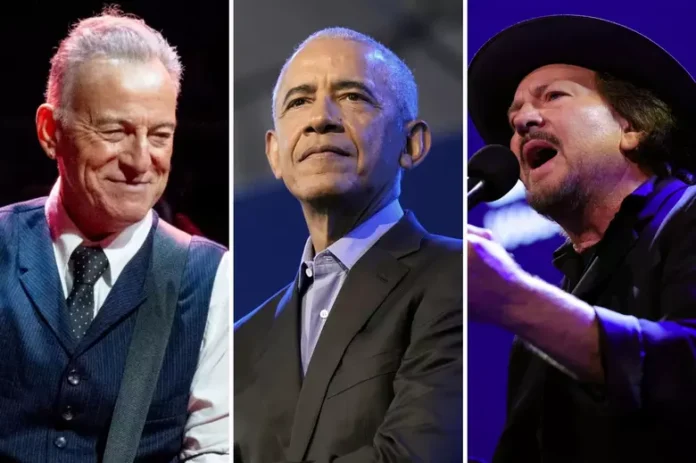

The opening of a presidential library is always more than a ribbon-cutting ceremony. It is a cultural moment, a reflection on history, leadership, public service, and the ideas that helped shape an era. This week, as the Obama Presidential Center officially opens on Chicago’s South Side, the event is being celebrated not only as the launch of a landmark civic institution but as one of the most significant cultural gatherings of 2026. The grand opening ceremony will bring together political leaders, artists, educators, community organizers, and thousands of visitors for a four-day celebration that stretches across the Juneteenth holiday weekend.
For New Jersey, however, the story carries an additional layer of significance.
At the center of the opening festivities is one of the Garden State’s most influential cultural ambassadors. Freehold native Bruce Springsteen will join an extraordinary lineup of performers helping inaugurate the new campus, reinforcing a connection between New Jersey and the Obama legacy that has been developing for nearly two decades.
The Obama Presidential Center arrives after years of planning and construction as a transformative addition to Chicago’s South Side. The sprawling campus represents far more than a traditional presidential library. Designed as a civic and cultural destination, the center combines museum exhibits, educational facilities, public gathering spaces, gardens, athletic facilities, community programming, and expansive public grounds intended to encourage engagement, dialogue, and civic participation.
The opening celebration reflects that broader mission.
The official dedication ceremony features remarks from former President Barack Obama and former First Lady Michelle Obama while bringing together an impressive roster of artists whose work has shaped American culture across multiple generations. Musical performances span genres and eras, from rock and soul to hip-hop, R&B, orchestral music, and global influences.
Yet among all the performers scheduled to appear, none may symbolize the connection between New Jersey and the Obama story more clearly than Bruce Springsteen.
For many Americans, the relationship between Springsteen and Obama has become one of the most visible intersections between music and public life in modern American culture.
Their friendship traces back to Obama’s first presidential campaign in 2008, when Springsteen emerged as one of the campaign’s most prominent supporters. At the time, Springsteen’s endorsement carried special weight. For decades, his music had chronicled the hopes, struggles, frustrations, and resilience of working Americans. His songs frequently explored themes of community, economic opportunity, identity, and the promise of the American experience.
Those themes aligned naturally with many of the messages that defined Obama’s rise to national prominence.
Over the years, the relationship evolved beyond politics.
Their conversations increasingly focused on broader questions about America itself. They discussed history, family, race, class, citizenship, community, and the challenges facing modern democracy. Those conversations eventually became the foundation for the acclaimed podcast series “Renegades: Born in the USA,” which was recorded in part at Springsteen’s Colts Neck property and provided listeners with a uniquely personal look at two public figures exploring the American story from different perspectives.
That collaboration reinforced what many fans already understood.
Springsteen’s influence extends beyond music.
He has become one of the nation’s most important cultural storytellers, using songs, interviews, performances, and public appearances to explore questions that reach far beyond entertainment. His appearance at the Obama Presidential Center dedication is therefore about more than performing songs. It represents the convergence of two public figures whose careers have often centered on understanding the American experience.
For New Jersey residents, seeing Springsteen play such a prominent role in one of the nation’s most important civic events serves as another reminder of the state’s remarkable influence on American culture.
The Garden State has produced an extraordinary number of artists, musicians, writers, performers, innovators, and public figures whose impact extends far beyond state borders. Springsteen remains perhaps the most recognizable example, but he is part of a larger tradition that continues shaping national conversations through music, media, education, and public service.
The timing of the Obama Center opening also creates an interesting convergence of events for New Jersey music fans.
While Chicago hosts the dedication of the Obama Presidential Center, Monmouth University is simultaneously preparing for one of the most significant music-related milestones in New Jersey history. The Bruce Springsteen Archives & Center for American Music is entering a new phase of public engagement, further cementing New Jersey’s role in preserving and celebrating American musical heritage.
Together, these events highlight the growing recognition that music is not simply entertainment. It is a historical record, a cultural force, and often a catalyst for dialogue about identity, community, and social change.
The opening weekend festivities at the Obama Presidential Center reflect that philosophy throughout the campus.
Beginning on Juneteenth, the center transitions from its dedication ceremony into a large-scale public celebration designed to welcome visitors from across the country. Open-air concerts, educational programs, athletic activities, community workshops, family events, gardening initiatives, library programs, and cultural exhibitions transform the campus into an active public gathering space.
The emphasis is on participation rather than observation.
Visitors are encouraged not simply to view exhibits but to engage with ideas. They are invited to contribute reflections, participate in discussions, explore history, and consider how civic engagement continues shaping communities today.
That approach mirrors many of the values long associated with Springsteen’s work.
Throughout his career, Springsteen has consistently emphasized community, connection, and participation. His concerts are known not just for musical performances but for creating a sense of collective experience. Audiences become participants rather than spectators. Stories become shared experiences rather than individual narratives.
It is perhaps fitting that Springsteen’s music will help launch a center built around similar principles.
The opening ceremony’s diverse lineup further reflects the broad cultural vision behind the project. Legendary performers, contemporary artists, community ensembles, and internationally recognized musicians come together to celebrate a campus intended to serve future generations. Their presence signals that the Obama Presidential Center aims to be more than a repository of documents and artifacts. It seeks to become an active cultural institution embedded within the life of its community.
For New Jersey residents watching from afar, the event offers another opportunity to recognize the outsized influence the state continues to have on national culture.
Whether through music, education, innovation, sports, business, or public service, New Jersey regularly produces voices that help shape broader American conversations. Bruce Springsteen’s appearance at the Obama Presidential Center opening serves as one of the latest examples of that influence reaching far beyond state lines.
As the center opens its doors and thousands of visitors gather throughout the Juneteenth weekend, one of the strongest connections between Chicago and New Jersey will be found in the music echoing across the campus. It will be the voice of an artist who emerged from Freehold, chronicled the American experience through decades of songwriting, and continues to represent the Garden State on some of the world’s most important stages.
In many ways, that story reflects the broader story of New Jersey itself.
A place where local roots often grow into national influence, where community experiences become universal stories, and where voices born along the Jersey Shore can ultimately help narrate the history of an entire nation.
















