
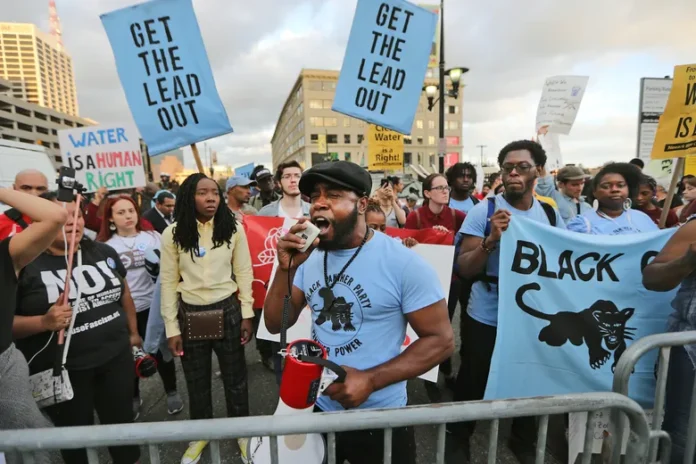

A decade after Newark’s drinking water crisis first made national headlines, the city has completed one of the fastest lead service line replacement programs in the country. A grassroots group born out of a single skeptical question is still making sure nobody gets left behind.
Newark Fixed Its Lead Pipes Faster Than Anyone Expected. The Fight Isn’t Over.
Newark’s drinking water crisis peaked nearly a decade ago, but its legacy still shapes how the city thinks about infrastructure, trust, and who is responsible for making sure both hold up. Like many older East Coast cities, Newark relied for generations on lead service lines, the underground pipes connecting the main water line beneath the street to individual homes. That aging infrastructure became a full blown public health emergency in 2015, when the city adjusted the chemistry of its water treatment process in a way that inadvertently degraded the protective mineral scale lining the interior of those pipes, allowing lead to begin leaching directly into the water supply.
How Bad the Crisis Actually Got
By 2016, testing had grown severe enough that Newark Public Schools ordered 30 school buildings to shut off water fountains and other child accessible outlets rather than risk continued exposure. The following year, Time reported that more than 10 percent of tested Newark homes showed lead levels at least twice the federal action level of 15 parts per billion, the threshold that triggers mandatory action under the EPA’s Lead and Copper Rule. National coverage from ABC, MSNBC, and The New York Times followed, and in 2018 the Natural Resources Defense Council filed a federal lawsuit against the city over Safe Drinking Water Act violations, the same organization that had previously sued the city of Flint, Michigan over its own water crisis. At the height of the emergency, the EPA and city officials distributed thousands of at home water filters and millions of gallons of bottled water to residents, with particular urgency in the Pequannock water service district where contamination ran highest.
A Remediation Program That Became a National Model
What followed the crisis distinguished Newark from many cities that have faced similar contamination. Backed by state funding and a 120 million dollar county bond, the city launched an aggressive program to replace roughly 23,000 lead service lines with safer copper piping, a project initially projected to take eight years. Newark completed the overwhelming majority of that work in just under three years, a pace that has since drawn attention from public health researchers and other municipalities working through their own lead line replacement efforts. The program has not been entirely without setbacks. City officials later discovered that a private contractor hired to handle a subset of roughly 1,500 lines had falsified completion reports without actually finishing the assigned work, prompting local audits and a reminder that even a fast moving, well funded infrastructure program still requires active oversight to function as intended.
The city now operates a Childhood Lead Poisoning Prevention Program that targets high priority blood lead cases and dispatches inspectors to screen homes for lead paint and dust, the other major source of exposure in a city with as much aging housing stock as Newark’s. Both the water crisis and the lead paint hazard trace back to the same underlying reality, that a city built largely before mid century construction standards carries lead risk baked into its infrastructure in more than one form, and that addressing the pipes alone does not fully close the exposure gap for families living in older homes.
The Question That Started a Movement
Much of the community pressure that helped keep the city accountable throughout the crisis traces back to a single skeptical question. In 2018, Newark resident Anthony Diaz found himself wondering why the city was distributing water filters to residents if, as officials had assured him, there was no real problem with the water. Diaz had raised concerns about the lead spike earlier that year while running for Newark City Council, and been told by the sitting mayor not to worry. When the city began handing out filters anyway just months later, the contradiction was enough to push Diaz and a friend, fellow Newark resident Sabre Bee, to hold the first meeting of what would become the Newark Water Coalition at a local church on December 18, 2018.
What started as an informal effort to fact check the city’s public messaging has grown into a genuine community institution. The Newark Water Coalition now operates out of an office on South Orange Avenue in the city’s Central Ward, and treats clean water, food security, and stable housing as a single interconnected ecosystem rather than separate causes. To date, the coalition has distributed more than 500,000 gallons of water, over 500 water filters, and roughly 700,000 pounds of food to residents, alongside free water quality testing kits and lead paint scanning equipment for families and tenants trying to understand their own risk directly rather than relying solely on city assurances.
Water Without the Plastic
One of the coalition’s more technically ambitious projects has been its Water Box initiative, developed in partnership with the technology focused nonprofit 501CTHREE. The Water Boxes are localized filtration kiosks that pull directly from the city’s municipal tap water supply and run it through a three stage filtration process followed by ultraviolet treatment, producing roughly 10 gallons of clean water per minute for residents to fill reusable containers, cutting down on the plastic waste that comes with relying on bottled water as a long term solution. According to 501CTHREE director Jaron Rothkop, water that passes through the full three stage and UV treatment process typically comes out cleaner than what is sold in stores as bottled water, giving residents a genuinely high quality option without the environmental cost of single use plastic.
An Office Built to Be Anything but Sterile
Diaz has been deliberate about how the coalition’s physical space operates, describing most nonprofit offices as sterile environments with a clear boundary between an executive director and the public they serve. At the Newark Water Coalition, that boundary does not exist in any meaningful way. Diaz sits at a desk residents can walk directly up to, and the office doubles as something closer to a community bulletin board than a traditional nonprofit headquarters, with handmade signs reading messages like clean water is a human right and no more lead pipes sharing wall space with causes extending well beyond the coalition’s original water mission.
That breadth is intentional. Diaz has said the coalition’s value system differs deliberately from more conventional nonprofits, and that willingness to speak on issues beyond water, paired with an insistence on remaining accountable directly to the community rather than to funders, has come with real costs. Diaz has acknowledged that the organization’s outspokenness on broader social justice issues has cost it funding opportunities other nonprofits might more easily secure, a trade off he has described as worth making in order to preserve the coalition’s independence and its willingness to talk about any subject as long as it remains accountable to the people it actually serves.
Nearly eight years after that first skeptical question about water filters, Newark’s underlying infrastructure crisis has largely been addressed through one of the more effective municipal lead remediation programs in the country. What Diaz and the volunteers who keep the Newark Water Coalition running argue, consistently and without much ambiguity, is that infrastructure alone was never the whole story, and that a community’s trust in the water coming out of its own taps takes far longer to rebuild than the pipes themselves.
















