
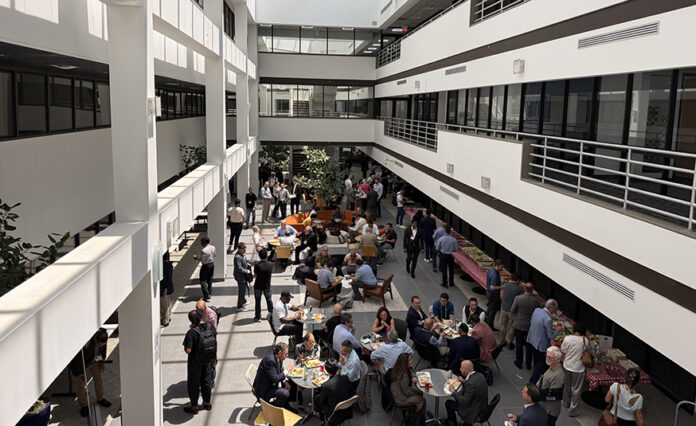

New Jersey’s innovation economy was on full display July 8 at the biannual NJx Venture Summit in Skillman, an event that brought together everyone from high school entrepreneurs pitching cybersecurity software to founders developing next generation nuclear energy platforms, AI powered business tools, and genuinely inventive consumer products. Co-hosted by 1435 Capital Management at the Montgomery Innovation Hub alongside Venture X Skillman, this year’s summit drew 303 registrants, a roughly 30 percent increase in attendance compared to last year’s event, with more than 87 percent of registrants actually turning out on the day itself, according to organizers.
The summit’s core programming featured roughly 40 startup presentations spread across five distinct industry tracks, covering consumer packaged goods, artificial intelligence, health, and broader technology innovation. Beyond the pitches themselves, the day’s agenda included investor panels, keynote presentations, and structured networking opportunities specifically designed to connect founders with venture capital firms, angel investors, and established industry leaders. A genuinely wide range of organizations took part as presenters, including Citrin Cooperman, the New Jersey Economic Development Authority, Startup Grind Princeton, Cogent Connections, the Montgomery Innovation Hub, 1435 Capital, Venture X, and Leader Bank, alongside investor groups and ecosystem partners such as Tech Council Ventures, Techstars, NJ Angels, JumpStart NJ Angel Network, Alumni Ventures, the Harvard Business School Alumni Angels Association, TiE New Jersey, TiE Silicon Valley, Family Office Advisory Services, Pranatech, Aventurine Partners, Builds Bio Plus, and representatives from both Somerset and Middlesex counties.
Ben Jen, managing partner at 1435 Capital, described the ecosystem’s growth as visible not just in raw attendance numbers but in the genuine breadth of who showed up this year, noting a clear increase in the number of startups, investors, and broader ecosystem participants taking part. Jen pointed to that expanding mix, spanning state agencies, financial institutions, angel networks, and venture investors alike, as a clear sign of how much the surrounding innovation environment continues evolving. He framed these kinds of gatherings as genuinely building toward a positive future for the region’s youth while creating real opportunities for startups to experiment with new concepts and potentially grow them into viable, lasting businesses.
Jen pointed directly to ModGuard as a clear embodiment of that vision. The cybersecurity startup was created by Ryan Norouzi and Ryan Soudkhah, two students at Bergen County Technical High School in Paramus, during the NJx AI Summer Hackathon held just weeks before the main summit. The pair built a desktop application capable of deep scanning game modifications and URLs, including files hidden inside game mods, specifically to detect malware before players ever launch a game, addressing a genuine cybersecurity threat facing millions of gamers worldwide. After winning first place at that hackathon, Norouzi and Soudkhah earned the opportunity to pitch their company directly to investors and business leaders at the Venture Summit itself, a genuinely remarkable opportunity for two high school founders. Jen also highlighted the participation of Massachusetts based Leader Bank as evidence of the summit’s expanding regional reach well beyond New Jersey’s own borders.
For entrepreneurs unfamiliar with the event, Jen described the summit’s core value simply as a place built for meaningful connection, whether someone is looking to meet other investors or connect with fellow innovators working through similar challenges.
Among the companies drawing genuine attention throughout the day was ColdSnap, a Massachusetts based company and 1435 Capital portfolio holding. The company has built a countertop appliance capable of producing frozen treats on demand using single serve pods, an idea founder Matt Fonte traced back to bedtime conversations with his daughters, during which the family would regularly invent new product ideas together. Fonte described how one such conversation led his daughter to suggest inventing a machine to make ice cream at home, and after he pointed out that such machines already existed, she simply asked why they didn’t have one themselves, a question that eventually evolved into what Fonte now describes as a Keurig for ice cream, designed specifically to eliminate the hassles associated with traditional home ice cream makers. The company is currently preparing to scale production at its 45,000 square foot factory and production facility in Billerica, Massachusetts. Fonte explained that his conviction the idea could become genuinely significant stemmed from a simple combination of factors, people’s enduring love of ice cream and his own experience navigating patent protection, giving him a real opportunity to build defensible technology if the concept could be pulled off successfully. The company is now on its fifth machine version and holds 127 issued patents, with Fonte now focused entirely on commercial scaling as the business moves toward what he believes could become a genuinely major consumer product. ColdSnap ran live demonstrations throughout the day, producing on demand ice cream, frozen lattes, protein shakes, and frozen cocktails for attendees to sample directly.
At the opposite end of the innovation spectrum, Princeton based Defense Physics Laboratory exhibited its own genuinely ambitious project, the Ultralight Modular Reactor, a mobile, subcritical nuclear power platform designed to deliver continuous power in locations where grid electricity is unavailable, delayed, or otherwise impractical to install. With surging electricity demand and grid capacity concerns dominating conversations across numerous industries, the company has positioned itself specifically around providing power for projects and missions that genuinely cannot afford to wait for traditional infrastructure. CEO Howard Oh described the platform during his pitch as a patent pending nuclear power system built specifically for deployment beyond the reach of the existing grid, addressing what he sees as a fundamental mismatch between the country’s ambitious energy demands over the coming decade and its current readiness to meet them. Oh explained that while national nuclear initiatives aiming to build and expand traditional nuclear power plants represent an important long term direction, that kind of infrastructure remains decades away from completion, leaving a genuine gap his company aims to fill with fast deployable power that doesn’t require years of construction before it can start operating. Oh emphasized that the platform’s mobility allows it to be transported directly to wherever power is needed, spanning applications from construction sites and critical infrastructure to military missions requiring resilient, mobile energy sources, describing the company’s mission simply as solving the gap between today’s power demands and tomorrow’s energy infrastructure.
Artificial intelligence emerged as a defining theme throughout the day’s broader programming as well. During his presentation titled The AI Adoption Journey, MTap and Hureka Technologies founder Roopak Gupta urged businesses to think beyond using AI simply as a tool for automating existing tasks, encouraging attendees instead to view artificial intelligence adoption as a genuine long term business transformation. Gupta outlined a progression he described as moving from AI assisted to AI enabled and finally to AI native, noting that even a startup typically needs around 12 months to fully embed that kind of process transformation, with more established companies generally requiring considerably longer given their existing organizational complexity. Gupta also pushed business leaders to reframe their thinking away from pure cost savings and toward genuine growth opportunities, challenging them to consider entirely new capabilities AI might unlock rather than simply using it to do existing work more cheaply.
The summit’s keynote address came from Sam Caucci, founder and CEO of Newark based 1Huddle, whose presentation, titled Winning the Talent Game, challenged business leaders to rethink workforce development in an era increasingly shaped by automation and artificial intelligence. Drawing on his own experience working with major employers, Caucci shared the story of a longtime hotel housekeeping employee who was ultimately promoted after leadership discovered she had independently mastered restaurant operations entirely through the company’s own training platform, without anyone specifically directing her to do so. Caucci argued that identifying this kind of hidden talent requires companies to look well beyond their own leadership ranks, urging leaders to actively seek out and develop the capability already present throughout their entire workforce rather than assuming top performers exist only at the top of the org chart. He framed tomorrow’s highest performing organizations as those that succeed not simply by doing more with fewer employees, but by genuinely excelling at identifying the talent they already have, inventorying the full mix of skills present across their teams, and repositioning that talent effectively as roles and business needs continue to evolve.
Taken as a whole, the NJx Venture Summit reflected considerably more than a simple startup showcase. By bringing entrepreneurs, investors, corporations, universities, government agencies, and service providers together under a single roof, the event demonstrated clearly that successful startups rarely emerge from founders working in isolation, but rather from the strength and depth of the surrounding ecosystem supporting them. From two high school students building cybersecurity software to a nuclear physics startup addressing genuine gaps in grid infrastructure, this year’s summit offered a genuinely wide ranging snapshot of exactly how much innovative energy New Jersey’s growing startup ecosystem currently has to offer.
















