
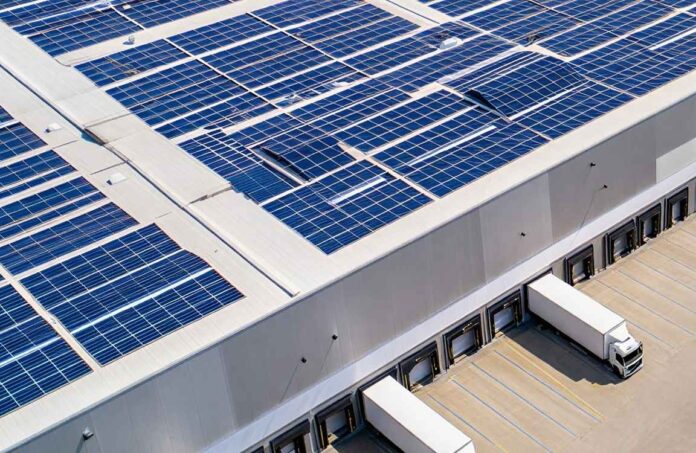

I just read an op-ed published by ROI-NJ, written by David Greek, chair of Circulate NJ and managing partner of Greek Real Estate Partners, and before even getting into the finer points of his argument, one idea jumped out immediately: New Jersey should be mandating that data centers offset the costs they create by helping provide cheaper power to the communities absorbing them. It’s a genuinely brilliant idea, and it’s sitting right there in plain sight. Every one of these buildings has acres of completely flat roof space that sits exposed to direct sun all day long, basically baking like it’s the desert, doing absolutely nothing. That’s the trade New Jersey should be making. Let data centers in if a town wants them, fine, but make them help lower power costs for the surrounding area by putting solar up there instead of leaving that roof space to go to waste. That’s the whole idea, and it’s genuinely smart policy.
Greek’s actual op-ed isn’t about data centers directly. It’s making the case for something already happening quietly across New Jersey, warehouse and industrial rooftop solar, and once you read through his argument, it becomes obvious why applying that same logic to data centers specifically makes so much sense.
According to Greek, commercial rooftops have become a real new layer of distributed energy infrastructure in New Jersey, with solar projects already up and running on buildings from Gloucester to Perth Amboy to Ocean Township. He argues these rooftop projects bring power generation physically closer to where electricity actually gets used, letting new capacity come online faster than most traditional energy projects allow, while also creating a new source of long term income for the commercial property owners hosting the panels. He points to New Jersey’s Community Solar Energy Program, recently expanded to allow more projects, as the vehicle making this possible, and makes the case that rooftop solar has a structural advantage almost nothing else in the energy world has: it can go up fast, on buildings that already exist, without new land use fights or major grid construction. In a state as land constrained as New Jersey, Greek argues, that makes commercial rooftops one of the most practical near term ways to add real energy supply.
Greek also cites real numbers behind the benefit to residents. He points to Solar Landscape, the Asbury Park headquartered solar developer he describes as the nation’s leading community solar company, reporting that more than 15,300 low and moderate income households across New Jersey are already benefiting from the program, saving an estimated $427 a year on their electricity bills based on current rates. On the business side, Greek lays out how the model actually works: developers lease the rooftop space from building owners, build and operate the solar systems themselves, sell the power back to the grid, and pay the property owner long term rent for the space, all at no upfront cost to the owner. He writes that his own firm, Greek Real Estate, has worked directly with developers like Solar Landscape on exactly this kind of deal, describing it as pure added income on an asset his company already owns, with zero operational burden on his team or his tenants, and an increase in net operating income of up to 5 percent.
The scale Greek describes is the part that really makes the case. New Jersey’s current program allows for up to three gigawatts of new community solar capacity, which he equates to roughly 245 million square feet of rooftop space statewide. And yet, by his own account, only about 5 percent of viable rooftops in New Jersey currently host solar. Ninety five percent of that opportunity is just sitting there right now, untouched.
That’s exactly the gap worth pointing back to the data center conversation. Towns across New Jersey are already fighting these battles openly, banning data centers outright or demanding they pay their own way on the grid, precisely because of the strain these facilities put on local electricity capacity and rates. Greek’s op-ed makes clear the fix for that strain, sun exposed flat roof space turned into real generation capacity, is already proven, already working, and already sitting mostly untapped across the state’s warehouse corridor. Data centers are, if anything, an even more obvious candidate for this than a typical warehouse. They’re large, low rise, flat roofed buildings by design, and they’re the exact facilities driving the grid strain everyone is already upset about. If a town is going to allow one in, requiring it to host rooftop solar and help offset the very costs it’s creating isn’t some radical ask. It’s just applying the model Greek already lays out to the one class of building that arguably needs to be doing it the most.
Greek closes his own piece by arguing that New Jersey’s industrial sector, long known for supporting the state’s economic growth, is now becoming a genuine piece of its energy future too, and that the rooftop opportunity sitting untapped across the state needs to be acted on now rather than later. Read that argument next to the ongoing data center fights playing out in towns across New Jersey, and the connection writes itself. The rooftops are already there. The sun is already free. The only thing missing is the requirement.
















