
For decades, the idea of owning a vacation home represented a particular version of the American dream. Whether it was a beachfront condominium along the Jersey Shore, a seasonal retreat near a lake, or a second residence purchased as a long-term family investment, vacation-home ownership served as both a lifestyle aspiration and a financial milestone. In New Jersey, where coastal communities, resort destinations, and seasonal tourism have long played an important role in local economies, second-home ownership has traditionally been a meaningful component of the broader real estate market.
Today, however, the landscape looks very different.
New data examining vacation-home purchasing trends across the United States reveals that New Jersey has experienced a dramatic contraction in second-home mortgage activity since the height of the pandemic-era housing boom. Between 2021 and 2025, second-home mortgage originations in New Jersey fell by 61 percent, one of the most significant declines recorded during a period that has fundamentally reshaped how Americans think about vacation property ownership.
The findings illustrate more than a cooling segment of the housing market. They offer a revealing look into changing consumer priorities, affordability challenges, evolving travel habits, and the broader economic pressures influencing real estate decisions throughout the Garden State and across the nation.
The decline follows an unprecedented period in American housing history. During the pandemic years, historically low interest rates, increased remote work flexibility, and changing lifestyle preferences fueled extraordinary demand for vacation homes. Buyers who suddenly found themselves working from anywhere sought properties near beaches, mountains, lakes, and resort destinations. Second homes became both personal retreats and alternative workplaces.
Nationally, vacation-home purchases financed through mortgages reached 257,549 transactions in 2021. By 2025, that number had fallen to just 88,158. The resulting 65.8 percent decline represents one of the most significant reversals in modern vacation-property history.
New Jersey’s numbers closely mirror that national trend.
In 2021, New Jersey recorded 6,680 second-home mortgage originations. By 2025, that number had dropped to 2,605. The loss of 4,075 transactions translates to a 61 percent decline in vacation-home purchasing activity, a dramatic pullback that reflects changing economic realities facing prospective buyers.
Yet the story becomes even more interesting when examining the underlying economics behind the decline.
Vacation-home purchases occupy a unique position within the housing market because they are almost entirely discretionary. Unlike primary residences, which families generally need regardless of economic conditions, second homes are optional purchases. Because of this distinction, the vacation-home sector often serves as an early indicator of broader shifts in consumer confidence and financial flexibility.
When buyers feel optimistic about their financial future, discretionary purchases tend to increase. When uncertainty rises, those purchases are often among the first expenses reconsidered.
Higher mortgage rates have been a major factor.
The low-rate environment that helped fuel the 2020 and 2021 buying surge no longer exists. Borrowing costs have risen substantially compared to pandemic-era levels, dramatically changing affordability calculations. Even affluent buyers who might have previously considered purchasing a second residence are now facing significantly higher monthly carrying costs.
At the same time, property values remain elevated across many desirable vacation destinations. Rather than seeing widespread price corrections that might offset higher interest rates, many leisure-oriented housing markets continue to command premium valuations.
For New Jersey buyers, this reality is particularly striking.
The median value of newly mortgaged second homes in New Jersey now stands at approximately $925,000, nearly double the national median of $495,000. That figure highlights just how expensive vacation-home ownership has become in many Garden State markets, particularly in coastal communities and highly desirable seasonal destinations.
The state’s second-home market continues to occupy a meaningful position within the broader housing ecosystem. Approximately 3.3 percent of all mortgage originations in New Jersey are tied to second homes, slightly above the national figure of 2.6 percent. Likewise, 3.4 percent of New Jersey housing stock is categorized as seasonal, recreational, or occasional-use property, closely mirroring national averages.
Yet even as traditional vacation-home purchases decline, another trend is accelerating.
Consumers have not abandoned the desire for leisure travel, vacation experiences, or access to resort destinations. Instead, many appear to be seeking alternative ownership models that provide flexibility while reducing financial exposure.
This shift becomes evident when examining the performance of the timeshare industry.
While vacation-home purchases have fallen sharply, timeshare-related activity has moved in the opposite direction. Following the disruption experienced during the pandemic’s early stages, the sector has staged a remarkable recovery.
Timeshare sales volume nationally reached a low point of approximately $4.9 billion in 2020. By 2024, that figure had more than doubled, climbing to $10.5 billion. Rental revenue has experienced even stronger growth, increasing from $1.3 billion in 2020 to $3.2 billion in 2024.
Those gains suggest many consumers continue to prioritize travel and vacation access but are increasingly reluctant to take on the substantial financial commitments associated with owning a second residence outright.
For many households, timeshares, fractional ownership arrangements, and short-term rental options provide a middle ground. They offer access to desirable destinations without requiring buyers to assume the full responsibilities of ownership, including maintenance costs, property taxes, insurance expenses, and long-term market risk.
The geographic patterns emerging within these trends are equally revealing.
The same destinations that historically attracted large numbers of second-home buyers are now experiencing some of the sharpest declines in traditional vacation-property purchases.
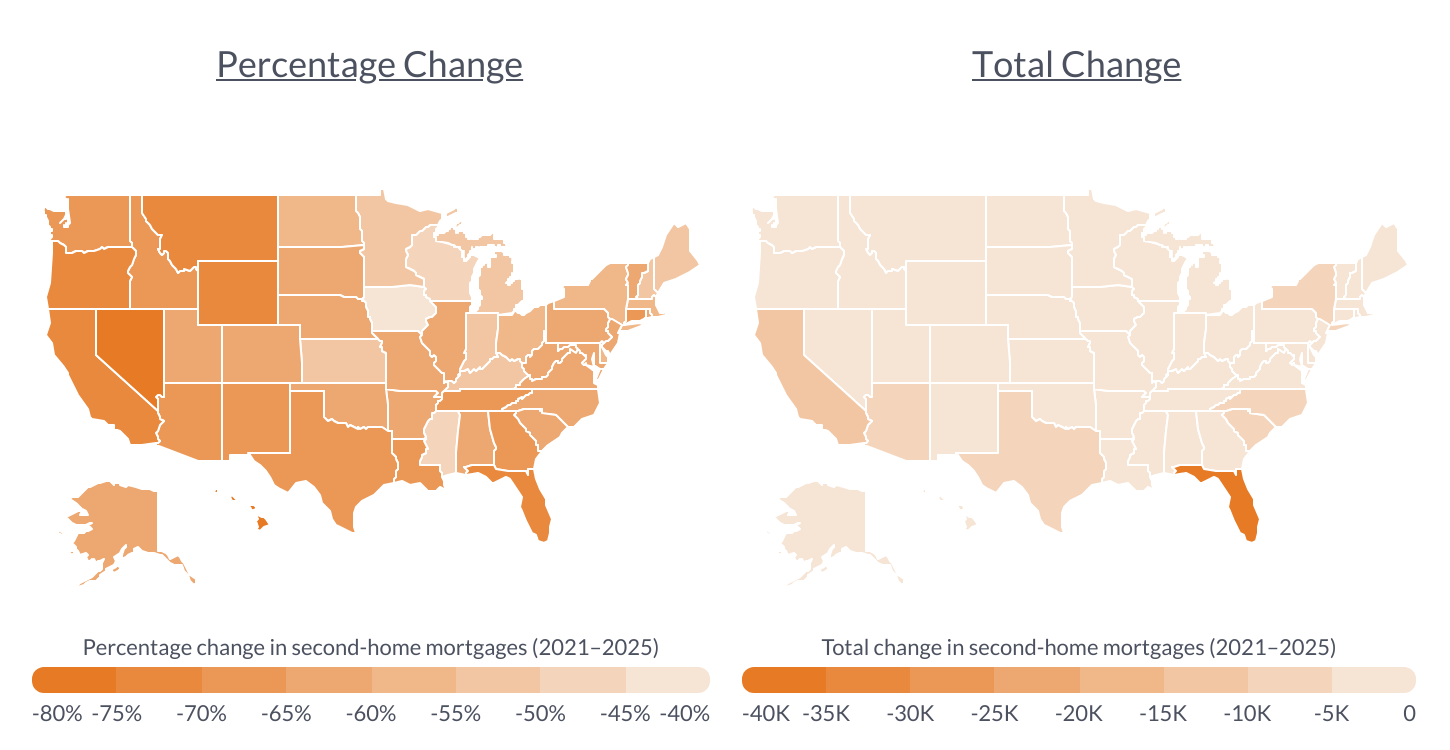
Florida, which remains the nation’s largest vacation-home market, recorded a decline of more than 38,000 second-home mortgage purchases between 2021 and 2025. California, Texas, and North Carolina also posted significant reductions.
On a percentage basis, however, several tourism-dependent states experienced even steeper contractions. Nevada led the nation with a 78.3 percent decline, followed closely by Hawaii at 77.8 percent and Wyoming at 74.5 percent.
At the metropolitan level, many of America’s most recognizable leisure destinations have seen dramatic reductions in activity. Austin, Las Vegas, Orlando, Miami, Naples, Breckenridge, and Kahului all recorded substantial declines as buyers reassessed affordability and investment priorities.
Interestingly, many of these same destinations remain among the most sought-after locations for timeshare ownership.
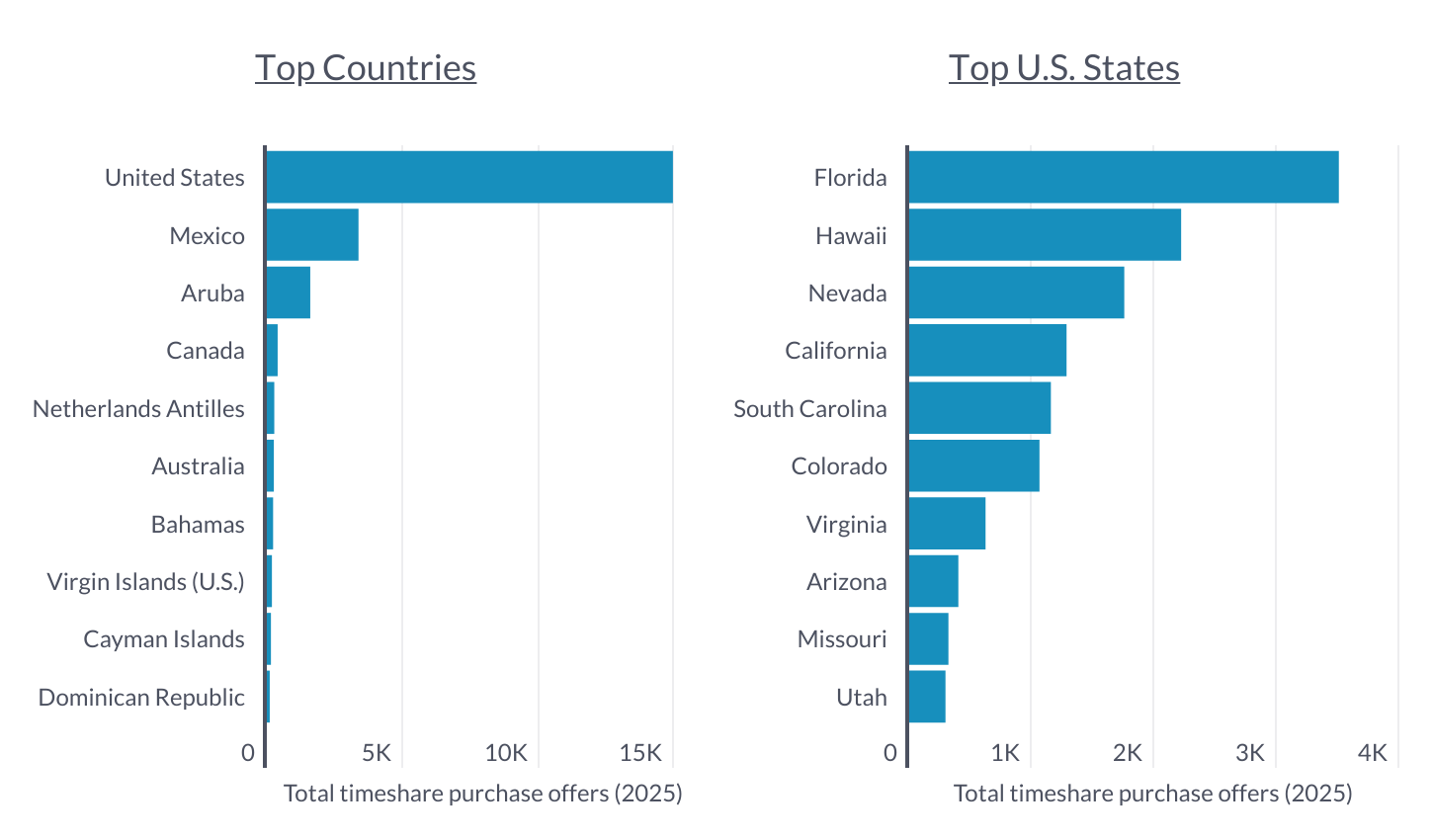
Within the United States, Florida continues to lead timeshare purchase activity, followed by Hawaii and Nevada. Internationally, destinations such as Mexico and Aruba remain especially popular among vacation-focused consumers.
The divergence between vacation-home ownership and vacation-access models reflects a broader evolution in consumer behavior. Buyers increasingly appear focused on flexibility, mobility, and reduced long-term obligations.
For New Jersey, these trends carry important implications.
Communities that rely heavily on seasonal residents have historically benefited from second-home ownership through property tax revenue, local spending, restaurant activity, retail purchases, service contracts, and tourism-related investment. While seasonal visitation remains strong, changing ownership patterns could influence how these communities grow and develop over the coming decade.
Real estate professionals, developers, hospitality operators, and local officials will likely continue monitoring these trends closely. The future may not necessarily involve fewer visitors or reduced tourism demand. Instead, it may involve a different relationship between consumers and vacation properties altogether.
The Garden State remains one of America’s most desirable destinations for seasonal living, offering access to beaches, recreation, cultural attractions, dining, entertainment, and proximity to major metropolitan markets. Those advantages have not disappeared.
What has changed is the financial equation.
The extraordinary conditions that fueled the vacation-home boom of 2021 have given way to a market defined by higher borrowing costs, elevated property values, and increased caution among consumers. As a result, New Jersey’s second-home market is entering a new chapter—one characterized less by rapid acquisition and more by careful evaluation of value, flexibility, and long-term financial commitment.
The 61 percent decline in vacation-home purchases is therefore more than a real estate statistic. It represents a broader shift in how Americans approach leisure, investment, travel, and property ownership. For New Jersey, a state deeply connected to tourism and seasonal living, understanding that transformation may prove essential to anticipating where the market goes next.
Here is a summary of the data for New Jersey:
- Percentage change in second-home mortgages (2021–2025): -61.0%
- Total change in second-home mortgages (2021–2025): -4,075
- Total second-home mortgage originations (2025): 2,605
- Total second-home mortgage originations (2021): 6,680
- Second-home share of total mortgage originations: 3.3%
- Median value of newly mortgaged second homes: $925,000
- Share of housing used for seasonal, recreational, or occasional use: 3.4%
For reference, here are the statistics for the entire United States:
- Percentage change in second-home mortgages (2021–2025): -65.8%
- Total change in second-home mortgages (2021–2025): -169,391
- Total second-home mortgage originations (2025): 88,158
- Total second-home mortgage originations (2021): 257,549
- Second-home share of total mortgage originations: 2.6%
- Median value of newly mortgaged second homes: $495,000
- Share of housing used for seasonal, recreational, or occasional use: 3.3%