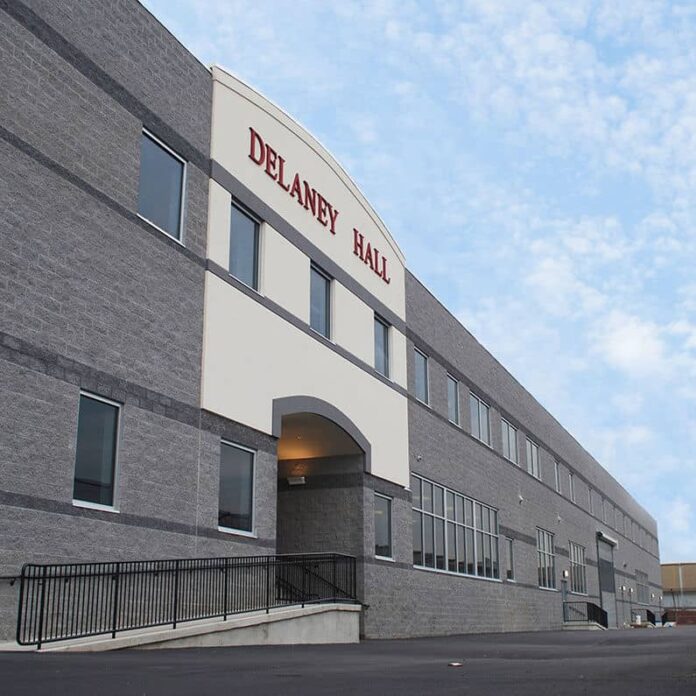

As protests continue outside Delaney Hall in Newark and political leaders battle over the future of one of the East Coast’s largest immigration detention facilities, a familiar argument has increasingly surfaced across social media, cable news, and political commentary.
The claim is straightforward: if Democrats oppose Delaney Hall today, they must explain why the Obama administration utilized the facility beginning in 2011.
On the surface, the argument appears compelling. Federal immigration authorities did, in fact, begin housing immigration detainees at Delaney Hall during Barack Obama’s presidency. That part is not disputed.
What is often omitted, however, is the history that existed long before federal immigration officials ever arrived at the facility.
The current debate frequently treats Delaney Hall as though it was created specifically as an immigration detention center. It was not. Long before ICE detainees were housed there, Delaney Hall operated as a rehabilitation-focused halfway house and community reentry facility that had already been built, approved, financed, and commercialized through New Jersey’s correctional infrastructure.
That distinction sits at the center of the modern controversy.
When federal immigration authorities began utilizing Delaney Hall in 2011, they were not constructing a new detention center in Newark. They were leasing existing capacity inside a facility that had already been operating for years under private management. The building itself was not created by the Obama administration. The approvals that allowed it to exist were not created by the Obama administration. The ownership structure surrounding the facility was not created by the Obama administration.
The facility’s origins stretch back years earlier.
When Delaney Hall opened on Doremus Avenue, it was named after Geraldine O. Delaney, a respected pioneer in addiction treatment and rehabilitation services. The facility was envisioned as a low-security rehabilitation and transitional housing operation designed to help individuals prepare for reintegration into society.
Its design reflected that mission.
Unlike traditional prisons built around cell blocks, hardened security infrastructure, and long-term incarceration, Delaney Hall was structured as a campus-style halfway house emphasizing treatment, counseling, supervision, and community reentry. Staff members functioned more as counselors and case managers than correctional officers. The facility’s stated purpose centered on rehabilitation rather than detention.
Over time, however, the facility’s role evolved.
As overcrowding pressures increased throughout New Jersey’s correctional system, Delaney Hall became part of a broader network of facilities used to house increasingly complex populations. What began as a rehabilitation-oriented operation gradually became integrated into larger correctional and detention systems serving county, state, and eventually federal needs.
At the center of that evolution was Community Education Centers, commonly known as CEC.
The company became one of the most influential private correctional and reentry operators in New Jersey. Through contracts with state, county, and federal agencies, CEC built a substantial footprint across the state while expanding its influence within correctional, rehabilitation, and community reentry programs.
The company’s growth also placed it squarely within New Jersey’s political landscape.
Among CEC’s most prominent executives was William “Bill” Palatucci, longtime law partner, close political adviser, and campaign chairman for former Governor Chris Christie. As Christie rose through New Jersey politics, CEC simultaneously expanded its presence throughout the state’s correctional infrastructure, receiving significant government contracts and becoming deeply embedded within the public-private partnerships that increasingly characterized correctional services.
By the time federal immigration authorities began seeking additional detention capacity in 2011, Delaney Hall was already an established facility operating within that system.
Federal officials needed bed space.
Delaney Hall had bed space available.
That reality became the foundation for the facility’s first immigration detention contract.
The distinction matters because it fundamentally changes the narrative often presented today. The debate is not simply about whether Obama-era ICE utilized Delaney Hall. The debate is about what Delaney Hall actually was when that occurred and how dramatically the facility has changed since then.
Supporters of the current operation frequently cite the Obama administration’s use of Delaney Hall as evidence that criticism of the facility is politically selective. Critics counter that such comparisons ignore the facility’s transformation over the past decade and a half.
Their argument centers on scale, purpose, and operational mission.
Under the Obama administration, Delaney Hall functioned primarily as a leased detention and processing site within a facility that had originally been developed as a rehabilitation and halfway-house operation. Today, Delaney Hall operates under a reported long-term federal agreement worth approximately $1 billion over fifteen years and serves as one of the most significant immigration detention centers on the East Coast.
For critics, that distinction is impossible to ignore.
The facility at the center of today’s protests is not simply the same operation that existed in 2011. It represents the culmination of decades of political decisions, corporate acquisitions, government contracts, and evolving federal priorities that gradually transformed a rehabilitation-focused facility into one of the most controversial detention centers in the country.
The next major turning point arrived in 2017.
That year, The GEO Group, one of the largest private prison and detention operators in the United States, acquired Community Education Centers in a transaction valued at approximately $360 million. Through that acquisition, GEO inherited Delaney Hall and thousands of additional beds nationwide, instantly expanding its footprint within correctional, detention, and community reentry operations.
For GEO, Delaney Hall represented a uniquely valuable asset.
Located near Newark Liberty International Airport, the facility offered logistical advantages for federal transportation operations while also providing an existing physical infrastructure that eliminated the need for controversial new construction. GEO inherited a functioning facility that had already been approved and developed years earlier.
That acquisition would eventually position Delaney Hall for its most significant transformation yet.
Following periods of reduced activity and changing federal priorities, immigration detention needs expanded dramatically. Federal authorities ultimately awarded GEO a long-term contract that transformed Delaney Hall into a cornerstone of modern immigration enforcement operations in the Northeast.
That contract fundamentally altered public perception of the facility.
What had once been known primarily as a rehabilitation and reentry center became synonymous with large-scale immigration detention. Protests intensified. Lawsuits followed. Elected officials demanded access. Advocacy organizations raised concerns about conditions and oversight. Federal officials defended the facility’s continued operation as a necessary component of immigration enforcement.
Today, Delaney Hall sits at the center of overlapping debates involving immigration policy, private prison corporations, state authority, federal authority, local oversight, public accountability, and the role of government contractors within public systems.
Yet amid the political rhetoric, one fact remains clear.
Delaney Hall did not begin as the facility people are debating today.
Its history stretches far beyond any single administration, any single contract, or any single political talking point. Understanding that history does not resolve the current debate, but it does provide essential context for understanding how a rehabilitation-focused facility evolved into one of the most consequential flashpoints in New Jersey politics.