

For residents of New Jersey, hurricane season has become more than a weather forecast. It has become a yearly exercise in preparation, awareness, and understanding that even storms hundreds of miles offshore can reshape beaches, flood communities, damage infrastructure, and disrupt daily life. As meteorologists continue to analyze conditions heading into the heart of the 2026 Atlantic hurricane season, one phrase is appearing frequently in forecasts and climate discussions: El Niño.
The naturally occurring climate pattern, driven by unusually warm ocean temperatures across the equatorial Pacific Ocean, is expected to play a significant role in shaping weather patterns across the globe during the coming months. For the Atlantic Basin, that influence is generally viewed as favorable because El Niño tends to suppress tropical storm development and reduce overall hurricane activity.
The headline sounds encouraging. Forecasts suggest a quieter Atlantic season than what many coastal residents have experienced in recent years. Yet weather experts continue to stress a critical point that often gets lost behind seasonal projections: fewer storms do not necessarily mean less danger.
For New Jersey, the lessons of the past decade have made that distinction painfully clear.
A Below-Normal Forecast Does Not Mean a Safe Season
Federal forecasters are projecting a greater likelihood that the 2026 Atlantic hurricane season will finish below long-term averages. Current outlooks indicate approximately a 55 percent probability of below-normal activity across the Atlantic Basin, with expectations for fewer named storms, hurricanes, and major hurricanes compared to a typical year.
While an average Atlantic season historically produces around 14 named storms, seven hurricanes, and three major hurricanes, current projections suggest totals could fall below those benchmarks. At first glance, that appears to be welcome news for coastal communities from Florida to New England.
The reality, however, is considerably more nuanced.
Hurricane seasons are not judged by how many storms form. They are remembered by where those storms go.
One landfalling hurricane can define an entire season. One storm can cause billions of dollars in damage, alter shorelines, flood neighborhoods, and leave lasting impacts on communities for years. New Jersey understands that reality better than most states.
The state does not require a direct hit from a major hurricane to experience significant impacts. Coastal flooding, beach erosion, dangerous surf, storm surge, infrastructure damage, and inland flooding can all occur from storms that remain well offshore or weaken before arrival.
That reality is why emergency management officials continue encouraging preparedness regardless of seasonal outlooks.
How El Niño Changes the Hurricane Equation
To understand why forecasters expect a quieter Atlantic season, it helps to understand how El Niño affects atmospheric circulation.
At its core, El Niño is a warming of surface waters across portions of the tropical Pacific Ocean. While that warming occurs thousands of miles from New Jersey, it triggers a chain reaction that influences weather patterns around the world.
One of the most important consequences involves upper-level winds across the Atlantic Basin.
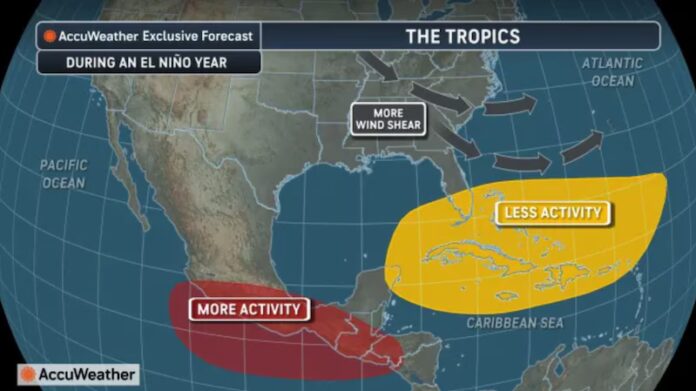
During El Niño years, stronger winds often develop high in the atmosphere over the Caribbean Sea and tropical Atlantic. Meteorologists refer to this phenomenon as vertical wind shear.
Wind shear occurs when wind speed or wind direction changes significantly between different levels of the atmosphere. Tropical systems thrive when the atmosphere remains relatively stable from top to bottom. Hurricanes are essentially giant heat engines powered by rising warm, moist air. When strong wind shear is present, it disrupts that process.
Instead of developing vertically into organized storm structures, tropical disturbances become tilted, fragmented, and weakened. The stronger upper-level winds act almost like a giant atmospheric mixer, preventing storms from developing the symmetry required to intensify.
El Niño also promotes areas of sinking air across portions of the Atlantic Basin. Because tropical systems depend on rapidly rising air to fuel thunderstorms and strengthen circulation, sinking air creates an environment that is less favorable for development.
Together, these factors help explain why El Niño years often produce fewer hurricanes.
The Pacific Tradeoff
Weather patterns rarely create winners without creating challenges elsewhere.
While El Niño tends to suppress Atlantic hurricane activity, it often has the opposite effect across the Pacific Ocean. Warmer waters and altered atmospheric circulation can contribute to increased tropical cyclone activity in portions of the eastern and central Pacific.
This raises risks for areas including Hawaii, Mexico, and portions of Asia that may face heightened threats from stronger typhoons and hurricanes during active Pacific seasons.
The interconnected nature of global weather systems serves as a reminder that climate patterns do not eliminate risk. They simply redistribute it.
Why New Jersey Cannot Afford Complacency
Perhaps the most important lesson for New Jersey residents is that seasonal hurricane forecasts describe overall activity, not local impacts.
History offers numerous examples of relatively quiet hurricane seasons producing devastating storms.
One of the most frequently cited examples remains Hurricane Andrew in 1992. That season was considered relatively inactive by historical standards, yet Andrew became one of the most destructive hurricanes in American history.
The lesson remains relevant today.
Forecasts can estimate the number of storms likely to form, but they cannot determine months in advance which storms will develop, where they will travel, or whether they will impact densely populated coastlines.
For New Jersey, geographic location creates additional vulnerabilities.
The state’s coastline faces unique exposure to storms approaching from the south, southeast, and offshore Atlantic waters. The shape of the coastline, combined with densely developed barrier islands and heavily populated coastal communities, means even moderate storms can generate significant impacts.
In many cases, flooding and erosion become larger concerns than direct wind damage.
Coastal communities continue investing heavily in resiliency projects, beach replenishment efforts, dune restoration programs, flood mitigation initiatives, and infrastructure improvements designed to strengthen defenses against future storms. Yet even with those investments, the state’s vulnerability remains significant.
Warm Atlantic Waters Add Another Variable
Complicating the forecast picture is the continued presence of unusually warm Atlantic Ocean temperatures.
Warm ocean water serves as the fuel source for tropical cyclones. Even during El Niño years, elevated sea surface temperatures can provide substantial energy for storm development when atmospheric conditions briefly become favorable.
Meteorologists frequently point to this interaction as one of the reasons seasonal forecasts carry uncertainty.
While wind shear may suppress many storms, a tropical system that manages to enter a pocket of lower shear over exceptionally warm water can strengthen rapidly. This process, known as rapid intensification, has become an increasingly important focus of hurricane forecasting over the last decade.
As a result, forecasters remain cautious about interpreting a quieter seasonal outlook as a guarantee of reduced risk.
What Matters Most for the Jersey Shore
For many residents and visitors, hurricane season is often viewed through the lens of direct landfalls. Yet some of the most significant impacts to New Jersey occur from storms that never officially strike the state.
Powerful offshore systems can generate prolonged periods of rough surf, coastal flooding, beach erosion, dangerous rip currents, and elevated tides. Barrier islands can experience significant damage even when a hurricane remains hundreds of miles offshore.
Recent years have demonstrated how tropical systems can influence the Jersey Shore through indirect effects long before or after a storm’s closest approach.
For tourism-dependent communities, these impacts can affect local economies, beach access, infrastructure maintenance, and public safety planning throughout the summer and fall.
Preparing for the Season Ahead
As New Jersey moves deeper into the 2026 hurricane season, the message from meteorologists remains consistent: appreciate the favorable aspects of the forecast without becoming complacent.
El Niño appears likely to reduce the overall number of storms that develop across the Atlantic Basin. That is meaningful and encouraging news. Fewer storms statistically reduce opportunities for major impacts.
At the same time, New Jersey’s experience has repeatedly shown that seasonal storm counts do not determine local outcomes.
What ultimately matters is whether a single storm finds the right combination of warm water, favorable atmospheric conditions, and a track that brings it toward vulnerable coastlines.
For a state with more than 130 miles of Atlantic coastline, extensive barrier island communities, and millions of residents and visitors who live, work, and vacation near the water, preparedness remains essential regardless of whether forecasts call for eight storms or eighteen.
The 2026 hurricane season may indeed prove quieter than average. El Niño may successfully suppress much of the tropical activity forecasters typically monitor each year. Yet as every coastal resident understands, hurricane seasons are not remembered for the storms that never formed.
They are remembered for the ones that did.
For New Jersey, that reality means vigilance remains just as important as ever, even during a year when the Atlantic appears poised to take a slightly calmer path.
















