
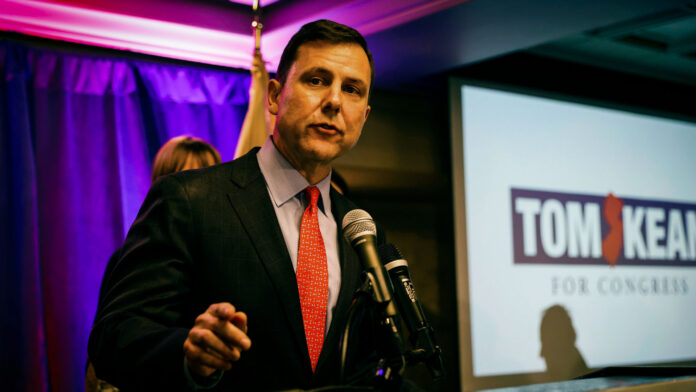

For much of his political career, Congressman Tom Kean Jr. has benefited from something increasingly rare in modern American politics: an ability to command influence while revealing relatively little about himself. That approach helped define his rise through New Jersey politics, from the State Legislature to leadership roles within the Republican Party and ultimately to representing New Jersey’s highly competitive 7th Congressional District in Washington. Now, however, as Kean prepares for an expected return to public life on June 30 following an extended absence related to an undisclosed medical issue, he finds himself facing a level of scrutiny unlike anything he has encountered before.
The attention surrounding Kean’s return is not simply about his health. It is also about the political environment in which he serves. New Jersey’s 7th Congressional District remains one of the most closely watched battleground districts in the country, a place where every development is analyzed through both political and electoral lenses. In a district that consistently attracts national attention and significant campaign spending, the absence of its representative inevitably generated questions. The anticipated return of Kean now presents another question entirely: how will he address those concerns, and what will his reemergence reveal about his approach to public engagement moving forward?
The discussion surrounding Kean’s political style has become almost as significant as the medical absence itself. While political observers often describe him as reserved, that characterization does not fully capture the evolution of his public persona. Long before he arrived in Congress, Kean developed a reputation in New Jersey politics as someone who could move comfortably through public events, local gatherings, and party functions. He was viewed as approachable, particularly during his years in the Legislature when he served first in the Assembly and later in the State Senate. Those who interacted with him during that period frequently recall a politician who appeared at ease in public settings and willing to engage in unscripted conversations.
That image has gradually shifted over the last several election cycles. Beginning with his first congressional campaign and continuing through subsequent races, Kean’s political operation adopted a noticeably more controlled approach. Public appearances became more structured. Media access became more limited. Events that traditionally might have welcomed broad press coverage often became tightly managed affairs. Supporters argue that such caution reflects the realities of modern politics, where every statement can instantly become national news and where political campaigns increasingly prioritize message discipline. Critics, however, contend that the strategy has created an unnecessary distance between the congressman and both constituents and journalists.
The issue of accessibility has surfaced repeatedly throughout Kean’s congressional tenure. Questions about public town halls, open forums, and unscripted constituent interactions have become recurring themes in discussions about his representation of the district. While many elected officials carefully manage their public schedules, the absence of traditional town hall meetings has generated particular attention because of the competitive nature of the district itself. Voters in swing districts often expect greater visibility from their representatives, particularly during periods of national uncertainty and political polarization.
The circumstances surrounding Kean’s recent absence have amplified those concerns. For months, information about his condition remained limited, fueling speculation and prompting calls for greater transparency. Reports now indicate that the congressman intends to provide additional details regarding his health situation upon his return. The method by which that information is delivered could prove almost as important as the information itself. Whether through a formal press conference, direct engagement with reporters, public statements, constituent communications, or a combination of approaches, the coming days may offer insight into how Kean intends to navigate a political landscape that increasingly demands accessibility and openness from elected officials.
The timing of his return is especially significant. New Jersey politics is entering another period of heightened attention as statewide leadership transitions, legislative priorities, and federal issues continue to shape public debate. At the same time, national political organizations are already examining districts that could determine future control of Congress. Few districts fit that description more clearly than the 7th. Stretching across portions of Central and North Jersey, the district contains a diverse mix of suburban communities, business centers, historic towns, and rapidly evolving demographic constituencies. Winning there requires appealing to independent voters, moderates, and swing constituencies that often decide elections by narrow margins.
That reality places unique pressures on any representative. Constituents expect responsiveness. Party leaders expect electoral success. National organizations expect disciplined messaging. Balancing those competing demands is never simple, particularly in a district where political margins remain razor thin. Kean has generally favored a lower-profile approach compared to some of his congressional colleagues, focusing more on committee work and legislative responsibilities than media appearances. Yet the current moment may make such a strategy increasingly difficult to maintain.
Public expectations have changed dramatically over the past decade. Voters now expect near-constant communication from elected officials. Social media, digital news platforms, livestreams, podcasts, and direct constituent outreach have transformed how representatives engage with the public. Silence or limited visibility often creates its own narrative. In competitive districts especially, information gaps are quickly filled by speculation, criticism, and partisan interpretation. Kean’s return therefore represents more than a personal milestone. It is a test of how a traditionally cautious political figure adapts to an era defined by perpetual public visibility.
The broader significance extends beyond one congressman or one district. Across New Jersey and the nation, voters continue to debate what transparency should look like in modern government. How much information should elected officials disclose about personal health matters? What level of accessibility should constituents reasonably expect? How should public officials balance privacy, security, governance, and accountability? These questions do not have simple answers, but they increasingly shape public expectations of political leadership.
As June 30 approaches, attention surrounding Tom Kean Jr. will likely continue to intensify. Political allies, opponents, journalists, and constituents will all be watching closely. The focus will undoubtedly begin with his health and recovery, but it will quickly expand into larger conversations about communication, public engagement, and representation in one of America’s most closely contested congressional districts. For a politician who has often operated outside the brightest spotlight, the coming weeks may prove to be among the most scrutinized of his career. How he responds could help define not only the next chapter of his congressional service but also the broader public perception of his leadership at a moment when visibility and transparency have never mattered more.
















