
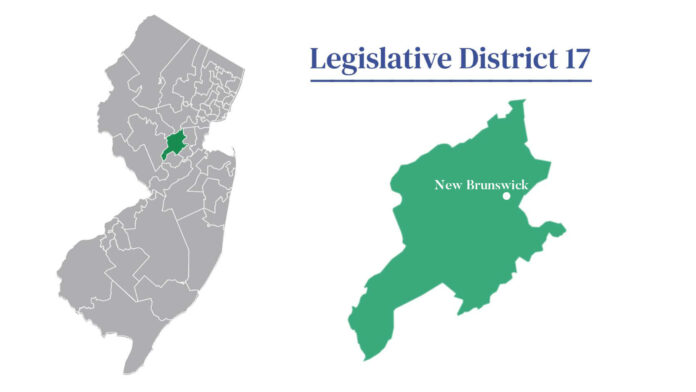

For decades, New Jersey’s 17th Legislative District has stood as one of the most reliable Democratic strongholds in the Garden State. Stretching across key portions of Middlesex County and extending into Somerset County, the district has consistently delivered overwhelming victories for Democratic candidates at both the state and federal levels. Yet while the district’s political identity remains firmly rooted in Democratic leadership, recent election cycles have demonstrated that even the safest seats in New Jersey politics are not entirely immune from internal challenges, shifting voter expectations, and evolving political dynamics.
Today, the district is represented in the State Senate by Senator Bob Smith, one of New Jersey’s longest-serving and most influential lawmakers. In the General Assembly, Assemblymen Joe Danielsen and Kevin P. Egan continue to represent the district after securing reelection in one of the more closely watched legislative contests of the 2025 election cycle.
While the final results ultimately reinforced the district’s long-standing Democratic dominance, the road to reelection revealed emerging political currents that could shape future elections throughout Central New Jersey.
The 17th Legislative District occupies a unique position within New Jersey’s political landscape. Anchored by communities including New Brunswick, Piscataway, and Franklin Township, the district encompasses a diverse mix of urban centers, suburban neighborhoods, educational institutions, healthcare hubs, and rapidly growing residential developments. The presence of major employers, research facilities, healthcare networks, Rutgers University, and an increasingly diverse population has helped shape a political environment that consistently leans heavily Democratic.
Political analysts frequently point to the district as one of the safest Democratic legislative territories in New Jersey. With a partisan advantage often measured among the strongest in the state, Democratic candidates have historically enjoyed substantial margins in both state and federal elections. Presidential election results have repeatedly reinforced that reality, with Democratic nominees routinely carrying the district by overwhelming margins.
That political consistency has helped create stability within the district’s legislative delegation.
Senator Bob Smith has represented the district in the State Senate since 2002 and has become one of the Legislature’s most recognizable voices on environmental policy, energy issues, sustainability initiatives, and infrastructure planning. As chair of the Senate Environment and Energy Committee, Smith has played a significant role in shaping many of New Jersey’s most consequential environmental policies during the past two decades.
Alongside him, Assemblyman Joe Danielsen has served since 2014 and has built a reputation as a legislative leader with deep involvement in transportation, public safety, and governmental operations. His current role as Deputy Parliamentarian further reflects his standing within the Assembly leadership structure.
Assemblyman Kevin P. Egan, meanwhile, has strengthened the district’s legislative team by focusing on labor issues, economic development initiatives, and community-based concerns affecting residents throughout Middlesex and Somerset counties.
Together, the three lawmakers have helped maintain Democratic control of the district while benefiting from the substantial electoral advantages that have long defined the area.
However, the 2025 election cycle demonstrated that political security does not necessarily eliminate political competition.
The most significant story of the year unfolded not during the general election but during the Democratic primary. In a district where winning the Democratic nomination is often considered the decisive step toward election, the primary battle attracted unusual attention from political observers throughout New Jersey.
Piscataway Board of Education member Loretta Rivers emerged as a serious challenger to the incumbent Assembly delegation. Running as part of Jersey City Mayor Steve Fulop’s broader Democrats for Change movement, Rivers positioned herself as an alternative voice within the Democratic Party and received support from the New Jersey Working Families Party.
The campaign quickly became one of the most closely watched legislative primaries in the state.
While the incumbents maintained significant advantages in fundraising, organization, endorsements, and political infrastructure, Rivers succeeded in energizing portions of the district’s electorate who were seeking new leadership perspectives and increased grassroots engagement.
The financial disparity between the campaigns was substantial. Danielsen and Egan collectively spent more than $400,000 during the race, while Rivers operated with a campaign budget of approximately $10,000. Under normal circumstances, such a gap would suggest a comfortable victory for incumbent officeholders.
Instead, the results surprised many political insiders.
When the votes were counted, Rivers came within roughly 500 votes of defeating Danielsen. Although the incumbents ultimately secured renomination, the narrow margin revealed a level of vulnerability that few had anticipated in one of the state’s safest Democratic districts.
The outcome sent a clear message throughout New Jersey politics. Even in districts where party dominance appears unquestioned, voters remain willing to challenge established political figures when they believe alternative voices deserve consideration.
The primary also highlighted a broader trend occurring within Democratic politics nationwide. Increasingly, many of the most competitive contests are taking place within party primaries rather than between Democrats and Republicans. Ideological differences, generational changes, grassroots organizing efforts, and debates over policy priorities are increasingly shaping political competition in districts where general election outcomes are largely predetermined.
Once the primary concluded, however, the district largely returned to its familiar electoral pattern.
In the November 2025 general election, Danielsen and Egan faced Republican challengers Susan Hucko and Patricia Badovinac. Despite a spirited campaign effort by the Republican ticket, the district’s longstanding Democratic orientation once again proved decisive.
The Democratic incumbents secured approximately 76 percent of the vote, delivering another overwhelming victory consistent with the district’s historical voting patterns. The result reinforced the reality that while internal Democratic contests may produce competitive races, the broader electorate remains firmly aligned with Democratic candidates.
The election results also underscored the district’s continuing importance within statewide political strategy.
As New Jersey continues to experience demographic shifts, population growth, economic transformation, and changing voter priorities, districts like the 17th serve as important indicators of broader political trends. The district’s diverse population, strong educational institutions, growing professional workforce, and evolving suburban landscape make it a valuable case study for understanding where New Jersey politics may be heading in future election cycles.
Issues such as housing affordability, transportation infrastructure, environmental sustainability, public education funding, healthcare access, economic development, and workforce growth continue to resonate strongly among voters throughout the district. Legislative leaders representing the area are increasingly tasked with balancing local concerns while also addressing statewide challenges that affect communities across New Jersey.
Looking ahead, the district remains firmly under Democratic control, but the lessons of 2025 are unlikely to be forgotten. The surprisingly competitive primary demonstrated that voters remain engaged, politically active, and willing to challenge conventional assumptions about electoral security.
For now, Senator Bob Smith, Assemblyman Joe Danielsen, and Assemblyman Kevin P. Egan continue to represent one of New Jersey’s most influential legislative districts. Yet the events of the past election cycle serve as a reminder that even the most predictable political landscapes can evolve. In a district where Democrats have historically dominated every level of government, the future may still bring new voices, new challenges, and new debates about the direction of one of New Jersey’s most important political regions.
The 17th Legislative District remains a Democratic fortress by virtually every measurable standard. But as recent elections demonstrated, even political fortresses can experience moments that reshape expectations and redefine the conversations taking place within them. For political observers across New Jersey, that reality may be one of the most important stories to emerge from the district’s recent electoral history.
















