

For generations, seagulls have been woven directly into the identity of the Jersey Shore. Their unmistakable calls echo across boardwalks from Cape May to Sandy Hook, they circle fishing boats and beaches with near-perfect precision, and they have long existed as one of the defining visual symbols of coastal New Jersey life. But in recent years, the relationship between humans and gulls along the Shore has changed dramatically. What was once viewed as harmless nuisance behavior has evolved into a far more complicated challenge involving tourism, sanitation, wildlife management, environmental law, public safety, and increasingly sophisticated animal behavior.
Across New Jersey’s coastal communities, seagulls are no longer simply scavengers opportunistically hovering near beachgoers. They are becoming highly adaptive urbanized wildlife populations displaying advanced learning patterns, social behavioral transfer, targeted food acquisition strategies, and remarkable cognitive intelligence. At the same time, municipalities, businesses, environmental organizations, and property managers are responding with equally advanced humane mitigation systems designed not to harm the birds, but to fundamentally disrupt the behavioral cycles that attract them to human environments in the first place.
The modern Jersey Shore seagull story is ultimately about coexistence, adaptation, and the growing realization that humans themselves inadvertently created the conditions that allowed gull populations to become increasingly aggressive around food-heavy tourist destinations.
Under federal law, gulls remain protected under the Migratory Bird Treaty Act, making it illegal to harm, trap, poison, or relocate them without highly specific federal permits. That legal framework has forced New Jersey communities to pursue non-lethal, humane, and behavior-based solutions rather than aggressive eradication campaigns. As a result, an entirely new category of coastal wildlife management has emerged across the state — one built around environmental design, architectural deterrence, behavioral psychology, sanitation control, and even aerial falcon patrols.
Perhaps nowhere is that evolution more visible than along New Jersey’s famous boardwalks and dumpster corridors, where the battle between gulls and humans has quietly become one of the Shore’s most fascinating environmental stories.
The most effective modern deterrence strategy begins with a surprisingly simple concept: eliminate food access entirely. Wildlife experts and environmental planners increasingly agree that seagull behavior is driven less by aggression and more by deeply reinforced habit loops. If gulls repeatedly find easy calories in a particular location, they return continuously, eventually conditioning entire flocks to associate humans, restaurants, beaches, and dumpsters with reliable food sources.
That is why modern humane gull management focuses heavily on absolute food exclusion rather than reactive deterrence alone.
Across commercial districts, restaurants, marinas, beach concessions, and boardwalk infrastructure, businesses are increasingly being advised to upgrade waste management systems using heavy-duty locking dumpster lids, enclosed trash corrals, sealed waste barriers, overhead netting systems, and animal-resistant disposal methods specifically designed to remove food access entirely. Standard plastic dumpster lids are often ineffective because gulls quickly learn how to pry them open or exploit partially secured openings.
In many New Jersey coastal towns, property managers are now constructing fully enclosed waste compounds using chain-link structures, wood enclosures, or masonry walls equipped with overhead netting or roofing systems to prevent gulls from dropping into open-top waste areas from above. Wildlife specialists emphasize that even brief exposure windows matter. Trash bags left temporarily beside dumpsters can become immediate feeding triggers, conditioning birds to revisit the location repeatedly throughout the day.
This approach reflects a larger shift happening in urban wildlife management nationwide. Experts increasingly recognize that animals are not merely reacting instinctively. They are learning patterns from human behavior, environmental consistency, and repeated reward cycles.
Seagulls, in particular, appear exceptionally skilled at this process.
Recent behavioral studies from universities including Exeter and Sussex have revealed remarkably sophisticated cognitive traits among gull populations. Research now shows that gulls actively observe human behavior to determine which food items are safest, most desirable, and easiest to acquire. In controlled experiments, gulls overwhelmingly chose food packages that humans had recently touched over identical untouched items. In essence, the birds interpret human interaction as a recommendation signal.
That discovery has major implications for why Jersey Shore gulls behave the way they do on beaches and boardwalks.
The infamous viral videos of gulls swooping down to steal pizza slices, fries, ice cream cones, sandwiches, or funnel cake directly from tourists are not random acts of chaos. They are targeted behavioral strategies rooted in highly advanced observational learning.
Researchers increasingly describe gull behavior as a form of opportunistic kleptoparasitism — the evolutionary practice of stealing food from other animals rather than hunting independently. The gulls study body language carefully. They wait for moments of distraction. They monitor visual awareness. They attack from blind spots.
In many cases, they specifically wait until a person looks down at a phone, turns toward a conversation, or shifts attention away from the food item before launching a rapid dive from behind.
That element of surprise is central to their success.
Ironically, only a relatively small percentage of gulls actually engage in direct food theft. Most gulls remain cautious and fearful around humans. However, researchers believe a smaller subset of highly intelligent, bold birds repeatedly succeeds at food theft and effectively teaches the behavior to surrounding flock populations through social observation.
That means certain Jersey Shore boardwalk gulls may now represent multi-generational learned behavioral cultures evolving directly alongside human tourism patterns.
As bizarre as that sounds, coastal communities are increasingly responding with equally behavior-focused countermeasures.
One of the most surprisingly effective deterrents is direct eye contact.
Behavioral studies have demonstrated that gulls strongly prefer attacking when they believe they remain undetected. When humans stare directly at approaching gulls, the birds frequently hesitate, retreat, or abandon the attempt entirely. Wildlife researchers describe gulls as fundamentally risk-averse opportunists. Once the element of surprise disappears, the food theft becomes significantly more dangerous for the bird.
This has led to growing public awareness campaigns encouraging beachgoers to maintain visual awareness when eating outdoors.
Experts also recommend practical defensive positioning strategies. Sitting beneath umbrellas, near walls, or against structures limits the birds’ attack pathways by restricting overhead access. Keeping food close to the body rather than elevated outward reduces visibility and makes swooping grabs physically harder to execute.
Verbal deterrence matters too. Recent behavioral testing suggests gulls respond strongly to urgent, loud vocal tones. Sharp human shouting often interrupts approach patterns because gulls recognize heightened distress or confrontation signals as elevated risk.
Still, for municipalities dealing with thousands of gull interactions daily, larger-scale environmental deterrents have become necessary.
This is where New Jersey’s increasingly sophisticated architectural bird management systems enter the picture.
Throughout coastal commercial zones, bird-control infrastructure now includes elevated wire grid systems, anti-roosting spikes, angled bird slopes, reflective visual deterrents, motion-activated sprinklers, tethered predator kites, and even specialized green laser systems used during dawn and dusk periods.
High-tensile overhead wire grids positioned above dumpsters or open-air food zones disrupt gull landing patterns by interfering with their large wingspans. Anti-bird spikes eliminate resting perches on rooftops, railings, fences, and boardwalk structures. Angled surfaces prevent stable roosting positions entirely.
Unlike older static scarecrow or fake owl systems that gulls quickly learn to ignore, modern deterrents focus on unpredictability and movement. Reflective devices shift constantly in the wind. Predator kites simulate aerial threats dynamically. Motion-activated water systems create surprise without harming the birds.
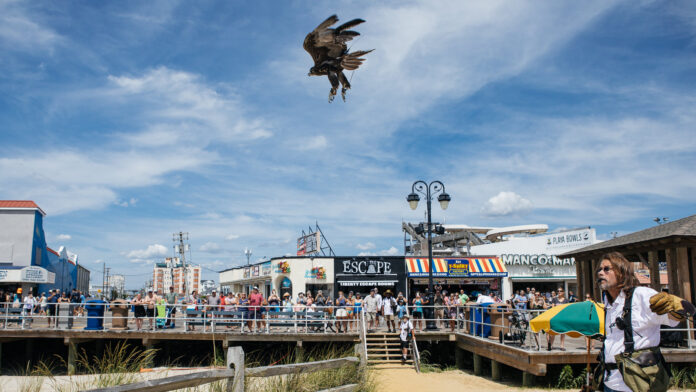
But perhaps the most fascinating example of humane seagull management anywhere in New Jersey remains Ocean City’s now-famous falconry abatement program.
What initially began in 2019 following a widely publicized boardwalk food theft incident involving a toddler and a slice of pizza has since evolved into one of the nation’s most closely watched municipal wildlife deterrence programs.
The specific “toddler in a stroller” incident that reportedly triggered the mayor’s response highlighted a major vulnerability in human-gull interactions along the boardwalk. Strollers naturally place children at waist height or lower, often outside a parent’s immediate line of sight while walking forward. To a diving seagull, a child in a stroller can appear to be an isolated and non-threatening target holding highly visible food completely out in the open.
Ocean City’s aggressive response demonstrated that while it is difficult to change human behavior or prevent children from eating snacks on the boardwalk, it is possible to alter the birds’ perception of risk. By introducing trained raptors into the environment, the boardwalk effectively shifted from being viewed by gulls as a “free buffet” to becoming a high-risk hunting ground where predatory threats were suddenly present.
The story has taken on near-legendary status across Shore communities, but what makes it especially significant now is that Ocean City has officially expanded and renewed the program again for the 2026 summer season.
The city recently authorized approximately $370,000 for East Coast Falcons to continue daily raptor patrols along the boardwalk throughout the summer. Beginning Memorial Day weekend, a rotating team of trained birds of prey — including falcons, hawks, and owls with names like Karen and Ozzy — will patrol the boardwalk from morning through evening in an effort to create a sustained aerial predator presence that naturally discourages gull activity.
The brilliance of the system lies in its ecological realism.
Rather than trapping or harming gulls, the falconry program simply reintroduces the appearance of natural predation risk into heavily urbanized environments where gulls have otherwise grown unusually fearless around humans.
Wildlife experts note that gulls evolved to avoid aerial predators instinctively. The constant movement of trained falcons overhead creates enough uncertainty that gulls begin abandoning the area voluntarily.
What makes the entire seagull deterrence strategy on the boardwalk so effective is that it is built more around intimidation and environmental control than actual hunting. The birds being used by professional falconers are not being released to violently attack flocks of gulls across the beach. In reality, much of the success comes from something far simpler and far smarter. A Harris’s Hawk or Peregrine Falcon is often directed to fly up and perch calmly on a visible light pole, rooftop edge, or elevated structure overlooking the boardwalk. The second seagulls spot what they instinctively recognize as an apex predator sitting in a hunting posture, the entire atmosphere changes instantly. Gulls do not wait around to test whether the threat is real. Their evolutionary wiring takes over, and they immediately abandon the area.
The psychological effect is enormous. For years, gulls treated crowded boardwalks like unlimited feeding grounds filled with pizza crusts, fries, funnel cake scraps, and unattended snacks. Once raptors entered the environment, that same airspace suddenly felt dangerous. The objective was never mass eradication. The goal was to convince the gull population that the boardwalk was no longer worth the risk. That alone dramatically reduced aggressive swooping incidents and food thefts from tourists.
Another major reason the program works so safely is the extreme level of discipline involved in professional falconry. These birds are carefully managed every single day under strict weight-control systems known within falconry circles as maintaining “abatement weight.” The raptors are kept healthy, conditioned, alert, and motivated to fly, but they are not starved animals being sent out to kill. In fact, they are routinely fed premium food rewards directly from the falconer’s glove before and during their shifts. Because of that, they have little interest in wasting energy trying to physically battle aggressive seagulls. The birds are trained to patrol, perch, intimidate, and return — not create chaos in front of families and tourists.
There is also a major legal and public safety component behind the operation. Seagulls are protected under federal law through the Migratory Bird Treaty Act, meaning intentionally killing them without specialized permits can lead to significant penalties. Companies operating these deterrence programs work under tightly regulated federal authorization designed specifically for harassment and dispersal, not extermination. Beyond the legal realities, nobody wants a family boardwalk turning into a graphic wildlife scene in front of children and vacationers. Cities are trying to create cleaner, safer, and more comfortable tourist environments, not public spectacles.
What ultimately makes the strategy successful is how efficiently it changes animal behavior without widespread physical confrontation. Reports from coastal communities have shown massive reductions in boardwalk gull populations simply because the birds begin associating the area with danger instead of easy food. In other words, the boardwalk stops feeling like an all-you-can-eat buffet and starts feeling like territory controlled by predators. For the gulls, that shift alone is often enough to send them elsewhere.
Ocean City officials have acknowledged, however, that the situation is becoming something of a behavioral “arms race.” Administrators noted a slight increase in gull aggression patterns over recent summers, suggesting certain birds may be attempting to adapt by shifting feeding activity later into the evening after raptor patrol intensity decreases.
That ongoing adaptation only reinforces the extraordinary intelligence researchers continue documenting within urban gull populations.
At the same time, the falcon program has become something far larger than a sanitation solution. It has evolved into a tourist attraction, a conservation discussion point, and a symbol of how New Jersey communities are increasingly approaching wildlife management through humane coexistence rather than eradication.
This broader shift aligns strongly with the growing environmental and humane-awareness culture developing throughout the state. Across New Jersey, organizations, municipalities, and tourism agencies are increasingly embracing wildlife management strategies that prioritize ecological balance, humane deterrence, behavioral science, and sustainable coexistence.
The challenge facing coastal communities is ultimately not about eliminating gulls entirely. Seagulls remain an essential part of coastal ecosystems and maritime environments. The real objective is restoring healthier boundaries between wildlife and dense human tourism infrastructure that unintentionally altered gull behavior over decades of unsecured food waste, boardwalk feeding patterns, and open-air commercial activity.
For Explore New Jersey readers, the evolving seagull story represents something uniquely reflective of the modern Jersey Shore itself. It combines tourism, science, wildlife psychology, environmental law, urban planning, coastal identity, public behavior, and community adaptation into one surprisingly complex narrative playing out daily above the beaches and boardwalks of the Garden State.
The image of gulls circling over the Shore will likely never disappear. Nor should it. They remain one of the defining visual and auditory elements of coastal New Jersey life. But as researchers continue uncovering just how intelligent and adaptive these birds truly are, the relationship between humans and gulls is clearly entering an entirely new era — one where science, humane innovation, and behavioral understanding are becoming just as important as beach umbrellas and boardwalk fries in shaping the future of the Jersey Shore experience.
















