
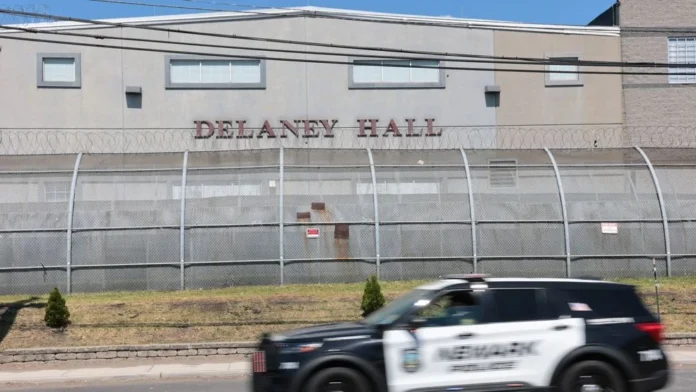

The legal and political battle surrounding Delaney Hall in Newark has entered a more confrontational phase after New Jersey officials announced that state health inspectors were once again prevented from conducting what they describe as a complete public health inspection of the privately operated immigration detention facility. The latest dispute has intensified an already contentious conflict between the State of New Jersey, the federal government, and the GEO Group, the private company that manages the detention center, while raising broader questions about public health oversight, detention standards, and the authority of state agencies to inspect facilities operating within New Jersey’s borders.
Governor Mikie Sherrill, Attorney General Jennifer Davenport, and Department of Health Commissioner Raynard E. Washington jointly criticized the decision to limit inspectors’ access after Department of Health personnel arrived for what officials said had been a previously scheduled inspection. According to the state, inspectors were permitted to enter portions of the facility but were prevented from conducting a comprehensive examination of critical operational areas, including the medical unit. Instead of performing a full inspection under New Jersey public health authority, officials said inspectors were escorted through only selected portions of the detention center.
For the Sherrill administration, the issue extends well beyond a disagreement over access. State officials argue that the inability to inspect every area of the facility prevents the Department of Health from carrying out one of its most fundamental responsibilities: protecting public health. Health inspections, they contend, are designed to identify conditions that could threaten not only detainees but also employees, contractors, visitors, emergency responders, and ultimately surrounding communities.
Governor Sherrill stated that denying inspectors unrestricted access only deepens concerns surrounding conditions inside Delaney Hall. Throughout her time in public office, she has maintained opposition to privately operated immigration detention facilities, and she reiterated that position following the inspection attempt, pledging to continue pursuing every available legal and administrative avenue to secure a complete review of the facility and improve conditions for individuals being housed there.
Attorney General Davenport similarly questioned why inspectors would be prevented from examining areas central to evaluating health and safety conditions. She noted that over recent months state officials have received multiple reports alleging deteriorating sanitary conditions, inadequate medical treatment, poor food quality, and other issues affecting detainees. According to the Attorney General, refusing to permit a complete inspection only increases public concern regarding the accuracy of those allegations and the conditions that may exist within the facility.
Health Commissioner Washington emphasized that public health inspections are conducted according to established health and safety standards rather than political considerations. He warned that communicable diseases are not confined by detention facility walls and that outbreaks can quickly extend beyond correctional or detention settings through employees, contractors, visitors, medical personnel, and others entering and leaving the property on a daily basis. From a public health perspective, officials argue, identifying sanitation concerns, food preparation practices, ventilation systems, medical operations, and infection control procedures remains essential regardless of the facility’s ownership or operational structure.
The latest inspection attempt follows several months of escalating concern surrounding Delaney Hall. Detainees, family members, legal representatives, and advocacy organizations have publicly alleged a range of health-related issues, including unsanitary living conditions, inconsistent access to medical treatment, delays in receiving prescription medications, poor food quality, and drinking water described by some detainees as having a metallic taste. Additional concerns have centered on reports that respiratory illnesses, including influenza and COVID-19, have circulated within the detention center.
State officials have also cited reports involving a detainee who was transported to University Hospital after being diagnosed with tuberculosis, a highly infectious disease that requires immediate public health intervention. Although the presence of a single communicable disease case does not necessarily indicate broader transmission, health officials maintain that such reports reinforce the importance of conducting comprehensive inspections capable of evaluating infection control procedures throughout the entire facility.
This week’s dispute is not the first confrontation between New Jersey officials and the operators of Delaney Hall. Earlier inspection efforts also resulted in state inspectors being denied access to several critical portions of the building. During that initial visit, inspectors were permitted to examine certain food service operations but were reportedly prevented from accessing sleeping quarters, shower facilities, restroom areas, ventilation systems, HVAC infrastructure, and medical treatment spaces. Those restrictions ultimately prompted the State of New Jersey to pursue legal action.
On June 2, New Jersey filed a lawsuit alleging that GEO Group violated state law by refusing to provide Department of Health officials with the access necessary to perform a complete inspection. The litigation argues that state law grants the Commissioner of Health broad authority to enter both public and privately operated detention facilities whenever there is reason to believe conditions affecting public health may exist. According to the state, that authority includes full access to areas necessary for evaluating sanitation, disease prevention, environmental health, food safety, ventilation, and other factors directly affecting the health of individuals housed inside the facility.
The dispute also illustrates the increasingly complex legal relationship between state regulatory authority and federally connected immigration operations. While immigration enforcement falls under federal jurisdiction, New Jersey maintains that state public health laws continue to apply to facilities operating within its borders, particularly when communicable disease prevention, environmental health, and sanitary conditions are involved. That jurisdictional conflict now appears likely to be resolved through the courts as litigation moves forward.
Beyond the legal arguments, Delaney Hall has become one of the most closely watched immigration detention facilities in New Jersey because it sits at the intersection of several ongoing national debates involving immigration policy, private detention contractors, public health oversight, and government accountability. As those discussions continue nationally, New Jersey’s actions may ultimately influence how other states approach inspections of privately operated detention centers located within their own jurisdictions.
Public health experts have long maintained that detention facilities present unique challenges because of their congregate living environments. Shared sleeping areas, dining facilities, bathrooms, medical spaces, and ventilation systems can create conditions where communicable illnesses spread more rapidly if appropriate safeguards are not maintained. For that reason, routine inspections evaluating sanitation practices, food handling procedures, infection prevention measures, medical care, environmental systems, and overall facility conditions have become standard components of public health oversight.
For the Sherrill administration, the central issue remains straightforward. State officials argue that meaningful inspections cannot occur if inspectors are prevented from entering portions of the facility they are legally authorized to examine. Until comprehensive access is granted, New Jersey officials maintain they will continue pursuing both administrative and legal remedies designed to enforce the Department of Health’s inspection authority and ensure that public health standards are fully evaluated at Delaney Hall.
As litigation proceeds and additional inspection efforts are expected, Delaney Hall will likely remain one of New Jersey’s most closely monitored public policy issues. The outcome may ultimately establish important precedent regarding the scope of state health inspection authority, the responsibilities of privately operated detention facilities, and the balance between federal immigration operations and state public health oversight within New Jersey.
















